

What if the secret to fluency isn’t learning more grammar, but simply having the right things to say? You’ve likely mastered the basics, yet you still feel a sense of hesitation when a colleague in the Tanjong Pagar business district asks for your thoughts on a new project. It’s a common frustration to know the rules of the language but lack the vocabulary for non-trivial discussions. We understand that transitioning from transactional phrases to fluid, opinion-based discourse is the hardest part of the journey.
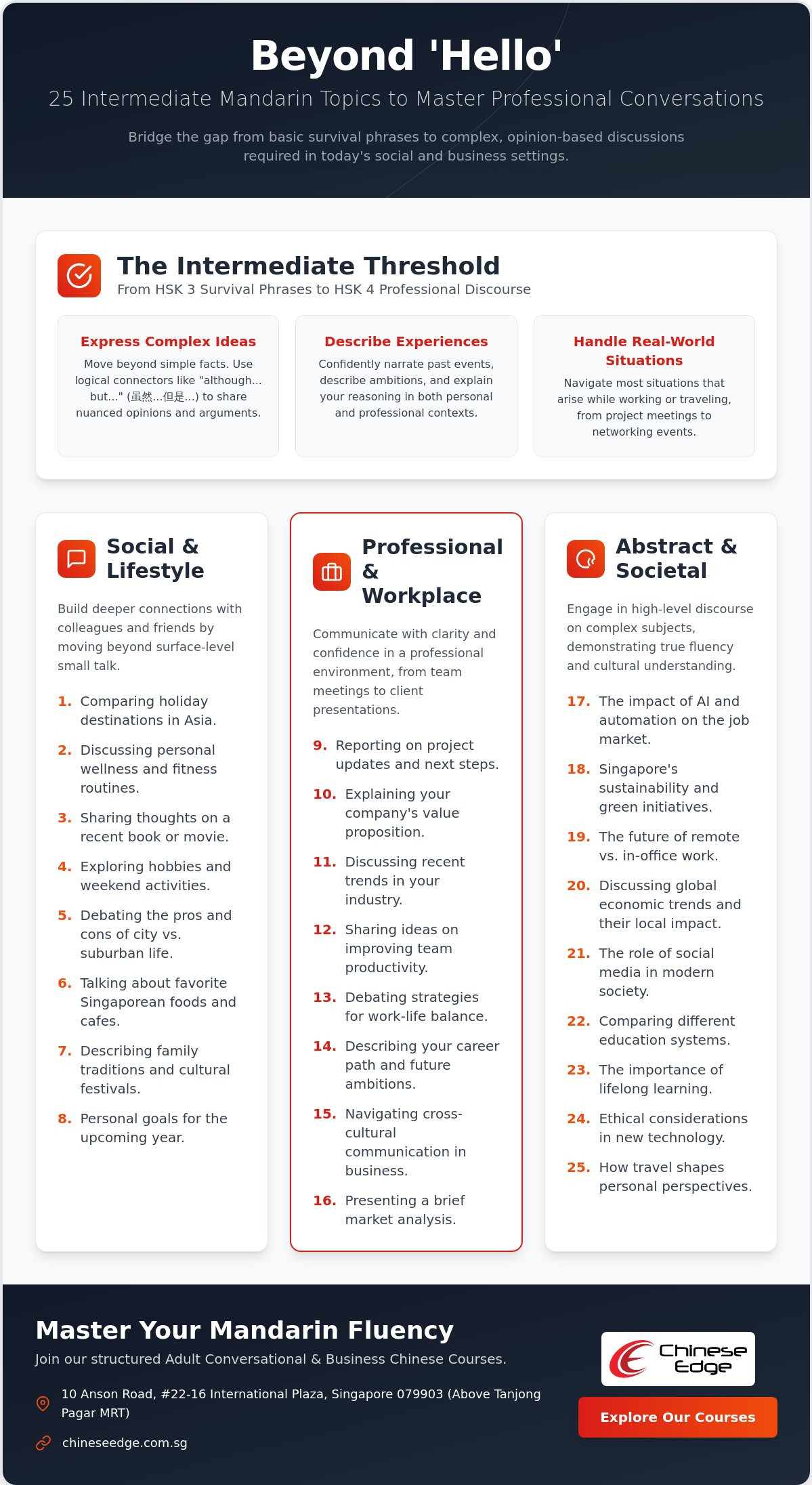
In this article, we provide 25 engaging intermediate mandarin conversation topics specifically curated for professionals. You’ll learn how to move beyond simple greetings and prepare for HSK 3 or 4 level interactions. We’ll also share proven strategies from our training center at 10 Anson Road, located right above Tanjong Pagar MRT, to help you sustain a 15-minute conversation with confidence. By exploring these themes, you’ll gain the linguistic tools to express complex thoughts in any social or business setting. Our goal is to help you shed the “permanent beginner” label and communicate with the authority your professional role demands.
Key Takeaways
- Learn how to bridge the gap between basic survival Chinese and complex discussions using 25 curated intermediate mandarin conversation topics designed for real-world application.
- Gain the ability to share personal opinions on lifestyle trends and wellness, allowing you to build deeper social connections beyond simple greetings.
- Master essential workplace communication skills to confidently report on project updates and explain company value propositions in a professional environment.
- Prepare for high-level discourse on abstract subjects, including AI technology and Singapore’s sustainability initiatives, to meet the requirements of HSK 4 proficiency.
- Discover how a structured, mentor-led approach at a dedicated adult training center can help you sustain a 15-minute conversation with confidence and clarity.
Defining the Intermediate Threshold in Mandarin Conversation
Reaching the intermediate level in Mandarin marks a pivotal shift in your language journey. For many adult learners, the transition from HSK 2 or 3 to HSK 4 represents the move from “survival Chinese” to “social and professional Chinese.” While the elementary stages focus on immediate needs like ordering food or asking for directions, the intermediate stage requires you to handle more abstract concepts. Standard frameworks used for Defining Intermediate Proficiency suggest you should communicate effectively in both social and workplace settings at this stage.
This stage is where many students encounter the “Intermediate Plateau.” It’s easy to feel stuck when you don’t see the same rapid progress you experienced as a beginner. Breaking through this barrier requires moving beyond rote memorization and engaging with diverse intermediate mandarin conversation topics. By discussing varied subjects, you force your brain to use new vocabulary and more complex sentence structures.
To better understand how these conversational shifts look in practice, watch this helpful video:
One of the most significant markers of an intermediate speaker is the use of logical connectors. You’ll start using conjunctions like “although” (虽然), “but” (但是), and “not only… but also” (不仅…而且). These allow you to express nuances and connect ideas, making your speech sound more natural and less like a series of disjointed facts.
Linguistic Capabilities at the B1/B2 Level
At this level, you can understand the main points of standard speech in familiar settings like the office or social gatherings. You’re no longer just identifying keywords; you’re following the logic of the conversation. Key abilities include:
- Handling most situations that arise while traveling or working in Chinese-speaking regions.
- Producing simple, connected text on topics of personal or professional interest.
- Describing experiences, events, and ambitions with reasonable fluency.
This level of proficiency is essential for effective workplace chinese communication in a diverse business hub like Singapore.
The Role of Opinion-Based Speaking
Transitioning to an intermediate level means moving away from simple statements like “I like coffee” to more complex arguments like “I prefer tea because it helps me focus during long meetings.” This shift to opinion-based speaking is vital for professionals. It requires a specific vocabulary set that covers abstract concepts rather than just daily chores. Our structured Adult Conversational Mandarin Courses are designed to facilitate this transition by providing the linguistic scaffolding needed for these intermediate mandarin conversation topics. When you join a mandarin class singapore at our center at 10 Anson Road, level 22, International Plaza, Singapore 079903, you’ll practice these skills right above Tanjong Pagar MRT, ensuring your learning is as convenient as it is effective.
Social and Lifestyle Topics for Personal Connection
Building professional rapport often starts with a casual chat over lunch or coffee. Moving beyond basic survival phrases allows you to connect on a human level with colleagues and clients. These intermediate mandarin conversation topics shift the focus from what you do to who you are. For instance, instead of simply stating you like traveling, you might compare holiday destinations in Asia. You could discuss how the pace of life in Tokyo differs from the relaxed atmosphere of Bali, or share your thoughts on the convenience of mobile wellness services like The Outcall Spa. This level of detail requires you to use specific adjectives and comparative structures that reflect a higher level of fluency.
In Singapore, where the history of language use is unique, understanding the cultural context of Workplace Conversations in Singapore can help you navigate social nuances more effectively. Discussing health and wellness is another excellent way to bond. You can share your fitness routine or debate the modern concept of work-life balance. This is particularly relevant for professionals working in the busy financial districts. If you want to refine these skills in a supportive environment, you might consider joining an Adult Conversational Mandarin Course at our center.
Food culture provides another rich avenue for connection. Intermediate learners can move beyond just ordering a dish to discussing its history or cooking techniques. You might explain why you prefer a specific style of Sichuan cuisine or describe the intricate process of making traditional dumplings. These discussions allow you to showcase your cultural depth while practicing specialized vocabulary.
Deepening Personal Narratives
Storytelling is a vital social skill. To tell an engaging story, you must master the past tense markers 了 (le) and 过 (guo). These allow you to recount childhood dreams or explain how your ambitions have evolved over time. You should also practice describing the personality traits of people you know. Is your manager strict but fair? Is your best friend adventurous? Comparing lifestyle habits in Singapore to other global cities also provides rich ground for storytelling and helps you master varied intermediate mandarin conversation topics.
Expressing Preferences and Hypotheticals
Intermediate learners should practice the conditional mood by discussing “what if” scenarios. For example, what would you do if you had a year of fully paid leave? These discussions help you move into more abstract territory. You can debate the pros and cons of living in a high-tech city like Singapore or share your opinions on trending social media topics. This ability to hypothesize is a key indicator of B1/B2 proficiency. Our school is conveniently located at 10 Anson Road, level 22, International Plaza, Singapore 079903. Being situated right above Tanjong Pagar MRT makes it easy for CBD professionals to drop in after work. If you’re ready to move past basic phrases, exploring our conversational chinese course options is a great next step.
Professional Mandarin: Navigating Workplace Conversations in Singapore
Stepping into a boardroom in the Tanjong Pagar business district requires more than just basic greetings. It’s about professional impact. For professionals in Singapore, workplace chinese communication is about building trust and demonstrating competence. At an intermediate level, you move beyond “I work at X” to explaining your specific role and how your company solves problems. This transition is essential for anyone looking to make a lasting impression during networking events or high-stakes client meetings.
Mastering intermediate mandarin conversation topics in a professional context means you can report on project progress with precision. Instead of saying a project is “good,” you’ll learn to discuss specific challenges, upcoming deadlines, and resource allocation. You’ll also be able to engage in discussions about broader market trends, such as the growth of the fintech sector in Singapore or e-commerce shifts in China. These Societal Discussion Points provide the necessary depth to keep a conversation going for 15 minutes or more, showing your partners that you’re well-informed.
Giving and receiving feedback is another critical skill. In a Chinese-speaking environment, the way you deliver a suggestion can be just as important as the suggestion itself. Intermediate learners practice using “softeners” to ensure their message is received professionally. This approach helps maintain harmony while ensuring project goals are met. If you’re looking for a mandarin course that prioritizes these practical skills, our center at 10 Anson Road, level 22, International Plaza, Singapore 079903, offers a structured path to fluency right above Tanjong Pagar MRT.
Workplace Communication and Etiquette
Understanding the concept of “face” (面子) is crucial when engaging in professional intermediate discourse. In a Singaporean office, knowing when to use the formal 您 (nín) versus the informal 你 (nǐ) can significantly impact your professional relationships. While Singapore is often more relaxed than Beijing, showing respect through language remains a powerful tool. Our Business Mandarin curriculum focuses on these nuances, ensuring you navigate corporate hierarchies with ease. We teach you the exact vocabulary needed for corporate mandarin training that feels natural and authoritative.
Negotiation and Problem Solving
Intermediate learners must develop the ability to express disagreement without causing offense. Phrases like “I understand your point, but…” (我明白你的意思,但是…) are vital for healthy brainstorming sessions. You’ll also practice discussing your own career development and potential internal promotions. Being able to articulate your ambitions in Mandarin shows a level of commitment that many corporate clients and partners deeply appreciate. By focusing on these practical intermediate mandarin conversation topics, you bridge the gap between being a language student and becoming a truly bilingual professional.
Abstract and Societal Discussion Points
Engaging with societal issues is the hallmark of a true intermediate speaker. It demonstrates you can think critically in your second language and move beyond simple transactional speech. These intermediate mandarin conversation topics require a more sophisticated vocabulary but offer the highest reward in professional circles. Moving beyond the “what” to the “why” allows you to participate in high-level debates that build significant intellectual rapport with your peers and clients.
Technology is a prime subject for debate in any modern business setting. You might discuss how AI and automation are reshaping the workforce in Singapore and China. For instance, the rise of shoppertainment through apps like Douyin and WeChat Channels is a massive trend. These platforms are projected to drive nearly 40% of digital sales in China by 2026. Discussing these closed-loop ecosystems requires you to use specific business and technical terminology that bridges the gap between basic fluency and professional mastery.
Sustainability is another vital area for discussion. Talking about the Singapore Green Plan 2030 allows you to use terminology related to urban planning and environmental protection. You can also compare Eastern and Western management styles. Is a hierarchical structure more effective in a fast-paced Asian market? Debating these points helps you understand the cultural depth behind the language. It’s a great way to keep your intermediate mandarin conversation topics fresh and relevant to your career.
Engaging with Current Events
Reading headlines from Mandarin news outlets keeps your vocabulary current and provides fresh material for discussion. You’ll learn to discuss urban planning and the evolution of language in the digital age. Internet slang changes quickly, and staying updated shows you’re connected to modern culture. This ability to reference current events makes you a more engaging conversationalist during business lunches or networking events in the CBD.
Philosophical and Abstract Concepts
Professionals often find value in defining success and happiness through a cultural lens, which might include discussing the importance of emotional wellbeing and supportive resources like Awaken Counselling Centre in achieving a balanced lifestyle. Discussing the importance of lifelong learning is also particularly relevant as industries shift. With 90 countries now incorporating Chinese into their national curricula as of 2026, the global shift toward Mandarin proficiency is undeniable. You might debate the merits of different learning approaches, such as:
- The effectiveness of AI-powered tools for tonal feedback.
- The transition from rote memorization to prioritized speaking skills.
- The role of structured mentorship in overcoming the intermediate plateau.
If you’re ready to master these complex discussions, consider enrolling in an Adult Conversational Mandarin Course at our training center. We’re located at 10 Anson Road, level 22, International Plaza, Singapore 079903, right above Tanjong Pagar MRT. Our expert mentors provide the disciplined environment you need to achieve results-oriented fluency.
Mastering Intermediate Fluency at Chinese Edge
Transitioning from basic phrases to fluid, opinion-based discussions is a journey that requires more than just self-study. While identifying intermediate mandarin conversation topics is a great starting point, mastering them requires real-time practice and professional guidance. At Chinese Edge, we specialize in helping adult learners break through the intermediate plateau by providing a structured environment where language theory meets practical application. We don’t believe in one-size-fits-all learning; instead, we provide the linguistic scaffolding necessary for you to express your unique professional perspectives.
Our Mandarin course is specifically designed for the busy professional. We recognize that your time is valuable, which is why our lessons focus on high-impact communication. By bridging the gap between the classroom and the real-world business settings of Singapore, we ensure that every hour spent studying translates into increased confidence in your next meeting or social gathering. It’s about results. Whether you’re aiming for HSK 4 proficiency or simply want to hold a 15-minute conversation with a client, our methodical approach ensures a logical progression toward your goals.
Our Methodology for Intermediate Learners
Our methodology for intermediate learners centers on active participation. We move away from passive listening to focus on role-play and immersive debate formats. This approach allows you to test your ability to handle complex intermediate mandarin conversation topics in a safe yet challenging setting. Small group sizes are a cornerstone of our philosophy. With fewer students in each class, you receive maximum speaking time and personalized attention. Our native-speaking instructors provide tailored feedback on your tones and sentence structure, ensuring you don’t just speak, but speak with the authority of a professional.
Join Us at International Plaza
Visit our center at 10 Anson Road, level 22, International Plaza, Singapore 079903. Our physical presence within a major commercial district isn’t just about convenience; it’s a reflection of our professional identity. Being located right above Tanjong Pagar MRT makes it easy for you to transition from your office to our classroom for productive after-work sessions. This proximity to the heart of Singapore’s business world allows you to apply what you’ve learned almost immediately in your professional life.
If you’re looking for a mandarin class singapore that understands your career goals, we invite you to book a trial for our conversational Chinese course today. Let us be your partner in achieving the fluency you need to thrive in a global business environment. With our expert mentorship and proven methodology, reaching professional-level Mandarin is an attainable reality.
Achieve Your Professional Fluency Goals
Mastering the transition to intermediate Mandarin is about more than just vocabulary; it’s about developing the confidence to handle abstract societal issues and nuanced workplace communication with ease. By focusing on the right intermediate mandarin conversation topics, you move past the “permanent beginner” stage and begin to demonstrate true professional authority in every interaction. Whether you’re navigating a networking event at Tanjong Pagar or discussing market trends with global partners, the ability to express complex opinions is your most valuable asset.
At Chinese Edge, we provide the structured environment you need to reach these milestones. Our native-speaking instructors have professional backgrounds that ensure your learning is both academically rigorous and practically relevant. We invite you to Elevate your fluency with our Adult Conversational Mandarin Course at our center located right above Tanjong Pagar MRT. With our proven curriculum designed specifically for adult learners, achieving professional fluency isn’t just a goal; it’s a logical progression. Join us at 10 Anson Road, level 22, International Plaza, and start your journey toward bilingual confidence today.
Frequently Asked Questions
What defines an intermediate level in Mandarin conversation?
Intermediate proficiency is defined by the ability to handle most social and professional situations using standard speech. You move beyond basic survival needs to discuss intermediate mandarin conversation topics like current events or work-life balance. According to global benchmarks, this level allows you to produce connected text and explain the reasoning behind your personal or professional opinions with reasonable fluency.
How many words do I need for intermediate Mandarin conversation?
You need between 2,000 and 5,400 words to navigate the intermediate threshold effectively under the HSK 3.0 framework. Level 4 requires a mastery of 2,000 words, while Level 6, the upper end of the intermediate scale, demands 5,400 words. Mastering this vocabulary range allows you to hold fluid discussions on non-trivial subjects without constantly searching for basic terms.
Can I learn intermediate Mandarin conversation online?
You can certainly master intermediate skills through Online Mandarin Classes designed specifically for adult learners. These programs prioritize real-time interaction and tonal feedback, ensuring you don’t miss the nuances of spoken Chinese. Modern digital platforms now use AI-powered tools to help students practice their speaking rhythm and character recognition from the comfort of their home or office.
How long does it take to move from beginner to intermediate Mandarin?
It typically takes several hundred hours of focused study to move from a beginner to a solid intermediate level. While the U.S. Foreign Service Institute estimates it takes 2,200 hours for a native English speaker to reach full professional proficiency, the transition to intermediate conversation occurs much earlier. Consistent practice with a conversational chinese course can significantly accelerate this progress.
Is intermediate Mandarin enough for business meetings in Singapore?
Intermediate Mandarin is usually sufficient for standard business interactions in Singapore, such as networking or providing project updates. It provides the essential foundation for workplace chinese communication, allowing you to explain your role and company value proposition. For high-stakes legal negotiations or complex financial discussions, however, you may eventually require more specialized, advanced training to ensure total precision.
What are the best topics to practice for HSK 4 speaking?
The best topics for HSK 4 speaking practice include travel experiences, health routines, and societal issues like environmental sustainability. Focusing on these intermediate mandarin conversation topics helps you practice the logic-based sentence structures required for the examination. It also prepares you for the abstract discussions common in professional settings, moving your speech beyond simple “like” or “dislike” statements.
How can I practice intermediate Mandarin conversation if I live in Singapore?
You can practice by enrolling in a mandarin course singapore located in a high-traffic business hub. Our training center at 10 Anson Road, level 22, International Plaza, Singapore 079903, is situated right above Tanjong Pagar MRT. This location provides ample opportunities to use your skills immediately with colleagues and clients in the Tanjong Pagar business district after your lessons.
Why is the intermediate level often called the “learning plateau”?
The “learning plateau” occurs because the leap from daily survival phrases to abstract concepts feels less linear than early progress. You’re no longer learning high-frequency words every day, but rather refining your ability to express complex thoughts and nuances. Breaking this plateau requires a structured mandarin course that uses varied, engaging topics to keep your brain challenged and your vocabulary expanding.
Disclaimer
Disclaimer
The Chinese articles on this website are provided for general information and learning purposes only. While we strive for accuracy, we make no guarantees regarding completeness or reliability. The content does not constitute professional advice, and we are not liable for any loss arising from its use. External links or third-party content are for reference only. By using this website, you agree to this disclaimer.