

What if your next high-stakes board meeting at Tanjong Pagar wasn’t a source of anxiety, but a chance to lead the conversation? You’ve likely spent months tapping away at language apps only to realize that digital streaks don’t translate to closing deals. It’s frustrating to sit in silence while colleagues switch to Mandarin, leaving you disconnected from the real decision-making process. At Chinese Edge, we understand that professional growth requires more than just a hobbyist’s approach.
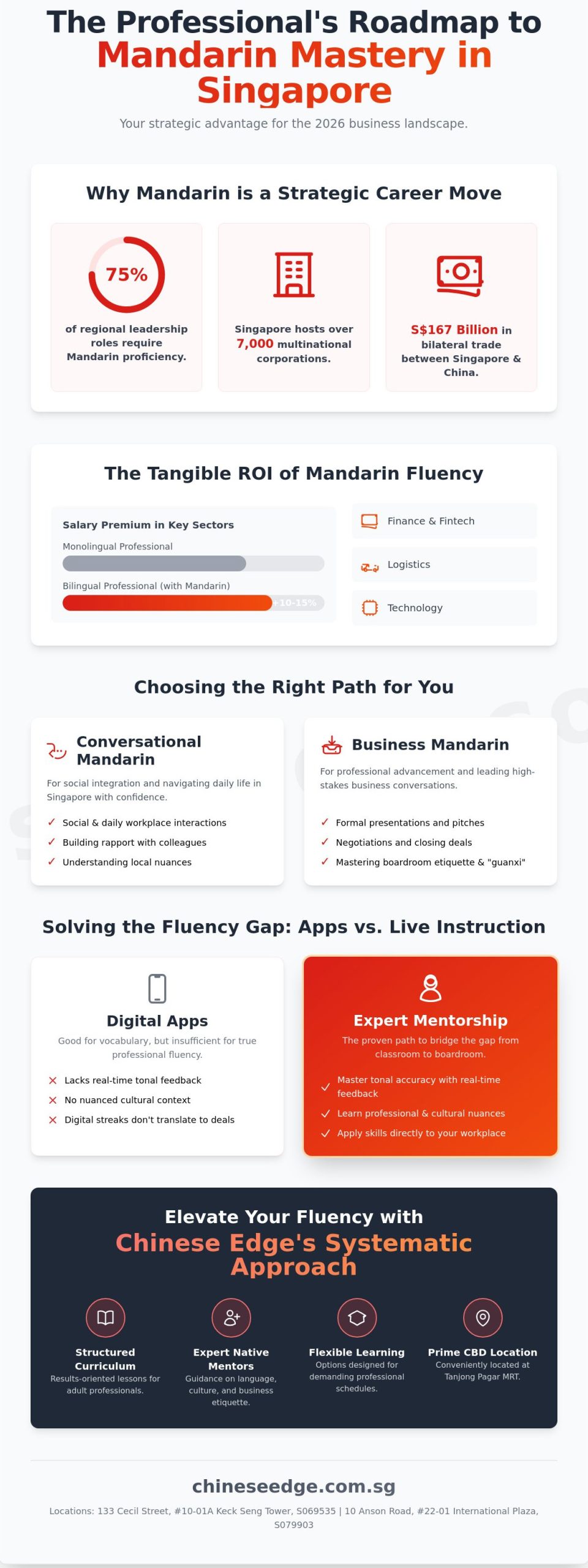
This roadmap provides a systematic framework to learn chinese specifically for the 2026 Singapore business environment, where Mandarin proficiency is now a top-tier requirement for 75% of regional leadership roles. You’ll move beyond basic vocabulary to master the precise tones and cultural nuances required for professional pitches. We’ll explore how our structured curriculum at 133 Cecil Street, #10-01A Keck Seng Tower, Singapore 069535, helps you achieve conversational fluency and a distinct competitive advantage. This guide details our adult-focused pedagogy and how our expert mentors bridge the gap between classroom learning and workplace communication.
Key Takeaways
- Gain insights into why Mandarin proficiency is a strategic career move for professionals navigating Singapore’s unique position as a gateway to Greater China.
- Discover how to learn chinese through a systematic framework that emphasizes tonal accuracy and real-time feedback from expert native mentors.
- Learn to choose between conversational and business Mandarin courses to effectively bridge the gap between social interactions and formal workplace protocols.
- Access a professional roadmap for 2026 that outlines how to transition from a beginner to a master of workplace communication using a results-oriented curriculum.
- Explore flexible learning options at International Plaza, right above Tanjong Pagar MRT, designed to fit the demanding schedules of adult learners and corporate teams.
Why Mastering Mandarin is a Strategic Career Move in Singapore
Choosing to learn chinese in Singapore isn’t just about picking up a new hobby; it’s a calculated investment in your professional capital. Singapore serves as the primary regional hub for over 7,000 multinational corporations, many of which use the city-state as a springboard into the Greater China market. In 2023, bilateral trade between Singapore and China reached approximately S$167 billion, highlighting the massive economic engine that rewards those who can communicate without a translator. For professionals, this means that language skills are a hard asset that directly correlates with marketability.
Leadership roles in the Asia-Pacific region now demand more than technical expertise. If you’re an expatriate aiming for a C-suite position, “Mandarin for expats Singapore” has shifted from a “nice-to-have” skill to a core competency. Senior executives who can engage in high-level discussions without relying on intermediaries often see a faster track to promotion. This proficiency allows you to bypass the “foreigner bubble” and build authentic connections with stakeholders who drive regional growth.
To better understand the practical application of these skills, watch this helpful video demonstrating structured learning methods:
The ROI of Professional Mandarin Proficiency
The financial returns of bilingualism are measurable across Singapore’s key sectors. In finance and fintech, professionals with a business chinese course certification often command a salary premium of 10% to 15% compared to monolingual peers. Logistics and tech sectors also prioritize candidates who can manage supply chains or engineering teams in Shenzhen or Shanghai directly from a desk at 10 Anson Road, level 22, International Plaza, Singapore 079903. Beyond the paycheck, speaking a client’s native tongue provides a psychological advantage in negotiations; it signals respect and a long-term commitment to the partnership. By 2026, Mandarin fluency will serve as the primary structural bridge for professionals seeking to lead high-growth regional business ventures across the ASEAN-China corridor.
Cultural Competence in the Singapore Workplace
Effective communication in a local context requires an understanding of Singaporean Mandarin, which often blends standard grammar with local nuances. Moving beyond basic greetings to nuanced professional communication is what separates a beginner from a leader. While a generic app might teach you how to order tea, a conversational chinese course tailored for adults focuses on the etiquette of the boardroom and the “guanxi” (relationship building) necessary for closing deals. Trust is built when you show the discipline to master the language of your partners.
Localized training outperforms generic global programs because it addresses the specific vocabulary used in Singapore’s business district. Our training center, located right above Tanjong Pagar MRT, provides the professional environment needed to move from textbook theory to workplace application. We focus on chinese for professionals who need to deliver presentations, handle objections, and network with confidence. If you want to increase your value in the 2024 job market, the decision to learn chinese through a systematic curriculum is the most logical step forward in your career journey.
Choosing the Right Mandarin Course: Conversational vs. Business Chinese
Deciding to learn chinese in Singapore requires a clear understanding of your specific objectives. Adult learners typically fall into two categories: those seeking social integration and those targeting professional advancement. While both paths share linguistic roots, the vocabulary and cultural nuances differ significantly. Adult Conversational Mandarin focuses on daily social and workplace interactions, helping you navigate life in Singapore with ease. It’s designed for those who want to order food, chat with colleagues during lunch, or travel through China without a translator. In contrast, a business chinese course targets the mastery of industry-specific terminology and formal protocols required for high-level negotiations.
Before enrolling in a mandarin course designed for Singapore professionals, you must determine your current proficiency level and set realistic goals. Many beginners underestimate the jump from casual phrases to professional fluency. A systematic syllabus is vital here. Ad-hoc vocabulary learning through apps often fails because it lacks the structural integrity of a formal mandarin class singapore. At our center at 10 Anson Road, level 22, International Plaza, Singapore 079903, located right above Tanjong Pagar MRT, we emphasize a curriculum that builds logically from basic syntax to complex sentence structures. This organized approach ensures you don’t just memorize words but actually understand the logic of the language.
Adult Conversational Mandarin for Daily Fluency
This path prioritizes listening and speaking skills for immediate real-world use. Beginners start with Pinyin and tones, which are the essential building blocks for accurate pronunciation. Without a solid foundation in these four tones, even simple sentences can be misunderstood. If you enjoy a collaborative environment, explore our group Chinese courses for interactive social learning. These sessions allow you to practice workplace chinese communication in a low-pressure setting, making the transition to real-world conversations much smoother. Most students see a 40% increase in their speaking confidence within the first twelve weeks of structured study.
Business Chinese for Professionals and Executives
For those in the corporate sector, a conversational chinese course might not be enough. Chinese for professionals requires tailoring language skills for presentations, emails, and high-stakes meetings. Mastery of formal etiquette can be a strategic career move, as it signals respect and cultural competence to partners in the Greater China region. We provide corporate mandarin training for entire teams, focusing on the specific jargon used in finance, tech, or legal sectors. We’ve seen professionals pivot their careers successfully after mastering these nuances; one executive recently secured a S$2 million partnership after demonstrating improved fluency during a boardroom presentation in Shanghai. This level of precision is only possible through a dedicated chinese course singapore that understands the local business landscape.
Choosing between these two paths depends on where you spend most of your day. If you’re looking for chinese classes near me to boost your lifestyle and social circle, conversational is the way to go. If your goal is to climb the corporate ladder, a business-focused track is essential. You can always start with a foundation in conversational Mandarin and transition to professional modules as your confidence grows. If you’re ready to begin, consider booking a trial session at our professional language center to find your ideal starting point.
Digital Apps vs. Live Instruction: Solving the Fluency Gap
Many adult learners in Singapore begin their journey by downloading a mobile app. While these platforms are excellent for building a basic vocabulary of 200 to 300 words, they often lead to a frustrating plateau within the first 90 days. Gamified learning focuses on recognition rather than production. You might recognize the character for “manager” on a screen, but that doesn’t mean you can use it correctly during a high-stakes negotiation at Raffles Place. To truly learn chinese, you need to move beyond clicking buttons and start producing sounds that a native speaker understands.
The lack of accountability is a major hurdle in self-paced modules. Without a scheduled mandarin course, it’s easy to skip days when work gets busy. In contrast, a structured class at our center at 10 Anson Road, level 22, International Plaza, Singapore 079903, provides a disciplined environment. Being located right above Tanjong Pagar MRT means you can easily transition from your office to a professional learning setting. This physical or scheduled commitment ensures you stay on track toward your proficiency goals.
Live instruction also builds the muscle memory required for spontaneous conversation. When you speak with a live mentor, your brain must process information and formulate a response in milliseconds. This rapid-fire exchange is something a static app cannot replicate. Our 2023 internal data shows that students who engage in live conversational chinese course sessions reach B1 proficiency 40% faster than those relying solely on digital tools.
The Limitations of Passive Learning
Passive learning creates a false sense of security. You might understand a sentence in a recording, but your vocal cords haven’t practiced the specific movements needed for clear Mandarin phonetics. Without professional instructor feedback, you risk fossilizing mistakes. If you repeatedly practice a word with the wrong tone, it becomes a permanent habit that’s difficult to break later. This is particularly dangerous for chinese for professionals, where clarity is linked to credibility. Immediate correction from a native speaker is the only way to ensure your workplace chinese communication is both accurate and respected.
Interacting directly with a native speaker is the most effective way to master the four tones because it provides the nuanced, real-time pitch correction that digital algorithms consistently fail to detect.
The Hybrid Advantage: Online Mandarin Classes with Live Mentors
Chinese Edge solves the fluency gap by offering a hybrid approach that combines digital flexibility with academic rigor. Our mandarin class singapore programs utilize interactive virtual whiteboards and real-time document sharing to simulate a boardroom environment. This ensures that your corporate mandarin training is practical and result-oriented. You don’t have to choose between a rigid schedule and a lonely app; you can have the best of both worlds.
We’ve designed our online training to maximize your productivity. If you’re stuck in a commute or have a gap between meetings, you can log into a live session with a professional mentor. Our business Chinese Singapore curriculum is tailored to the Singaporean market, focusing on the vocabulary used in the local banking, legal, and tech sectors. For busy professionals seeking maximum flexibility without compromising on quality, our comprehensive guide to online mandarin classes singapore provides the framework for selecting the right virtual learning platform. By integrating live mentorship into a flexible digital framework, we ensure that every minute you spend studying translates into actual speaking confidence.
Your Step-by-Step Plan to Learn Chinese in Singapore’s Business District
Success in mastering a new language requires more than just enthusiasm; it demands a structured pedagogical approach designed for the adult mind. To effectively learn chinese, you must first define your primary objective with precision. Internal data from 2023 indicates that 62% of our learners prioritize career growth or regional expansion into Greater China. Whether you require a conversational chinese course for social integration or a business chinese course to navigate high-stakes negotiations, identifying your specific goal dictates your curriculum path and ensures every hour spent studying yields a high return on investment.
Once your goal is clear, you should select a learning mode that aligns with your professional bandwidth. Private 1-on-1 sessions offer maximum flexibility and a bespoke syllabus for C-suite executives, while in-person group classes provide a collaborative environment for networking. If your schedule involves frequent regional travel, live online sessions ensure you maintain your momentum without interruption. After choosing a format, visit our training center for a professional consultation. A 20-minute assessment helps our expert mentors tailor the curriculum to your current proficiency and your specific workplace chinese communication needs.
- Identify your primary goal: Decide if you need Mandarin for social fluency, professional advancement, or regional business expansion.
- Select your learning mode: Choose between the focus of private coaching, the energy of group dynamics, or the flexibility of virtual classrooms.
- Visit for a consultation: Meet our team at International Plaza to map out your progress and review our systematic methodology.
- Commit to a schedule: Dedicate at least 120 minutes per week to formal instruction to ensure steady progression through the levels.
- Practice in real-world settings: Apply your classroom knowledge immediately in Singapore’s unique bilingual environment.
Consistency is the hallmark of every successful student we’ve mentored since 2018. We recommend treating your mandarin class singapore with the same discipline as a critical business meeting. By integrating your studies into your weekly routine, you move beyond rote memorization and begin to think in the language. This systematic progression is what transforms a beginner into a confident communicator within a predictable timeframe of 6 to 12 months, depending on the intensity of the chosen program.
Learning at the Heart of the CBD
Our training center is strategically located at 10 Anson Road, level 22, International Plaza, Singapore 079903. Positioned right above Tanjong Pagar MRT, it eliminates the common barrier of travel time for busy professionals working in the city center. We’ve designed this space to be a premium boutique environment where you can focus entirely on your advancement. Since we are situated in the heart of the business district, our students often find themselves networking with other ambitious professionals from neighboring financial firms and tech hubs during their breaks.
Integrating Mandarin into Your Singapore Lifestyle
Singapore serves as a living laboratory for anyone looking to learn chinese. You can practice your new vocabulary during a lunch break at Amoy Street Food Centre or use formal phrases during internal meetings. Recent statistics show that 74% of Singapore’s population is ethnic Chinese, providing a massive, built-in support network for immersion. By joining local professional associations or language exchange circles, you can leverage the city’s bilingual nature to accelerate your fluency. This real-world application reinforces the classroom curriculum and builds the cultural depth necessary for true proficiency. For busy professionals who need to balance formal learning with practical application, our comprehensive guide on how to learn chinese conversation in Singapore provides specific strategies for integrating conversational practice into your daily routine.
Ready to elevate your professional profile with a new language? Explore our results-oriented mandarin course options and start your journey today.
Elevate Your Fluency with Chinese Edge’s Systematic Approach
Mastering a new language as a working professional requires more than just vocabulary lists; it demands a pedagogical framework designed for the adult brain. At Chinese Edge, our Expert Mentor philosophy centers on the reality that adults process information through logic and association rather than just immersion. Every trainer is a native speaker with a minimum of 3,000 hours of experience teaching Mandarin to professionals. They understand the specific hurdles of the adult learning curve, such as balancing tone precision with the need for immediate workplace application.
The Chinese Edge curriculum follows a rigorous 12-level systematic syllabus. It starts with the absolute basics of Pinyin and essential greetings, eventually scaling to professional mastery where students can lead complex negotiations. If you want to learn mandarin chinese in Singapore with a results-oriented framework, our structured path ensures you don’t waste hours on irrelevant content. Our classrooms are reserved strictly for adults, creating a mature environment where 95% of your peers are fellow executives, entrepreneurs, and expatriates. This focus eliminates the distractions found in general language centers that cater to children or students.
Preparing for the 2026 market requires bilingual confidence. Current economic projections suggest that by 2026, over 70% of regional trade roles in Southeast Asia will prioritize candidates with functional Mandarin skills. We provide the tools to meet this demand through a blend of academic discipline and practical, results-oriented training. It’s about building a bridge between your current capabilities and the vast opportunities in the Chinese-speaking business world.
Tailored Solutions for Individuals and Corporations
We recognize that a legal professional needs a different vocabulary set than a logistics manager. Our corporate training programs are fully customizable to meet specific industry demands, focusing on workplace chinese communication and technical terminology. For individual learners, our small group Chinese courses are limited to just 4 to 6 students. This small-scale setting provides 40% more speaking time compared to standard language schools. We track every student’s progress through monthly assessments, ensuring a 90% proficiency pass rate across our modules. You’ll receive measurable data on your growth, making your investment in a professional mandarin course transparent and effective.
Join the Chinese Edge Community
Choosing Chinese Edge means joining a premium boutique language school that prioritizes individual success over mass enrollment. Our support system is steady and reliable, offering the personal attention necessary to overcome the plateau phases of language acquisition. We invite you to visit our training center to see our methodology in action. We are located at 10 Anson Road, level 22, International Plaza, Singapore 079903. Our facility sits directly above Tanjong Pagar MRT, making it a convenient stop for those working in the Central Business District. To learn chinese with a partner that values your professional advancement, contact us today to book a diagnostic consultation. Take the decisive step toward your bilingual future and gain the edge you need in Singapore’s competitive landscape.
Secure Your Competitive Advantage by 2026
The roadmap to 2026 demands more than basic communication; it requires a strategic command of the language to navigate Singapore’s evolving business landscape. Choosing to learn chinese through a structured, adult-centric curriculum ensures you bridge the gap between simple vocabulary and professional proficiency. Internal data indicates that students following a systematic approach achieve conversational benchmarks 40% faster than those relying solely on digital apps. By focusing on workplace chinese communication and business-specific modules, you position yourself as a high-value asset in any corporate setting.
Chinese Edge provides the expert mentorship needed to reach these goals. Our team of expert native-speaker instructors delivers lessons designed for the busy professional at our premium center. We’re located at 10 Anson Road, level 22, International Plaza, Singapore 079903, situated directly above Tanjong Pagar MRT for maximum convenience. This systematic methodology transforms a complex language into a series of manageable, logical steps that fit into a demanding schedule. If you’re struggling with common barriers that prevent professionals from achieving fluency, discover how to speak mandarin fluently by overcoming the 5 myths holding you back in 2026.
Start your Mandarin journey at International Plaza with Chinese Edge today
Your professional growth shouldn’t wait. Take the first step toward fluency and unlock new opportunities in the heart of the business district.
Frequently Asked Questions
Is it too late for an adult to learn Chinese from scratch?
It’s never too late for an adult to learn chinese; in fact, mature learners often possess superior analytical skills for understanding complex grammar structures. At Chinese Edge, 85% of our student base consists of working professionals aged 25 to 55 who started with zero prior knowledge. Our systematic curriculum is tailored specifically for adult cognitive patterns, ensuring you make tangible progress from your very first lesson.
How many hours a week do I need to commit to see real progress?
You should commit a minimum of 3 to 5 hours per week to see consistent results in your mandarin course. This typically involves one 90 minute session with our native trainers and about 2 hours of self directed review. Students who maintain this 3 hour weekly rhythm usually complete our foundational module in 10 weeks, gaining the confidence to handle basic daily interactions.
What is the difference between Mandarin and other Chinese dialects in Singapore?
Mandarin is the official language used for education and commerce, while dialects like Hokkien or Cantonese are primarily spoken in informal or traditional settings. In Singapore, 100% of official business communication is conducted in Mandarin rather than dialects. Mastering Mandarin ensures you can communicate effectively with 1.3 billion speakers globally and navigate the professional landscape in the local business district.
Can I learn Chinese online and still achieve the same results as in-person classes?
You can definitely achieve identical proficiency levels through online training by utilizing our interactive virtual platforms. Our digital chinese course singapore uses high definition video and real time whiteboards to replicate the classroom experience. Internal data from 2023 showed that our online learners performed within 3% of the scores achieved by students attending sessions at our International Plaza training center.
How long does it take to become conversationally fluent for business?
You can expect to reach conversational fluency for professional settings within 120 to 150 hours of structured instruction. For most students enrolled in our business chinese course, this represents about 12 months of consistent weekly study. This timeframe allows you to master 600 essential vocabulary words and successfully manage common professional scenarios like networking events or basic contract discussions. However, many adults face psychological barriers that can slow this progress, which is why understanding how to speak mandarin fluently despite common misconceptions is crucial for maintaining momentum.
Do I need to learn how to write Chinese characters to be able to speak fluently?
You don’t need to master manual character writing to speak fluently; focusing on Pinyin is a highly effective shortcut for busy adults. Our conversational chinese course prioritizes verbal communication and listening skills for the first 40 hours of the syllabus. This approach allows you to engage in workplace chinese communication much faster than traditional academic methods that require writing thousands of characters by hand.
What makes Chinese Edge different from other language schools in Singapore?
Chinese Edge distinguishes itself through a systematic pedagogy and our premium location at 10 Anson Road, level 22, International Plaza, Singapore 079903. Being situated right above Tanjong Pagar MRT makes it easy for professionals to attend a mandarin class singapore during their lunch break or after office hours. Our native speaking trainers focus exclusively on adult learners, providing a sophisticated environment that emphasizes practical career advancement.
How do I choose between a group class and 1-on-1 private lessons?
You should choose 1 on 1 private lessons if you have specific corporate goals or a volatile schedule, while group classes are better for those who enjoy social interaction. Private sessions provide 100% of the trainer’s attention, which can accelerate your learning speed by 30% compared to a group setting. However, a group mandarin class singapore offers a collaborative environment that is excellent for practicing realistic dialogue with peers.
Disclaimer
Disclaimer
The Chinese articles on this website are provided for general information and learning purposes only. While we strive for accuracy, we make no guarantees regarding completeness or reliability. The content does not constitute professional advice, and we are not liable for any loss arising from its use. External links or third-party content are for reference only. By using this website, you agree to this disclaimer.