
A technical certification alone will no longer guarantee a top-tier salary in Singapore’s 2026 tech market. You’ve likely noticed that technical expertise is now the baseline, not the differentiator, for high-level career advancement. It’s frustrating to watch high-paying regional roles go to others simply because you can’t communicate effectively with Mandarin-speaking stakeholders. If you want to stand out, learning chinese for IT support professionals is the most strategic move you can make this year.
We understand that explaining complex server migrations or cloud architecture to non-English speaking users is a major hurdle that slows down your workflow. This article shows you how to bridge that gap and improve your user satisfaction scores by at least 25% through targeted language training. You’ll discover how a specialized business chinese course can help you master essential technical vocabulary and qualify for premium vacancies in multinational tech firms.
Our systematic approach at Chinese Edge, located at 10 Anson Road, level 22, International Plaza, right above Tanjong Pagar MRT, ensures you gain practical skills from native speakers. We’ll preview the specific curriculum designed for chinese for professionals and explain how this mandarin class singapore prepares you for the 2026 job market.
Key Takeaways
- Understand the rising demand for bilingual tech support as Singapore solidifies its role as a regional hub for North Asian market operations in 2026.
- Master specialized technical vocabulary for hardware and cloud infrastructure to deliver effective chinese for IT support professionals in high-pressure environments.
- Learn to bridge communication gaps during technical troubleshooting by using active listening and simplified Mandarin analogies for complex IT issues.
- Identify the salary benchmarks and career advancement opportunities available to bilingual IT engineers in Singapore’s Fintech and E-commerce sectors.
- Discover systematic learning pathways at International Plaza, right above Tanjong Pagar MRT, designed to fit the schedules of busy corporate professionals.
Why IT Support Professionals in Singapore Need Mandarin in 2026
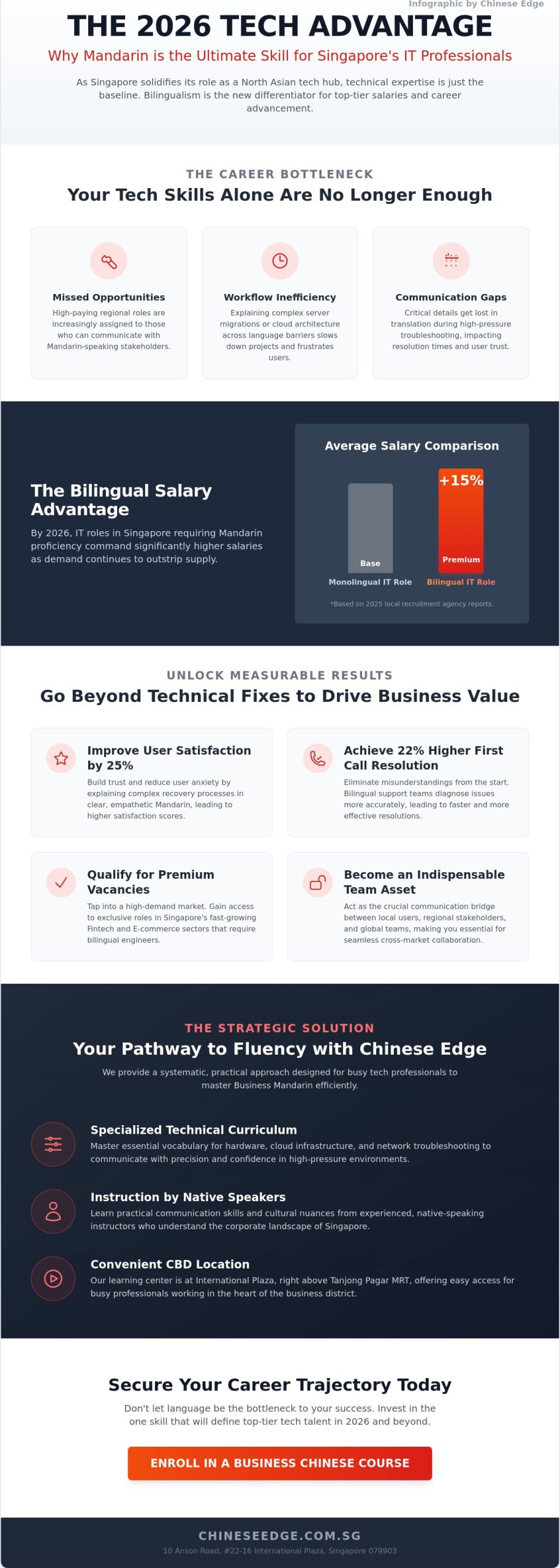
By 2026, Singapore’s tech ecosystem has solidified its position as the central nerve center for North Asia. Technical proficiency alone no longer guarantees career progression in this competitive environment. Recruiters now prioritize chinese for IT support professionals to manage complex regional infrastructures. A January 2025 report from local recruitment agencies indicated that IT roles requiring Mandarin proficiency offer salaries approximately 15% higher than monolingual positions. This shift reflects the reality of local operations where technical support intersects with regional business needs.
To better understand how language impacts workplace efficiency, watch this helpful video:
The Regional Hub Advantage
Singapore acts as the strategic gateway for tech giants expanding into China and Taiwan. Large firms in the CBD require engineers who can communicate fluently with stakeholders in Beijing or Taipei. While English remains the standard, many regional offices prefer Singaporean Mandarin for internal collaboration. Professionals who enroll in a business chinese course gain a distinct advantage. They can navigate technical discussions without the delays caused by language barriers. This makes them indispensable to global teams that value seamless integration across North Asian markets.
Improving User Experience (UX) in Support
High-pressure environments like IT helpdesks require more than just fixing the problem. They require empathy and clarity. During critical system downtime in a regional branch, a user’s frustration peaks if they can’t express the issue accurately. Being able to explain a recovery process in Mandarin reduces anxiety and builds immediate trust. Data from 2024 service desk audits shows that bilingual support teams achieve a 22% higher First Call Resolution rate when dealing with regional users. This proficiency in workplace chinese communication ensures that cultural nuances don’t turn a minor bug into a major organizational crisis. It’s about bridging the technical gap where English terminology doesn’t always translate perfectly to the end-user’s experience.
A quick search on Jobstreet in late 2025 reveals a surge in Bilingual IT Support listings. These roles often involve supporting proprietary software used by Chinese fintech firms that have moved their regional HQs to Singapore. Being a bilingual IT engineer isn’t just a nice to have skill anymore; it’s a career safeguard. If you can provide chinese for IT support professionals, you’re tapping into a market where demand consistently outstrips supply.
Our training center at 10 Anson Road, level 22, International Plaza, Singapore 079903, is located right above Tanjong Pagar MRT. We provide a structured environment to help you master these essential skills. If you’re looking to advance your career, our chinese course singapore is tailored to meet the needs of busy professionals in the heart of the business district.
Essential Mandarin Vocabulary for IT Support Professionals
Mastering technical terminology is the first step toward proficiency in any specialized field. In Singapore’s rapidly evolving tech sector, there is an insatiable demand for ICT skills, and the ability to communicate these concepts in Mandarin provides a distinct competitive advantage. Whether you’re managing a data center near Jurong or providing helpdesk support at International Plaza, having the right “chinese for IT support professionals” toolkit allows you to resolve tickets faster and build trust with Mandarin-speaking stakeholders.
Technical communication isn’t just about direct translation. It’s about using the specific terms that local professionals recognize. In 2026, as hybrid work models become the standard for 80% of Singaporean firms, the ability to explain cloud transitions or security protocols in Mandarin is no longer a niche skill; it’s a core competency for career advancement.
Hardware and Infrastructure Terms
Standardizing your vocabulary for physical components prevents misunderstandings during hardware deployments. You’ll often deal with workstations (工作站 – gōngzuòzhàn) and their various peripherals. Key terms include the monitor (显示器 – xiǎnshìqì), keyboard (键盘 – jiànpán), and the central processing unit (中央处理器 – zhōngyāng chǔlǐqì). When moving into the server room (机房 – jīfáng), you must distinguish between a network switch (交换机 – jiàohuànjī) and a router (路由器 – lùyóuqì).
Security infrastructure is equally vital. In a support context, a Firewall (防火墙 – fánghuǒqiáng) acts as the primary barrier that filters incoming and outgoing traffic to protect the corporate network from unauthorized access. If you’re looking to master these technical nuances, our group chinese courses provide a structured environment to practice workplace-specific dialogues.
Troubleshooting and Action Phrases
Effective support relies on clear, actionable instructions. When a user reports a laggy system, the most common first step is to ask them to “restart your computer” (请重启您的电脑 – qǐng chóngqǐ nín de diànnǎo). If the issue persists, you might need them to “check your network connection” (检查您的网络连接 – jiǎnchá nín de wǎngluò liánjiē). These direct phrases reduce downtime and prevent user frustration.
Handling software and security requests requires a more formal approach to ensure compliance. You’ll frequently encounter these scenarios:
- Software Updates: Explain that “we need to install a security patch” (我们需要安装安全补丁 – wǒmen xūyào ānzhuāng ānquán bǔdīng) to maintain system integrity.
- Password Resets: For identity verification, ask the user to “provide your employee ID” (请提供您的员工编号 – qǐng tígōng nín de yuángōng biānhào).
- VPN Issues: If a remote worker can’t access the internal portal, guide them to “reconnect to the VPN” (重新连接虚拟专用网络 – chóngxīn liánjiē xūnǐ zhuānyòng wǎngluò).
Our training center is conveniently located at 10 Anson Road, level 22, International Plaza, Singapore 079903, right above Tanjong Pagar MRT. We focus on practical “chinese for IT support professionals” that you can apply immediately in your next technical briefing or user support session. Learning these terms systematically ensures you don’t just speak the language, you speak the business.
Overcoming Communication Barriers in Technical Troubleshooting
Mastering chinese for IT support professionals requires a structured method to bridge the gap between technical complexity and user understanding. By 2026, the demand for bilingual troubleshooting in Singapore tech hubs has made clear communication a core competency for any helpdesk role. Follow these five steps to ensure a smooth resolution process.
- Step 1: Active Listening. Don’t jump to conclusions. Listen to the user’s tone to identify their emotional state. If they sound anxious about a deadline, your first priority is to offer calm, steady reassurance in Mandarin before diving into the logs.
- Step 2: Simplified Analogies. Explain complex issues using everyday concepts. If a server is down, describe it as a “closed office door” (办公室门关了) rather than discussing packet loss or handshake failures.
- Step 3: Confirming Understanding. Use clarifying questions to verify the user follows your logic. Ask them to describe what they see on their screen to ensure you’re both looking at the same error message.
- Step 4: Clear, Actionable Instructions. Provide one step at a time. Use direct verbs like “click” (点击) or “restart” (重启). This prevents the user from feeling overwhelmed by a long list of commands.
- Step 5: Bilingual Documentation. Record the resolution clearly. In Singapore’s 2026 business environment, reporting often needs to be accessible to both English-speaking local teams and Mandarin-speaking regional stakeholders.
Effective chinese for IT support professionals isn’t just about vocabulary; it’s about the systematic application of language to solve problems. Our training center at 10 Anson Road, level 22, International Plaza, Singapore 079903, located right above Tanjong Pagar MRT, focuses on these practical workplace applications.
Simplifying Technical Jargon
Avoid over-complicating your explanations. Use “everyday” Mandarin for tech concepts to reduce user frustration. For example, a 2024 industry report found that 68% of users feel more confident when technicians use descriptive language rather than abstract terms. Supplement your speech with visual aids or remote desktop tools. These visual cues provide a safety net when language nuances become difficult. Always maintain patience and offer professional encouragement to build trust during the call.
Professional Etiquette in Helpdesk Scenarios
Distinguishing between formal and informal address is vital. In a corporate setting, use Nín (您) when speaking to senior management or external clients to show proper respect. When closing a support ticket, use professional courtesy phrases like “It is my pleasure to help” to leave a positive impression. If you want to master these social nuances, a Business Chinese Course offers the specific framework needed for high-level professional etiquette. It’s a proven way to ensure your communication is as polished as your technical skills.
Career Advancement: Mandarin-Speaking IT Roles in Singapore
In the 2026 Singaporean job market, the demand for chinese for IT support professionals has reached a new peak. Data from recent recruitment surveys indicates that IT engineers who are fluent in both English and Mandarin can earn between 12% and 18% more than their monolingual peers. This salary premium reflects the scarcity of technical talent capable of managing stakeholders in Greater China or supporting regional infrastructure. If you’re based in the city, you’ll find these opportunities concentrated in specific high-value hubs.
To maximize your market value, you must highlight your proficiency strategically. Don’t just list “Mandarin” as a skill on your LinkedIn profile. Instead, specify your ability to “troubleshoot technical issues with Mandarin-speaking stakeholders” or “document system architectures in Chinese.” Employers at International Plaza and other CBD tech hubs look for evidence of functional, workplace-ready language skills rather than just academic knowledge.
High-Growth Sectors for Bilingual IT
Fintech firms dealing with regional payment gateways represent the largest hiring block in 2026. These companies require engineers who can communicate with developers in Beijing or Shanghai to resolve API discrepancies and transaction errors. Similarly, Cybersecurity Operations Centers (SOC) now prioritize bilingual staff to monitor regional threats and coordinate with North Asian security teams. If you want to position yourself for these roles, you should Learn Chinese in Singapore to gain the specific technical vocabulary required for regional data centre management and cloud infrastructure support.
Interview Success Strategies
Preparing for a technical interview in Mandarin requires a different approach than a standard conversation. You’ll need to practice explaining complex concepts like “latency,” “redundancy,” or “packet loss” using the correct technical terminology (术语). Interviewers often look for your ability to simplify technical jargon for non-technical users while maintaining professional etiquette. Common questions for Mandarin-speaking helpdesk roles often include scenarios where you must de-escalate a frustrated user from a regional office.
Success in these interviews also hinges on cultural competence. Understanding the nuances of workplace hierarchy and communication styles in Chinese corporate environments is just as vital as your linguistic ability. It’s about showing that you can bridge the gap between different corporate cultures seamlessly. If you’re ready to upgrade your professional toolkit, explore our group Mandarin courses for professionals to start your journey toward bilingual technical mastery.
Our training center is conveniently located at 10 Anson Road, level 22, International Plaza, Singapore 079903, right above Tanjong Pagar MRT. This central location allows busy IT professionals to attend classes before or after their shifts in the heart of the financial district.
Chinese Edge: Specialized Mandarin Training for Tech Professionals
Professional IT support requires more than just technical troubleshooting; it demands clear and effective communication. Chinese Edge provides a systematic curriculum that prioritizes the specific needs of busy adults and tech teams. Our pedagogy focuses on practical application, ensuring you can use what you learn immediately in a helpdesk or data center environment. Our native-speaking instructors bring years of experience in professional business Mandarin, helping you bridge the gap between technical jargon and effective workplace chinese communication.
We understand that tech professionals often work under high pressure. Our lessons are structured to be direct and functional, avoiding unnecessary complexity. If you want to gain a competitive edge in the 2026 job market, mastering a business chinese course is a logical step. Our instructors act as expert mentors, guiding you through the nuances of technical terminology and cultural etiquette. This structured approach ensures that fluency isn’t just a goal, but a predictable outcome of your commitment to professional growth.
Flexible Learning Near Tanjong Pagar MRT
Finding a mandarin course singapore that fits an IT professional’s schedule shouldn’t be a challenge. We offer sessions at our training center located at 10 Anson Road, level 22, International Plaza, Singapore 079903. Being situated right above Tanjong Pagar MRT makes it easy for the CBD workforce to attend lunchtime or after-work sessions without a long commute. Our environment is designed to be supportive and results-oriented, encouraging you to reach professional fluency through consistent practice. For those who prefer a remote setup, our live virtual classes offer the same high-quality instruction as our in-person mandarin class singapore, allowing you to learn chinese from your home or office.
Corporate Training Solutions
For organizations planning regional expansion, upskilling an entire IT department is a strategic investment. Our corporate mandarin training is tailored for helpdesk teams and technical staff who need to interact with Mandarin-speaking stakeholders across Asia. We provide live virtual classrooms that accommodate remote or hybrid tech workers, ensuring everyone stays on the same page regardless of their physical location. By focusing specifically on chinese for IT support professionals, we help your team handle complex support tickets and client interactions with confidence. This targeted training turns language skills into a measurable business asset that improves service delivery. Explore our Business Mandarin Course for your team to discover how we can customize a syllabus for your technical requirements.
Future-Proof Your IT Career in Singapore
The Singaporean tech landscape is shifting rapidly. By 2026, IT experts who bridge the gap between technical infrastructure and Mandarin-speaking stakeholders will lead the industry. Mastering chinese for IT support professionals isn’t just about learning a language. It’s about gaining a functional tool to resolve complex tickets and manage regional hardware deployments with precision. You’ll find that technical fluency reduces downtime and builds immediate trust with corporate clients. This specialized skill set transforms you from a standard technician into a strategic regional asset.
Chinese Edge provides the structured environment you need to excel. Our native-speaking expert mentors deliver a proven systematic teaching methodology tailored for the modern workplace. Our training center is conveniently located at 10 Anson Road, level 22, International Plaza, Singapore 079903, right above Tanjong Pagar MRT. You’ll gain the confidence to handle any technical crisis or software rollout in Mandarin. It’s time to unlock new leadership opportunities and higher-tier roles in the tech sector.
Start your journey to professional Mandarin fluency at Chinese Edge today!
Your career growth in Singapore’s digital economy is within reach; we’re here to help you master the language of innovation.
Frequently Asked Questions
Is it difficult for IT professionals to learn Mandarin from scratch?
Learning Chinese isn’t as daunting as it seems for tech experts who already understand complex systems. Many IT professionals find the logical structure of Mandarin grammar easier to grasp than European languages. If you start from zero, our structured approach helps you build a solid foundation quickly. Most students find that 40 hours of focused study allows them to handle basic hardware troubleshooting in a professional environment.
What are the most common Mandarin terms used in IT helpdesks?
Common terms for chinese for IT support professionals include “chóng qǐ” for restart, “mǎ mǎ” for password, and “fu wu qi” for server. You’ll also frequently use “wang luo” when discussing network issues. Mastering these technical keywords allows you to provide faster solutions to Mandarin speaking clients. Our curriculum prioritizes these high frequency workplace terms to ensure you’re ready for helpdesk tickets from day one.
Do I need to learn to write Chinese characters for IT support?
You don’t need to master hand writing characters to be effective in tech support. Modern IT environments rely on typing using Pinyin, which is much faster to learn. If you can recognize characters on a screen, you can navigate Chinese operating systems and ticketing software. This practical focus is a core part of our conversational chinese course designed for busy professionals in Singapore’s tech sector.
How long does it take to become conversational in Mandarin for work?
Most adult learners become conversational for work within 6 to 12 months of consistent study. If you commit to a weekly mandarin course, you’ll likely reach a level where you can explain technical steps by your 30th lesson. By 2026, demand for bilingual tech staff in Singapore is expected to rise by 15 percent, making this a timely investment in your career advancement.
Can I take Mandarin classes online if I have a rotating shift schedule?
Yes, you can take a mandarin class singapore online to fit a rotating shift schedule. We offer flexible scheduling that allows you to attend lessons from your home or office. If you prefer in person sessions, our center at 10 Anson Road, level 22, International Plaza, is located right above Tanjong Pagar MRT for easy access before or after your shift.
What is the difference between general Mandarin and Business Mandarin for IT?
General Mandarin focuses on daily social interactions like ordering food or introducing yourself. A business chinese course for IT dives into professional etiquette and specific technical jargon. You’ll learn how to manage client expectations and explain complex data migrations. This specialized training ensures your workplace chinese communication remains professional and clear during high pressure outages.
Are there specific technical Mandarin courses for companies in Singapore?
We provide corporate mandarin training specifically tailored for technology firms and internal IT departments. These programs focus on the unique challenges of tech support, such as explaining security protocols to non technical staff. If your team is based near the CBD, our training center at International Plaza provides a convenient hub for professional development and language mastery.
How do I prove my Mandarin proficiency to a potential tech employer?
The most effective way to prove your skills is through the HSK proficiency test, which is the global standard for Chinese language certification. You can also showcase your ability during technical interviews by explaining a simple process in Mandarin. Highlighting a completed chinese course singapore on your resume shows employers you’ve the discipline and cultural competence needed for regional roles.
Disclaimer
Disclaimer
The Chinese articles on this website are provided for general information and learning purposes only. While we strive for accuracy, we make no guarantees regarding completeness or reliability. The content does not constitute professional advice, and we are not liable for any loss arising from its use. External links or third-party content are for reference only. By using this website, you agree to this disclaimer.