

What if you could transition from feeling like an outsider in your own boardroom to leading a negotiation in Mandarin within just six months? Most professionals find that the best way for expats to learn mandarin in Singapore isn’t through academic memorization, but through practical, adult-focused immersion instead of searching for generic chinese classes near me. You’ve likely realized that traditional, slow paced language courses don’t fit your 60 hour CBD work week or your need for immediate, practical application.
We agree that your time is your most valuable asset. This guide promises to reveal a systematic approach to learn chinese for professionals through a tailored chinese course singapore syllabus. We’ll preview our curriculum for corporate mandarin training and explain how our mandarin course center, located at 10 Anson Road, level 22, International Plaza, Singapore 079903, right above Tanjong Pagar MRT, provides the premier mandarin class singapore experience to master workplace chinese communication through a business chinese course or conversational chinese course.
Key Takeaways
- Understand how to navigate the “Singapore Paradox” by adopting a strategic approach that overcomes the challenges of learning Mandarin in an English-speaking environment.
- Discover why a systematic conversational chinese course is more effective for professionals than traditional rote learning methods.
- Evaluate the ROI of various learning formats to identify the best way for expats to learn mandarin in Singapore while balancing a demanding career.
- Learn practical techniques to transform your daily commute and interactions at the hawker centre into high-value language immersion sessions.
- Explore the advantages of training at a professional center in International Plaza, right above Tanjong Pagar MRT, to ensure consistent progress and networking opportunities.
The Expat’s Challenge: Why Learning Mandarin in Singapore Requires a Strategic Approach
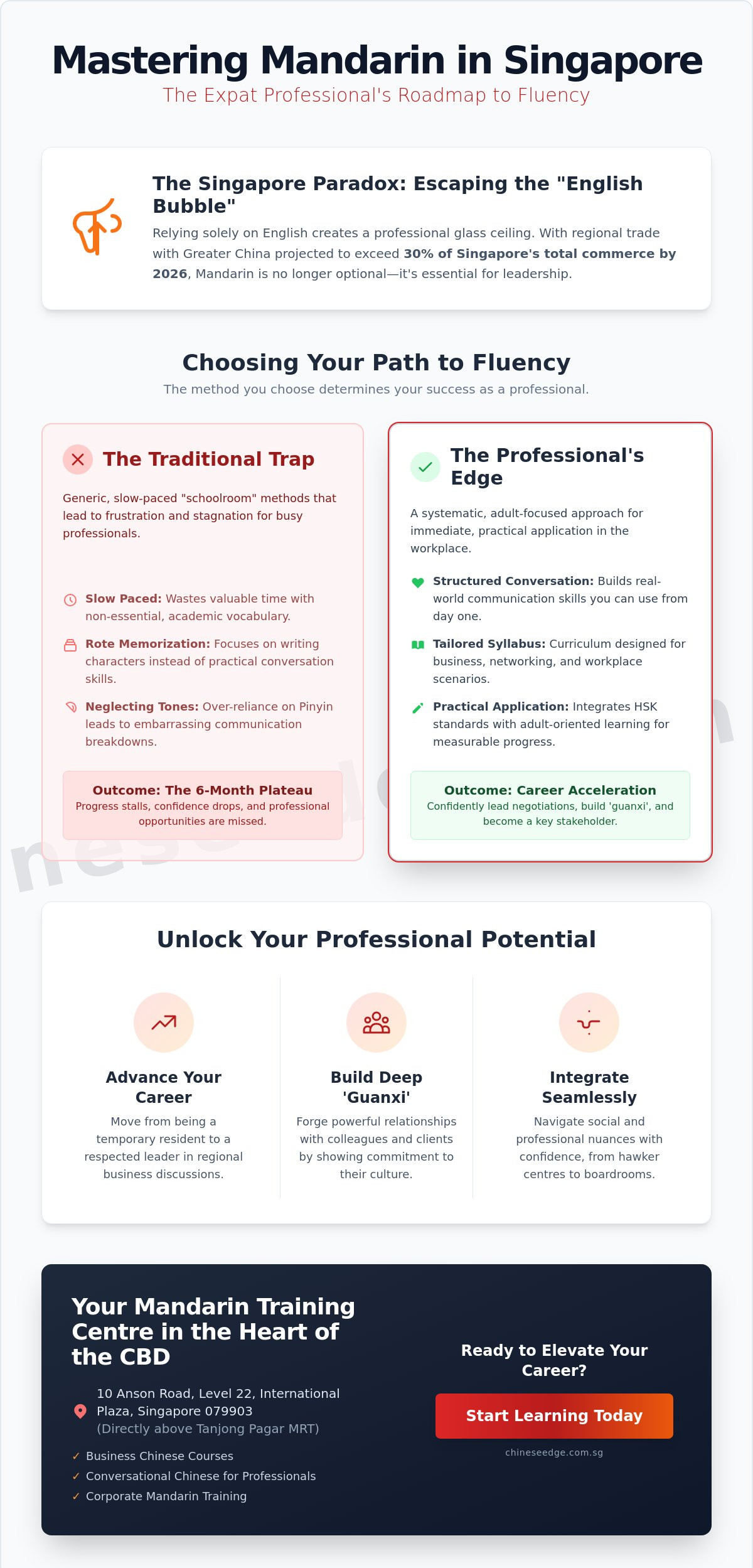
Living in the Lion City presents a unique linguistic contradiction known as the Singapore Paradox. While English is one of Singapore’s official languages and serves as the primary tongue for administration and retail, this convenience often traps professionals in a “linguistic bubble.” By 2026, as regional trade with Greater China is projected to comprise over 30% of Singapore’s total commerce, relying solely on English creates a visible glass ceiling. Expats who don’t learn Chinese often find themselves sidelined during informal office discussions or regional networking events where Mandarin is the bridge language.
Finding the best way for expats to learn mandarin in Singapore involves moving past the “tourist phase” of language acquisition. In 2026, the competitive landscape of the CBD demands more than just basic greetings. It requires a systematic mandarin course that addresses the specific nuances of a professional environment. If you want to move from being a temporary resident to a respected stakeholder, a structured approach is the only path to sustainable fluency.
To better understand the impact of language on the migrant experience, watch this helpful video:
The Social and Professional Benefits of Mandarin Fluency
Mastering a conversational chinese course does more than just help you order at a hawker center. It builds deep rapport with local colleagues by demonstrating a commitment to their culture. In the Singaporean business context, the concept of ‘guanxi’ (relationships) is vital. Being able to participate in a business chinese course allows you to navigate these social nuances during high-stakes dinners or regional client meetings. This psychological shift from ‘visitor’ to ‘local’ is often the catalyst for career advancement within multinational firms located near our training center at 10 Anson Road, level 22, International Plaza, Singapore 079903, situated right above Tanjong Pagar MRT.
Common Pitfalls for Expats Learning Mandarin
Many adult learners fail because they rely too heavily on Pinyin, the Romanized system for Chinese. While Pinyin is a useful starting tool, neglecting the four distinct tones leads to significant workplace chinese communication breakdowns. Another common error is choosing general hobbyist classes instead of a targeted chinese course singapore residents can use in professional settings. Without a structured syllabus like the one found in our group chinese courses, most expats hit a ‘Plateau Effect’ after six months. A professional mandarin class singapore curriculum prevents this stagnation by integrating HSK standards with practical, adult-oriented scenarios.
If you are searching for chinese classes near me that cater specifically to the busy schedule of a professional, 2026 is the ideal year to start. The availability of corporate mandarin training and specialized chinese for professionals has never been more accessible for those working in the downtown core.
Structured Conversation vs. Rote Learning: Choosing the Right Pedagogy for Professionals
Traditional language instruction often relies on the “schoolroom” model, which focuses heavily on memorizing long lists of characters and nursery-rhyme vocabulary. For a busy executive, this approach is rarely effective. The best way for expats to learn mandarin in Singapore is through a pedagogy that respects your time and leverages your professional experience. Adult learners don’t need to learn like children; they need a system that prioritizes logic, patterns, and immediate utility in the workplace.
A systematic conversational chinese course replaces repetitive drills with structured dialogue. This method focuses on high-frequency vocabulary used in Singapore’s business hubs, from the boardroom at Raffles Place to networking events in Tanjong Pagar. Understanding the history of Singapore’s language policies provides context for why Mandarin is so vital in the local commercial landscape. By learning from native-speaking instructors, you receive real-time feedback on your pronunciation and cultural etiquette, ensuring you project confidence in every interaction.
Why Adult Learners Need a Different Approach
Adult language acquisition is most successful when it builds on existing cognitive frameworks. Instead of memorizing by rote, our curriculum uses a problem-solution framework to help you master workplace chinese communication quickly. We prioritize speaking and listening because these skills build the immediate confidence required to lead a team or manage a local client. A structured roadmap ensures that you aren’t just learning words, but are instead mastering the functional grammar needed for chinese for professionals. This logical progression allows you to apply 85% of your lesson content to your daily life the moment you leave the classroom.
Mastering the Four Tones in a Practical Context
Tones are often the most intimidating aspect of Mandarin. However, our mandarin classes singapore use practical exercises to train your ear to distinguish pitch changes naturally. We focus on these key areas:
- Ear Training: Recognizing tones in the context of full sentences rather than isolated syllables.
- Consistency over Perfection: In early stages, maintaining a consistent tone is more important for being understood than achieving a perfect native accent.
- High-Frequency Drills: Practicing common business phrases until the correct tones become muscle memory.
Our training center is located at 10 Anson Road, level 22, International Plaza, Singapore 079903, right above Tanjong Pagar MRT. This central location makes it easy to attend a session before or after your workday. If you want to see how a systematic approach can accelerate your fluency, you might find it helpful to explore a trial group session to experience our pedagogy firsthand.
Comparing Learning Formats: Group Classes, Private Tuition, or Online Mandarin Lessons?
Selecting the best way for expats to learn mandarin in Singapore requires a clear evaluation of your professional ROI. For most executives working in the Central Business District, time is a finite resource. You need a learning format that integrates with a demanding schedule while delivering measurable results. Whether you prefer the energy of a classroom at International Plaza or the convenience of your home office, the right choice hinges on your specific career goals and travel frequency.
- Group Classes: These are ideal for building foundational conversational skills while networking with other professionals in the city.
- Private Tuition: This format offers the highest efficiency for mastering industry-specific vocabulary and technical terms.
- Online Lessons: This is the optimal solution for regional directors and frequent travelers who need to maintain a consistent learning rhythm across borders.
Our training center is located at 10 Anson Road, level 22, International Plaza, Singapore 079903, situated right above Tanjong Pagar MRT. This central location makes it easy to transition from your office to our group chinese courses without disrupting your workday. For many expats, the 15 minute commute from Raffles Place or Marina Bay is a small investment for high-quality, systematic instruction.
The Group Class Experience: Collaborative Learning
Small group sizes are essential for effective adult pedagogy. By keeping our classes under 10 students, we ensure you receive personalized attention from your instructor while benefiting from a social environment. This setting fosters peer-to-peer practice, allowing you to test your pronunciation in a supportive atmosphere before using it in a high-stakes boardroom. It’s vital to find a mandarin course that aligns strictly with your current proficiency level to ensure steady progress through a proven curriculum.
Private and Corporate Training Solutions
If you’re looking for the best way for expats to learn mandarin in Singapore for specialized sectors like fintech or legal services, private tuition is the most efficient path. We can tailor a business chinese course to reflect the specific terminology of your field. This 1-on-1 focus allows you to skip general content and dive deep into workplace chinese communication relevant to your daily tasks. Many firms now opt for corporate training delivered at their office premises. This eliminates transit time for your team and ensures the syllabus focuses on your company’s unique operational requirements.
Flexibility remains a priority for the modern professional who may spend 30% of their month traveling for business. The availability of online mandarin classes singapore means your progress doesn’t stop when you leave the country. You can maintain your learning rhythm from a hotel in Shanghai or a home office in Sentosa, ensuring your path to fluency remains uninterrupted.
Beyond the Classroom: Practical Ways to Practise Mandarin in Singapore
Formal instruction provides the structural framework, yet true fluency is forged in the streets of Singapore. The best way for expats to learn mandarin in Singapore is to integrate the language into every facet of daily life. This transformation turns a routine commute into a high-impact learning session. By shifting your perspective, you can treat the entire city as a living laboratory for your conversational chinese course skills.
Interacting with local taxi drivers or “uncles” at the neighborhood coffee shop builds conversational muscle that textbooks cannot replicate. These individuals often appreciate the effort and provide immediate, real-time feedback on your tones. Start by asking about their day or the weather. These low-stakes interactions reduce the anxiety often associated with speaking a new language in professional settings. Consistency in these micro-interactions is what separates a student from a confident speaker.
Daily Rituals for Language Integration
Small habits yield significant results over a 12-month period. Intermediate learners should consider changing their smartphone and social media interface to Chinese. This forces you to recognize characters like “Settings” (设置) and “Messages” (信息) through sheer repetition. During your morning gym session or commute to Tanjong Pagar, replace your usual playlist with local Mandarin radio stations like YES 933 or Capital 958. Even if you don’t understand every word, you’re absorbing the natural rhythm and cadence of the language.
- Order your morning caffeine fix using Mandarin phrases. Instead of asking in English, try using “Ka fei jia nai, shao tang” for a coffee with milk and less sugar.
- Use the 15-minute MRT ride to review vocabulary from your latest mandarin course module using flashcard apps.
- Listen to podcasts specifically designed for chinese for professionals to hear industry-specific terminology used in natural contexts.
The CBD Immersion Strategy
For those working in the Central Business District, immersion opportunities are everywhere. Our training center at 10 Anson Road, level 22, International Plaza, is situated right above Tanjong Pagar MRT, placing you in a prime location to observe how Mandarin is used in professional settings. Pay attention to how colleagues or nearby diners at Maxwell Food Centre switch between English and Mandarin to build rapport or emphasize a point. This code-switching is a hallmark of the local environment.
Engaging with building security and reception staff is a practical way to practice basic greetings and polite inquiries. These brief exchanges are perfect for testing your pronunciation before a high-stakes meeting. If you’re serious about professional growth, joining local interest groups or networking events where Mandarin is the primary medium can provide a faster path to functional fluency than solo study. This exposure ensures your workplace chinese communication remains sharp, culturally relevant, and effective in a 2026 business climate.
Ready to take your skills from the classroom to the boardroom? Explore our group chinese courses to start your journey toward fluency today.
Elevating Your Career at Chinese Edge: Mandarin Excellence in the Heart of the CBD
Finding the best way for expats to learn mandarin in Singapore involves more than just picking up a textbook. It requires a training partner that understands the high-stakes environment of the Central Business District. At Chinese Edge, we specialize in helping professionals bridge the gap between basic understanding and workplace fluency. Our systematic pedagogy is built on the foundation of native-speaker instruction, ensuring that you learn the authentic tones and cultural nuances required for successful communication in 2026.
We recognize that expats face unique hurdles, from limited study time to the need for immediate practical application. Our curriculum isn’t a generic school program. It’s a results-oriented framework designed for adults who need to see a return on their educational investment. By focusing on high-frequency vocabulary and real-world scenarios, we ensure you can use what you learn the very next day in your office.
The Chinese Edge Advantage for Professionals
Our mandarin course offerings are tailored specifically for the corporate world. We don’t teach children; we mentor executives, managers, and entrepreneurs. This focus allows us to maintain a sophisticated learning environment where the content is always relevant to your career. Our expert mentors are native speakers who possess a deep understanding of the challenges expats face when acquiring a new language later in life.
- Systematic Learning: We follow a structured syllabus that moves you logically from a conversational chinese course to more advanced levels.
- Expert Mentorship: Our trainers provide steady support, acting as your personal guide through the complexities of Mandarin grammar and phonetics.
- Flexible Scheduling: We offer morning, lunch-hour, and evening slots. If your work schedule shifts, we provide options to ensure you don’t fall behind in your chinese course singapore.
- Career-Focused Content: Once you’ve established a foundation, you can transition into our specialized business chinese course to master workplace chinese communication and negotiation.
Join the Community at International Plaza
Convenience is a critical factor in maintaining consistency. Our training center is located at 10 Anson Road, level 22, International Plaza, Singapore 079903. Because we’re situated right above Tanjong Pagar MRT, you can step out of the station and into your classroom within three minutes. This central location makes us the premier choice for those seeking chinese classes near me while working in the CBD.
Getting started is a straightforward, professional process. We begin with a 20-minute proficiency assessment to determine your current standing. This ensures your placement in our group chinese courses is accurate and effective. From there, we’ll help you set clear milestones for your first 10 lessons. Contact us today for a professional consultation and discover why we’re the best way for expats to learn mandarin in Singapore. Your journey toward Mandarin excellence starts with a single, well-placed step in the heart of the city.
Take the Next Step Toward Mandarin Proficiency
Navigating the professional landscape in Singapore requires more than just basic vocabulary; it demands a systematic approach to language acquisition. Choosing a pedagogy focused on structured conversation ensures you can apply your skills immediately in high-stakes business environments. Whether you select group classes or private tuition, the best way for expats to learn mandarin in Singapore is through a curriculum designed specifically for the adult professional mindset. You need a program that respects your schedule and career goals.
At Chinese Edge, our professional native-speaking instructors deliver a systematic curriculum from our prime CBD location at 10 Anson Road, level 22, International Plaza. Situated right above Tanjong Pagar MRT, we make it easy to integrate learning into your workday. We’ve helped hundreds of professionals bridge the cultural gap since our founding, focusing on practical workplace communication rather than academic theory. You’ll find that with the right support, mastering Mandarin is a logical and rewarding progression for your career in Southeast Asia.
Don’t let language barriers limit your potential in this global business hub. Book Your Adult Conversational Mandarin Trial at Chinese Edge today. Your journey to bilingual confidence starts with a single, structured lesson.
Frequently Asked Questions
How long does it take for an expat to become conversational in Mandarin?
Most expats require 150 to 200 hours of structured study to reach a basic conversational level. If you enroll in a conversational chinese course twice a week, you can expect to reach this milestone in 10 to 14 months. This timeline assumes you’re practicing regularly with native speakers and following a systematic curriculum designed for adult learners.
Is it possible to learn Mandarin while working a full-time job in Singapore?
It’s entirely possible, as 85 percent of our students are busy professionals who balance career demands with language study. The best way for expats to learn mandarin in Singapore is to choose a school that offers flexible evening or weekend sessions. Our training center at 10 Anson Road, level 22, International Plaza, is located right above Tanjong Pagar MRT, making it easy to attend a mandarin class singapore after your workday ends.
Should I focus on learning characters or just speaking and listening?
You should prioritize speaking and listening if your immediate goal is workplace chinese communication. While reading characters is important for long-term literacy, 70 percent of professional interactions for expats rely on verbal fluency and tonal accuracy. A professional mandarin course will typically use Pinyin to help you master sounds before introducing the complexities of written Chinese script.
Are online Mandarin classes as effective as in-person lessons?
Online training is highly effective when it features live, face-to-face instruction rather than pre-recorded videos. Virtual lessons offer 100 percent flexibility for executives who travel across Asia for work. However, many students prefer attending chinese classes near me at our International Plaza office to benefit from the immersive environment and immediate feedback that only a physical classroom provides.
What is the difference between General Mandarin and Business Chinese?
General Mandarin covers social interactions like ordering food or introducing your family, while a business chinese course focuses on professional terminology and corporate etiquette. You’ll learn specific phrases for negotiations, presentations, and formal meetings. This specialized chinese for professionals curriculum is tailored for those who need to navigate the regional business landscape from a Singapore headquarters.
How do I overcome the fear of making tonal mistakes in public?
The most effective way to build confidence is through consistent practice in a supportive, low-stakes environment. While tones are crucial, 90 percent of native speakers will understand your meaning through context even if your pitch isn’t perfect. Our corporate mandarin training emphasizes practical usage, helping you overcome the psychological barrier of speaking in public through systematic drills and role-play exercises.
Is Mandarin really necessary for a successful career in Singapore?
While English is the primary language of business here, Mandarin is a significant competitive advantage for the 35,000 international companies operating in the city-state. Proficiency allows you to engage directly with partners in the Greater China region and shows a deep commitment to the local culture. Learning the language often leads to better networking opportunities and can be a deciding factor in regional leadership roles.
What should I look for when choosing a Mandarin school in Singapore?
You should look for a school that employs native-speaking instructors and follows a structured, results-oriented pedagogy. It’s important to choose a provider with a proven track record in adult education rather than general language centers. Ensure the location is convenient for your schedule; our facility at 10 Anson Road is a popular choice because it’s situated in the heart of the Central Business District, making every chinese course singapore session easy to access.
Disclaimer
Disclaimer
The Chinese articles on this website are provided for general information and learning purposes only. While we strive for accuracy, we make no guarantees regarding completeness or reliability. The content does not constitute professional advice, and we are not liable for any loss arising from its use. External links or third-party content are for reference only. By using this website, you agree to this disclaimer.