
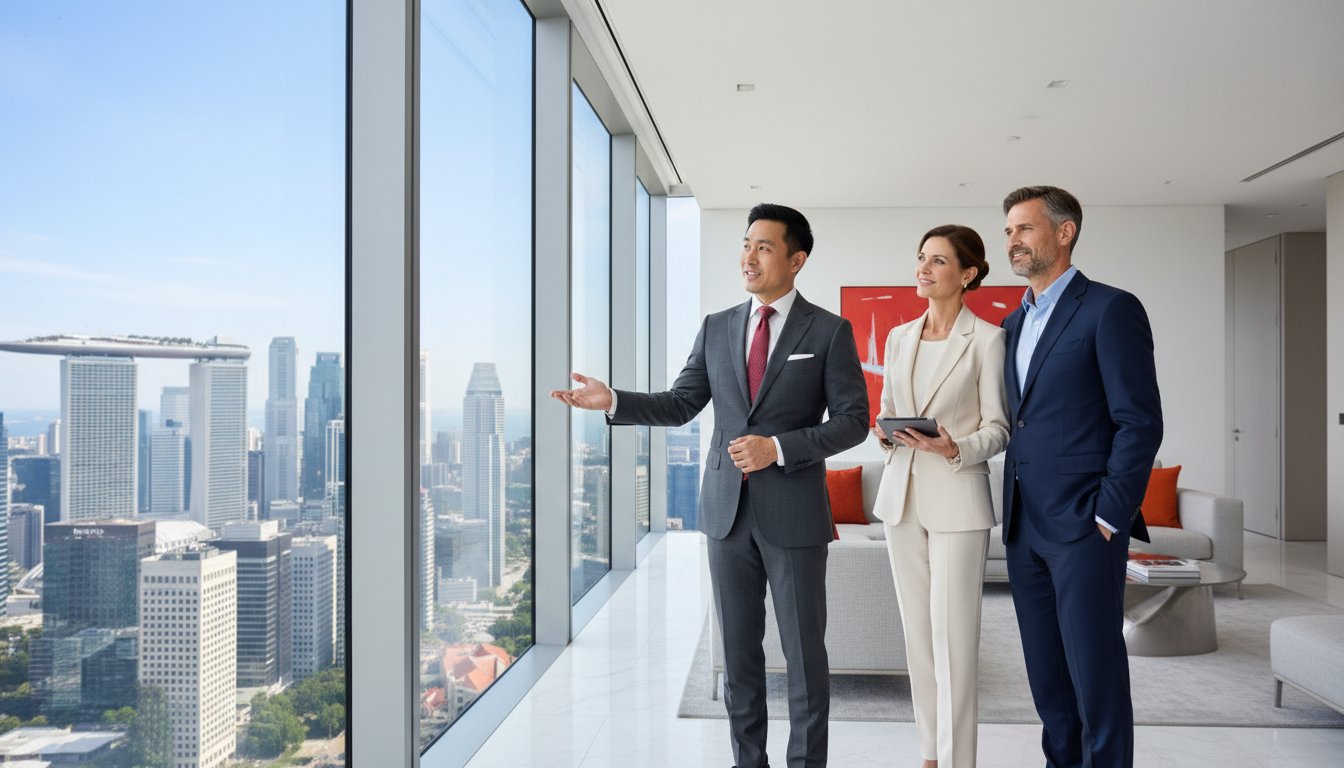
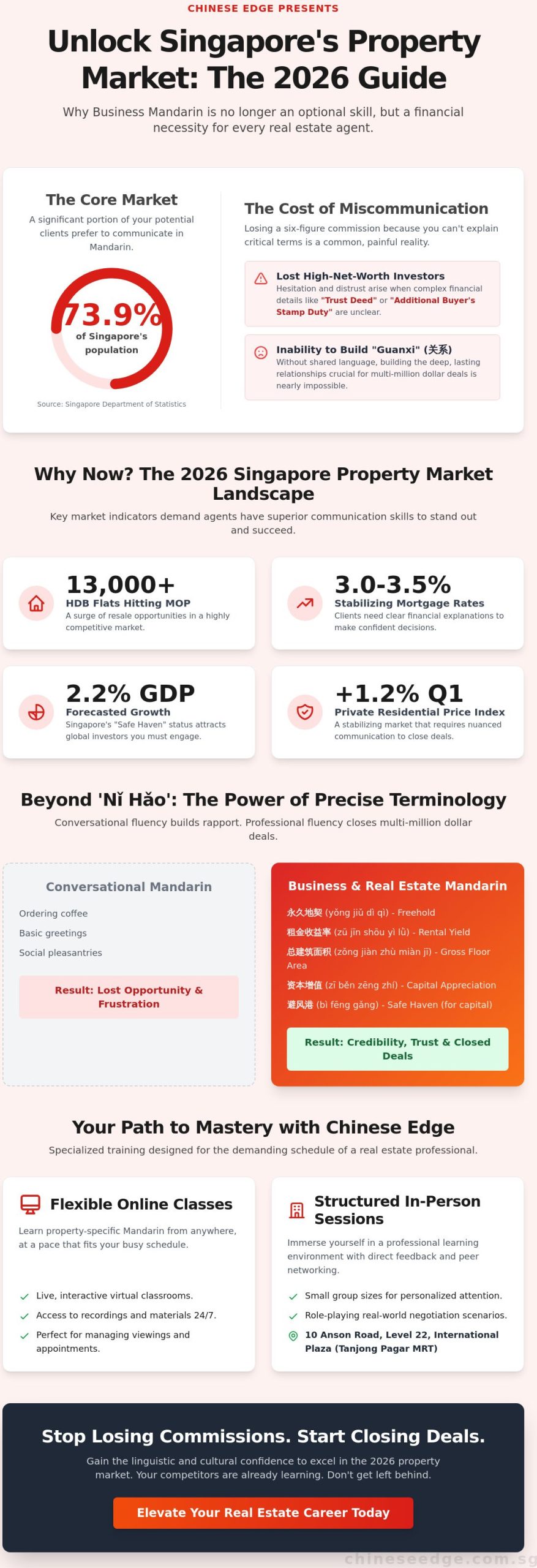
How many six-figure commissions did you hand over to your competitors last year simply because you couldn’t explain a “Trust Deed” or “Additional Buyer’s Stamp Duty” in Mandarin? It’s a common pain point for many in the industry. As 73.9% of Singapore’s population is of Chinese ethnicity, mastering business mandarin for real estate agents Singapore is no longer just an optional skill; it’s a financial necessity. You’ve likely felt the frustration of watching a high-net-worth investor hesitate because you couldn’t articulate complex financial terms or build the deep “Guanxi” needed to secure a multi-million dollar deal.
At Chinese Edge, we understand that you don’t have time for academic courses that ignore the realities of the property market. This 2026 guide provides the exact roadmap you need to gain fluency in property-specific terminology and handle end-to-end negotiations with confidence. You’ll learn how to navigate a market where 13,000 HDB flats are hitting their Minimum Occupation Period this year and mortgage rates are stabilizing between 3.0% and 3.5%. From our training center at 10 Anson Road, level 22, International Plaza, right above Tanjong Pagar MRT, we’re here to help you bridge the gap between a simple viewing and a successful closing.
Key Takeaways
- Master precise real estate terminology like “freehold” and “rental yield” to project professionalism during high-stakes negotiations.
- Understand the cultural nuances of “Guanxi” to build lasting trust with high-net-worth investors from the Chinese-speaking world.
- Learn why specialized business mandarin for real estate agents Singapore is essential for navigating the 2026 property market and its stabilizing interest rates.
- Identify the most effective learning formats, whether through flexible online classes or structured in-person sessions at our Tanjong Pagar training center.
- Gain the confidence to handle end-to-end property transactions in Mandarin, ensuring you never lose a commission to a more linguistically prepared competitor.
The Growing Necessity of Business Mandarin for Real Estate Success in Singapore
The 2026 Singapore property market is entering a phase of stabilization. Data from the Urban Redevelopment Authority (URA) shows private residential prices increased by 1.2% in the first quarter of the year. For property consultants, this environment requires more than just listing skills; it demands the ability to communicate with a diverse investor base. While English remains the primary medium for transactions, Mandarin is one of the four official languages in Singapore and remains the preferred tongue for a significant portion of high-net-worth individuals. Mastering business mandarin for real estate agents Singapore is the bridge between being a standard agent and becoming a trusted advisor for the 73.9% of the population with Chinese ethnicity.
To better understand the practical application of business communication, watch this helpful video:
Beyond Basic Conversation: Why Industry Specificity Matters
Conversational fluency helps you order coffee, but it won’t help you close a deal at International Plaza. There’s a massive gap between daily social Mandarin and the technical vocabulary required for property transactions. If you can’t accurately translate “Gross Floor Area” (总建筑面积) or “Tenure” (土地年限), you risk appearing unprofessional. Misunderstandings regarding legal clauses or investment analysis can lead to collapsed deals or legal disputes. Specialized training ensures you have the precision to explain complex financial structures. This builds immediate credibility with sophisticated investors who value technical mastery and results-oriented communication.
The ROI of Language Training for Property Consultants
Investing in your language skills offers a direct return on investment through higher referral rates. Mandarin-speaking clients are known for their loyalty to agents who respect their cultural nuances and language preferences. In 2026, with over 13,000 HDB flats reaching their Minimum Occupation Period (MOP), the resale market is more competitive than ever. Being able to explain the nuances of the Additional Buyer’s Stamp Duty (ABSD) or current mortgage rate trends, which are stabilizing at 3.0% to 3.5%, in a client’s native language sets you apart. For those looking to broaden their professional reach, our Business Chinese in Singapore guide offers deeper insights into professional fluency. Our training center at 10 Anson Road, level 22, International Plaza, right above Tanjong Pagar MRT, provides the perfect environment for professionals to sharpen these essential skills.
Essential Vocabulary and Communication Skills for Property Professionals
Closing a high-value deal at International Plaza requires more than a friendly smile; it requires technical precision. When you transition from social pleasantries to a professional property pitch, your vocabulary must shift accordingly. Using the correct terminology for “freehold” (永久地契) or “gross floor area” (总建筑面积) signals to your client that you possess the same level of expertise as their legal or financial advisors. This linguistic authority is the foundation of business mandarin for real estate agents Singapore, allowing you to move beyond surface-level interactions into the heart of the transaction.
Investors in 2026 are particularly focused on Singapore’s status as a “Safe Haven” (避风港) for capital. With a forecasted GDP growth of 2.2% and a stable regulatory environment, explaining these macro-economic factors in Mandarin is vital. You should be prepared to discuss “rental yield” (租金收益率) and “capital appreciation” (资本增值) with data-backed confidence. If you’re looking for specialized training for real estate professionals, focusing on these technical clusters will yield the fastest results in your career advancement.
Mastering the Property Pitch: From Introduction to Closing
A successful pitch in Mandarin follows a structured sequence: the introduction of the developer’s track record, the site analysis, and finally, the financial projection. You’ll often encounter objections regarding the 1.2% price growth seen in early 2026 or the property’s distance from the Core Central Region. Instead of stumbling, use prepared phrases to reframe these concerns. For instance, if a client says the price is too high (价格太高), you can pivot to discussing the limited supply of new launches or the stabilizing mortgage rates between 3.0% and 3.5%. Using market trends effectively shows you’re a consultant, not just a salesperson.
Financial and Legal Terminology for Real Estate
Technical mastery extends to the legalities of the Singapore Land Authority (SLA) and asset management. You must be able to discuss REITs (房地产投资信托基金) and portfolio diversification (投资组合多元化) to appeal to institutional investors. Precision is non-negotiable when discussing the title of a property. For example, a professional might say: “该物业的产权是永久地契,经新加坡土地管理局查询,产权上没有任何抵押或负担。” (The property’s tenure is freehold, and a search with the Singapore Land Authority confirms there are no encumbrances on the title.)
Mastering these complex strings of workplace chinese communication takes practice, but the rewards are significant. If you want to accelerate your progress through structured learning, consider joining our group chinese courses at our Tanjong Pagar training center to practice these scenarios with native speakers.
Mastering Property Negotiations and Client Relationship Building (Guanxi)
Building a successful career in the local property sector involves more than just analyzing URA flash estimates. While technical data is important, the real engine of high-value transactions is Guanxi (关系). In the context of the Singapore real estate market, Guanxi represents the deep-seated trust and mutual obligation between an agent and a client. This is particularly crucial considering the recent influx of Chinese homebuyers who prioritize long-term relationships over one-off transactions. Language serves as the primary vehicle for this connection. If you can’t speak the language of your client’s business culture, you’re essentially locked out of their inner circle. This is why mastering business mandarin for real estate agents Singapore is the ultimate competitive advantage in a stabilizing market.
A common trap for many agents is the belief that basic conversational skills are enough to get by. This is a risky assumption. High-stakes negotiations often hinge on subtle linguistic nuances that basic Mandarin simply doesn’t cover. One of the most critical concepts to master is “Face” or Mianzi (面子). In a professional setting, preserving a client’s Mianzi is just as important as the property’s rental yield. If you use overly aggressive sales tactics or fail to show proper deference to a senior investor, you risk causing them to lose face. Once trust is broken at this level, it’s nearly impossible to recover. Investing in specialized business mandarin for real estate agents Singapore training teaches you how to maintain this delicate balance with professional authority.
Negotiation Tactics in a Mandarin-Speaking Environment
Successful negotiation requires you to read between the lines. In Mandarin, a client might say “we’ll consider it” (我们考虑一下) as a polite way of saying “no.” Recognizing these subtle cues allows you to pivot your strategy without making the client feel pressured. You should adopt the role of an “Expert Mentor” rather than a traditional salesperson. This means providing steady support and results-oriented advice while maintaining professional boundaries. It’s about being a reliable partner in their wealth growth, not just someone looking for a quick commission. This pedagogical approach builds the kind of rapport that leads to consistent referrals.
Cultural Nuances: What to Avoid in Professional Interactions
Authority can be undermined by simple tonal errors or the use of overly casual vocabulary. For example, failing to use the honorific “nín” (您) when addressing a high-net-worth individual can come across as a lack of discipline. You should also avoid taboo topics like personal wealth comparisons or sensitive political discussions. If you’re serious about refining your workplace chinese communication, check out our guide on Mastering Mandarin: The Ultimate Guide to a Chinese Speaking Course. Our systematic approach at 10 Anson Road ensures you learn the professional etiquette needed to excel, located right above Tanjong Pagar MRT.
Choosing a Mandarin Course That Fits a Realtor’s Schedule
Real estate agents don’t work typical office hours. Your calendar is a mosaic of last-minute viewings, developer launches, and late-night negotiations. Because of this, a standard, rigid language program often fails. When you search for business mandarin for real estate agents Singapore, you need a solution that prioritizes flexibility without sacrificing the depth of the curriculum. Success requires discipline. A results-oriented approach focuses on high-frequency property terms rather than general academic concepts that you’ll never use in a showroom.
Native-speaking instructors are non-negotiable for this level of training. They provide more than just vocabulary; they offer insights into the current Singapore business context. This includes understanding the nuances of local property regulations and the specific etiquette expected by high-net-worth investors. Time is money. Joining a group Chinese course also offers a strategic advantage. It allows you to network with other professionals in the industry, sharing experiences and potentially forming partnerships that can lead to co-broking opportunities in the future.
Online vs. In-Person: Finding the Right Balance
Choosing between online and in-person learning depends on your daily workflow. Physical classes offer an immersive experience where you can practice body language and formal etiquette in a controlled environment. However, online Mandarin classes provide unmatched convenience. You can log in for a session between viewings or while traveling to a site. Our approach to virtual learning is live and interactive, ensuring you aren’t just watching a video but actively engaging with an Expert Mentor. This systematic method ensures that even on your busiest days, your progress remains steady.
The Importance of a Central Location for In-Person Training
For agents focusing on the Core Central Region or the CBD, location is everything. A training center that is out of the way is a training center you won’t visit. Our facility is strategically located at 10 Anson Road, level 22, International Plaza, Singapore 079903. Being situated right above Tanjong Pagar MRT means you can attend a session and be back at a client meeting within minutes. This physical presence near the financial hub reflects our professional identity and makes it easy to integrate learning into your professional life. While private tutor rates in 2026 range from S$50 to over S$120 per hour, our structured courses provide a more comprehensive curriculum for long-term success.
If you’re ready to secure your competitive edge in the 2026 market, explore our professional Mandarin training options today.
Elevate Your Real Estate Career with Chinese Edge’s Specialized Training
Standing out in the 2026 property market requires more than just a real estate license; it requires the ability to communicate with precision and cultural authority. Chinese Edge is the premier choice for property consultants who recognize that general language apps cannot replace professional instruction. Our school is a sophisticated bridge between you and the Chinese-speaking world. We focus exclusively on adult learners, ensuring that your classroom environment is professional, focused, and free from the distractions of general or child-oriented courses. By enrolling in our Business Mandarin Course, you’re choosing a curriculum designed specifically for high-stakes workplace chinese communication.
The 2026 landscape is increasingly competitive. Mastering business mandarin for real estate agents Singapore allows you to reclaim commissions that might otherwise go to competitors with better linguistic reach. Whether you’re navigating the surge in interest in the Outside Central Region (OCR) or managing the expectations of seniors “right-sizing” their portfolios, your ability to articulate financial benefits in Mandarin is your most valuable asset. We provide a systematic roadmap that transforms your language skills into a closing tool.
The Chinese Edge Methodology: Results-Oriented Learning
Our pedagogy is built on practical application. We don’t waste your time with academic theories that don’t apply to a property viewing. Instead, you’ll learn from native speakers who specialize in business communication and understand the specific pressures of the Singapore real estate industry. We also offer customized corporate Mandarin training for agencies looking to upskill their entire team. This collective approach ensures your whole office can handle the 73.9% of the local population that identifies as Chinese with the highest level of professionalism.
Your Journey to Fluency Starts Here
Language mastery is a career-long investment that yields immediate dividends. We invite you to visit our training center at 10 Anson Road, level 22, International Plaza, Singapore 079903. Located right above Tanjong Pagar MRT, our boutique school is the perfect place for a consultation between your client appointments. Mastering business mandarin for real estate agents Singapore isn’t just about learning words; it’s about translating trust and securing your place as a top-tier consultant. Explore our Mandarin Classes in Singapore 2026 Guide to find the program that aligns with your professional goals and start your journey toward closing high-value deals today.
Secure Your Competitive Advantage in the 2026 Property Market
The 2026 property market offers significant opportunities for those who can bridge the communication gap with Chinese-speaking investors. Mastering business mandarin for real estate agents Singapore is about more than just vocabulary; it’s about projecting professional authority and building the deep trust required for multi-million dollar transactions. By focusing on technical precision and cultural nuances like “Guanxi,” you position yourself as an expert mentor in a stabilizing market where 73.9% of the population is of Chinese ethnicity. This linguistic mastery transforms your ability to explain complex financial terms or regulatory details with absolute confidence.
Our adult-only learning environment at 10 Anson Road, level 22, International Plaza, Singapore 079903, ensures you gain these skills in a results-oriented setting. Located right above Tanjong Pagar MRT, our native-speaking instructors provide the business expertise you need to thrive. You don’t have to navigate this journey alone; our systematic approach is designed to fit your busy schedule. Master Business Mandarin for Real Estate at Chinese Edge – Enroll in our Group Courses Today!
Success in real estate is built on the relationships you cultivate today. We’re here to provide the steady support and practical training you need to excel. Take control of your career advancement and start building stronger connections with your clients right now. Your next high-value closing is within reach.
Frequently Asked Questions
How long does it take for a real estate agent to become proficient in Business Mandarin?
Proficiency usually takes between three and six months of consistent study depending on your starting level. Our systematic approach focuses on high-frequency property terms to accelerate your results. This allows you to handle viewings and basic negotiations within a few months of starting your business mandarin for real estate agents Singapore training. We prioritize practical application over abstract theory to ensure you see a return on your time investment quickly.
Do I need to have a background in Chinese to join the Business Mandarin course?
You don’t need a prior background in Chinese to begin your journey toward fluency. We offer foundational modules for absolute beginners that transition into specialized real estate terminology. Our Expert Mentors guide you through the basics of phonetics and essential sentence structures before moving into complex financial and legal vocabulary. This structured progression ensures that even those with zero experience can eventually master professional workplace communication.
Can the real estate Mandarin training be customized for my specific agency?
Yes, we provide customized corporate Chinese language training specifically tailored for real estate agencies. We can adjust the syllabus to focus on your agency’s specific niche, whether you specialize in luxury residential properties, commercial assets, or HDB resale markets. This ensures your entire team maintains a consistent professional standard when communicating with high-net-worth investors. Training can be conducted at our Tanjong Pagar center or your office.
What is the difference between a conversational Chinese course and a business Chinese course?
A conversational Chinese course focuses on daily social interactions like ordering food or basic greetings. In contrast, a business Chinese course covers technical terminology like rental yields, stamp duties, and asset management. For realtors, the business-centric approach is essential for explaining market trends, such as the 1.2% private property price growth seen in Q1 2026. It provides the professional precision needed for high-stakes property negotiations.
Are there online options available for agents who cannot commute to Tanjong Pagar?
We offer live, interactive online Mandarin classes for agents with demanding schedules. These virtual sessions provide the same academic rigor and native speaker interaction as our in-person training at International Plaza. You can participate from any location using a laptop or tablet, making it easy to learn between property viewings or during travel. This flexibility ensures your professional development doesn’t stop when you’re on the move.
Is the curriculum focused on the Singapore property market or general real estate?
The curriculum is specifically designed for the Singapore property market and its unique regulatory environment. You’ll learn terminology related to the Singapore Land Authority (SLA), Additional Buyer’s Stamp Duty (ABSD), and current HDB regulations. We use real-world data, such as the 13,000 HDB flats reaching their Minimum Occupation Period in 2026, to ensure the content is immediately applicable to your daily work as a property consultant.
What happens if I miss a class due to a last-minute property viewing?
We understand the unpredictable nature of the real estate industry and offer flexible scheduling options. If a last-minute viewing at Tanjong Pagar prevents you from attending your scheduled session, we provide makeup classes or digital resources to ensure you don’t fall behind. Our goal is to be a reliable partner in your growth, providing the steady support you need to balance your career and your studies.
How does Mandarin proficiency impact my commission potential in Singapore?
Mandarin proficiency significantly expands your commission potential by giving you direct access to the 73.9% of Singapore’s population with Chinese ethnicity. It allows you to build “Guanxi” with international investors who account for a large portion of non-resident homebuyers. Being able to handle end-to-end negotiations in Mandarin means you won’t lose high-value deals to competitors. This skill is vital for closing multi-million dollar transactions in the 2026 market.
Disclaimer
Disclaimer
The Chinese articles on this website are provided for general information and learning purposes only. While we strive for accuracy, we make no guarantees regarding completeness or reliability. The content does not constitute professional advice, and we are not liable for any loss arising from its use. External links or third-party content are for reference only. By using this website, you agree to this disclaimer.