
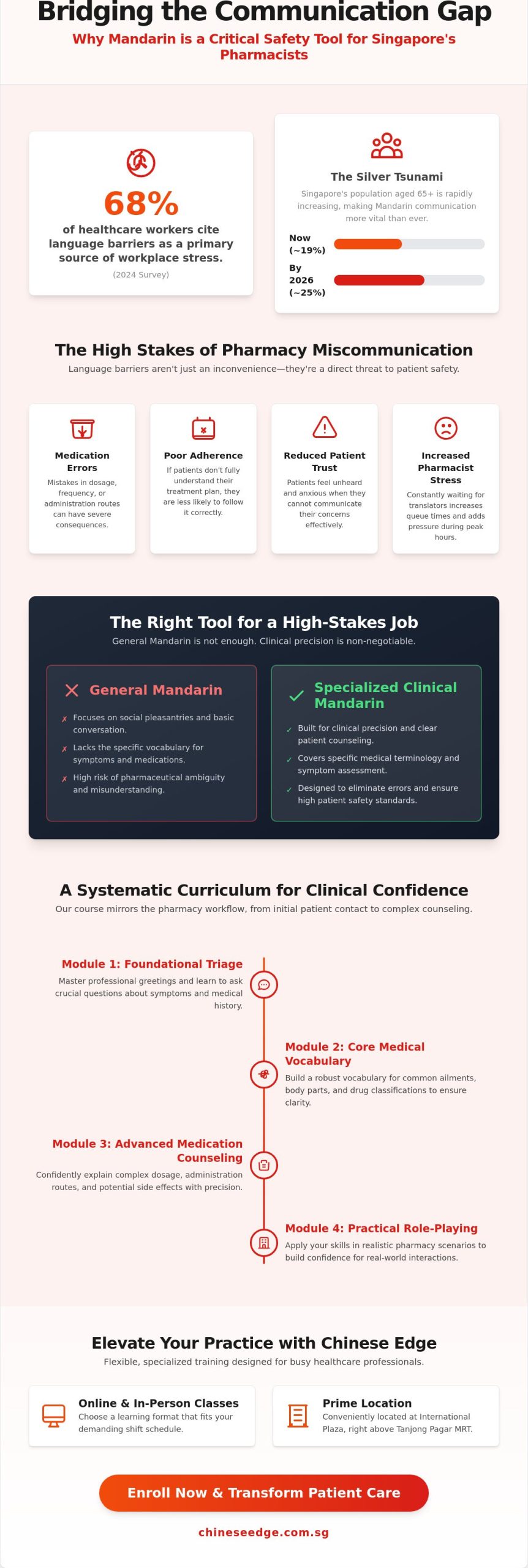
Did you know that a 2024 survey revealed 68% of Singapore’s healthcare workers find language barriers to be a primary source of workplace stress? For a busy pharmacist, this stress often manifests as a sharp anxiety over potential medication errors when explaining complex prescriptions to elderly patients. You likely understand the frustration of seeing a long queue form while you wait for a bilingual colleague to help translate simple dosage instructions. It’s a common challenge in a nation where nearly 19% of the population is aged 65 and above, a demographic that frequently relies on Mandarin for clear communication.
Mastering mandarin for pharmacists Singapore is not just about professional growth; it’s a critical safety tool for your daily practice. This guide will empower you to provide accurate clinical counseling and bridge the communication gap at the pharmacy counter. You’ll learn how a structured mandarin course can help you explain side effects and administration routes with total confidence. We will preview the essential medical vocabulary you need and show you how our systematic training at 10 Anson Road, level 22, International Plaza, Singapore 079903, located right above Tanjong Pagar MRT, can turn language barriers into a thing of the past.
Key Takeaways
- Understand why mastering mandarin for pharmacists Singapore is a vital clinical safety measure as nearly 25% of the population enters their senior years by 2026.
- Discover a systematic curriculum designed to move you from basic patient greetings to complex medication counseling and precise symptom assessment.
- Learn why specialized clinical Mandarin is superior to general courses for avoiding pharmaceutical ambiguity and ensuring high patient safety standards.
- Explore flexible learning solutions, including online Mandarin classes, tailored to fit the demanding shift schedules of modern healthcare professionals.
- Identify how professional training at our Tanjong Pagar center can improve your workplace efficiency and reduce reliance on bilingual colleagues during peak hours.
The Critical Role of Mandarin in Singapore’s 2026 Pharmacy Landscape
Medical Mandarin has evolved into a specialized professional tool that’s essential for pharmaceutical safety in Singapore. It isn’t just about being polite; it’s about ensuring that a patient understands exactly how to take their medication. By 2026, nearly 25% of the Singaporean population will be aged 65 or older. This demographic shift, often called the Silver Tsunami, means your daily interactions will increasingly involve elderly patients who may struggle with English medical jargon. Proficiency in mandarin for pharmacists Singapore directly impacts medication adherence and patient recovery rates. When a patient understands their treatment plan, they’re far more likely to follow it correctly. In today’s healthcare environment, cultural empathy and clear communication are becoming key performance indicators (KPIs) for pharmacy staff.
To better understand the daily reality of pharmacy communication and how it impacts patient care, watch this helpful video from the Ministry of Health:
Bridging the Gap at the Pharmacy Counter
Many elderly Singaporeans naturally revert to Mandarin or local dialects when they feel unwell or overwhelmed. Hearing clinical instructions in their native tongue has a profound psychological impact. It makes patients feel heard and valued, which is the cornerstone of patient-centric care. A 2024 survey of local healthcare workers indicated that 68% of respondents found language barriers to be a primary source of workplace stress. This stress often leads to miscommunication. In a high-pressure pharmacy environment, even a small misunderstanding about dosage or frequency can have serious consequences for patient safety.
Mandarin as a Core Clinical Competency
Language skills are no longer just an extra on your resume. They’re a core clinical competency that enhances the professional profile of any pharmacist or pharmacy technician. Major healthcare hubs like SGH and NUH are increasingly moving toward multilingual services to meet the needs of a diverse population. However, general conversational skills often fail in high-stakes pharmaceutical environments. You need a structured mandarin course that focuses on clinical precision rather than just social pleasantries. Understanding the nuances of Singaporean Mandarin is crucial because it incorporates local terms that elderly patients actually use. Enrolling in a mandarin course singapore at our center above Tanjong Pagar MRT ensures you can handle complex counseling without relying on busy colleagues during peak hours.
The Pharmacy Mandarin Curriculum: From Triage to Counseling
Effective communication starts the moment a patient approaches the counter. A professional curriculum for mandarin for pharmacists Singapore follows a logical sequence that mirrors the actual pharmacy workflow. It begins with professional greetings and moves quickly into the precision required for clinical triage. You don’t just learn simple social phrases; you learn how to ask “what are your symptoms?” or “how long have you felt this way?”. Mastering symptom vocabulary allows you to identify if a patient is self-medicating for a minor ailment or something requiring immediate referral. This systematic approach ensures that your language skills are as disciplined as your pharmaceutical training.
Mastering these specific terms helps you build trust with elderly patients who may feel vulnerable. When you can accurately describe symptoms in their native tongue, it reduces patient anxiety and improves the quality of the information they provide. This clarity is the first step in preventing the Communication barriers faced by pharmacists that often lead to clinical misunderstandings in Singapore’s busy retail and hospital pharmacies.
Counseling on Dosage and Frequency
Precision is the most important factor when translating medication schedules. Mistakes in dosage instructions can lead to severe clinical outcomes. You must be able to clearly explain concepts like “before meals” (饭前), “after meals” (饭后), or “as needed” (需要时). It’s also vital to confirm patient safety by asking about drug allergies using direct, unambiguous questions. You can Enhance your skills with our conversational Chinese course to ensure these high-stakes interactions are seamless and error-free. Being able to explain that a tablet should be taken “twice a day” (一天两次) rather than “every two hours” is a basic but life-saving distinction.
Explaining Side Effects and Storage
A pharmacist’s job isn’t finished until the patient knows what to expect after taking their medicine. Explaining side effects like drowsiness (嗜睡), nausea (恶心), or dizziness (头晕) requires a balance of clinical clarity and reassurance. You want to inform the patient without causing alarm. Use reassurance phrases like “This is a common side effect” (这是常见的副作用) to maintain patient confidence. Additionally, storage instructions are often critical for drug stability. Whether a medication needs to be kept in the refrigerator or away from direct sunlight, your ability to convey this in Mandarin ensures the medication remains effective. If you’re looking for a structured way to master these professional interactions, our courses at Chinese Edge offer the specialized training needed for the Singaporean healthcare context.
Why Specialized Training Beats General Mandarin Courses
While a basic mandarin course might help you navigate a holiday, the requirements for mandarin for pharmacists Singapore are significantly more demanding. Hospitality or general Mandarin focuses on social survival; clinical Mandarin focuses on patient survival. There is a dangerous risk in using layman terms that lead to pharmaceutical ambiguity. For instance, a general learner might know the word for “pain,” but a pharmacist needs to distinguish between “acute,” “chronic,” “stabbing,” or “dull” sensations to provide the correct counseling. Our curriculum prioritizes high-frequency workplace chinese communication over generic vocabulary, ensuring your time in the classroom yields immediate results at the counter.
Specialized training ensures that every lesson is relevant to your professional environment. Instead of learning how to discuss hobbies or travel, our students practice role-playing high-stakes pharmacy scenarios. This includes explaining the difference between systemic and topical treatments or describing the onset of action for a particular drug. This targeted pedagogy ensures that every hour you spend in our classroom at 10 Anson Road, level 22, International Plaza, Singapore 079903, translates directly to efficiency in your healthcare setting.
Clinical Precision vs. Casual Conversation
In a clinical setting, a simple term like “stomach ache” can be dangerously vague. A pharmacist must use precise vocabulary to determine if a patient is experiencing gastric reflux (胃食道逆流), intestinal bloating (肠胃胀气), or a more serious abdominal condition. We also focus on eliminating Singlish interference, which can sometimes blur the lines of professional medical explanations. Tonal accuracy is a non-negotiable component of patient safety, as a single misplaced tone can change the meaning of a medication’s name or its dosage instructions. By focusing on these nuances, you avoid the common pitfalls that lead to the 68% of language-related stress reported by local healthcare workers.
The Role of Native Speakers in Mastering Nuance
Our native-speaking instructors provide the cultural depth necessary to communicate with Singapore’s elderly population effectively. They understand that local seniors often use a blend of Mandarin and traditional terms that general textbooks ignore. Learning the correct honorifics and polite forms of address is a key part of our conversational chinese course, helping you establish the trust required for a patient to disclose their full medical history. If you’re interested in how these skills apply to broader professional environments, you may find our guide on Business Chinese in Singapore: The 2026 Professional Guide helpful. This systematic training ensures you are no longer part of the demographic struggling with mandarin for pharmacists Singapore during peak hours at Tanjong Pagar pharmacies.
Overcoming Learning Barriers for Busy Pharmacists
The primary hurdle for many healthcare professionals is the perception that language learning is an all-or-nothing commitment. You don’t need to spend years in a classroom to see a significant improvement in your patient outcomes. Many pharmacists cite a lack of time as the #1 reason they haven’t enrolled in a mandarin course singapore. With 12-hour shifts and rotating rosters, attending a fixed weekly class can feel impossible. However, mastering mandarin for pharmacists Singapore doesn’t require hours of daily study. It requires a strategic approach that fits into your existing workflow. By utilizing modern educational technology and flexible scheduling, you can achieve clinical proficiency without compromising your professional duties or personal rest.
Flexible Online Classes for Shift Workers
Unlike traditional programs with rigid 6:00pm to 8:00pm schedules that are common in many local institutions, our approach prioritizes your professional reality. If you’re looking for a way to manage your learning around a rotating roster, our Online Mandarin Classes Singapore: The 2026 Professional’s Buying Guide highlights how virtual learning accommodates the unpredictable nature of healthcare. You can switch between physical lessons at our International Plaza center, located right above Tanjong Pagar MRT, and live virtual classes as your schedule changes. If an emergency shift arises, recorded sessions ensure you never fall behind in the curriculum. This flexibility is essential for pharmacists who need a learning partner that understands the demands of the Singaporean healthcare sector.
Systematic Methods for Terminology Retention
Retention is built through consistency rather than intensity. We encourage micro-learning techniques that you can apply between patient consultations or during your commute. Instead of rote memorization, we focus on context-based pharmaceutical learning that moves beyond abstract theory. Using a systematic approach ensures that high-stakes terminology moves from your short-term memory into long-term clinical mastery. Consider these practical steps for your daily practice:
- Use spaced repetition to master complex drug names and anatomical terms in Mandarin.
- Build a personalized Pharmacy Mandarin Cheat Sheet for immediate use at the counter.
- Practice one new reassurance phrase or dosage instruction during each morning shift.
This method allows you to build confidence incrementally. If you’re ready to start your journey with a structured and proven methodology, you can explore our adult conversational Mandarin course to find a learning path that fits your career goals. Our center at 10 Anson Road, level 22, International Plaza, Singapore 079903, provides the perfect environment for professionals to bridge the communication gap in Singapore’s pharmacy sector.
Elevate Your Career at Chinese Edge’s International Plaza Center
Chinese Edge stands as the premier choice for professionals seeking a results-oriented mandarin for pharmacists Singapore curriculum. We understand that your goal isn’t just to learn a new language, but to provide safer, more empathetic care to your patients. Our Expert Mentor approach pairs you with native speakers who have a deep understanding of the Singaporean medical context. These instructors don’t just teach grammar; they guide you through the cultural nuances of patient interaction. This ensures you’re prepared for the high-stakes environment of a modern pharmacy where every word counts toward patient safety.
Professional Training Right Above Tanjong Pagar MRT
Convenience is a significant factor when choosing a mandarin course singapore. Our training center is located at 10 Anson Road, level 22, International Plaza, Singapore 079903, situated directly above Tanjong Pagar MRT. This central location makes it easy to attend a session before your shift begins or immediately after it ends. The professional, boutique environment at International Plaza is specifically designed for adult learners. It provides a sophisticated space that’s far removed from a traditional classroom setting. It’s a place where you can focus on your professional development alongside other like-minded healthcare and business professionals who value efficiency and results.
Customized Corporate Solutions for Pharmacy Groups
We recognize that the needs of a retail pharmacist in a neighborhood mall differ from those of a clinical pharmacist in a major hospital. If you’re looking for a solution for your entire department, we offer customized corporate mandarin training tailored to your specific setting. Our team can provide on-site training for major Singaporean healthcare groups, ensuring that your whole staff is aligned on clinical communication standards. This systematic approach reduces workplace stress and improves patient satisfaction scores across the board. For more insights on selecting the right program for your team, see The 2026 Guide to Choosing a Mandarin Course in Singapore.
By choosing Chinese Edge, you’re investing in a career-long asset. Whether you prefer a small group chinese course or private coaching, our structured methodology ensures that fluency is an attainable goal. We provide the tools you need to bridge the communication gap, ensuring that by 2026, you’re recognized as a leader in patient-centric pharmaceutical care. Our commitment to your success is reflected in every lesson, positioning us as your reliable partner in professional growth within the Singaporean healthcare sector.
Take Command of Your Clinical Communication
As Singapore moves toward 2026, the ability to communicate fluently with the 73.9% Chinese ethnic population becomes a non-negotiable safety standard. You’ve seen how specialized clinical training prevents the ambiguity that leads to dangerous medication errors. By moving beyond general conversational skills and embracing a systematic curriculum, you protect your patients and your professional reputation. Mastering mandarin for pharmacists Singapore is a direct path to higher patient satisfaction scores and significantly reduced workplace anxiety during peak dispensing hours.
Our expert native speakers provide the cultural depth and precision required for the high-stakes healthcare sector. With our training center located right above Tanjong Pagar MRT at 10 Anson Road, level 22, International Plaza, Singapore 079903, you can easily integrate professional development into your busy shift schedule. We provide a tailored clinical curriculum that addresses the specific needs of pharmaceutical triage and counseling. Start Your Pharmacy Mandarin Journey Today and gain the confidence to lead in an aging society. We’re here to support your professional growth and ensure fluency is an attainable goal for your career.
Frequently Asked Questions
Is there a specific Mandarin course for pharmacists in Singapore?
Yes, we provide a specialized mandarin for pharmacists Singapore curriculum tailored for the local healthcare context. Our program focuses on the technical vocabulary needed for medication counseling and patient triage. You’ll learn to explain dosage instructions and side effects with clinical precision. This systematic approach ensures that you can handle high-pressure situations at the pharmacy counter without needing translation assistance from colleagues.
How long does it take to learn basic pharmacy Mandarin?
A standard group course at Chinese Edge involves 20 hours of instruction spread over 10 sessions. This duration is designed to move you from basic greetings to functional clinical proficiency. During these 20 hours, you’ll focus on high-frequency terms related to common ailments and medication administration. This allows you to apply your new skills immediately in your daily healthcare practice.
Can I attend classes if I work irregular hospital or retail shifts?
Absolutely, we accommodate the demanding schedules of healthcare professionals. Our hybrid learning model allows you to transition between physical lessons at International Plaza and live virtual classes. If you have a last-minute shift change, our recorded sessions ensure you don’t miss any critical curriculum content. We prioritize flexibility to help you maintain consistent progress despite irregular working hours.
What is the difference between a general Mandarin course and a medical one?
General courses focus on social interactions like dining or travel, whereas medical Mandarin focuses on patient safety. In a specialized pharmacy course, you learn the exact terms for contraindications and chronic conditions. Using general layman terms can lead to pharmaceutical ambiguity. Our clinical curriculum ensures you have the precise vocabulary to avoid misunderstandings that could impact medication adherence.
Are the teachers at Chinese Edge native speakers?
Yes, our instructors are all professional native speakers. They possess the cultural depth necessary to help you understand how elderly Singaporeans describe their symptoms. This is vital because local seniors often use a specific blend of terms that general textbooks don’t cover. Our native-speaking mentors guide you through these nuances to build a stronger rapport with your Mandarin-speaking patients.
Do you offer corporate training for entire pharmacy departments?
Yes, we offer customized corporate mandarin training for hospital pharmacy departments and retail chains. We tailor the syllabus to match your specific clinical or retail environment. Whether your team needs to focus on chronic disease management or general medication counseling, we provide on-site or virtual solutions. This systematic training helps reduce workplace stress caused by language barriers across your entire department.
Is the International Plaza center accessible for those taking the East-West Line?
Yes, our center is located directly above Tanjong Pagar MRT (EW15) on the East-West Line. Being at 10 Anson Road, level 22, International Plaza, means you can reach us within minutes of leaving the train. This is especially convenient for staff working at SGH or other medical hubs along the green line. Our central CBD location provides a professional environment perfect for adult learning.
Can I focus only on speaking and listening for patient counseling?
Yes, our conversational Chinese course is optimized for pharmacists who primarily need oral communication skills. While we follow a systematic curriculum, we prioritize the listening and speaking skills required for effective patient counseling. You’ll spend your class time practicing role-play scenarios that mirror real-world counter interactions. This ensures you can provide clear, verbal medication instructions with total confidence.
Disclaimer
Disclaimer
The Chinese articles on this website are provided for general information and learning purposes only. While we strive for accuracy, we make no guarantees regarding completeness or reliability. The content does not constitute professional advice, and we are not liable for any loss arising from its use. External links or third-party content are for reference only. By using this website, you agree to this disclaimer.