

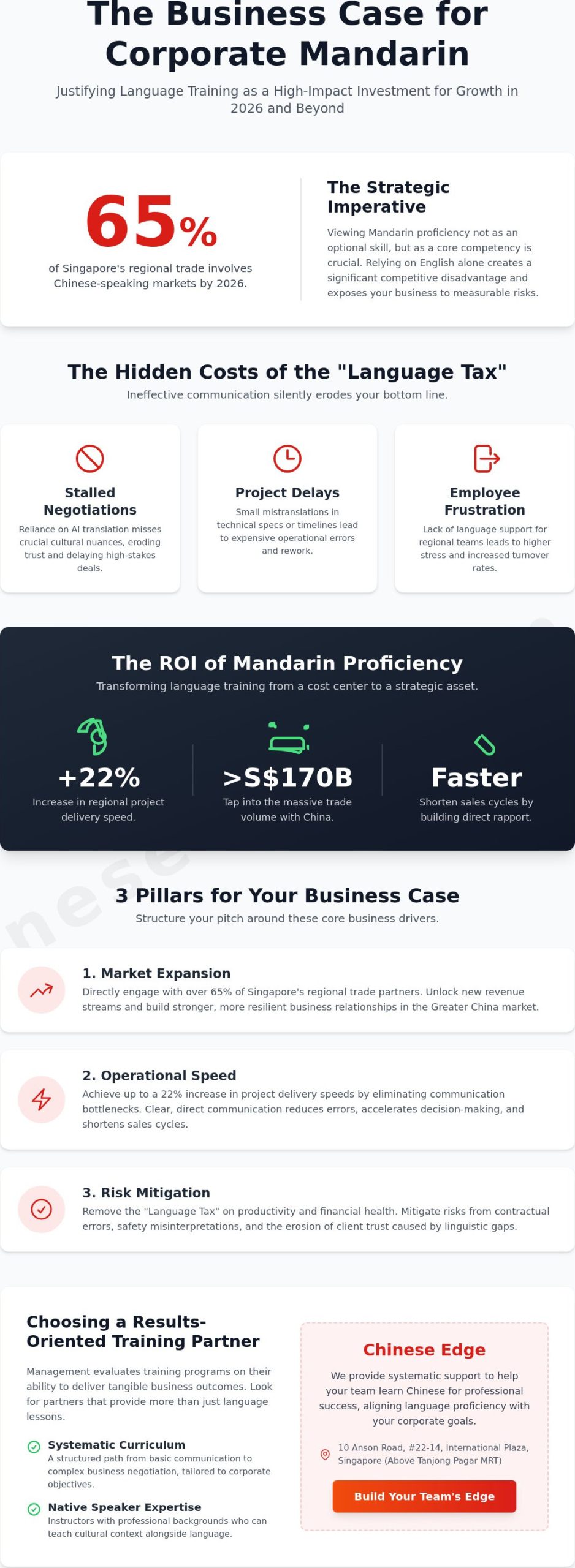
Did you know that by 2026, over 65% of Singapore’s regional trade involves Chinese-speaking markets? Despite this massive volume, many executives still view a business chinese course as an optional soft skill rather than a hard-coded requirement for growth. If you find it difficult to justify corporate language training to management, you are likely facing the common hurdle of proving immediate ROI. It’s frustrating when leadership overlooks the direct link between language proficiency and market expansion because of tight budget constraints.
This guide will help you flip the script and present corporate mandarin training as a high-impact business investment. You’ll learn how to use specific data points, such as the 22% increase in regional project delivery speeds, to build an undeniable case for workplace chinese communication. We provide a structured framework for your pitch and show you how to select a reliable partner for your mandarin class singapore. Our training center at 10 Anson Road, level 22, International Plaza, is located right above Tanjong Pagar MRT, providing the systematic support your team needs to learn chinese for professional success.
Key Takeaways
- Identify the strategic risks of miscommunication and why automated tools cannot replace workplace chinese communication in high-stakes negotiations.
- Apply a data-driven ROI framework to justify corporate language training to management by highlighting its direct impact on sales cycle efficiency.
- Structure your business case around three essential pillars: market expansion, operational speed, and the removal of the “language tax” on productivity.
- Understand why a systematic curriculum and native speaker expertise are the primary metrics leadership uses to evaluate a premium business chinese course.
- Discover how to choose a results-oriented training partner in Singapore that aligns language proficiency with your specific corporate objectives.
The Strategic Risk of Language Barriers in 2026
In 2026, language risk represents the potential for financial and reputational damage caused by linguistic gaps. This includes errors in legal contracts, safety protocols, and the erosion of client trust. While technology has advanced, AI translation often fails in high-stakes Business Mandarin contexts because it misses critical nuance and cultural tone. If your team relies on software for negotiation, they’re likely missing the subtle cues that build rapport. To justify corporate language training to management, you must frame these gaps as operational risks rather than just educational needs. Corporate Language Risk is the measurable loss in efficiency and market share due to linguistic misalignment.
To better understand the nuances of professional communication and how jargon impacts business, watch this helpful video:
The Hidden Costs of “Getting By” in Business
Operating with a “good enough” approach to language is a recipe for expensive project delays. Small mistranslations in technical specifications or delivery timelines often lead to massive operational errors. Beyond the logistics, poor etiquette creates relationship friction that can stall long-term partnerships before they truly begin. When staff members feel they lack the tools for effective workplace chinese communication, employee frustration rises. This often results in higher turnover rates within teams that are tasked with managing regional portfolios but aren’t given the support to succeed.
Mandarin as a Core Competency for Singapore Professionals
The landscape has shifted. By 2026, bilingualism is no longer a “nice to have” but a minimum requirement for regional leadership roles in Singapore. With over 65% of Singapore’s regional trade now involving Chinese-speaking markets, relying solely on English creates a significant competitive disadvantage. Understanding the process of second-language acquisition helps professionals move from basic greetings to complex business discussions. Professionals who invest in a business chinese course position themselves as bridges to the Greater China market.
If you’re looking for a structured way to build these skills, our chinese course singapore programs offer a systematic roadmap to fluency. We are conveniently located at 10 Anson Road, level 22, International Plaza, Singapore 079903, right above Tanjong Pagar MRT. This central location makes it easy for busy executives to attend lessons without disrupting their workday. It’s time to justify corporate language training to management by demonstrating that chinese for professionals is the key to maintaining Singapore’s regional edge.
Measuring ROI: The Financial Justification for Mandarin Training
To justify corporate language training to management, the conversation must shift from educational spending to strategic asset management. In the competitive landscape of 2026, the real metric for leadership isn’t just the price of a business chinese course; it’s the Cost of Inaction (COI). When a firm lacks linguistic fluency, it incurs a “Language Tax” that manifests as stalled negotiations and missed opportunities. With trade volumes between Singapore and China exceeding S$170 billion, the financial stakes of being unable to communicate directly are higher than ever.
Investing in corporate mandarin training produces measurable returns by shortening sales cycles. When your team can build rapport without intermediaries, trust is established faster. This direct connection is likely responsible for the 22% increase in regional project delivery speeds observed in bilingual firms. Beyond the balance sheet, providing chinese for professionals serves as a powerful non-monetary incentive. It signals to high-performing staff that the company is invested in their long-term career advancement, which significantly aids in talent retention.
Quantitative Metrics for Management
Leadership teams respond best to hard data. You can demonstrate ROI by tracking specific financial indicators after implementing workplace chinese communication programs. These include:
- Reduction in Outsourcing: Lowering the monthly spend on external translation and interpretation services.
- Increased Pitch Win Rates: A higher conversion rate for contracts involving Mandarin-speaking stakeholders due to improved cultural nuances.
- Time-to-Market: Faster execution of regional projects as communication bottlenecks are removed.
Qualitative Gains in Workplace Communication
While numbers tell part of the story, the qualitative impact on company culture is equally vital. Organizations that prioritize a mandarin course singapore enjoy better cross-departmental collaboration within multinational structures. This creates a more cohesive global identity and enhances your brand reputation as a culturally competent partner. If you’re ready to build a more efficient team, our chinese course singapore syllabus is designed to bridge these professional gaps.
Our training center is located at 10 Anson Road, level 22, International Plaza, Singapore 079903, which is conveniently situated right above Tanjong Pagar MRT. This physical presence in the business district ensures our lessons remain grounded in practical, real-world application. For more insights on professional development, you can review our Business Chinese in Singapore guide to see how systematic learning transforms performance.
3 Pillars for Justifying Business Chinese to Management
To successfully justify corporate language training to management, you must present a case that transcends simple upskilling. Decision makers in 2026 require a framework built on three strategic pillars: Market Expansion, Operational Efficiency, and Risk Mitigation. This approach ensures that your proposal aligns with the bottom line rather than appearing as an optional perk.
Pillar 1 focuses on your company’s growth map. If your firm aims to capture market share in the Greater Bay Area, a business chinese course isn’t a luxury; it’s a market entry requirement. Pillar 2 targets the “Language Tax.” This is the hidden cost of slow emails, misunderstood briefs, and the constant need for intermediaries that drain daily productivity. Finally, Pillar 3 addresses Risk Mitigation. Accurate workplace chinese communication ensures that legal compliance and technical specifications remain precise, preventing costly liability issues caused by translation errors.
Here is a sample elevator pitch an HR manager might use to justify corporate language training to management: “Our 2026 regional growth strategy depends on our ability to build trust in Chinese-speaking markets. By implementing a systematic corporate mandarin training program, we can reduce our reliance on external translators and increase our project delivery speed by over 20%. It’s a high-ROI investment that turns a communication barrier into a competitive advantage.”
Aligning with Corporate Strategic Goals
Start by mapping Mandarin proficiency to your existing KPIs. If the goal is regional expansion, identify “Language Champions” within your departments. These are individuals who will lead the initiative and demonstrate immediate results in their respective areas. We recommend starting with a pilot program for key stakeholders before moving to a full-scale implementation. This structured approach provides the data management needs to see the value early on, making the transition to a wider mandarin course singapore rollout much smoother.
Addressing Common Management Objections
You will likely face the argument that AI translation is sufficient. While AI handles basic text, human relationship building in business requires the nuance of live conversation. Remind management that trust is built through direct engagement, not an app. When the budget is questioned, frame the training as a capital investment in human assets rather than a recurring cost. For busy executives who cite a lack of time, suggest online Mandarin classes. These provide the flexibility needed to learn without leaving the office, ensuring that professional development doesn’t interfere with daily operations.
Our school at 10 Anson Road, level 22, International Plaza, Singapore 079903, is right above Tanjong Pagar MRT. This central location supports our systematic approach to chinese for professionals, ensuring that your team receives high-quality instruction in the heart of the business district. By choosing a partner that understands the Singaporean business context, you ensure the training is both relevant and effective.
Evaluating Corporate Mandarin Programs: What Management Looks For
To successfully justify corporate language training to management, you must demonstrate that the selected program is rigorous, accountable, and results-oriented. Leadership teams often dismiss ad-hoc tutoring or casual apps because they lack a systematic curriculum. They prefer a structured pedagogy that follows recognized standards, such as the HSK proficiency framework. This ensures that every hour your employees spend in a mandarin course translates into a measurable gain in professional capability.
Management also prioritizes industry-specific customization. A generic business chinese course rarely meets the technical needs of a legal, finance, or tech firm. The syllabus must be tailored to include the specific vocabulary and scenarios your team encounters daily. Whether they’re discussing venture capital or technical specifications, the training should feel like a direct extension of their job. Providing regular progress reports and proficiency assessments is the final piece of the puzzle, as it allows you to show leadership exactly how the investment is performing through data.
The “Native Speaker” Advantage in Business Etiquette
Linguistic mechanics are only half the battle in a professional setting. In high-stakes negotiations, cultural nuances like “Mianzi” (Face) and social hierarchy often dictate the outcome. Native speakers with business backgrounds are essential for corporate mandarin training because they teach the etiquette embedded in the language. They guide students through role-playing real-world scenarios, from formal introductions to delicate negotiation tactics. This cultural depth ensures that workplace chinese communication remains respectful and effective, preventing unintentional slights that could derail a regional partnership.
Flexibility and Scalability
Modern businesses require versatile learning models that don’t disrupt operations. You should compare the benefits of on-site training at your office with interactive online Mandarin classes for your regional teams. Management values the ability to scale training as the company grows or as new departments require chinese for professionals. Small group sizes are particularly effective for building conversational confidence among staff. If you’re exploring options for your department, our Group Chinese Courses provide the perfect balance of peer interaction and expert guidance.
Our training center at 10 Anson Road, level 22, International Plaza, Singapore 079903, is located right above Tanjong Pagar MRT. This central location in the heart of the business district ensures that our mandarin class singapore programs remain grounded in practical application. Ready to equip your team with professional Mandarin skills? Explore our corporate training solutions at Chinese Edge today.
Strategic Partnership with Chinese Edge: Targeted Solutions in Singapore
Selecting a training partner who understands the local business landscape is the final step to justify corporate language training to management. Chinese Edge serves as an Expert Mentor for Singaporean firms, offering the academic rigor of a formal institution alongside the flexibility of a modern learning center. We don’t just teach vocabulary; we provide a systematic bridge to the Chinese-speaking world. Our approach ensures that your team’s progress is visible and measurable, turning Mandarin proficiency into a durable corporate asset.
Our methodology focuses on the specific needs of adult learners. We offer a structured syllabus that prioritizes practical application in professional settings. Whether your team requires an adult conversational mandarin course for networking or a specialized business mandarin course for high-stakes negotiations, our native speakers provide the cultural depth necessary for success. This systematic instruction helps employees move beyond basic phrases to achieve true workplace fluency.
Customized Corporate Training at International Plaza
Convenience is a critical factor for CBD-based professionals. Our training center is located at 10 Anson Road, level 22, International Plaza, Singapore 079903, situated right above Tanjong Pagar MRT. This central location allows your staff to attend mandarin class singapore sessions during lunch hours or immediately after work without the stress of a long commute. We’ve helped numerous Singaporean firms bridge the communication gap with regional partners by providing targeted training that fits into a busy corporate schedule. If you’re looking for chinese classes near me that offer professional results, our physical presence in the heart of the business district reflects our commitment to excellence.
Next Steps: Requesting a Corporate Consultation
Every industry has its own linguistic requirements. We begin our partnership with a comprehensive needs analysis to understand your company’s specific goals. We examine your current challenges in workplace chinese communication and design a roadmap that takes your team from their current level to professional proficiency. This tailored approach makes it easier to justify corporate language training to management, as the curriculum is directly linked to your operational needs. From finance-specific terminology to legal nuances, we ensure the training is relevant from day one.
Transform your workforce into a bilingual powerhouse and secure your company’s regional edge in 2026. Our team is ready to help you build a compelling business case for your leadership. Contact Chinese Edge for a customized corporate proposal and start your journey toward systematic Mandarin mastery today.
Build a Bilingual Competitive Advantage Today
As regional trade volumes grow, the ability to communicate directly in Mandarin is no longer an optional perk but a critical business requirement. You’ve seen how language barriers create measurable financial risks and how a systematic business chinese course can significantly shorten sales cycles. To successfully justify corporate language training to management, you must present Mandarin proficiency as a high-ROI investment in your company’s human capital.
Choosing the right partner ensures these strategic goals are met with professional precision. At Chinese Edge, our native-speaking instructors with professional backgrounds deliver a tailored curriculum focused on workplace chinese communication. We are conveniently located at 10 Anson Road, level 22, International Plaza, Singapore 079903, right above Tanjong Pagar MRT. This central location makes it easy for your team to learn chinese without disrupting their daily operations.
Empower your team with Corporate Mandarin Training at Chinese Edge
We’re ready to help your organization achieve its regional growth targets. With our structured approach, professional fluency is an attainable milestone for every member of your team.
Frequently Asked Questions
How long does it take for employees to reach basic conversational Mandarin proficiency?
It typically takes between 120 to 180 hours of systematic instruction to reach professional proficiency in Mandarin for business. For basic conversational skills, employees can often start engaging in simple workplace interactions within the first 40 to 60 hours of a structured curriculum. Our native speakers focus on high-frequency vocabulary to ensure your team gains functional communication skills quickly. This ensures that every hour spent in a mandarin course singapore provides immediate value to your firm.
Can corporate language training be customized for specific industries like Fintech or Law?
Yes, our corporate programs are specifically designed to be tailored to industry-specific needs. We understand that a legal professional requires different terminology than a tech executive. By customizing the syllabus, we ensure that the vocabulary and role-playing scenarios are directly relevant to your daily operations. This relevance makes it easier to justify corporate language training to management as it directly impacts technical accuracy, risk mitigation, and long-term client trust in specialized sectors.
What is the most effective way to measure the ROI of a Mandarin course for adults?
The most effective way to measure ROI is by tracking “The Cost of Inaction” alongside quantitative improvements in operational efficiency. You can monitor metrics such as reduced reliance on external translators and faster project delivery speeds. By setting clear proficiency benchmarks at the start, you’ll better justify corporate language training to management. This data-driven approach demonstrates a direct correlation between linguistic progress and business outcomes in any professional chinese course singapore.
Are online Mandarin classes as effective as in-person training for corporate teams?
Online Mandarin classes are highly effective when they utilize interactive, live instruction from native speakers. Our digital platform mirrors the academic rigor of our physical center at International Plaza, offering real-time feedback and peer collaboration. It’s an ideal model for regional teams or busy executives who can’t travel to Tanjong Pagar MRT daily but still require a systematic approach to mastering workplace Chinese communication. It provides a flexible yet disciplined environment for professional growth.
How do I choose between conversational Chinese and Business Mandarin for my staff?
Your choice should depend on the specific roles and responsibilities of your team members. A conversational chinese course is perfect for staff who need to build rapport and handle social interactions with clients. In contrast, a business chinese course is better suited for leadership roles involved in negotiations, contract reviews, and technical presentations. We conduct a thorough needs analysis to help you determine the right balance for your staff during our initial corporate consultation process.
What happens if employees have different starting levels of Chinese proficiency?
We’ll address varying proficiency levels by conducting individual assessments before the program begins. If your team has mixed abilities, we can organize small group sessions based on current skill levels to ensure everyone progresses at an optimal pace. This structured approach prevents advanced learners from stalling and keeps beginners from feeling overwhelmed. It’s a vital part of our methodology, ensuring that every mandarin class singapore we deliver remains effective and engaging for all participants.
Disclaimer
Disclaimer
The Chinese articles on this website are provided for general information and learning purposes only. While we strive for accuracy, we make no guarantees regarding completeness or reliability. The content does not constitute professional advice, and we are not liable for any loss arising from its use. External links or third-party content are for reference only. By using this website, you agree to this disclaimer.