

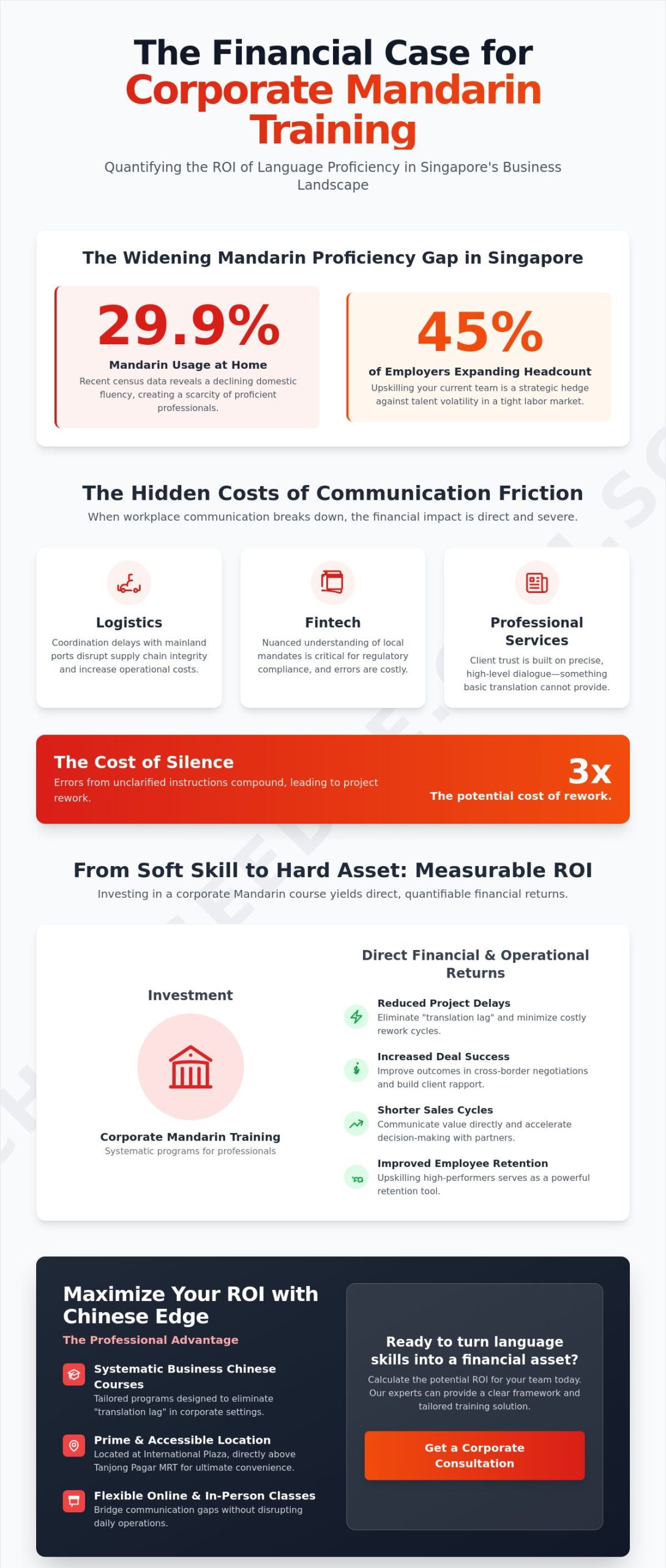
With Mandarin usage at home in Singapore dropping to just 29.9% according to recent census data, the scarcity of fluent professionals has turned language proficiency into a high-stakes financial asset. You’ve likely felt the frustration of project delays or miscommunications with regional partners, yet justifying the ROI of mandarin training for employees to a results-oriented board remains a constant challenge. We agree that “soft skills” often feel intangible when compared to direct capital investments. However, in a market where 45% of Singaporean employers are actively expanding headcounts, upskilling your existing team is a strategic hedge against talent volatility. This guide provides a clear framework to quantify how a business chinese course or corporate mandarin training directly impacts your bottom line. You’ll discover how to link workplace chinese communication to reduced operational friction and improved employee retention. We will break down the specific financial metrics and productivity gains you can expect when your team masters chinese for professionals through our systematic programs at International Plaza, located right above Tanjong Pagar MRT.
Key Takeaways
- Learn why Mandarin proficiency is a critical financial hedge against regional operational friction in Singapore’s 2026 business landscape.
- Apply our 5-step framework to quantify the ROI of mandarin training for employees by tracking measurable gains in project efficiency and client satisfaction.
- Understand how a tailored business chinese course serves as a strategic retention tool for upskilling high-performing staff in a tight labor market.
- Discover the professional advantage of a systematic mandarin course singapore located at International Plaza, designed to eliminate the “translation lag” in corporate settings.
- Explore how flexible online mandarin classes can bridge the communication gap between local teams and regional partners without disrupting daily operations.
The Strategic Imperative: Why ROI on Mandarin Training Matters in 2026
Corporate Language ROI is no longer a vague concept. It is the measurable financial and operational gain your company achieves compared to the total cost of program implementation. By 2026, Singapore has solidified its role as the primary regional hub for Chinese tech and fintech giants. This shift has transformed Mandarin proficiency from a luxury perk into a core operational requirement for any firm looking to scale. To stay competitive, leaders must view language through the lens of the Economics of language, recognizing that linguistic skills are a form of human capital that directly influences market expansion and internal efficiency.
Moving beyond “soft skills” is essential for the modern C-suite. We focus on hard financial data. When you calculate the ROI of mandarin training for employees, you aren’t just looking at test scores. You’re measuring the reduction in project turnaround times and the increase in successful cross-border negotiations. If your team can communicate directly with partners in Beijing or Shanghai, you eliminate the middleman and the associated costs of delay. Investing in a business chinese course ensures your workforce can handle complex discussions without external help.
To better understand how language skills integrate with professional growth, watch this helpful video:
The Cost of Communication Friction
Miscommunication in workplace chinese communication leads to literal project delays that can derail a quarterly budget. When technical requirements are lost in translation, the resulting rework costs are often triple the price of the original task. We define the “Cost of Silence” as the hidden financial drain caused when staff don’t clarify instructions due to language barriers, allowing errors to compound over time. This risk is particularly high in specific sectors:
- Logistics: Where real-time coordination with mainland ports is vital for supply chain integrity.
- Fintech: Where regulatory compliance hinges on a nuanced understanding of local mandates.
- Professional Services: Where client trust is built through precise, high-level dialogue rather than basic translation.
Singapore-China Trade Dynamics in 2026
The 2026 economic landscape is shaped by deeper regional trade agreements that have surged the demand for chinese for professionals. While hiring external translators might seem like a quick fix, it often creates a bottleneck in fast-moving industries. Internal proficiency allows for immediate decision-making and builds deeper rapport with stakeholders. Our systematic approach at 10 Anson Road, level 22, International Plaza, Singapore 079903, ensures your team gains the practical skills needed to navigate these complex regulatory environments. Being located right above Tanjong Pagar MRT, we provide the accessibility and professional rigor required for your workforce to master corporate mandarin training effectively. This internal capability is the only way to maximize the ROI of mandarin training for employees in a high-velocity market.
Quantitative Metrics: Measuring the Direct Financial Impact
Quantifying the ROI of mandarin training for employees requires a shift from tracking attendance to measuring fiscal outcomes. When your team can navigate Greater China markets independently, revenue growth follows. Sales cycles shorten because your staff doesn’t need to wait for external interpreters to bridge the gap. Beyond the individual cognitive and career benefits that drive personal performance, the corporate value lies in negotiation power. There is a stark financial difference between 1st-party and 3rd-party communication. Direct dialogue builds a “Trust Premium” that often results in more favorable contract terms and lower procurement costs.
Operational efficiency is another major driver of profit. Reducing the “translation lag” in email and meeting cycles can save hundreds of man-hours annually. If a manager spends four hours a week waiting for translations or clarifying miscommunications, that’s a significant drain on your productivity. By investing in corporate mandarin training, you eliminate these bottlenecks. Risk mitigation is equally critical. Direct understanding of technical documents or legal nuances helps your firm avoid costly contractual errors that third-party agencies might overlook.
Time-to-Market and Project Velocity
Teams equipped with a business chinese course execute cross-border projects with significantly higher velocity. When project managers can speak directly with HQ or vendors, the feedback loop tightens. Effective workplace chinese communication reduces the need for redundant meetings and ensures that technical specifications are met on the first attempt. This direct link saves time and reduces the “Cost of Inaction” where projects stall due to linguistic uncertainty. If you want to see these results in your department, consider a group chinese course to synchronize your team’s skills.
Sales and Business Development Gains
There’s a direct correlation between language proficiency and closing rates in Chinese-speaking markets. High-level chinese for professionals allows your sales team to leverage cultural etiquette, or Guanxi, to secure long-term partnerships. You aren’t just selling a product; you’re building a relationship in the client’s native tongue. This professional edge is best developed through a systematic mandarin course singapore. At Chinese Edge, located at 10 Anson Road, level 22, International Plaza, Singapore 079903, we provide the structured environment needed for these results. Being right above Tanjong Pagar MRT, we make it easy for your leadership team to integrate training into a busy corporate schedule.
Qualitative Returns: Retention, Culture, and the Talent War
Financial gains are only half the story. The ROI of mandarin training for employees also manifests in workforce stability and cultural synergy. In a market where job vacancies reached 1.58 for every job seeker in late 2025, keeping your best talent is a financial priority. When a company invests in corporate mandarin training, it sends a clear signal that the organization values the long-term growth of its staff. This proactive approach to education acts as a “golden handcuff,” not through restriction, but by providing the tools for career advancement within the firm. Employees who feel supported in mastering chinese for professionals report higher levels of confidence and job satisfaction, which directly reduces the high cost of replacement and retraining.
Company culture thrives when communication barriers fall. Building a bridge between local Singaporean teams and Chinese expatriate leadership is essential for a harmonious office environment. By fostering workplace chinese communication, you create an inclusive atmosphere where regional goals are understood by everyone. This positioning also boosts your brand reputation. Being seen as a “China-ready” firm helps you attract top-tier regional talent who are looking for sophisticated, globally-minded employers. Our systematic lessons at 10 Anson Road, level 22, International Plaza, Singapore 079903, are designed to facilitate this cultural shift, making fluency an attainable goal for your entire leadership team.
Upskilling as a Recruitment Tool
Gen Z and Millennial professionals in Singapore prioritize continuous learning more than previous generations. Offering a mandarin course singapore as part of a benefits package makes your firm significantly more attractive to high-potential candidates. With 45% of employers planning to increase headcounts in 2026, you need every competitive edge possible. Corporate mandarin training provides a clear roadmap for internal mobility, allowing staff to transition into regional roles that require high-level linguistic proficiency. It’s a strategic move that aligns individual career goals with your company’s expansion needs.
Cross-Cultural Leadership and Synergy
Shared language is the most effective way to break down silos between regional offices. While technical skills are vital, a conversational chinese course allows for the informal networking and “water cooler” moments that build genuine trust between colleagues. These small interactions prevent the cultural gaps that often lead to executive turnover and project friction. If your team can engage in workplace chinese communication during social hours or casual meetings, the resulting synergy improves overall productivity. Our location right above Tanjong Pagar MRT makes it convenient for your team to attend a mandarin class singapore and start building these essential bridges today.
A 5-Step Framework for Calculating Your ROI
To present a compelling case to your board, you need a structured methodology. Calculating the ROI of mandarin training for employees is a data-driven process that moves beyond anecdotal success. By following a systematic framework, you can turn linguistic proficiency into a tangible line item on your financial reports. This approach ensures that your investment in corporate mandarin training is both transparent and accountable for the 2026 fiscal year.
- Step 1: Identify Baseline Performance. Document current project speeds, error rates in regional communications, and client satisfaction levels before your team begins to learn chinese.
- Step 2: Define Total Training Costs. Calculate the full investment, including course fees for your mandarin course singapore, materials, and the value of employee time spent in class.
- Step 3: Set Specific KPIs. Establish clear, time-bound targets. For example, aim to “Reduce the need for external translation services by 50% within 6 months” of starting a business chinese course.
- Step 4: Track Behavioral Changes. Monitor the practical application of skills. Look for increased workplace chinese communication in emails, internal messaging, and regional meeting participation.
- Step 5: Compare Gains vs. Costs. Apply the formula [(Net Profit / Cost of Investment) x 100] to demonstrate the ROI of mandarin training for employees to your leadership team.
Setting Realistic Benchmarks for 2026
You shouldn’t expect native-level fluency overnight, but you should expect immediate efficiency gains. A team starting a conversational chinese course will quickly master greetings and basic technical terms, which immediately reduces social friction with partners. It’s vital to differentiate between these early wins and advanced business negotiation skills. To truly measure success, isolate the effects of language training from other market variables by comparing the performance of trained departments against those without chinese for professionals training.
Tools for Tracking Progress
Using internal surveys and project management data allows you to track communication improvements in real time. Regular proficiency assessments are a core part of our pedagogy at 10 Anson Road, level 22, International Plaza, Singapore 079903. These tests ensure that the mandarin class singapore is meeting its objectives. To sustain these gains long-term, consider creating a “Language Champions” program where proficient employees mentor their peers. If you’re ready to implement this framework, you can explore our corporate training solutions to find the right fit for your team. Our center right above Tanjong Pagar MRT provides the professional environment your leadership team needs to succeed.
Maximizing ROI with Chinese Edge: The Professional Advantage
Choosing the right partner is the final step in securing the ROI of mandarin training for employees. At Chinese Edge, we don’t just teach vocabulary. We act as an Expert Mentor for your team. Our instructors are native speakers with extensive business backgrounds, ensuring that the workplace chinese communication your staff learns is immediately applicable in high-stakes environments. This professional rigor transforms a standard mandarin course into a strategic asset. By focusing on a systematic pedagogy, we help your employees reach professional fluency faster, which directly translates to a quicker return on your training investment.
We understand that corporate schedules are demanding. That’s why our corporate mandarin training offers total flexibility. Your team can seamlessly switch between intensive on-site sessions and online mandarin classes without losing momentum. This hybrid approach ensures that regional travel or tight deadlines don’t disrupt the learning syllabus. Whether your staff prefers chinese classes near me in the CBD or the convenience of a digital classroom, our structured methodology remains consistent and results-oriented.
Strategic Location in the Heart of the CBD
Productivity is often lost in travel downtime. Our training center is located at 10 Anson Road, level 22, International Plaza, Singapore 079903, situated right above Tanjong Pagar MRT. This prime location in the heart of the business district allows your employees to transition from the office to the classroom in minutes. The professional, boutique environment of our school is specifically designed for adult learners, providing a sophisticated space that reflects the corporate world they navigate daily. This proximity to major firms in the CBD is a key factor in maximizing the ROI of mandarin training for employees by minimizing time away from core tasks.
Tailored Curriculum for Business Excellence
A generic conversational chinese course isn’t enough for the 2026 landscape. We provide a business chinese course that is customized to your industry’s specific needs, whether you operate in fintech, logistics, or professional services. We move beyond basic phrases to focus on the nuances of negotiation, technical terminology, and cultural etiquette. This targeted chinese course singapore ensures that your team isn’t just speaking Mandarin; they’re doing business in it. If you want to foster a collaborative learning environment, explore our group Chinese courses for team-based learning. Our mandarin class singapore programs are the bridge between your local team and global success.
Securing Your Competitive Advantage in 2026
Mastering Mandarin is no longer just a personal achievement; it’s a strategic financial hedge for your organization. By reducing the “translation lag” and building internal proficiency, your team can execute regional projects with far greater velocity. We’ve seen how a systematic framework turns qualitative gains into hard data, proving that the ROI of mandarin training for employees is a critical metric for any leader looking to scale in Greater China. Upskilling your workforce doesn’t just improve communication; it builds a culture of continuous growth that attracts and retains top-tier talent in Singapore’s competitive market.
Since 2012, Chinese Edge has served as a trusted partner for firms in the heart of the business district. Our native speaker instructors bring professional backgrounds to the classroom, ensuring your staff learns workplace chinese communication that actually works in the boardroom. Located at 10 Anson Road, level 22, International Plaza, we are situated right above Tanjong Pagar MRT to ensure training fits seamlessly into your corporate schedule. This accessibility combined with our proven pedagogy makes fluency an attainable goal for your entire team.
If you’re ready to transform your workforce and see measurable results, Request a Customized Corporate ROI Proposal today. We look forward to supporting your organization’s professional growth and helping you build a resilient, China-ready team.
Frequently Asked Questions
How long does it take to see a measurable ROI from Mandarin training?
Measurable results typically emerge within three to six months of starting a systematic training program. You’ll first notice a reduction in “translation lag” and improved social rapport during regional meetings. As the ROI of mandarin training for employees grows, these early efficiency gains evolve into significant cost savings on external interpreters and faster project turnaround times for your regional teams.
Is online Mandarin training as effective as in-person for corporate teams?
Online mandarin classes are just as effective as in-person sessions when they follow a structured, interactive curriculum. Our digital platform allows your team to maintain their mandarin course schedule regardless of regional travel or remote work arrangements. This flexibility ensures that learning remains a priority without compromising the academic rigor found at our physical center right above Tanjong Pagar MRT.
How do we choose between conversational and business-specific Mandarin for our employees?
Your choice should depend on the specific roles and daily responsibilities of your staff. If your team needs to build rapport and handle social networking, a conversational chinese course is the best starting point. For those handling technical contracts or high-level presentations, a business chinese course provides the specialized vocabulary required for professional excellence. Many corporate clients choose a blended approach to cover both bases.
What is the most effective way to measure employee progress in a corporate setting?
Combining formal language assessments with real-world performance metrics is the most reliable method. We recommend tracking the frequency of workplace chinese communication in emails and the speed of resolving cross-border queries. Regular proficiency milestones based on HSK standards ensure that the corporate mandarin training stays aligned with your organization’s strategic goals and provides a clear roadmap for employee advancement.
Can Mandarin training really improve employee retention in Singapore?
Upskilling employees through a mandarin course singapore is a proven strategy for increasing loyalty and reducing turnover. Professionals in Singapore value continuous learning and career pathing. By providing the tools to master chinese for professionals, you show a commitment to their long-term growth. This investment makes your firm a more attractive employer in a market where talent volatility remains a significant concern for leaders.
What are the hidden costs of not providing language training for regional teams?
The primary hidden costs are the expenses associated with miscommunication and lost opportunities in the Greater China region. Project delays caused by linguistic friction can derail quarterly budgets and damage partner trust over time. Without a mandarin class singapore program, your firm may also face higher recruitment costs as you struggle to find “China-ready” talent who can navigate complex regulatory environments independently.
Disclaimer
Disclaimer
The Chinese articles on this website are provided for general information and learning purposes only. While we strive for accuracy, we make no guarantees regarding completeness or reliability. The content does not constitute professional advice, and we are not liable for any loss arising from its use. External links or third-party content are for reference only. By using this website, you agree to this disclaimer.