
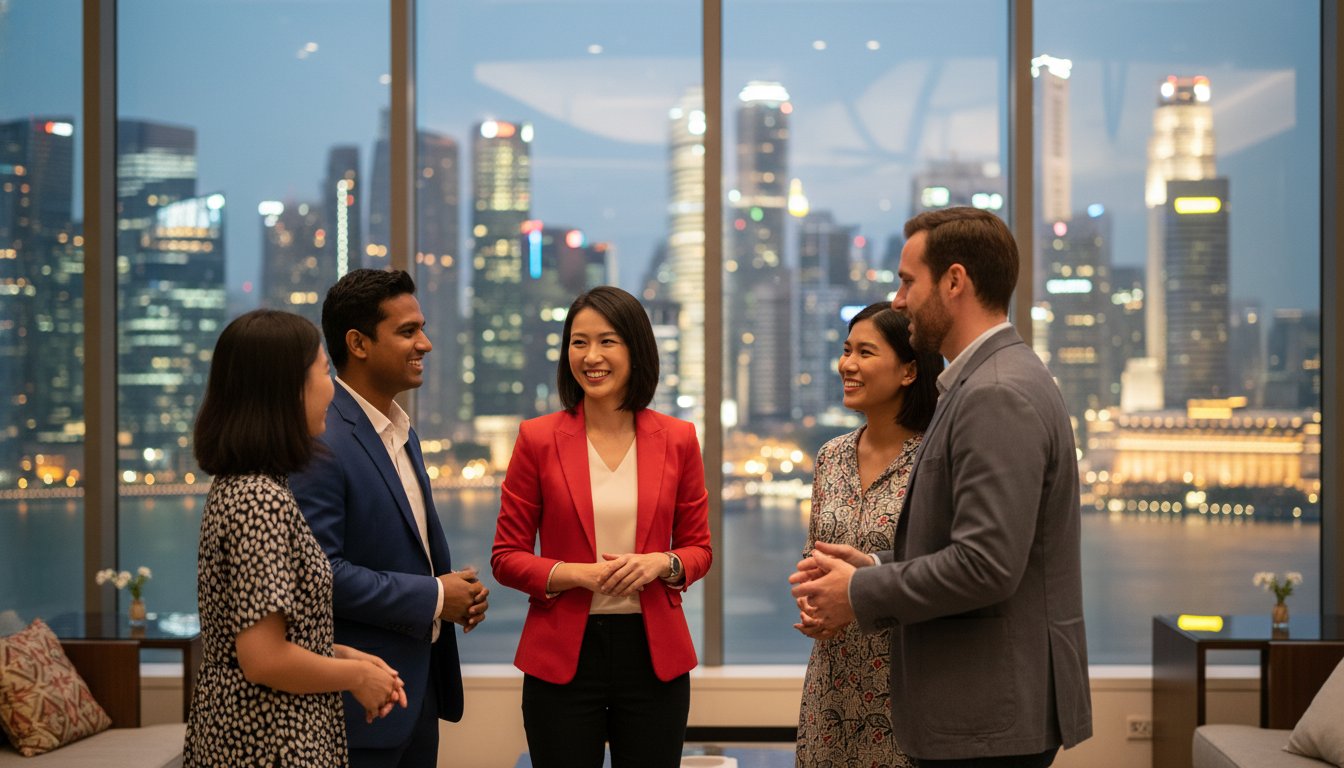
You’re standing in a sleek lounge near Tanjong Pagar, holding a business card and ready to make a vital connection, but your throat tightens the moment the conversation shifts away from English. Many professionals find that mastering Mandarin for networking events in Singapore is less about vocabulary and more about overcoming the intense fear of losing “face” in a high-stakes environment. It’s completely natural to feel anxious about tones changing meanings or being judged by native speakers while you’re trying to project authority in the CBD.
We understand these pressures and believe that fluency is an attainable goal through a disciplined, structured approach. This guide will help you master the psychological and practical techniques required to speak Mandarin confidently in any professional or social setting. You’ll learn how to reframe your mindset, manage linguistic stress, and navigate business mixers without the constant urge to retreat into English. By focusing on results-oriented communication from our base at International Plaza, you can transform your presence and build genuine rapport with partners across the region.
Key Takeaways
- Identify the psychological roots of Foreign Language Anxiety to stop the reflexive switch back to English during professional interactions.
- Learn to manage the pressure of “face” (mianzi) and overcome the fear of making tonal mistakes in front of colleagues or clients.
- Discover why prioritizing functional, conversational outcomes over rigid academic perfection leads to faster fluency in business environments.
- Master practical scripting and micro-speaking strategies to navigate Mandarin for networking events in Singapore with professional authority.
- Explore how structured training at International Plaza provides the immersion needed to bridge the gap between classroom learning and real-world application.
Understanding Foreign Language Anxiety in the Singapore Workplace
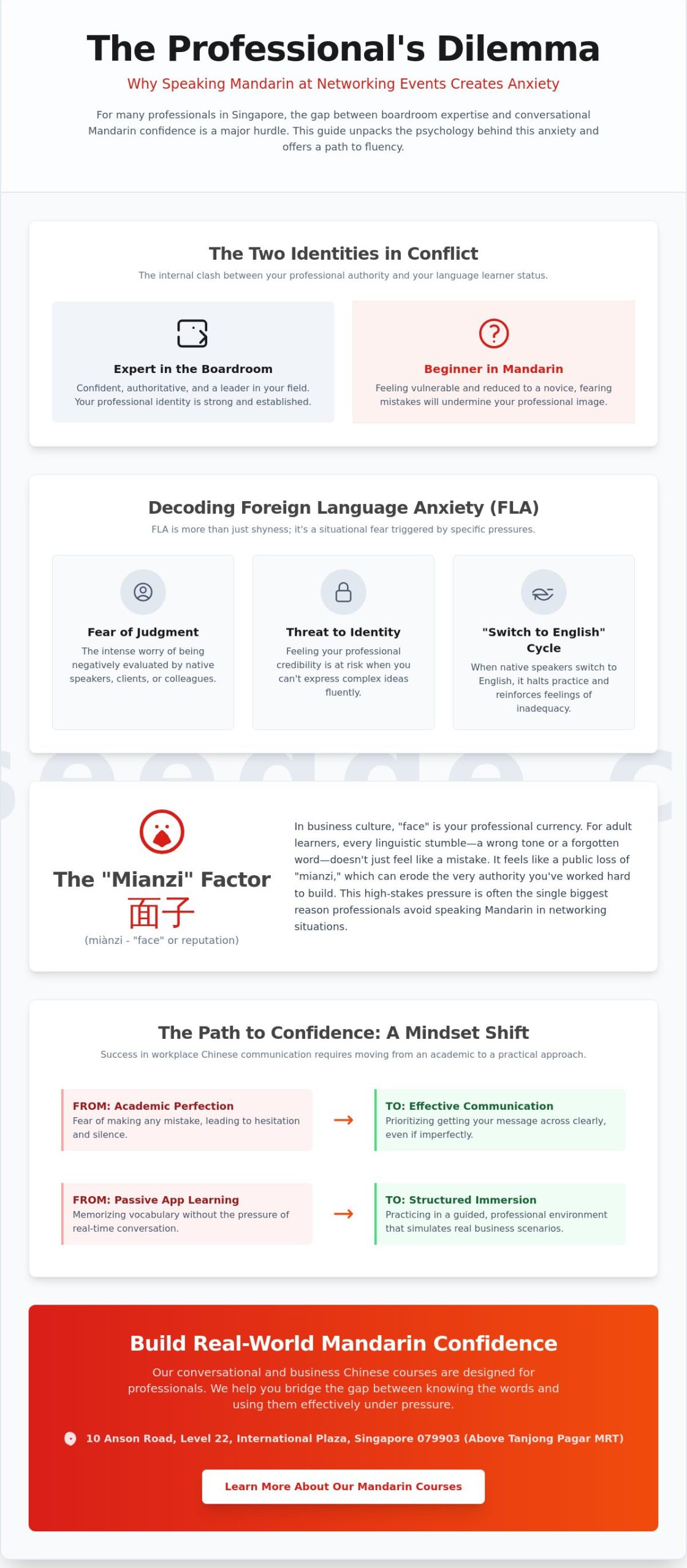
Professionals in the CBD often face a unique psychological hurdle when attempting to use a second language in high-pressure environments. This phenomenon, known as Understanding Foreign Language Anxiety, is particularly prevalent among those learning Mandarin in Singapore. It isn’t merely a lack of knowledge but a situational fear that can cause even seasoned executives to freeze during a critical introduction. This anxiety stems from the fear of being evaluated and the perceived threat to one’s professional identity.
In Singapore, this is exacerbated by the “Switch to English” phenomenon. When a native speaker notices your slight hesitation and immediately switches to English, it can feel like a polite dismissal of your linguistic efforts. While well-intentioned, this cycle prevents you from gaining the necessary “airtime” to build confidence. It reinforces a sense of inadequacy, making the transition to fluent workplace chinese communication feel like an insurmountable task.
To better understand the environment where these skills are put to the test, watch this helpful video of a local business gathering:
Passive learning apps often fail to prepare you for these live moments because they lack the unpredictability of a real conversation. Swiping through flashcards doesn’t simulate the noise of a crowded lounge or the pressure of a direct question from a potential partner. Mastering mandarin for networking events in Singapore requires more than just memorizing characters; it demands real-time processing and the ability to handle linguistic stress without a digital safety net. For those seeking a structured environment to practice, our mandarin course at International Plaza provides the professional setting needed to bridge this gap.
The Silent Barrier: Why Professionals Struggle Most
The most significant struggle for adults is the gap between their corporate expertise and their linguistic level. You might be a leader in your field, yet you feel reduced to a beginner’s persona when you can’t find the right word in Mandarin. This mismatch can lead to a fear of being misunderstood, which directly impacts career growth in regional roles where rapport is built through shared language. Classroom fluency often dissolves when faced with the rapid-fire demands of a boardroom performance, as the pressure to maintain professional authority remains high even when your vocabulary is still developing.
Common Triggers at Networking Events
Networking mixers present specific triggers that can spike anxiety levels. One major fear is that a tonal error might change the intended business meaning, turning a professional statement into something confusing or awkward. Additionally, the fast-paced nature of native conversations at mixers can be intimidating for those used to slower, academic speech. Professionals often worry about missing industry-specific terminology or failing to observe local business etiquette. When preparing for mandarin for networking events in Singapore, you must focus on these high-stakes scenarios rather than generic greetings to ensure you project the right level of sophistication.
The Psychology of “Face” and Mandarin Tonal Anxiety
In the Singaporean business community, your reputation acts as your primary currency. This is where the concept of “mianzi,” or face, becomes a significant psychological hurdle for adult learners. Unlike children who experiment with language through play, adults often view speech as a direct reflection of their professional competence. When you hesitate or stumble over a word, you don’t just feel a linguistic lapse; you feel a perceived drop in your authority. This internal pressure to remain flawless is the leading reason why many executives avoid using mandarin for networking events in Singapore, even when they possess the necessary vocabulary.
Perfectionism is frequently the enemy of conversational fluency. Many professionals fall into the “Tonal Trap,” a belief that a single misplaced pitch will lead to total incomprehension or embarrassment. In reality, native speakers are incredibly skilled at using context to bridge gaps in your speech. If you are discussing a regional expansion or a market trend, your listener isn’t waiting for a tonal slip to judge you; they’re listening for the value of your ideas. Breaking free from this anxiety requires a shift in focus from perfect execution to effective delivery.
Deconstructing the Tonal Myth for Professionals
Context is the most powerful tool in your linguistic arsenal. In a high-stakes professional setting, the surrounding sentences provide enough data for your counterpart to understand your meaning, even if your tones aren’t pitch-perfect. Most adults over-analyze the classic examples of tonal shifts, like the difference between “mother” and “horse,” which rarely appear in a corporate dialogue. Focus instead on the overall rhythm of your sentences. A communication-first mindset allows you to maintain the flow of a conversation, which is far more impressive to a business partner than a slow, stuttered attempt at perfect phonetics.
Building Emotional Resilience in the CBD
Success at International Plaza or within the bustling mixers of the Tanjong Pagar district requires emotional resilience. You must learn to reframe every linguistic mistake as a valuable data point for improvement rather than a personal failure. Building a safe feedback loop is essential for this growth. Working with native-speaker mentors allows you to test your phrases in a controlled environment before you step into the boardroom. If you want to build this confidence among like-minded peers, joining a conversational chinese course can help normalize errors and accelerate your progress. By practicing in a supportive setting just above Tanjong Pagar MRT, you’ll find that the fear of losing face slowly vanishes, replaced by a steady sense of professional authority.
Shifting from Perfection to Effective Communication
Many adult learners get trapped in the Academic Method, which prioritizes complex grammar and perfect stroke order. While these foundations have value, they often hinder progress in a fast-paced business environment. A professional business chinese singapore program shifts the focus toward functional outcomes. This methodology prioritizes your ability to build rapport and close deals over the ability to pass a written exam. By focusing on practical application, you can start contributing to conversations much sooner than you think.
We recommend applying the 80/20 rule to mandarin for networking events in Singapore. You don’t need to master 10,000 characters to be effective. Instead, you should focus on the 20% of high-frequency phrases that cover 80% of networking scenarios. Using strategic filler phrases like “让我想想” (let me think) or “怎么说呢” (how should I say it) is a vital skill. These fillers buy you precious seconds to compose your thoughts while making your speech sound more natural and less like a rehearsed textbook response.
The Power of Functional Fluency
Functional fluency starts with a minimum viable vocabulary for a professional introduction. This includes your name, your specific role, and a concise summary of your company’s value proposition. If you hit a linguistic wall, don’t panic. You can handle “I don’t know the word” gracefully by using phrases like “那个词怎么说?” (how do you say that word?) to keep the momentum. We encourage students to use body language and visual context to bridge any gaps. A confident gesture or a shared glance at a digital presentation can often communicate more than a perfectly pitched sentence ever could.
Analyzing the Singapore Context
Singapore offers a unique linguistic landscape where standard Mandarin meets colloquial local variations. You’ll likely encounter a wide range of accents in a multicultural office near Tanjong Pagar. Don’t let this variety intimidate you. One of the greatest advantages of working in the CBD is the bilingual nature of the community. If a technical term escapes you, it’s perfectly acceptable to use the English equivalent before returning to Mandarin. This hybrid approach allows you to stay engaged in the conversation rather than withdrawing. Our mandarin course at International Plaza is designed to help you navigate these nuances, ensuring you project authority regardless of the setting.
5 Strategies for Mandarin for Networking Events in Singapore
Moving from psychological readiness to actual performance requires a methodical plan. Utilizing mandarin for networking events in Singapore effectively involves setting micro-speaking goals. Don’t wait for a major mixer to start. Begin with low-stakes daily interactions, such as ordering your lunch in Mandarin at the International Plaza food court or greeting colleagues. These small interactions desensitize you to the sound of your own voice in a second language and build the momentum needed for high-stakes environments.
Another powerful tool is the scripting technique. Prepare and rehearse your professional introduction, a few questions about your counterpart’s industry, and a graceful exit line. A structured mandarin course acts as a safe laboratory where you can refine these scripts before taking them to the CBD. We also recommend recording your practice sessions on your phone. Reviewing these recordings helps you identify tonal inconsistencies and desensitizes you to tonal anxiety. Finally, prioritize active listening. By focusing intently on how native speakers phrase their thoughts, you’ll naturally pick up the rhythm and vocabulary used in modern Singaporean business circles.
Strategy 1: High-Frequency Phrase Mastery
Success in a fast-paced mixer depends on automation. You should master survival phrases like “幸会” (Xìnghuì – Pleased to meet you) and “请多指教” (Qǐng duō zhǐjiào – I look forward to learning from you) until they require zero mental effort. Automating these basics provides a significant psychological boost. When you start a conversation with a strong, fluent opening, it sets a positive tone for the rest of the exchange and increases your confidence to handle more complex follow-up questions.
Strategy 2: Controlled Immersion
Jumping into a large networking event without preparation can be overwhelming. Instead, opt for controlled immersion. A specialized chinese speaking course offers a safer environment than the unpredictable “wild” of a public event. You can gradually increase your audience size, starting with one-on-one drills before moving to small group simulations. Consistent, scheduled practice is essential. Our training center at 10 Anson Road, located right above Tanjong Pagar MRT, provides the perfect professional setting for this disciplined growth.
If you are ready to transform your professional presence, consider enrolling in our Adult Conversational Mandarin Course to start practicing in a supportive, results-oriented environment.
Building Confidence with a Professional Conversational Chinese Course
Building confidence isn’t just about individual study. It requires a structured environment where you can simulate real-world scenarios without the fear of a professional setback. Chinese Edge designs every lesson specifically for the chinese for professionals demographic. We understand that your time is valuable and your goals are specific. Our methodology moves beyond the passive style of learning apps, focusing instead on the active demands of using mandarin for networking events in Singapore.
Our Adult Conversational Mandarin Course emphasizes verbal interaction from the very first day. You’ll work with native instructors who possess a deep understanding of the Singaporean business landscape. This expertise is vital; it ensures you aren’t just learning a language, but also the cultural nuances that build rapport in the CBD. Live instructor interaction provides the immediate tonal correction needed to overcome the anxieties we’ve discussed. By practicing in a controlled setting, you can refine your pitch and project the authority your role demands.
A Curriculum Built for Adults
We focus on practical social and business interactions that you can apply immediately after class. You’ll practice handling introductions, explaining complex projects, and navigating social mixers with ease. This results-oriented approach is why many firms choose our corporate mandarin training to solve team-wide speaking fears. When a team learns together, it creates a supportive internal culture that encourages the use of Mandarin in the workplace. This collective growth helps normalize the language, making it a natural part of your professional toolkit.
Your Training Center in the Heart of the CBD
Accessibility is essential for busy professionals working in the city. Our training center is located at 10 Anson Road, level 22, International Plaza, Singapore 079903. Being situated right above Tanjong Pagar MRT means you can easily attend a session during your lunch break or immediately after work. The professional learning environment at International Plaza mirrors the high-stakes settings where you’ll put your skills to use. We invite you to visit our center for a personal consultation to see how our methodical approach can bridge the gap between your current level and professional fluency.
If you’re ready to stop switching back to English and start leading the conversation, our Adult Conversational Mandarin Course offers the proven structure you need. Join a community of like-minded professionals and transform your presence in the Singaporean business world today.
Elevate Your Professional Presence in the CBD
Overcoming the psychological barriers of “mianzi” and tonal anxiety is the first step toward genuine professional growth. By shifting your focus from academic perfection to functional communication, you can navigate high-stakes environments with newfound confidence. Mastering mandarin for networking events in Singapore is an attainable goal when you combine strategic scripts with a supportive, disciplined environment.
At Chinese Edge, we provide a structured methodology specifically designed for adult learners. Our native-speaking instructors bring extensive corporate experience to every lesson, ensuring your training is directly relevant to the Singaporean business landscape. Our training center at International Plaza, Level 22, offers a professional setting located right above Tanjong Pagar MRT for your convenience.
Master your conversational skills with our Adult Mandarin Course at Tanjong Pagar and bridge the gap between classroom learning and boardroom success. We are ready to act as your reliable partner in achieving linguistic authority and professional excellence.
Frequently Asked Questions
Is it normal to feel anxious when speaking Mandarin even after years of study?
Yes, feeling anxious is a documented psychological response known as Foreign Language Anxiety. It’s common for professionals to have high reading comprehension but struggle with verbal output because speaking involves a perceived threat to one’s professional identity. This anxiety often persists until you engage in structured, real-world simulations that build the emotional resilience needed for workplace interactions.
How can I fix my tones if I am already at an intermediate level?
Fixing fossilized tonal errors requires targeted feedback from native instructors and active self-observation. Instead of practicing isolated words, focus on tone pairs and the natural rhythm of full sentences used in business. Recording your speech and comparing it to a native speaker’s pitch helps you identify specific patterns that need adjustment to ensure clarity during professional mixers.
Will native speakers in Singapore be patient with my slow Mandarin?
Most business partners in Singapore appreciate the effort to communicate in their mother tongue as it signals respect and a commitment to building “guanxi.” While some may switch to English to save time, staying consistent in your delivery usually results in a supportive response. Using mandarin for networking events in Singapore is about building rapport, not achieving linguistic perfection.
Can I learn to speak Mandarin fluently through online classes alone?
You can certainly achieve fluency through online training if the sessions are live, interactive, and focused on verbal output. Our online Mandarin classes provide the same rigorous, results-oriented curriculum as our physical center. This format allows you to practice real-time business dialogues and receive immediate corrections from instructors, ensuring you are prepared for live networking scenarios without needing a physical classroom.
What is the best way to practice speaking if I don’t have Chinese friends?
Joining a group-based conversational Chinese course is the most effective solution for professionals without a local speaking circle. This provides a “safe laboratory” where you can practice with peers who face similar challenges. Our center at International Plaza facilitates these interactions, allowing you to rehearse networking scripts and receive professional feedback in a supportive, low-stakes environment before heading into the CBD.
How long does it take for a professional to overcome speaking fear?
While everyone’s journey differs, most professionals report a significant drop in speaking anxiety within 8 to 12 weeks of consistent, structured practice. This timeframe allows for enough positive reinforcement to replace the initial fear with a sense of situational control. By setting micro-goals and practicing regularly near Tanjong Pagar MRT, you can transform your confidence in a single quarter.
Should I focus on grammar or speaking first to build confidence?
Speaking should always be your priority if the goal is to build confidence. Functional fluency relies on your ability to convey a message and maintain the flow of a conversation. Once you are comfortable initiating interactions and using mandarin for networking events in Singapore, grammar naturally becomes the tool you use to refine your speech and project a higher level of professional authority.
How does a conversational Chinese course differ from a traditional textbook course?
Conversational courses prioritize oral output and real-world business scenarios over rote memorization of characters or complex grammar rules. Traditional methods often focus on passing written exams, which doesn’t translate to boardroom performance. A conversational approach at our International Plaza center ensures you spend the majority of your time speaking, listening, and reacting to the unpredictable nature of live professional dialogue.
Disclaimer
Disclaimer
The Chinese articles on this website are provided for general information and learning purposes only. While we strive for accuracy, we make no guarantees regarding completeness or reliability. The content does not constitute professional advice, and we are not liable for any loss arising from its use. External links or third-party content are for reference only. By using this website, you agree to this disclaimer.