

What if the primary hurdle to your fluency isn’t the complexity of the characters, but the English logic you’re inadvertently forcing onto the language? Many professionals who want to learn chinese find that even after completing a standard mandarin course, they still struggle to be understood in high-stakes environments. It’s frustrating to realize that the common mistakes english speakers make in mandarin often stem from a direct translation of Western sentence structures. You want to sound authoritative, yet a simple grammar slip can make you appear unintentionally blunt during a business chinese course or a real-world negotiation.
You likely feel the frustration of being misunderstood despite your dedication, especially when a direct translation fails to convey your true intent. We promise that by identifying these linguistic traps, you’ll gain the confidence to lead meetings and build genuine professional networks in 2026. This article provides a strategic breakdown of the shifts needed for sophisticated workplace chinese communication. If you’re searching for a mandarin class singapore, our center at 10 Anson Road, level 22, International Plaza, Singapore 079903, is located right above Tanjong Pagar MRT to support your growth. We’ll now examine the specific structural and tonal adjustments that will help you sound like a native professional.
Key Takeaways
- Learn how to replace English SVO logic with Mandarin’s flexible structure to eliminate ‘Chinglish’ and improve your professional conversational flow.
- Master the shift from emotional intonation to meaning-based tones to ensure native speakers understand your intent during every interaction.
- Navigate professional hierarchies by understanding ‘Mianzi’ and avoiding the trap of being too informal in high-stakes business environments.
- Pinpoint the common mistakes english speakers make in mandarin when local ‘Singlish’ habits inadvertently bleed into your formal workplace communication.
- Break through learning plateaus by moving beyond mobile apps toward a results-oriented business chinese course that offers structured, expert feedback.
The Direct Translation Trap: Why English Logic Fails in Mandarin
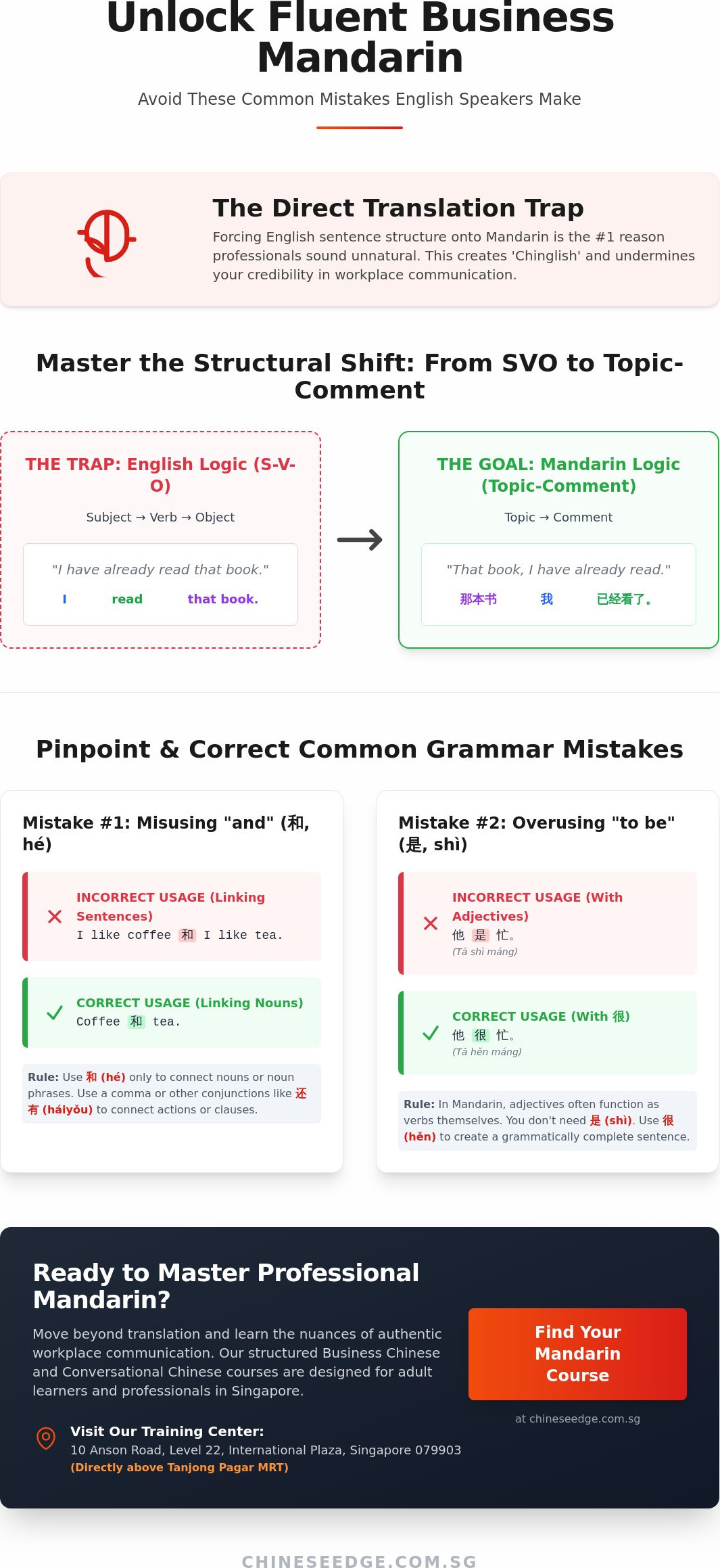
One of the primary reasons learners struggle is the attempt to map English syntax directly onto Mandarin. This word-for-word approach produces ‘Chinglish,’ a linguistic hybrid that often leaves native speakers puzzled. In English, the Subject-Verb-Object (SVO) structure is almost immutable. Mandarin, however, is a topic-prominent language. This means the ‘Topic’ of the sentence is established first, followed by a ‘Comment’ that provides the details. Relying too heavily on English logic is one of the most foundational Chinese grammar rules to unlearn if you want to sound natural.
When you join a conversational chinese course at our center in International Plaza, you’ll learn to pivot away from this rigid structure. For instance, an English speaker might say, “I have already read that book.” A native Mandarin speaker is more likely to say, “That book, I already read.” By placing the object at the beginning, you align with the natural cadence of the language. This shift is essential for avoiding the common mistakes english speakers make in mandarin that signal a lack of fluency.
To better understand this concept, watch this helpful video:
Cultural directness also plays a role in these logic traps. In English, being direct is often seen as efficient. In Mandarin, particularly in professional settings, high levels of directness can be perceived as abrupt or even rude. English speakers often translate “I want…” or “Give me…” directly, forgetting that Mandarin requires specific softening particles or indirect phrasing to maintain social harmony. Mastering these nuances is a key component of effective workplace chinese communication.
The ‘hé’ (和) vs. ‘háiyǒu’ (还有) Confusion
A frequent error involves the word ‘hé,’ which many beginners use as a catch-all for the English word ‘and.’ In Mandarin, ‘hé’ is strictly a connector for nouns or noun phrases. You can say “coffee 和 tea,” but you cannot use it to link two sentences. Saying “I like coffee 和 I like tea” is grammatically incorrect. Instead, you should use ‘háiyǒu’ to add information or simply use a comma and a pause to connect independent thoughts. The word ‘hé’ functions exclusively as a conjunction for nouns or noun phrases and cannot link independent predicates or clauses.
Overusing ‘shì’ (是) with Adjectives
English speakers often feel a grammatical urge to include the verb ‘to be’ (shì) before an adjective. This leads to the incorrect sentence “Tā shì máng” for “He is busy.” In Mandarin, most adjectives function as stative verbs, meaning they already contain the sense of “to be.” The correct structure is “Tā hěn máng.” In this context, ‘hěn’ acts as a structural filler to balance the sentence rather than strictly meaning ‘very.’ If you omit ‘hěn,’ the sentence can sound like an incomplete comparison, which is another of the common mistakes english speakers make in mandarin that we correct in our professional training sessions at 10 Anson Road, level 22, International Plaza, Singapore 079903.
Tones and Phonetics: Common Pronunciation Pitfalls for English Speakers
Tones are often cited as the primary barrier for professionals looking to learn the language. It’s a valid concern. In English, we use pitch to convey emotion or ask questions, a concept known as intonation. In Mandarin, however, pitch determines the actual meaning of the word. This fundamental difference is the source of many common mistakes english speakers make in mandarin. For instance, the syllable ‘ma’ can mean mother, hemp, horse, or a scold depending entirely on the tone used. Mastering how to learn Chinese tones requires shifting your brain’s focus from the feeling of a sentence to the specific frequency of each syllable.
Beyond tones, Pinyin itself contains several ‘false friends.’ These are letters that look familiar but represent entirely different sounds. Many learners struggle with aspirated vs. unaspirated consonants. In English, the difference between ‘p’ and ‘b’ is voicing. In Mandarin, it’s about the puff of air. If you don’t master these subtle breath controls, your speech will sound muffled or confusing to native colleagues. This is why a structured conversational chinese course is vital; it provides the real-time feedback needed to correct these physical articulation errors before they become permanent habits.
The Third Tone Sandhi: The Secret to Sounding Natural
The Third Tone Sandhi is where textbook learning often fails in real-world application. When two third-tone characters appear together, the first one automatically shifts to a second tone. Consider ‘Nǐ hǎo.’ You don’t actually say two dipping tones; it sounds like ‘Ní hǎo.’ Additionally, native speakers rarely perform the full ‘dip and rise’ of a third tone unless they are emphasizing a single word. They use a ‘Half-Third Tone,’ which is just a low, flat pitch. If you try to complete the full dip in every sentence, your speech will sound robotic and exhausted. Learning these shortcuts is essential for anyone enrolled in a mandarin course singapore who wants to achieve true fluency.
Pinyin Traps: J, Q, X and the ‘Ü’ Challenge
The letters J, Q, and X require a specific tongue positioning against the lower teeth that doesn’t exist in English. A common error is pronouncing ‘qù’ (to go) as ‘chew.’ The ‘Ü’ or umlaut sound is equally challenging for English speakers. To get it right, start with an ‘ee’ sound and slowly round your lips into a tight circle without moving your tongue. These technical refinements are a core part of our professional training at 10 Anson Road, level 22, International Plaza, Singapore 079903. Located right above Tanjong Pagar MRT, our center focuses on helping professionals navigate these phonetic hurdles with precision and confidence.
Professional and Social Etiquette: Blunders in Business Mandarin
In a professional environment, language proficiency is closely tied to the concept of ‘Mianzi’ or ‘Face.’ While you might focus on grammar, your choice of words directly affects how colleagues perceive your respect for hierarchy and social harmony. One of the common mistakes made by learners is failing to recognize that linguistic errors can be interpreted as social slights. In Western business, efficiency often trumps ceremony, but in Mandarin, the way you ask is as important as what you ask. Failing to soften your language can lead to a loss of face for both parties, which is why our business chinese course emphasizes cultural intelligence alongside vocabulary.
English speakers frequently use imperative verbs when they want to get things done quickly. In a Mandarin context, a direct translation of “Give me the report” sounds like a demand from a superior rather than a request between peers. This lack of verbal cushioning is among the common mistakes english speakers make in mandarin that can damage long term rapport. To sound professional, you must learn to use ‘helping’ verbs like ‘qǐng’ (please) or conditional phrasing to maintain harmony. This cultural awareness distinguishes a functional speaker from a truly fluent professional who understands workplace chinese communication.
Misusing Honorifics: Nín (您) vs. Nǐ (你)
Choosing between ‘Nín’ and ‘Nǐ’ is a frequent point of confusion for professionals in Singapore. While the local business environment can feel modern, ‘Nín’ remains the standard for addressing senior management, elder colleagues, or high value clients. Using ‘Nǐ’ with a director can come across as overly familiar or even disrespectful. Beyond pronouns, it’s often better to use a person’s title, such as ‘Lǐ Jīnglǐ’ (Manager Li), rather than their first name. This shows you respect their position within the corporate structure. If you’re looking for a mandarin course singapore that covers these nuances, our center at 10 Anson Road, level 22, International Plaza, Singapore 079903, provides the targeted training you need. We are located right above Tanjong Pagar MRT for your convenience.
The ‘Yes’ That Means ‘No’: Navigating Indirect Communication
In many Mandarin speaking cultures, a flat ‘No’ is considered too harsh for professional settings. This often leads to ‘soft nos’ that English speakers misinterpret as agreement. If a partner says ‘Hǎo’ or ‘Shì,’ they might simply be acknowledging that they hear you, not that they agree with your proposal. Similarly, ‘Maybe’ or ‘We will consider it’ often functions as a polite rejection. Taking these literal translations at face value during a business pitch can lead to significant strategic errors. Identifying these subtle cues is a critical skill we teach in our corporate mandarin training programs.
The Singapore Context: Navigating Local Linguistic Habits
Singapore’s linguistic landscape is a double-edged sword for professionals. English, Mandarin, and Singlish intermingle constantly in the workplace. While this makes the city a vibrant place to live, it also creates unique traps for those trying to master the language. Local habits often lead to hybrid speech patterns that can undermine your professional image during a high-stakes meeting. Understanding the common mistakes english speakers make in mandarin within this specific local context is vital for maintaining credibility among your peers.
Sentence particles like ‘lah,’ ‘lor,’ and ‘meh’ are ubiquitous in daily life. However, letting these bleed into your formal Mandarin can make your speech sound overly casual or confusing to non-local business partners. Standard Mandarin remains the benchmark for professional excellence in international trade. While it’s tempting to mirror the casual ‘Huayu’ nuances heard at a local coffee shop, professionals should strive for a clearer, more standardized version of the language to ensure their message is understood globally.
Avoiding ‘Mandarin-Singlish’ Interference
English speakers in Singapore often struggle with ‘code-switching’ effectively. A common error involves inserting English conjunctions like “so” or “but” into the middle of a Mandarin sentence. This disruption of linguistic flow is one of the most visible common mistakes english speakers make in mandarin. To succeed in a Business Mandarin Course, you must learn to rely on native connectors like ‘suǒyǐ’ or ‘kěshì’ instead of their English counterparts. Eliminating these ‘crutch words’ immediately elevates the perceived quality of your workplace chinese communication.
Topic-Comment Structure in the Local Office
The Topic-Comment structure is particularly effective in the fast-paced Singaporean office environment. Instead of the wordy English structure “I have already finished that report you asked for,” the local rhythm favors “That report, finished already.” This isn’t just about speed; it’s about immediate clarity. By establishing the topic first, you ensure your colleagues are on the same page from the first syllable. Mastering this framework helps you blend into the professional rhythm of the city while maintaining high grammatical standards.
You can use the city as your living classroom. Every interaction at Tanjong Pagar MRT is a chance to listen and refine your skills. To ensure you’re building professional habits rather than picking up local slang, join our mandarin class singapore at 10 Anson Road, level 22, International Plaza, Singapore 079903. Our location right in the heart of the business district ensures your training remains relevant to your daily professional needs.
Mastering Fluency: A Structured Path for Adult Learners in Singapore
Achieving professional fluency requires more than just memorizing word lists. Many learners find that self-study apps eventually lead to a plateau where progress stalls and uncorrected errors become fossilized. These digital platforms cannot provide the nuanced, real-time feedback necessary to fix the common mistakes english speakers make in mandarin, particularly regarding the complex tone shifts and cultural etiquette we’ve explored. A structured environment offers the discipline needed to move from basic comprehension to sophisticated workplace chinese communication.
Working with native instructors allows you to catch phonetic slips before they become permanent habits. This immediate correction is vital for professionals who cannot afford to be misunderstood in the boardroom. We encourage you to adopt a growth mindset where every linguistic stumble is viewed as an essential data point for improvement. By identifying these traps early, you accelerate your path toward sounding like a native professional. Enrolling in a conversational chinese course provides the rigorous framework and peer support that isolated study simply cannot match.
The Chinese Edge Methodology: Real-World Practice
Our training center is strategically located at 10 Anson Road, level 22, International Plaza, Singapore 079903. This professional setting, situated right above Tanjong Pagar MRT, is designed to meet the needs of busy executives in the heart of the business district. Our Adult Conversational Mandarin Course focuses specifically on unlearning English-centric habits. We move beyond the academic and into the practical, ensuring that every lesson translates directly into your daily professional interactions. This methodical approach ensures that your learning is both efficient and relevant to the 2026 Singaporean job market.
Creating a Sustainable Learning Habit
Consistency is the foundation of language mastery. You should look for opportunities to integrate Mandarin into your daily Singaporean routine, whether that’s practicing your order at a CBD hawker center or engaging in brief office banter with colleagues. For those with demanding travel schedules, our online Mandarin classes offer the flexibility to maintain your progress without sacrificing the quality of expert instruction. Fluency is a marathon, not a sprint. By combining a structured curriculum with daily practical application, you ensure that your investment in a mandarin course singapore yields tangible professional results.
Elevate Your Professional Communication Today
Mastering the transition from English syntax to the topic-comment framework and refining your tonal accuracy ensures your message is never lost in translation. These strategic adjustments are the key to moving beyond basic conversation and into high-level workplace chinese communication. By identifying the common mistakes english speakers make in mandarin, you’re now positioned to lead with authority in any business setting. True fluency is built on unlearning rigid structures and embracing the conceptual logic of the language.
Our center at 10 Anson Road, level 22, International Plaza, Singapore 079903, provides the expert mentorship needed to refine these skills. You’ll benefit from a structured curriculum for professionals, native-speaking instructors, and small group sizes that maximize your speaking time. Located right above Tanjong Pagar MRT, we make it easy to integrate high-quality learning into your busy schedule. Join our Adult Conversational Mandarin Course at Tanjong Pagar today!
Professional fluency is an attainable goal through a disciplined and proven approach. We look forward to being your partner in this transformative journey toward linguistic excellence.
Frequently Asked Questions
What is the most common grammar mistake English speakers make in Mandarin?
The most frequent error is the direct translation of English Subject-Verb-Object (SVO) logic into Mandarin sentences. Many learners also incorrectly use the verb ‘shì’ (to be) before adjectives, such as saying “Tā shì máng” instead of “Tā hěn máng.” These common mistakes english speakers make in mandarin often stem from a lack of exposure to the topic-comment framework that defines natural speech.
Why do native Mandarin speakers struggle to understand my tones?
Native speakers likely struggle because you’re applying English intonation patterns to Mandarin syllables. In English, pitch changes indicate emotion or questions, but in Mandarin, pitch defines the word’s actual meaning. If your tones are inconsistent, you might be saying an entirely different word than intended. Real-time feedback from a professional instructor is necessary to correct these pitch contours effectively.
Is it better to learn ‘Standard’ Mandarin or the local Singaporean version?
Standard Mandarin (Putonghua) is the preferred choice for professional success and international business. While local ‘Huayu’ nuances are helpful for social integration in Singapore, using standard grammar and pronunciation ensures you’re understood by partners across the global Chinese-speaking world. Our business chinese course focuses on this professional standard to maximize your career opportunities in the finance and technology sectors.
Can I learn Mandarin effectively through apps alone?
Apps are useful for vocabulary building but generally fail to help you achieve professional fluency. They can’t provide the critical real-time phonetic correction or explain the complex cultural nuances of workplace chinese communication. For adult professionals, a structured curriculum with native-speaking mentors is essential to avoid fossilizing bad habits and to break through common learning plateaus.
How long does it take for an adult professional to become conversational in Mandarin?
An adult professional can typically reach a functional conversational level within six to twelve months of consistent, structured study. This timeline assumes at least two to four hours of active instruction per week. Achieving a level suitable for high-stakes business negotiations may take longer, depending on your commitment to practicing outside the classroom and your previous linguistic background.
What is the ‘hé’ mistake and how can I avoid it?
The ‘hé’ mistake occurs when a learner uses ‘hé’ to connect two independent clauses or sentences, similar to the English word ‘and.’ In Mandarin, ‘hé’ is strictly a conjunction for nouns or noun phrases. To connect thoughts or actions, you should use ‘háiyǒu’ or simply a pause. Mastering this distinction is a hallmark of a student who has moved beyond basic translation.
How do I sound more polite in a Chinese business meeting?
Politeness in a business meeting is achieved through the use of honorifics and indirect phrasing. Address senior colleagues using ‘Nín’ instead of ‘Nǐ’ and always use their professional titles, such as ‘Manager’ or ‘Director,’ rather than their first names. Additionally, using ‘qǐng’ (please) and softening your requests with conditional language helps maintain ‘Mianzi’ or social face for all participants during negotiations.
Why is word order so important in Mandarin compared to English?
Word order is crucial because Mandarin lacks the grammatical markers, like verb conjugations, found in many Western languages. In Mandarin, the position of a word in a sentence frequently determines its grammatical function. Shifting the word order often changes the entire focus of the sentence, moving from a general statement to a specific topic-comment structure preferred in professional workplace communication.
Disclaimer
Disclaimer
The Chinese articles on this website are provided for general information and learning purposes only. While we strive for accuracy, we make no guarantees regarding completeness or reliability. The content does not constitute professional advice, and we are not liable for any loss arising from its use. External links or third-party content are for reference only. By using this website, you agree to this disclaimer.