

You stand in a fast-paced queue at a Tanjong Pagar stall, feeling the pressure as the uncle asks for your order while the line behind you grows. It’s a scenario that many who learn chinese face; the leap from a structured mandarin course to the raw energy of a Singaporean lunch hour is significant. You likely want to use your skills but worry about holding up the queue or being misunderstood. This guide provides the definitive strategy on how to order food in mandarin at a hawker centre with the poise of a seasoned local.
We will cover the specific vocabulary needed for a S$3.82 economy rice order, the social protocol of “chope-ing,” and how to interpret the latest SAFE hygiene grades. By the end of this article, you’ll know how to apply your chinese for professionals to real-world interactions, turning every meal into a practical extension of your conversational chinese course. Our team at 10 Anson Road, level 22, International Plaza, located right above Tanjong Pagar MRT, is dedicated to ensuring you navigate these daily professional and social exchanges with absolute confidence.
Key Takeaways
- Discover why learning how to order food in mandarin at a hawker centre is the most effective way to build linguistic muscle memory for daily life in Singapore.
- Master the social hierarchy of addressing stallholders correctly to ensure smooth, polite interactions during the busy lunch hour.
- Gain a specialized vocabulary for proteins and noodle types that allows you to customize your meals with precision and confidence.
- Acquire practical, step-by-step scripts for ordering local favorites like Hainanese Chicken Rice and Fish Soup without the fear of being misunderstood.
- Understand how these essential survival phrases provide the necessary foundation for advancing into more complex workplace chinese communication and professional fluency.
Why the Hawker Centre is Your Best Conversational Mandarin Classroom
Singapore’s hawker centres are much more than community dining rooms; they are the most vibrant linguistic hubs in the city. For a professional, mastering Singapore’s hawker centres provides a unique opportunity to practice Mandarin in a high-density, high-frequency environment. While some see these spaces merely as convenient spots for a quick meal, the savvy learner views them as a practical training ground. Understanding how to order food in mandarin at a hawker centre bridges the gap between textbook theory and the fast-paced reality of local life.
Developing this skill creates a form of linguistic muscle memory that is difficult to replicate in a silent study room. Every interaction requires you to process information quickly and respond with clarity. By learning Chinese through these daily rituals, you transform a routine lunch into an active lesson that deepens your connection to Singapore’s heritage. It is a low-stakes environment where a mistake only results in a minor clarification rather than a missed business opportunity.
To better understand how these interactions function in a real-world setting, watch this helpful video:
The “Live Lab” Effect for Adult Learners
A hawker stall serves as a “live lab” where feedback is instantaneous. If your pronunciation is accurate, you receive exactly what you ordered; if not, the immediate need for clarification forces you to adapt your tones and vocabulary on the spot. Mastering the specifics of how to order food in mandarin at a hawker centre allows you to bypass the hesitation that often plagues new learners. This environment is ideal for drills because the transactional nature of ordering follows a highly predictable pattern. You focus on the core nouns and verbs that drive the interaction, effectively breaking the “English-first” habit that many professionals fall into within the Central Business District.
Building Confidence Beyond the Classroom
Success at the noodle stall translates directly to confidence in the boardroom. These small, daily wins reduce the anxiety often associated with speaking a new language in a professional setting. While a structured mandarin course provides the grammatical framework, the hawker centre offers the volume of practice needed for fluency. Consistent practice also improves your workplace chinese communication. When you can comfortably navigate a crowded food centre, you’re better prepared for the spontaneous, informal conversations that occur with colleagues and clients. Our students at 10 Anson Road, level 22, International Plaza, Singapore 079903, located right above Tanjong Pagar MRT, often use their lunch break to test the phrases they learned in the morning. This immediate application ensures that your education remains relevant and results-oriented.
The Social Protocol: Addressing Hawkers and Basic Ordering Phrases
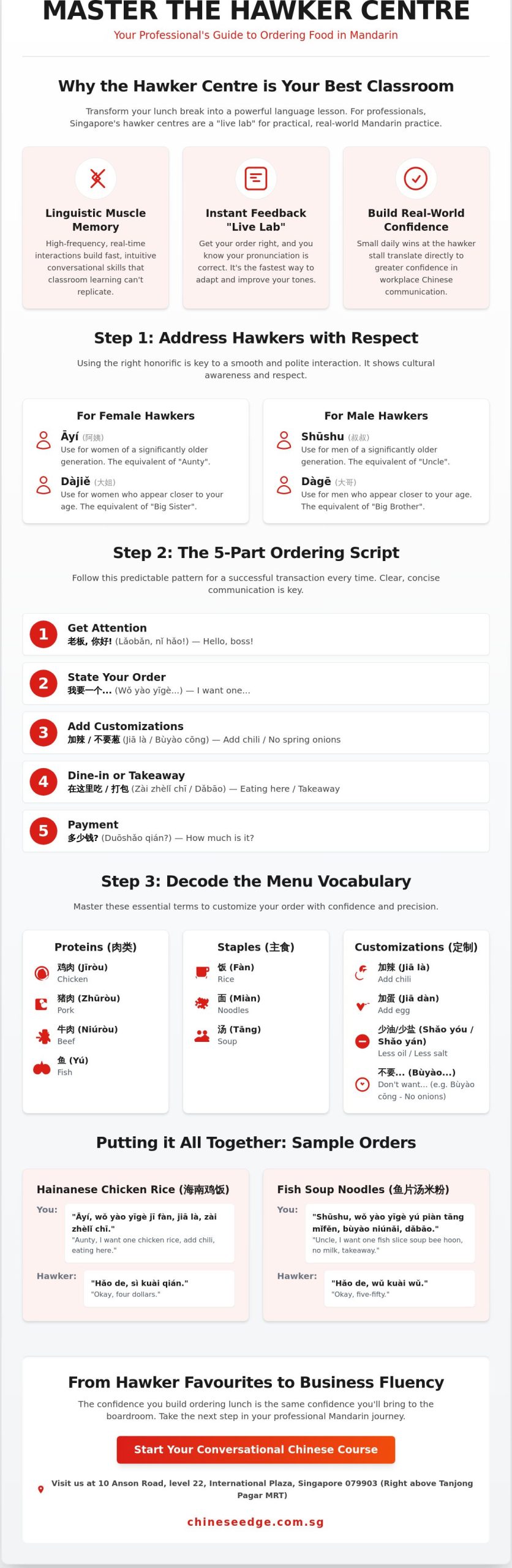
Mastering the social etiquette of a food court is just as vital as knowing the names of the dishes. When you are learning how to order food in mandarin at a hawker centre, you’ll find that the way you address a stallholder sets the tone for the entire interaction. In a high-pressure environment where efficiency is prized, using the correct honorific shows respect and helps you stand out as a culturally aware patron. It’s about navigating the social hierarchy with the same precision you would use in a professional meeting at our center at 10 Anson Road, level 22, International Plaza.
Addressing the Stall Owner Corrected
The standard “Uncle” and “Aunty” are ubiquitous in Singapore, but using the Mandarin equivalents adds a layer of sophistication to your speech. Use Āyí (Auntie) for women who appear to be of a significantly older generation, or Dàjiě (Big Sister) for those who might be closer to your age to show respect without implying they are old. For male hawkers, Shūshu (Uncle) is the traditional choice, though Lǎobǎn (Boss) is an exceptionally safe and common term. Calling someone “Boss” is a professional acknowledgement of their business ownership; it works well regardless of the age gap.
Using these terms helps you navigate the complex linguistic landscape of hawker centres, where Mandarin and various dialects often intersect on signboards and in speech. If you’re unsure, a polite nod followed by “Lǎobǎn” is always appropriate. It signals that you’re ready to order and respect their authority in that space.
The Universal Ordering Template
Efficiency is the primary goal during the lunch rush. You don’t need complex sentences to be effective. The most common structure is “Wǒ yào…” (I want…), followed by the dish name. If you prefer a more polite tone, “Qǐng gěi wǒ…” (Please give me…) is an excellent alternative that remains concise. When indicating your choice among several items on display, use zhège (this one) or nàge (that one) while pointing clearly to the item.
Precision in quantity is equally important. Use the measure word fèn to indicate a portion, such as “Yī fèn” (one portion). This is more accurate than just using a generic number. Finally, you must specify if you are eating there or taking away. Use Chī (Eat) or Zàizhèr chī (Eat here) for dine-in, and Dǎbāo for takeaway. This distinction is the first thing a hawker will ask once you’ve named your dish. If you want to refine these interactions, joining a conversational chinese course can help you practice these drills until they become second nature. Small linguistic wins at the stall build the confidence needed for more complex workplace chinese communication later in the day.
Decoding the Menu: Essential Vocabulary for Customizing Your Meal
While knowing how to address a stallholder is a great start, the real test of your proficiency lies in your ability to customize your order. When you understand how to order food in mandarin at a hawker centre, you move past the limitations of pointing at pictures. You gain the agency to request exactly what you want, whether it’s a specific protein or a precise spice level. This technical vocabulary is a core component of any conversational chinese course, as it directly impacts your daily satisfaction and professional energy levels.
Start with the foundations of protein: Jī (Chicken), Zhū (Pork), Yú (Fish), and Niú (Beef). Pair these with your preferred base. In Singapore, you’ll frequently choose between Mǐfěn (thin rice vermicelli), Guǒtiáo (flat rice noodles), or Miàn (yellow wheat noodles). If you’re managing dietary restrictions or personal tastes, use modification phrases. Bùyào là ensures no chili, while Dà là is for those who prefer maximum heat. You can also request Bùyào cōng to omit spring onions or Jiā dàn to add an egg for extra protein. These small adjustments demonstrate a higher level of fluency and cultural integration.
The “Cai Fan” (Economy Rice) Challenge
The economy rice stall is the ultimate high-pressure environment for language practice. With over 20 options displayed, it requires quick decision-making. Use Zhège (this one) and Nàge (that one) combined with the protein names mentioned above. To ask for a larger portion of a specific dish, say Duō yīdiǎn zhège. Understanding the common Liǎng ròu yī cài (two meats, one vegetable) structure helps you predict your bill. Following the unspoken rules to follow, such as having your SGQR payment ready or exact cash, ensures the queue moves smoothly. An average meal of one meat and two vegetables currently costs around S$3.82, making it a cost-effective way to fuel your workday.
Drink Stall Lingo in Mandarin
The beverage stall has its own logic that often confuses new learners. While the local terms Kopi and Teh are standard, using Mandarin equivalents like Kāfēi and Chá is perfectly acceptable and often appreciated. You should customize your sugar levels from Quán táng (full sugar) to Wú táng (no sugar). Finally, specify the temperature: Bīng de for iced or Rè de for hot. These precise requests are what we emphasize in our chinese for professionals training at 10 Anson Road, level 22, International Plaza, right above Tanjong Pagar MRT. It’s about achieving clarity in every transaction, whether you’re ordering a S$1.71 canned drink or presenting a project in the boardroom.
Step-by-Step Scripts for Ordering Singapore Favorites
While memorizing individual nouns is a helpful start, professionals require complete sentence structures to maintain a smooth flow during the high-pressure lunch rush. Many online resources provide a list of ingredients but fail to prepare you for the rapid-fire exchange at the stall. Mastering how to order food in mandarin at a hawker centre involves understanding the sequence of the transaction. Having a mental script ready allows you to focus on your pronunciation rather than searching for the next word while the queue grows behind you.
Scenario: The Chicken Rice Stall
Ordering this national staple is the perfect entry point for practicing your Mandarin. Begin by stating the quantity: “Yī fèn jī fàn” (one portion of chicken rice). The hawker will often ask which cut of meat you prefer. You can specify “Jī xiōng” if you prefer breast meat or “Jī tuǐ” if you want a drumstick. Finally, confirm your dining arrangement by saying “Zàizhèr chī” (eat here) or “Dǎbāo” (takeaway). This structured approach ensures you provide all the necessary information before they even have to ask, demonstrating a high level of situational fluency.
Scenario: The Drink Stall
The drink stall, or “water shop,” moves faster than almost any other stall in the centre. If you’re ordering for a team, use a clear numerical structure: “Sān bēi bīng kǎfēi” (three cups of iced coffee). To manage your sugar intake, simply add “Shǎo táng” (less sugar) or “Wú táng” (no sugar) to the end of your request. When it’s time to pay, ask “Duōshǎo qián?” (How much?). With the average price of a canned drink now around S$1.71, and brewed coffee often less, having your SGQR app or cash ready is essential for maintaining the communication rhythm.
Handling “The Pivot”: What if they speak English back?
It’s common for stallholders to switch to English if they perceive you’re a learner. When this happens, don’t revert to English immediately. Continue the interaction in Mandarin to signal your commitment to practicing the language. If they say something you don’t catch, use the polite phrase “Qǐng zài shuō yībiàn?” (Please say it again?). This keeps the exchange professional and turns a simple transaction into a micro-lesson for your conversational chinese course.
Our instructors at 10 Anson Road, level 22, International Plaza, located right above Tanjong Pagar MRT, often emphasize that these real-world “pivots” are where the most significant learning occurs. By staying the course, you build the resilience needed for more complex workplace chinese communication. If you’re ready to take your skills from the hawker centre to the boardroom, explore our Adult Conversational Mandarin Course today.
Transitioning from Hawker Phrases to Fluent Conversation
Mastering how to order food in mandarin at a hawker centre is a significant milestone for any professional living in Singapore. It marks the transition from being a passive observer to an active participant in the local culture. However, survival Mandarin is often limited to transactional exchanges. While you can successfully navigate a S$4.50 plate of Char Kway Teow, the linguistic requirements of a boardroom or a high-stakes negotiation are vastly different. Understanding the logic behind the grammar allows you to pivot from basic requests to complex, persuasive arguments. Moving from “survival” to “fluency” requires a shift from memorized scripts to a flexible command of the language.
There is a distinct difference between the informal shorthand used at a food stall and the precise terminology required for business chinese singapore. In a professional setting, your choice of words reflects your competence and respect for cultural nuances. Structured lessons provide the framework to ensure your speech is not only accurate but also appropriately formal. This transition is where many adult learners find the most value, as it transforms a personal skill into a powerful professional asset. By moving beyond the stall, you prepare yourself for the deeper interactions that drive business success.
Moving Beyond the Menu
Applying your food vocabulary to formal business dinners is a natural next step. Knowing your proteins and spice levels helps when hosting international clients at a premium restaurant. However, you also need the grammar foundation to discuss market trends or project timelines over that meal. Our mandarin classes singapore are designed to bridge this gap. We focus on workplace chinese communication that goes beyond the menu, teaching you how to:
- Express complex opinions with clarity and confidence.
- Handle professional objections using polite, formal structures.
- Build rapport with Chinese-speaking stakeholders in social and corporate settings.
- Navigate the subtle differences between casual lingo and professional Mandarin.
About Chinese Edge: Your Partner in Fluency
At Chinese Edge, we pride ourselves on being more than just a language school; we are your partner in personal and professional growth. Our native-speaking teachers bring deep linguistic expertise and a thorough understanding of the local Singaporean context. This ensures that the Mandarin you learn is both authentic and practical for your daily life. We avoid overly complex syntax in favor of clear, functional instruction that produces immediate results.
Our training center is conveniently located at 10 Anson Road, level 22, International Plaza, Singapore 079903. Being situated right above Tanjong Pagar MRT makes it easy for busy professionals to attend classes before or after work. We offer specialized programs including our Adult Conversational Mandarin Course and corporate training solutions tailored for entire teams. If you are ready to move beyond the hawker stall and achieve true fluency, we invite you to join us. Start your journey today with our group Chinese courses and experience our results-oriented methodology firsthand.
Transform Your Daily Interactions into Professional Fluency
Mastering how to order food in mandarin at a hawker centre is a vital step toward cultural and professional integration in Singapore. You have learned to navigate social protocols, decode complex menus, and use specific scripts for your favorite local dishes. These small, daily successes are the building blocks of confidence. They provide the practical experience needed to move from survival phrases to meaningful workplace chinese communication. By applying these lessons consistently, you ensure that your progress remains steady and your skills remain relevant.
At Chinese Edge, we specialize in helping adults achieve their linguistic goals through a structured and results-oriented approach. Our native-speaking instructors provide the academic rigor and steady support necessary for professional growth. We are conveniently located at 10 Anson Road, level 22, International Plaza, Singapore 079903, situated right above Tanjong Pagar MRT. Whether you are looking for a conversational chinese course or corporate mandarin training, we are your reliable partner in achieving fluency. Master Conversational Mandarin with Chinese Edge — View Our Courses. Your path to confident communication starts with a single, well-placed phrase. We look forward to supporting your journey.
Frequently Asked Questions
Do I need to use tones when ordering at a hawker centre?
Tones are fundamental for accuracy in Mandarin, but the high-context environment of a food stall provides a helpful safety net. While a misplaced tone might change a word’s meaning, the hawker usually understands your intent based on the specific stall’s menu. We recommend focusing on the flat first tone for many common food items to ensure maximum clarity. Consistent practice in a conversational chinese course helps you internalize these tones until they become second nature.
What is the most polite way to address an older hawker?
Addressing an older hawker as Āyí (Auntie) or Shūshu (Uncle) is the standard mark of respect in Singapore. These terms create an immediate social bond and show that you understand local etiquette. If you want a more professional or gender-neutral option, Lǎobǎn (Boss) is always appropriate. Using these honorifics ensures your interaction starts on a positive, respectful note, which is a key component of effective workplace chinese communication.
How do I say “takeaway” in Mandarin in Singapore?
The most common term for takeaway in Singapore is Dǎbāo. While standard Mandarin speakers in other regions might use Wàidài, the local preference in Singapore is almost exclusively for Dǎbāo. You should state this at the end of your order to ensure the hawker uses the correct packaging. Knowing how to order food in mandarin at a hawker centre using local terminology like this demonstrates your integration into the Singaporean linguistic landscape.
Can I use standard Mandarin, or must I use Singlish?
Standard Mandarin is highly effective and widely understood at every hawker centre in the city. While you will hear a blend of Mandarin, dialects, and Singlish, using the “Putonghua” you learn in a formal mandarin course is a sign of proficiency. Hawkers appreciate the effort of a clear, standard order. It allows you to practice the grammar and vocabulary that you will eventually use in professional corporate mandarin training sessions.
What should I do if I do not understand the price the hawker said?
If you don’t understand the verbal price, politely ask Qǐng zài shuō yībiàn? (Please say it again?). Most stalls also have prices clearly listed on their menus, and digital payment terminals will display the final amount. In 2026, many hawkers use the SGQR system, which allows you to see the price on your phone screen before confirming the transaction. This removes the anxiety of mishearing numbers during a busy lunch hour.
Is it rude to practice my Mandarin if there is a long queue?
It isn’t rude to practice your Mandarin provided you have your order ready before reaching the front of the line. Efficiency is the priority during peak hours, so keep your sentences short and direct. Use the “Wǒ yào…” (I want…) structure for speed. If the queue is moving very quickly, save more complex customizations for a quieter time. This approach respects the hawker’s time while still allowing you to build real-world confidence.
How do I ask if a dish contains a certain allergen like peanuts?
To ask about allergens, use the phrase Zhège yǒu méiyǒu huāshēng? (Does this have peanuts?). You can replace huāshēng with other ingredients like niúnǎi (milk) or jīdàn (eggs). It’s critical to be clear and direct when discussing dietary restrictions for safety. For those with severe allergies, showing a written card in Mandarin can provide an extra layer of security. This precise vocabulary is a core part of our chinese for professionals curriculum.
What are the best hawker centres near Tanjong Pagar to practice Mandarin?
Maxwell Food Centre and Amoy Street Food Centre are excellent locations near our office at 10 Anson Road, level 22, International Plaza. These centres host a diverse range of stalls where you can practice how to order food in mandarin at a hawker centre. Tanjong Pagar Plaza Food Centre is also right above Tanjong Pagar MRT and offers a more local atmosphere. These spots provide the perfect environment to apply what you learn in your conversational chinese course.
Disclaimer
Disclaimer
The Chinese articles on this website are provided for general information and learning purposes only. While we strive for accuracy, we make no guarantees regarding completeness or reliability. The content does not constitute professional advice, and we are not liable for any loss arising from its use. External links or third-party content are for reference only. By using this website, you agree to this disclaimer.