

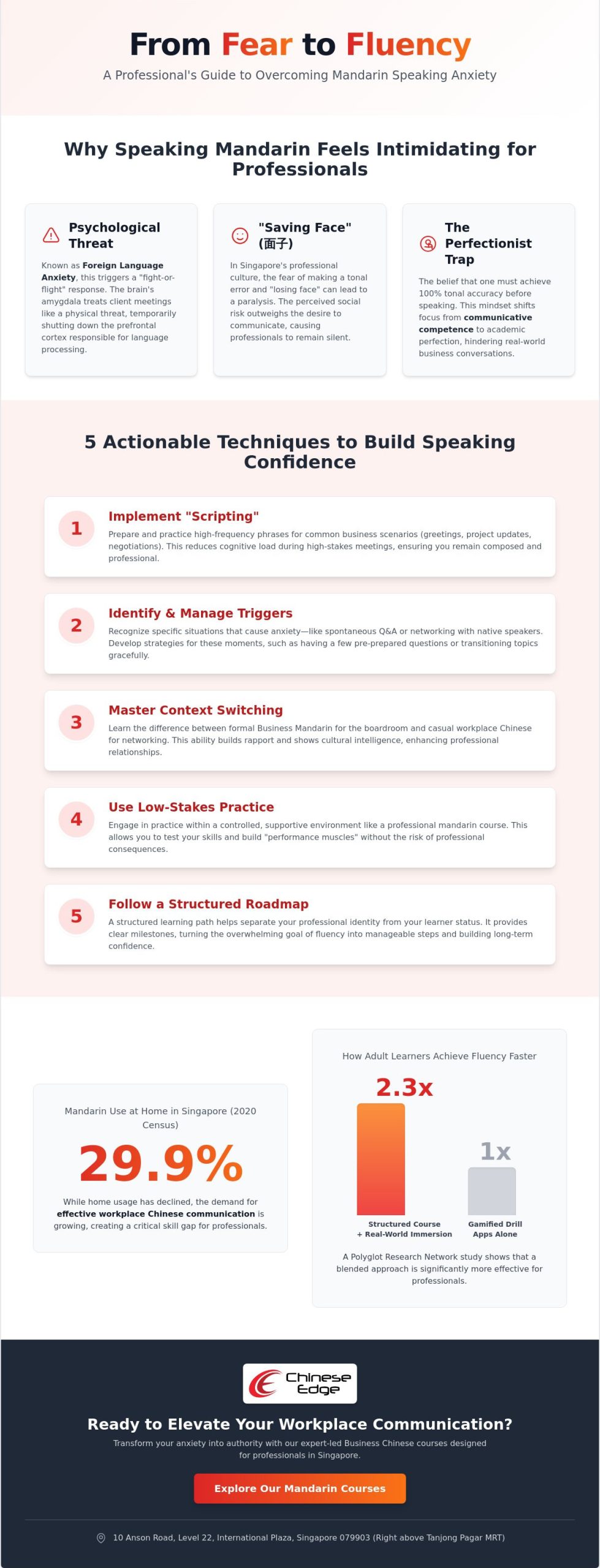
What if the biggest obstacle to your next promotion isn’t your technical expertise, but the physical anxiety that strikes when you need to speak Mandarin at a corporate event? You aren’t alone; many high-performing professionals in Singapore struggle with overcoming fear of speaking chinese in public, even when they possess a solid foundation of the language. While the 2020 Singapore Census highlighted a decline in home Mandarin use to 29.9 percent, the necessity for effective workplace chinese communication continues to grow in our regional business hub.
It’s natural to feel concerned about making tonal mistakes or being judged by native-speaking clients during spontaneous conversations. This guide provides actionable psychological strategies and practical techniques to help you transform that nervous energy into calm, authoritative communication. We’ll show you how to build rapport and express complex ideas clearly through a methodical business chinese course approach. If you’re ready to learn chinese in a way that sticks, this roadmap will help you feel relaxed and professional in any environment, including our mandarin class singapore at 10 Anson Road, Level 22, International Plaza, Singapore 079903, located right above Tanjong Pagar MRT.
Key Takeaways
- Understand the psychological impact of Foreign Language Anxiety and how the local “saving face” culture can hinder your professional progress.
- Implement the “Scripting” method to prepare high-frequency phrases, ensuring you remain composed during high-stakes client meetings.
- Discover actionable psychological strategies for overcoming fear of speaking chinese in public by identifying and managing your specific communication triggers.
- Master the transition between formal Business Mandarin in the boardroom and casual workplace chinese communication during networking breaks.
- Follow a structured confidence roadmap that utilizes low-stakes practice in a professional mandarin course to build long-term fluency.
Decoding Foreign Language Anxiety: Why Speaking Chinese Feels Intimidating
For many executives, the challenge of overcoming fear of speaking chinese in public isn’t about a lack of vocabulary; it’s about managing a specific psychological response. This phenomenon is known as Foreign language anxiety. It triggers the brain’s amygdala, essentially treating a client meeting like a physical threat. When this happens, your prefrontal cortex, the area responsible for language processing, temporarily shuts down. You don’t just “forget” words; your brain physically blocks access to them.
To better understand this concept, watch this helpful video:
In the high-pressure environment of Singapore’s financial districts, this anxiety is often amplified by the local “Saving Face” (mianzi) culture. Professionals frequently feel that making a tonal error is a reflection of their overall competence. This leads to a paralysis where the fear of looking foolish outweighs the desire to communicate. You might experience physical symptoms like a tightening throat or a racing heart during networking events, paired with cognitive “blanking” where even basic Pinyin seems to vanish.
To navigate the deeper psychological impacts of performance anxiety in the workplace, female executives may find it beneficial to visit Female Focused Therapy for specialized counseling and support.
The Perfectionist Trap in Mandarin Learning
Mandarin tones create a unique hurdle for English speakers. Because a slight change in pitch can alter a word’s meaning entirely, many learners fall into a perfectionist trap. They believe they must achieve 100 percent tonal accuracy before they’re allowed to speak. This mindset often leads to total silence in the boardroom. It’s vital to distinguish between academic accuracy and communicative competence. Real-world workplace chinese communication is about connecting with people, not passing a phonetics exam. When you focus on the message rather than the mechanics, your brain stays relaxed and functional.
The Role of Face and Professional Identity
High-achieving professionals are used to being experts in their fields. When you begin to learn chinese, you’re forced into the role of a beginner, which can feel incredibly vulnerable. It’s difficult to reconcile your identity as a senior manager with the feeling of struggling to order lunch in Mandarin. The key is to separate your professional expertise from your current linguistic level. You aren’t “less professional” because your Mandarin is developing; you’re a professional who is actively expanding their toolkit. For a structured approach to this transition, see our learn-chinese-in-singapore-the-professionals-roadmap-to-fluency-in-2026/.
5 Practical Techniques to Overcome Your Fear of Speaking Mandarin
Overcoming fear of speaking chinese in public requires moving beyond passive study and into active performance management. While understanding the psychological roots of anxiety is helpful, you need a toolkit of reliable techniques to use when you’re standing in front of a client. These strategies focus on reducing the cognitive load on your brain, allowing you to maintain your professional composure even when your vocabulary feels limited.
A 2026 study by the Polyglot Research Network found that combining structured courses with real-world immersion helps adult learners achieve conversational fluency 2.3 times faster than using gamified drill apps alone. This efficiency is largely due to the development of “performance muscles” that apps cannot replicate. By practicing in a group chinese course, you create a controlled exposure environment where you can test these techniques without professional risk.
The Power of High-Frequency Phrases
One of the most effective ways to manage workplace chinese communication is the “Scripting” method. This involves preparing a set of anchor phrases for specific professional interactions, such as introducing a colleague or asking for clarification. An Anchor Phrase is a pre-rehearsed linguistic safety net designed to stabilize your thoughts and reduce mid-conversation panic when your vocabulary feels out of reach. By having these phrases on a mental “cheat sheet,” you spend less energy on sentence construction and more on the actual message.
Strategic Tones and Mental Preparation
The 80/20 rule applies to Mandarin tones just as much as it does to business. Focus on the most critical tones that impact meaning in your specific industry. Recent research into foreign language anxiety suggests that perfectionism is often the enemy of progress. Instead of worrying about every syllable, use visualization and mental rehearsal before a meeting. Imagine yourself successfully delivering a pitch in Mandarin; this preps the brain to treat the situation as familiar rather than threatening.
Managing Physical Anxiety Symptoms
When anxiety strikes, your body often reacts before your mind does. Throat tightening is a common symptom that can make your tones sound forced or incorrect. To counter this, practice deep breathing to relax the vocal cords before you enter a meeting room. Implementing the “Slow Down” rule is also vital. Speaking slower actually improves your perceived fluency because it gives your brain time to select the right words and ensures your tones are distinct. Use confident body language and steady eye contact to bridge the gap when you’re searching for a specific term; your professional presence often carries the conversation further than a perfect vocabulary could alone.
Mastering Workplace Chinese Communication in Professional Singapore Settings
Navigating the nuances of workplace chinese communication requires a strategic shift depending on your immediate environment. In a formal boardroom, the emphasis remains on precision and specialized terminology. Conversely, during a coffee break, the goal is rapport and cultural connection. Successfully overcoming fear of speaking chinese in public involves recognizing these shifts and adapting your linguistic register accordingly. In Singapore’s unique bilingual landscape, colleagues often switch to English to accommodate you. While this is helpful, persisting in Mandarin with professional grace demonstrates commitment and builds deeper trust with Chinese-speaking clients.
Strategic listening is a powerful tool for the developing speaker. Instead of rushing to reply, use active listening phrases to buy yourself cognitive processing time. This allows you to organize your thoughts and select the correct Business Mandarin terms without the pressure of an immediate response. When a colleague corrects your tones, treat it as a high-value coaching moment rather than a critique of your professional identity. This mindset shift is essential for maintaining momentum in any mandarin course.
Networking Near Tanjong Pagar: A Local Proving Ground
Conducting Meetings with Confidence
Leading a discussion in your second language is a significant milestone. To succeed, focus on a core set of “meeting management” phrases that allow you to clarify and confirm information. This prevents misunderstandings and ensures you remain in control of the narrative. Many leaders find that overcoming fear of speaking chinese in public becomes much easier once they have a bank of reliable transition phrases to keep the meeting on track. If you find that your entire team struggles with these interactions, structured corporate mandarin training can provide a collective boost in confidence. Practicing these scenarios within a business chinese course environment ensures that when you step into a real meeting, the language feels like a tool rather than a barrier.
Building Your Confidence Roadmap Through a Conversational Chinese Course
While the techniques mentioned previously provide immediate relief, sustainable progress in overcoming fear of speaking chinese in public requires a structured development plan. You cannot expect to master workplace chinese communication through sporadic self-study alone. A professional roadmap moves you through five distinct stages of growth, starting with a diagnostic assessment to identify your specific speaking triggers. Whether your anxiety stems from tonal accuracy or social “face,” pinpointing the cause is the first step toward a solution.
Once your triggers are identified, you move into low-stakes practice within a group environment. This is followed by intensive role-play scenarios that simulate the specific professional challenges you face in the Singapore business world. Expert feedback loops then refine your pronunciation, ensuring you possess the precision required for senior-level interactions. Finally, you integrate these skills into your daily life, transforming your commute from Tanjong Pagar MRT into an opportunity for real-world application.
Why Group Learning Beats Solo Study for Confidence
Solo study often reinforces the fear of being judged because it lacks a social feedback loop. In a group-chinese-courses/ setting, you realize that your peers share the same anxieties. Normalizing mistakes among other high-achieving adults reduces the psychological weight of “saving face.” Seeing a colleague struggle with a complex sentence and then successfully navigate it provides a powerful mental blueprint for your own success. This shared experience is vital for anyone looking to learn chinese in a supportive, professional atmosphere.
The Role of the Expert Mentor
The instructors at Chinese Edge act as more than just teachers; they are linguistic bridges to the target business world. They provide the cultural nuances that help you sound like a sophisticated professional rather than a textbook recording. This includes understanding when to use formal address and how to navigate the subtle hierarchies of a Chinese-speaking boardroom. Immediate, native-speaker feedback is crucial for building communicative confidence because it provides the real-time validation necessary to silence your inner critic. This expert guidance ensures that your conversational chinese course translates directly into career-advancing skills.
If you’re ready to move beyond the plateau of “reading but not speaking,” it’s time to join a structured program. Our training center at 10 Anson Road, level 22, International Plaza, Singapore 079903, provides the ideal environment for professionals to refine their skills right in the heart of the CBD.
Elevate Your Fluency with Expert-Led Mandarin Classes in Singapore
Achieving professional fluency is a journey that requires more than just a textbook; it demands a partner who understands the specific pressures of the Singaporean corporate world. Chinese Edge serves as that partner, offering a structured environment where overcoming fear of speaking chinese in public becomes a manageable and rewarding process. Our methodology is designed specifically for adults, moving away from rote memorization toward practical, result-oriented communication. Whether you’re looking for a conversational chinese course to improve social rapport or a specialized business chinese course to lead regional meetings, our programs provide the linguistic tools you need to excel.
Convenience is a cornerstone of our service. Our training center is situated at 10 Anson Road, level 22, International Plaza, Singapore 079903, located right above Tanjong Pagar MRT. This physical presence in the heart of the Central Business District allows you to transition seamlessly from your office to your mandarin class singapore. For those with demanding travel schedules or regional responsibilities, our interactive online mandarin classes offer the same high-quality instruction with the flexibility that modern professionals require. This blended approach ensures that your learning remains consistent, regardless of your professional commitments.
Why Professionals Choose Chinese Edge
Our school functions as a premium boutique institution where individual student success is the primary metric of our performance. We prioritize adult learners and corporate training solutions, ensuring that every lesson is relevant to your career goals. Our native-speaking instructors bring a wealth of professional experience, acting as expert mentors who guide you through the complexities of workplace chinese communication. We don’t just teach grammar; we provide the cultural insights and professional etiquette that help you sound authoritative and persuasive in any business setting. This specialized focus creates a supportive environment where you can shed your anxieties and build authentic confidence.
Start Your Confidence Journey Today
Taking the first step toward overcoming fear of speaking chinese in public is often the most challenging part of the process. We invite you to visit our center at International Plaza for a personal consultation to identify your specific needs and goals. Our systematic methodology has helped countless executives transform their anxiety into a powerful professional asset. By choosing a program that aligns with your professional identity, you’re investing in a skill that will pay dividends for years to come. For more information on how to begin, explore our mandarin-classes-in-singapore-the-2026-guide-for-professionals/. Let us help you bridge the gap between your current level and the linguistic world you aim to master.
Step into Your Future as a Confident Bilingual Professional
Mastering Mandarin in a professional context is less about achieving academic perfection and more about building the resilience to communicate effectively under pressure. By implementing the scripting techniques and psychological strategies discussed, you’re well on your way to overcoming fear of speaking chinese in public. Remember that your professional identity remains intact even as you navigate the learning curve of a new language; every mistake is simply a stepping stone toward authority.
At Chinese Edge, we specialize in helping executives bridge the gap between textbook knowledge and real-world application. Our native-speaking expert mentors provide the nuanced guidance needed to excel in Singapore’s competitive business landscape. With a curriculum designed exclusively for adult and corporate learners, we ensure every lesson translates into career-advancing skills. Our center is conveniently located right above Tanjong Pagar MRT at 10 Anson Road, level 22, International Plaza, Singapore 079903, making it easy to fit professional development into your busy schedule.
Master your conversational confidence; join our Adult Mandarin Courses today!
Fluency is an attainable goal when you have the right partner. We look forward to supporting your growth and seeing you lead your next meeting with poise, clarity, and confidence.
Frequently Asked Questions
How can I stop being so shy when speaking Chinese to my colleagues?
You can reduce speaking shyness by using pre-rehearsed anchor phrases for common office interactions, such as morning greetings or project updates. Shyness often stems from the fear of being unable to respond; by preparing these scripts in advance, you lower the cognitive pressure during spontaneous workplace chinese communication. Starting with these low-stakes interactions builds the psychological momentum necessary for more complex professional discussions.
Will a Business Mandarin course help with my public speaking anxiety?
Yes, a specialized business chinese course is designed to simulate high-pressure environments like boardrooms, presentations, and negotiations. These courses assist in overcoming fear of speaking chinese in public by providing a controlled environment to practice professional etiquette and industry-specific terminology. This structured approach helps you maintain your professional identity and authority while communicating in a second language.
How long does it take to see an improvement in speaking confidence?
Most professionals notice a significant shift in their speaking confidence within three to six months of consistent, structured practice. A 2026 study by the Polyglot Research Network found that adult learners using a combined approach of formal courses and daily immersion reached HSK 4-equivalent comprehension in an average of 11 months. While full fluency takes time, the ability to feel relaxed during spontaneous workplace communication often develops much earlier through regular group practice.
Is it okay to make tonal mistakes in a professional setting?
Making occasional tonal mistakes is a normal part of the learning journey and is generally accepted in Singapore’s business community. Most native-speaking clients and colleagues prioritize communicative competence and the quality of your professional insights over linguistic perfection. If you focus on delivering your message clearly and use confident body language, minor tonal errors will rarely hinder your professional rapport or success.
Should I choose group or private Mandarin classes for overcoming fear?
Group classes are generally more effective for overcoming fear of speaking chinese in public because they provide a supportive community of peers. Seeing other high-achieving adults navigate similar challenges helps normalize mistakes and reduces the anxiety associated with “saving face.” While private lessons are excellent for technical vocabulary, a group conversational chinese course provides the social interaction necessary to build real-world public speaking confidence.
What are some quick tips for speaking Chinese during a networking event?
Implement the “Slow Down” rule to give your brain more time to select the correct words and ensure your tones remain distinct. Before attending an event near our center at International Plaza, situated right above Tanjong Pagar MRT, prepare three simple conversational openers to initiate dialogue. Using active listening and clarifying questions also buys you valuable processing time, allowing you to formulate more confident and professional responses in Mandarin.
Disclaimer
Disclaimer
The Chinese articles on this website are provided for general information and learning purposes only. While we strive for accuracy, we make no guarantees regarding completeness or reliability. The content does not constitute professional advice, and we are not liable for any loss arising from its use. External links or third-party content are for reference only. By using this website, you agree to this disclaimer.