

Your current struggle with Mandarin isn’t a lack of talent; it’s a clear sign that your beginner study habits have officially expired. You’ve likely spent months feeling stuck at the same conversational level, unable to bridge the gap between basic small talk and complex business negotiations. It’s incredibly frustrating to put in the effort only to feel your motivation slip as visible progress disappears. This guide will show you how to get past the mandarin learning plateau by identifying the psychological hurdles and linguistic shifts required for success in 2026. Many who start with a mandarin course find that reaching professional proficiency requires a more structured, methodical approach to workplace chinese communication.
We’ll provide a clear plan to reach professional fluency and expand your vocabulary beyond daily survival phrases. As chinese for professionals becomes more demanding with the new HSK 3.0 translation and speaking requirements, your strategy must evolve to meet these benchmarks. From our training center at 10 Anson Road, level 22, International Plaza, Singapore 079903, located right above Tanjong Pagar MRT, we’ve helped countless learners regain their momentum. You’ll learn the exact strategies needed to transform your conversational chinese course foundations into high-level proficiency and renewed confidence in every meeting.
In this guide, you will discover:
- The psychological reasons behind the “Intermediate Stall” and why progress in your mandarin course often feels non-linear after the beginner phase.
- Proven techniques on how to get past the mandarin learning plateau by addressing language fossilization and shifting from survival phrases to nuance-based communication.
- Why active production is more effective than passive listening for professionals enrolled in a conversational chinese course, especially with the new HSK 3.0 requirements.
- Four actionable strategies to regain momentum, including industry-specific focus for a business chinese course and advanced tone refinement.
- How our structured methodology at 10 Anson Road, level 22, International Plaza, located right above Tanjong Pagar MRT, helps professionals learn chinese for the modern workplace.
Understanding the Mandarin Learning Plateau: Why Progress Feels Slower
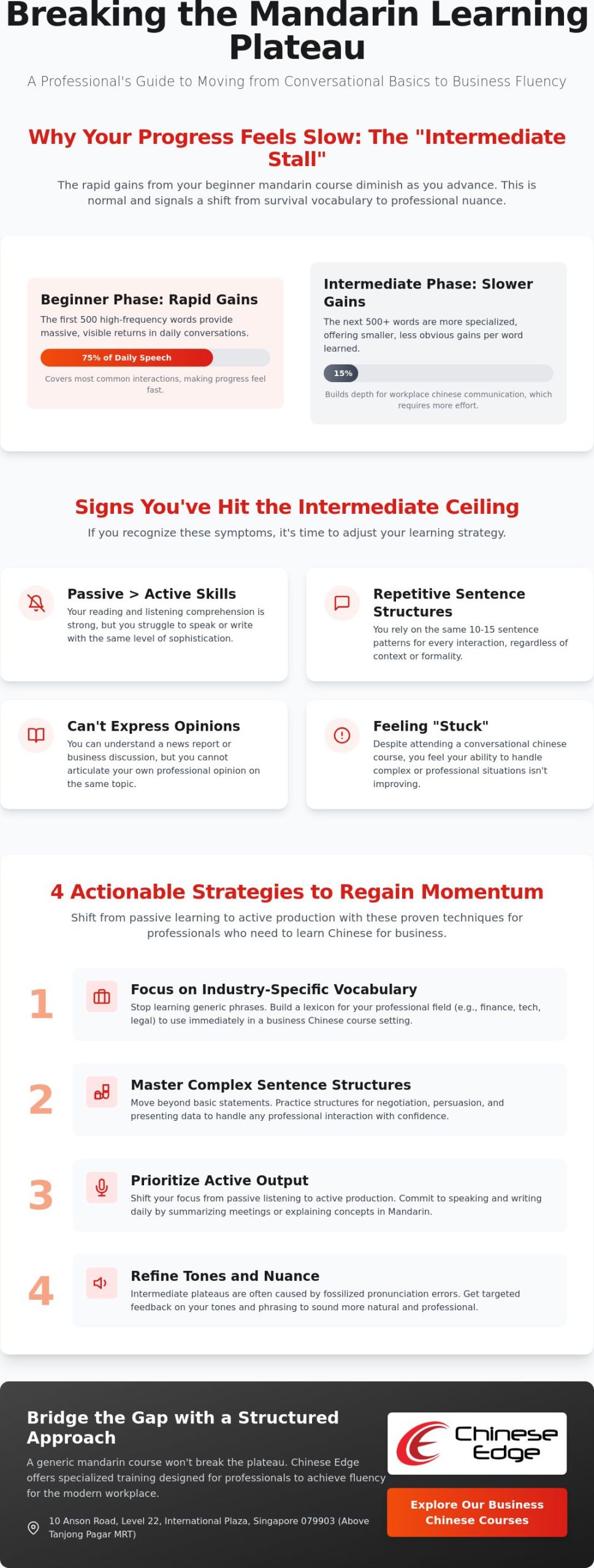
Many professionals find that their initial surge of progress eventually hits a wall, often referred to as the “Intermediate Stall.” This phenomenon is a specific manifestation of the plateau effect, where the rapid gains of the beginner phase begin to level off. In the early stages of a mandarin course, every new character you learn yields immediate results because you’re focusing on high-frequency vocabulary. However, as you move toward professional fluency, the “Law of Diminishing Returns” takes hold. While the first 500 words might cover 75% of daily speech, the next 500 words provide significantly less coverage, making your progress feel invisible.
The psychological impact of this stall shouldn’t be underestimated. For high-achieving professionals, the lack of visible progress can lead to a loss of motivation. You might feel that your vocabulary is stuck, which often results in learners scaling back their efforts just when they need to intensify them. Understanding how to get past the mandarin learning plateau requires recognizing that this isn’t a failure of effort. It’s a change in the linguistic landscape. You’re no longer just learning to survive; you’re learning to influence, negotiate, and lead in a second language.
To better understand this concept, watch this helpful video:
The Illusion of Stagnation
Beginner progress often feels like a rocket launch because the curriculum is designed for quick wins. You move from zero to being able to order coffee and introduce yourself in weeks. The intermediate stage feels like a marathon because you’ve shifted from high-frequency grammar to low-frequency, specific terminology. The Mandarin plateau is a necessary transition phase where your brain consolidates foundational knowledge before moving toward advanced linguistic precision. It’s a period of “perceived stagnation” rather than actual stagnation; your brain is still working, but the results aren’t as flashy as they were on day one.
Signs You Have Hit the Intermediate Ceiling
Identifying the plateau is the first step toward breaking it. You might find that you can navigate daily life in Singapore with ease but completely freeze when it comes to Business Chinese training or technical discussions. If you recognize these symptoms, it’s time to adjust your strategy:
- Your passive recognition (reading and listening) is vastly superior to your active vocabulary.
- You rely on the same 10 to 15 sentence structures for every interaction, regardless of the context.
- You can understand a news broadcast but cannot explain your own professional opinion on the same topic.
- You feel “stuck” at a basic conversational level despite attending a regular conversational chinese course.
When you reach this point, continuing with generic study methods won’t help. To learn chinese at a professional level, you need a structured approach that prioritizes workplace chinese communication and active output. Moving your lessons to a specialized mandarin course designed for adults can provide the targeted feedback necessary to break through these barriers and master how to get past the mandarin learning plateau.
The Science of Stagnation: Why Professional Mandarin Requires a New Strategy
Breaking through the intermediate level requires more than just increased effort; it demands a fundamental shift in how you process the language. One of the primary scientific reasons learners stall is “Language Fossilization.” This occurs when you stop correcting your own tonal and grammar errors because you’ve reached a level of “functional fluency” where people generally understand you. While this is fine for social interactions, these uncorrected habits become permanent fixtures in your speech. To understand how to get past the mandarin learning plateau, you must move from “Survival Chinese,” which is purely needs-based, to “Professional Chinese,” which is rooted in linguistic nuance and cultural precision.
Passive listening, a staple of beginner learning, loses its effectiveness at this stage. Your brain has already mapped out the high-frequency patterns it needs to survive, so it begins to tune out the very nuances that lead to advanced proficiency. Research into strategies for advanced learners suggests that active production and structured feedback are the only ways to overwrite these fossilized mistakes. Without a mentor to identify these subtle errors, you risk staying stuck in a loop of repetitive, unpolished communication that doesn’t reflect your professional seniority.
The Trap of “Good Enough” Communication
In a multicultural hub like Singapore, patient colleagues and friends often adapt to your level, which can inadvertently hinder your growth. This leads many professionals to settle for a functional but unrefined “Singdarin” style. While you might be understood in the office pantry, using unrefined language nuances during a high-stakes negotiation can make you appear less authoritative. Professionals who ignore these small errors often find their career progression slowed by a perceived lack of cultural and linguistic depth. Refining your workplace chinese communication is about moving beyond being understood to being influential.
Cognitive Load and Advanced Vocabulary
The brain processes abstract business concepts differently than concrete daily objects. Rote memorization, while effective for learning “apple” or “taxi,” fails when you’re trying to grasp complex financial terms or subtle management directives. This is why a specialized mandarin course that targets specific professional domains is essential. By reducing the cognitive load through context-heavy learning, you can integrate advanced vocabulary more naturally into your speech.
If you’re ready to move beyond the basics, consider how structured group classes can provide the peer interaction and expert guidance needed to sharpen your skills. Our training center at 10 Anson Road, level 22, International Plaza, Singapore 079903, is conveniently located right above Tanjong Pagar MRT, making it easy to fit high-level chinese classes near me into a busy corporate schedule. Taking the step toward professional Mandarin training is the most effective way to ensure your linguistic growth matches your career ambitions.
Passive Exposure vs. Active Output: Breaking the Cycle
Many professionals spend hours listening to Mandarin podcasts or scrolling through flashcards, yet they remain unable to lead a corporate meeting. This struggle highlights the difference between passive exposure and active output. While input is essential for beginners, intermediate learners often fall into the trap of “comfortable consumption.” You understand the words being said, so your brain stops working to acquire new structures. To understand how to get past the mandarin learning plateau, you must shift your focus toward active production. A high-quality conversational chinese course forces you to use the language in real-time; this is where the actual growth happens.
Language acquisition for adults relies heavily on “Deliberate Practice.” This isn’t just repetition. It’s the process of identifying specific knowledge gaps and working specifically to fill them. Instead of a broad, generic review, you should focus on the exact phrases you lack during workplace chinese communication. If you can explain your weekend but not your quarterly financial report, your training should pivot exclusively to that deficit. This targeted approach ensures that every hour spent in a mandarin course yields a direct return on your professional capabilities.
Why Your Current Routine is Failing You
There’s a significant difference between “studying” and “training.” Studying is passive; it’s about gathering information. Training is active; it’s about building a skill through discomfort. Apps and flashcards have limited utility for intermediate conversational fluency because they don’t simulate the pressure of a real conversation. To break the stall, you need high-stakes practice environments. This might include delivering a mock business presentation or participating in a simulated negotiation. These activities force your brain to retrieve vocabulary under pressure, which is the only way to move beyond basic survival phrases.
The Power of Professional Feedback
Self-study lacks a critical component: the feedback loop. Native-speaking instructors are essential for identifying “blind spots” you simply cannot hear yourself. You might be consistently mispronouncing a tone that changes the meaning of a professional term without even realizing it. Enrolling in group chinese courses offers the added benefit of peer-to-peer learning. Observing the errors and successes of other professionals helps you internalize grammar rules more effectively. At our center at 10 Anson Road, level 22, International Plaza, Singapore 079903, located right above Tanjong Pagar MRT, we emphasize this active feedback to transform your passive knowledge into professional-grade speech. This structured environment is the most reliable way to learn how to get past the mandarin learning plateau and achieve lasting fluency.
4 Proven Strategies to Regain Momentum in Your Mandarin Journey
Regaining your momentum requires moving beyond general study and adopting a high-performance training mindset. If you’re wondering how to get past the mandarin learning plateau, you must replace aimless browsing with these four targeted strategies. These methods transition you from a passive recipient of information to an active, professional speaker who can command a room in Mandarin. By focusing on precision rather than just volume, you’ll see visible improvements in your workplace chinese communication within weeks. It’s about training smarter, not just harder.
- Strategy 1: Narrow your focus. Stop trying to learn everything at once. Focus exclusively on the “lexical set” relevant to your specific industry.
- Strategy 2: Use recording techniques. Record yourself speaking and compare it to a native speaker to identify tonal drifts that you might miss in real-time.
- Strategy 3: Increase output. Aim for a 70/30 ratio where most of your session is spent speaking or writing rather than just listening or reading.
- Strategy 4: Use professional milestones. Align your learning with international proficiency benchmarks or specific career goals like leading a business chinese course presentation.
Domain-Specific Mastery
General fluency is a myth for professionals; you need domain-specific mastery. Whether you work in finance, tech, or law, you must build a vocabulary that reflects your expertise. A specialized business chinese course tailored for professionals allows you to move from vague descriptions to precise terminology. Instead of using generic verbs, you’ll learn to discuss “market volatility,” “strategic pivots,” and “regulatory compliance.” This shift in your chinese for professionals training ensures you’re prepared for the high-stakes environment of the Singapore business district. You’ll find that mastering 50 industry-specific terms is more valuable than 500 random daily words.
Refining Tones and Fluency
Tonal accuracy is the hallmark of a high-level speaker. At the intermediate stage, many learners develop “lazy tones,” which can undermine their professional authority. Implementing “Shadowing”—repeating a native speaker’s audio immediately after hearing it—helps recalibrate your internal ear. For busy executives, utilizing online mandarin classes singapore provides the consistency needed for this refinement. Consistent, expert feedback is the only way to ensure your mandarin class singapore sessions lead to native-like fluency. This disciplined approach is essential for how to get past the mandarin learning plateau.
If you’re ready to see real results and bridge the gap to professional fluency, enroll in our structured mandarin course today. Visit us at 10 Anson Road, level 22, International Plaza, Singapore 079903, located right above Tanjong Pagar MRT, to begin your journey toward mastery.
Structured Breakthroughs: How Chinese Edge Helps Professionals Bridge the Gap
Achieving professional fluency is a disciplined pursuit that requires more than just self-study; it requires a partner who understands the high stakes of the corporate world. At Chinese Edge, our methodology is specifically engineered to address how to get past the mandarin learning plateau by replacing generic lessons with a results-oriented framework. We recognize that as an adult professional, your time is a finite resource. This is why our mandarin course structure focuses on immediate application, ensuring that every hour spent in our center translates directly to improved performance in your workplace.
Our native-speaking mentors serve as the expert guides your progress requires. They don’t just teach grammar; they provide the nuanced feedback that self-study apps and casual conversation partners cannot offer. Whether you’re enrolled in a business chinese course or seeking corporate mandarin training for your entire team, our approach bridges the gap between basic survival and sophisticated influence. We provide the systematic structure needed to move past fossilized errors and master workplace chinese communication with total confidence.
Expert Mentorship at International Plaza
The environment in which you learn is as important as the curriculum itself. Our training center is located at 10 Anson Road, level 22, International Plaza, Singapore 079903. Being situated right above Tanjong Pagar MRT makes it exceptionally convenient for professionals to attend chinese classes near me immediately after their workday ends. We maintain a strictly adult-only, professional learning environment. This ensures you’re surrounded by peers who share your drive for excellence and career growth, creating a focused atmosphere that hobbyist courses simply cannot replicate.
Your Roadmap to Fluency Starts Here
There’s a fundamental difference between a standard language class and a professional development program. A class teaches you words; our program builds your professional identity in a new language. We help you transition from the frustration of being stuck at the intermediate level to the confidence of being an advanced speaker. By following a structured roadmap with clear professional milestones, you can finally achieve the fluency you need for the 2026 business landscape. If you’re ready to stop stagnating and start leading, book a consultation for our Adult Conversational Mandarin Course and take the first step toward your linguistic breakthrough.
Your Path to Professional Mandarin Mastery
The intermediate stall is a natural part of the linguistic journey, but it doesn’t have to be your final destination. By shifting from passive consumption to active production and focusing on industry-specific vocabulary, you’ve already identified the essential tools for how to get past the mandarin learning plateau. Success in 2026 requires more than just effort. It demands a structured environment where expert feedback replaces guesswork and bad habits are corrected before they fossilize.
At Chinese Edge, we specialize in providing this professional structure for adult learners. Our native-speaking instructors bring years of experience in adult education, delivering a tailored business chinese course that prepares you for high-stakes negotiations. Located at 10 Anson Road, level 22, International Plaza, Singapore 079903, right above Tanjong Pagar MRT, our center offers the perfect environment for focused, distraction-free learning. Whether you’re looking for chinese classes near me or comprehensive corporate mandarin training, we’re here to help you bridge the final gap to fluency.
Master Professional Mandarin at Chinese Edge – Explore Our Courses. Your professional growth is within reach. It’s time to take the next step with a methodology proven to deliver results.
Frequently Asked Questions
How long does the Mandarin learning plateau typically last?
The duration of this phase depends entirely on your willingness to adopt new learning methodologies. For many, it can last indefinitely if they continue using basic flashcards and apps. However, professionals who switch to a structured mandarin course often see a significant breakthrough within three to six months of consistent, active effort. This timeline is achievable when you move from passive consumption to the targeted strategies required for how to get past the mandarin learning plateau.
Can I get past the plateau through self-study alone?
While self-study provides a foundation, it is rarely enough to learn how to get past the mandarin learning plateau effectively. You lack the critical feedback loop necessary to identify tonal drifts and grammar fossilization that occur at the intermediate level. Professional chinese classes near me provide the expert mentorship required to identify your specific blind spots and bridge the gap to advanced fluency through active production.
Is Business Mandarin harder than Conversational Mandarin?
Business Mandarin is more specialized rather than inherently more difficult. While a conversational chinese course focuses on high-frequency daily life phrases, a business chinese course targets precise, abstract terminology used in negotiations and financial reports. It requires a more disciplined approach to workplace chinese communication, but the vocabulary is often more predictable once you master your specific industry’s lexical set.
How often should I attend classes to see a breakthrough?
Attending lessons at least twice a week is the standard for maintaining linguistic momentum. This frequency ensures that you’re consistently pushed beyond your comfort zone while allowing enough time for self-revision between sessions. Our mandarin class singapore sessions at International Plaza are designed to fit into the schedules of busy executives, ensuring that professional development remains a consistent priority without causing burnout.
What is the most effective way to expand my professional vocabulary?
The most effective way is to build a lexical set tailored to your specific industry. Instead of learning generic lists, focus on vocabulary that appears in your daily emails, meetings, and industry news. This makes chinese for professionals more relevant and easier to retain because you use the words immediately in a real-world context. This targeted approach is a cornerstone of our mandarin course singapore curriculum.
How do I know if I am ready for an advanced Mandarin course?
You are likely ready for an advanced course if you can navigate basic social situations but feel lost during complex professional discussions. If you find yourself using the same simple sentence structures repeatedly or struggling to express abstract opinions, it’s a clear sign you need the rigorous framework of an advanced chinese course singapore. Moving to a higher-level program is often the catalyst needed to break through a long-term stall.
Does Chinese Edge offer corporate training for entire teams?
Yes, we provide customized corporate mandarin training solutions for organizations of all sizes. These programs are designed to align with your company’s specific objectives and industry requirements, focusing on practical workplace chinese communication. We can conduct these sessions at your office or at our professional center right above Tanjong Pagar MRT at 10 Anson Road, level 22, International Plaza, Singapore 079903.
Why are tones so difficult to correct at the intermediate level?
Tones are difficult at this level because of language fossilization. Your brain has reinforced incorrect tonal patterns through months of “good enough” communication where you were understood despite errors. Correcting these requires deliberate practice and the expert guidance of native-speaking mentors who can hear the subtle errors you might miss. Overwriting these habits is essential for anyone looking to learn chinese at a professional, authoritative level.
Disclaimer
Disclaimer
The Chinese articles on this website are provided for general information and learning purposes only. While we strive for accuracy, we make no guarantees regarding completeness or reliability. The content does not constitute professional advice, and we are not liable for any loss arising from its use. External links or third-party content are for reference only. By using this website, you agree to this disclaimer.