

What if the reason you struggle to recall Chinese vocabulary during a high-pressure board meeting isn’t a lack of effort, but a flaw in your brain’s filing system? For many busy executives, the visual memory burden of characters feels like an insurmountable wall that traditional rote memorization simply cannot scale. You might spend hours on apps only to find your mind blank when it’s time to close a deal. This guide provides actionable tips for retaining mandarin vocabulary by leveraging the science of contextual anchoring rather than just repetition.
We understand that your corporate schedule doesn’t allow for hours of daily study, and the mental fatigue of switching languages can be exhausting. It’s frustrating to recognize a character in a report but fail to produce it in a live conversation. By mastering the science of long-term memory, you’ll stop forgetting your hard-earned progress and start using Mandarin confidently in professional settings. This article outlines ten proven strategies to move your vocabulary from passive recognition to active usage. Whether you are training at our center at 10 Anson Road, level 22, International Plaza, right above Tanjong Pagar MRT, or via our online platforms, these methods ensure your daily routine remains sustainable and results-oriented.
Key Takeaways
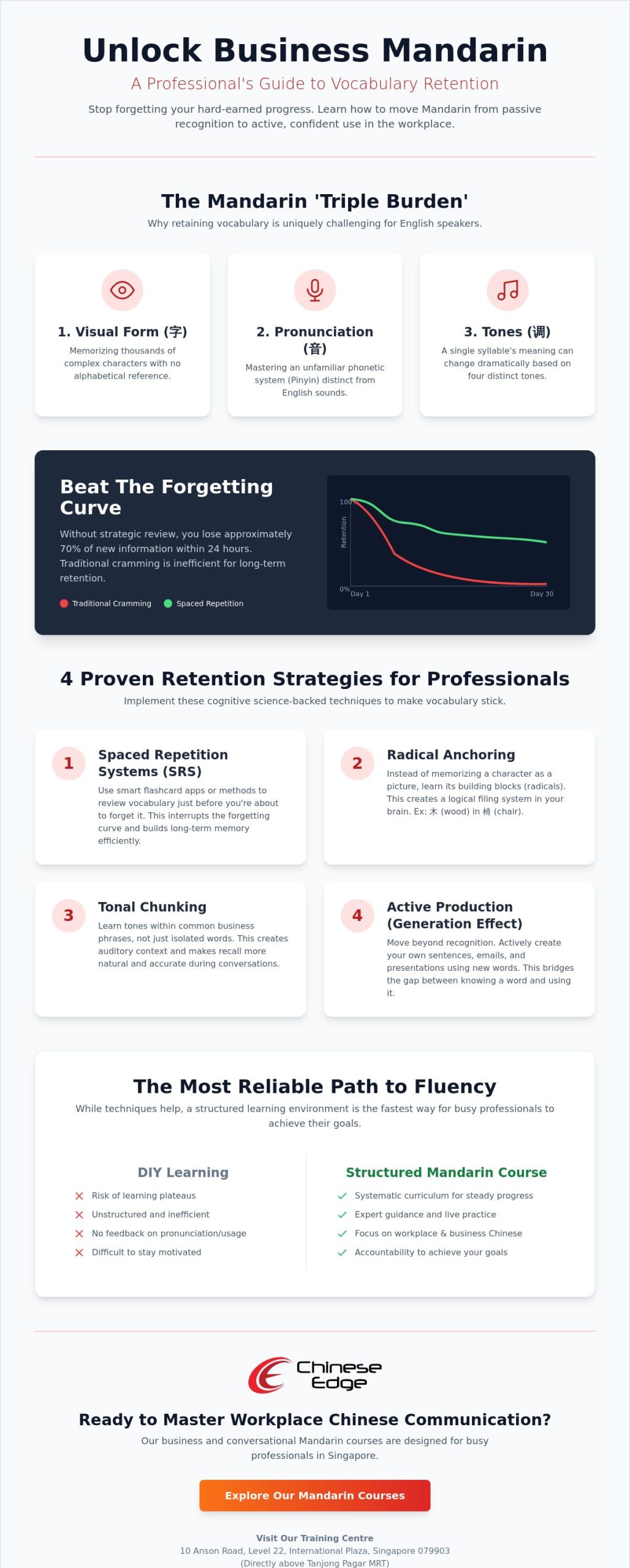
- Understand how to overcome the “Triple Burden” of Mandarin by applying cognitive science to the forgetting curve.
- Discover why Spaced Repetition Systems are the gold standard for moving professional terminology into your long-term memory.
- Master the “Generation Effect” to bridge the gap between passive recognition and active workplace communication.
- Implement actionable tips for retaining mandarin vocabulary that fit a corporate schedule, including utilizing the linguistic landscape near Tanjong Pagar.
- Learn why a structured mandarin course is the most reliable way for professionals to avoid learning plateaus and maintain fluency.
The Science of Forgetting: Why Mandarin Vocabulary Is Hard to Retain
Professionals often find that Mandarin vocabulary slips away just when they need it most. This isn’t a lack of discipline; it’s a result of the “Triple Burden” where you must simultaneously recall the character’s visual form, its Pinyin pronunciation, and its specific tone. Unlike European languages, Mandarin provides no familiar anchors. Most learners fall into the trap of “cramming” before a meeting, but this approach fails because your brain is already saturated with high-level work decisions. True retention requires a methodical approach that respects your cognitive limits. This is why students at 10 Anson Road, level 22, International Plaza, right above Tanjong Pagar MRT, focus on systematic reinforcement rather than short-term memorization.
To understand why words disappear, we look to The Forgetting Curve. This scientific model shows that without structured review, we lose roughly 70% of new information within 24 hours. Because Mandarin is a non-cognate language, this curve is even steeper. You can’t rely on “guessing” meanings based on English roots. This makes finding effective tips for retaining mandarin vocabulary essential for long-term success in any professional setting.
To better understand this concept, watch this helpful video:
Many adult learners confuse recognition with recall. You might recognize a character in a presentation, which is passive memory, but find yourself unable to produce the word during a negotiation, which requires active memory. Passive recognition is a low-level cognitive task, whereas active recall requires a stronger neural pathway. Implementing specific tips for retaining mandarin vocabulary helps bridge this gap. It ensures you aren’t just a spectator in conversations but an active participant who can communicate with authority.
The Lack of Cognates in Mandarin
English speakers can often decipher Spanish or French by identifying shared Latin roots. Mandarin offers no such shortcuts. To build a mental filing system, you must learn radicals. These are the building blocks of characters that signify categories like “water” or “person”. Radical Anchoring is a strategy where you use the semantic component of a character to create a permanent mental hook for its meaning. Understanding these components allows you to categorize new words logically, reducing the mental effort required for long-term storage.
The Role of Tonal Memory
In a professional context, a wrong tone can change “ask” to “kiss,” leading to significant embarrassment. Auditory memory is the foundation of tonal recall. Instead of memorizing tones for isolated words, use “chunking” to learn them within common business phrases. This method reduces mental fatigue and ensures your group chinese courses or private sessions result in workplace-ready communication. By hearing and repeating tones in context, you create a stronger auditory imprint that is much harder to forget than an isolated syllable.
Leveraging Spaced Repetition Systems (SRS) for Corporate Efficiency
Spaced Repetition Systems (SRS) represent the gold standard for professionals aiming to move vocabulary from short-term memory to long-term fluency. While traditional rote memorization relies on brute force, SRS uses cognitive science to maximize efficiency. It is often cited as the secret to learning a language because it targets the precise moment your brain is primed to discard information. By reviewing content at increasing intervals, you reinforce neural pathways with surgical precision, ensuring that the time you spend studying yields the highest possible return on investment.
The core of this methodology lies in predictive algorithms. These digital tools track your performance and schedule reviews for specific characters just before you are likely to forget them. For a busy executive, this means you don’t waste time reviewing words you already know. Instead, you focus your mental energy on challenging professional terminology. To make this sustainable, we recommend “Micro-Learning” sessions. Use your 10-minute commute from Tanjong Pagar MRT or a short break between meetings to complete high-intensity reviews. Consistency is far more valuable than intensity; 10 minutes of daily SRS practice is significantly more effective than a two-hour weekend “cram” session. This disciplined approach is one of the most effective tips for retaining mandarin vocabulary while managing a demanding corporate schedule.
Beyond Flashcards: Sentence Mining
Learning words in isolation is often the fastest way to forget them because the brain lacks context to anchor the meaning. To combat this, we encourage “sentence mining” from your Business Mandarin Course materials. Focus on the “i+1” principle: select sentences where you understand every word except for one new term. This allows your brain to use existing knowledge as a scaffold for the new vocabulary. When you learn a word like “negotiation” within a full sentence about a contract, the professional context serves as a powerful memory trigger during actual workplace communication.
Customizing Your Deck for the Workplace
Generic vocabulary lists often include words that have little relevance to your daily operations. To optimize your retention, prioritize high-frequency business vocabulary that you can use immediately. Create “Personalized Context” by adding notes to your digital flashcards that relate to your specific industry, such as finance, law, or tech. Digital SRS tools allow you to sync your progress across your phone, tablet, and laptop, making it easy for the busy expat to maintain their routine. If you find yourself struggling to stay consistent, joining a structured mandarin course in singapore can provide the necessary accountability to keep your digital reviews on track. This customization ensures that every word you retain has a direct application in your professional life, reducing mental clutter and increasing confidence.
Active Production: The Bridge from Study to Fluency
Consumption alone will not lead to mastery. While reading and listening provide the building blocks, output is the most effective form of reinforcement for the professional brain. This phenomenon is known as the “Generation Effect.” When you actively produce a word, your brain creates significantly stronger neural connections than when you simply hear it. For an executive, this means that speaking a new term during a meeting is worth more than ten hours of passive listening. If you want to see real progress, you must transition from being a consumer of the language to a producer of it.
Many adult learners in Singapore struggle with a psychological barrier: the fear of tonal error. This anxiety often leads to silence, which is the enemy of retention. Avoiding speech because you’re worried about your tones actually accelerates the forgetting process. One of the most practical tips for retaining mandarin vocabulary is to embrace “Mental Labeling” throughout your workday. As you navigate through International Plaza or wait for your train at Tanjong Pagar MRT, mentally name the objects, actions, and professional tasks you see in Mandarin. This low-stakes practice builds the cognitive muscle memory required for high-stakes business negotiations without the pressure of a live audience.
The 24-Hour Rule for New Vocabulary
The window for moving a word into long-term storage is remarkably short. To ensure a new term sticks, you must use it in a real-world conversation within 24 hours of your lesson. This doesn’t require a formal presentation or a complex dialogue. You can force new vocabulary into low-stakes social interactions, such as greeting a colleague or ordering a coffee near our center at 10 Anson Road. Using a word or losing it is a fundamental neurological pathway that determines your eventual fluency.
Auditory Feedback Loops
Retention isn’t just about memory; it’s about accuracy and confidence. Recording your own voice and listening back helps you catch tonal drifts that you might miss in the heat of a conversation. This active listening and self-correction is a core component of any high-quality conversational chinese course. You can also use shadowing techniques, where you mimic the rhythm and intonation of native speakers in real-time. This builds the physical muscle memory in your jaw and tongue, making the vocabulary feel more natural and less like a mental chore. These auditory loops ensure that the professional language you learn today remains available for use tomorrow.
5 Actionable Tips for Daily Mandarin Retention in Singapore
Living in a multilingual hub like Singapore offers a unique advantage that many learners overlook. You don’t need to travel abroad for immersion; it’s available right outside your office door. Implementing practical tips for retaining mandarin vocabulary becomes significantly easier when you utilize the city’s linguistic landscape. By integrating these habits into your existing corporate schedule, you transform mundane tasks into powerful reinforcement exercises.
- Leverage your environment: Stop ignoring the signage at Tanjong Pagar MRT. These official translations provide high-frequency vocabulary in a clear, standardized format that is easy to digest during your commute.
- Mandarin-only coffee breaks: Propose short, focused sessions with colleagues at the cafes around International Plaza. Even fifteen minutes of social chatter reinforces workplace chinese communication.
- The Dictation Method: Write your daily to-do lists in characters. This forces you to recall specific verbs and nouns related to your professional tasks rather than relying on English.
- Passive Immersion: Maximize your transit time with local Chinese business podcasts. Listening to discussions on the Asian economy helps you internalize the rhythm of professional speech.
- The Weekly Anchor: Schedule a weekly Mandarin course to stabilize your progress. A structured environment ensures your self-study remains aligned with international proficiency benchmarks.
Contextual Immersion in the CBD
The Central Business District is a living classroom. International Plaza, located at 10 Anson Road, is surrounded by opportunities to test your retention. Engage service staff in Mandarin when ordering lunch to build real-world confidence. Additionally, scan the headlines of local business news like Lianhe Zaobao. Look for “Keyword Clusters,” which are groups of related terms such as “market volatility” or “investment strategy,” to see how professional vocabulary is used in current reporting.
The Power of Visual Mnemonics
Complex characters require mental “hooks” for memory. Use the “Method of Loci” by mentally placing difficult vocabulary in specific areas of your Singapore office layout. For instance, associate the character for “contract” with your legal department or a specific filing cabinet. Etymology is another secret weapon for the professional. Understanding the history and evolution of a character provides a logical explanation for its structure, making it much harder to forget than a random collection of strokes.
If you are ready to stabilize your progress with expert guidance, explore our Adult Conversational Mandarin Course today to turn these tips into permanent skills.
Why a Structured Course Is Essential for Vocabulary Longevity
Self-study is a productive starting point, but it often lacks the corrective feedback required for high-level professional fluency. Many learners eventually hit a plateau where they recognize characters but fail to use them accurately in real-time. This is where fossilized errors often take root. These are mistakes in grammar or tone that become deeply ingrained because they aren’t corrected early by an expert. Without a native-speaking mentor to identify these subtle mistakes, your progress can stall. A structured group chinese course provides the social accountability and expert oversight necessary to transform passive knowledge into active, reliable skill. It ensures that your linguistic foundation is solid before you move on to more complex business terminology.
Relying solely on digital tools or self-led books can make it difficult to maintain a long-term routine. While earlier sections discussed various tips for retaining mandarin vocabulary, a formal class serves as the ultimate anchor for these habits. It creates a dedicated space where you’re forced to produce the language under professional guidance. The group dynamic also introduces a healthy level of peer pressure. Seeing your colleagues or peers progress can be a powerful motivator during those weeks when your work schedule is particularly demanding. This environment is crucial for building the confidence needed for workplace chinese communication, where precision and cultural nuance are non-negotiable. You aren’t just learning words; you’re learning how to command a room in a second language.
The Chinese Edge Methodology
Our approach prioritizes practical, conversational application over dry academic theory. We understand that professionals need results that translate to the boardroom, not just a passing grade on a written test. Our native instructors facilitate active recall in every session, ensuring that you aren’t just absorbing information but generating it. We use real-world business scenarios to ensure the vocabulary stays relevant to your career. This curriculum is designed specifically for adult learners in Singapore, focusing on the vocabulary and scenarios you encounter in your daily operations. It bridges the gap between a textbook and a live negotiation.
Convenient Learning at International Plaza
Accessibility is a vital component of consistency. If a class is difficult to reach, you’re more likely to skip it. Our training center is located at 10 Anson Road, level 22, International Plaza, Singapore 079903, situated right above Tanjong Pagar MRT. This central location in the heart of the CBD allows you to attend a mandarin course before or after your working hours without disrupting your professional schedule. You can step out of the office and into a learning environment in minutes. We invite you to join a trial session to experience our retention-focused approach firsthand and see how a structured environment can accelerate your path to fluency.
Master Professional Mandarin Through Strategic Retention
Mastering a language as complex as Mandarin requires more than just exposure; it demands a strategic alignment with how your brain stores information. By moving beyond passive recognition and embracing active production, you bridge the gap between studying and speaking. These tips for retaining mandarin vocabulary, from leveraging Spaced Repetition Systems to utilizing the linguistic landscape of the CBD, provide a sustainable framework for any busy professional. You’ve seen that consistency beats intensity. Now, it’s time to apply these methods to your daily corporate routine.
True fluency is an attainable goal when you have the right support structure. While self-study provides a foundation, a structured environment ensures your progress doesn’t plateau. At Chinese Edge, we provide a curriculum optimized for adult professional learners, delivered by native-speaking instructors with extensive corporate experience. Our center at 10 Anson Road, level 22, International Plaza, is conveniently located right above Tanjong Pagar MRT, making it easy to fit lessons into your busy workday. We take pride in being a reliable partner in your professional growth.
Join our Adult Conversational Mandarin Course at International Plaza today and start communicating with confidence in every professional setting. You have the tools and the methodology; now it’s time to take the next step in your linguistic journey. Your path to professional fluency starts here.
Frequently Asked Questions
How many Mandarin words should I learn per day for maximum retention?
You should aim for 5 to 10 new words per day to ensure long term retention without cognitive burnout. For busy professionals, quality always outweighs quantity in a sustainable learning routine. Focusing on a smaller set of high frequency terms allows you to apply the production techniques discussed earlier. Overloading your mental capacity often leads to the forgetting curve acting more aggressively on your memory.
Is it better to learn characters or Pinyin first for long term memory?
You should learn Pinyin and characters simultaneously to build a comprehensive neural map of the language. While Pinyin provides the phonetic bridge, characters offer the semantic depth necessary for long term memory. Relying solely on Pinyin creates a ceiling that prevents you from reading professional documents or recognizing signs at Tanjong Pagar MRT. Mastering both ensures you don’t confuse homophones during workplace chinese communication.
Why do I forget Mandarin tones even when I remember the word meaning?
Tones are often forgotten because they are processed in a different part of the brain than semantic meaning. This tonal drift happens when you treat the tone as an optional add on rather than an integral part of the word’s identity. To fix this, use auditory feedback loops and record yourself speaking during your mandarin course. Remembering the meaning without the tone is only half the battle in a professional setting.
Can I retain Mandarin vocabulary if I only study once a week?
Retaining vocabulary requires daily engagement even if it is only for ten minutes at a time. Studying once a week allows the forgetting curve to erase most of your progress before your next session. If you can only attend a mandarin class singapore once a week, you must supplement it with daily micro learning. Use your commute or breaks to review your SRS deck to keep the neural pathways active.
What are the best apps for retaining Mandarin vocabulary in 2026?
In 2026, the most effective tools for retention are those utilizing advanced Spaced Repetition Systems like Skritter for characters and Pleco for dictionary based learning. HelloChinese remains a strong choice for beginners to learn chinese through gamified context. These apps provide excellent tips for retaining mandarin vocabulary by automating the review schedule. However, they work best when used as a supplement to a structured conversational chinese course.
How does Business Mandarin differ from Conversational Mandarin in terms of retention?
Business Mandarin focuses on specialized keyword clusters and formal registers that require more precise retention than casual social Chinese. While conversational Mandarin relies on high frequency daily verbs, business courses emphasize industry specific terminology and formal etiquette. Retention in a corporate mandarin training context is often higher because the vocabulary is immediately applied in high stakes meetings, providing a powerful emotional anchor for memory.
Should I focus on reading or speaking to help words stick better?
Speaking is generally superior for memory reinforcement because it involves active production and physical muscle memory. While reading builds recognition, speaking forces your brain to retrieve information under pressure, which is the ultimate test of retention. Combining both through shadowing techniques ensures you build a balanced skill set. This dual approach is a core feature of any effective chinese course singapore.
What is the role of radicals in remembering Chinese characters?
Radicals serve as the semantic filing system for your brain, providing logical hooks for complex characters. Instead of seeing a random arrangement of strokes, you see components that represent water, fire, or people. Understanding radicals is one of the most essential tips for retaining mandarin vocabulary because it allows you to categorize and predict the meaning of new words. This systematic approach reduces the visual memory burden significantly.
Disclaimer
Disclaimer
The Chinese articles on this website are provided for general information and learning purposes only. While we strive for accuracy, we make no guarantees regarding completeness or reliability. The content does not constitute professional advice, and we are not liable for any loss arising from its use. External links or third-party content are for reference only. By using this website, you agree to this disclaimer.