

You might think living in a city where over 75% of the population is ethnically Chinese makes fluency a given, but Singapore’s linguistic efficiency is actually your biggest hurdle. Since English is the primary language for nearly half the population, it’s far too easy to stay in a comfortable bubble. You likely feel the frustration of reverting to English at a hawker center or staying silent when a client switches to Mandarin. Many professionals find it difficult to maintain progress because they lack consistent practice partners in a corporate environment.
This guide explains exactly how to practice mandarin daily in Singapore by turning your existing routine into a high-impact learning environment. You’ll discover how to integrate micro-habits into your daily schedule and master workplace chinese communication. Whether you’re looking for a conversational chinese course or a structured business chinese course, our methodology focuses on real-world application. We’ll show you how to learn chinese effectively, even during your commute to our professional training space at 10 Anson Road, level 22, International Plaza, right above Tanjong Pagar MRT. By the end of this article, you’ll have a clear roadmap to ensure your next mandarin class singapore leads to genuine conversational confidence.
Key Takeaways
- Learn why consistent 15-minute micro-immersion sessions are more effective for fluency than long weekly cramming sessions.
- Discover how to practice mandarin daily in Singapore by turning routine lunch orders at Maxwell or International Plaza into active learning opportunities.
- Improve your workplace chinese communication by identifying informal “Mandarin moments” during office breaks and professional email exchanges.
- Develop a high-impact 15-minute routine that leverages your MRT commute to Tanjong Pagar for audio drills and listening practice.
- Find out how a structured mandarin course provides the professional correction needed to bridge the gap between casual conversation and business proficiency.
Why Practicing Mandarin Daily in Singapore is Your Key to Fluency
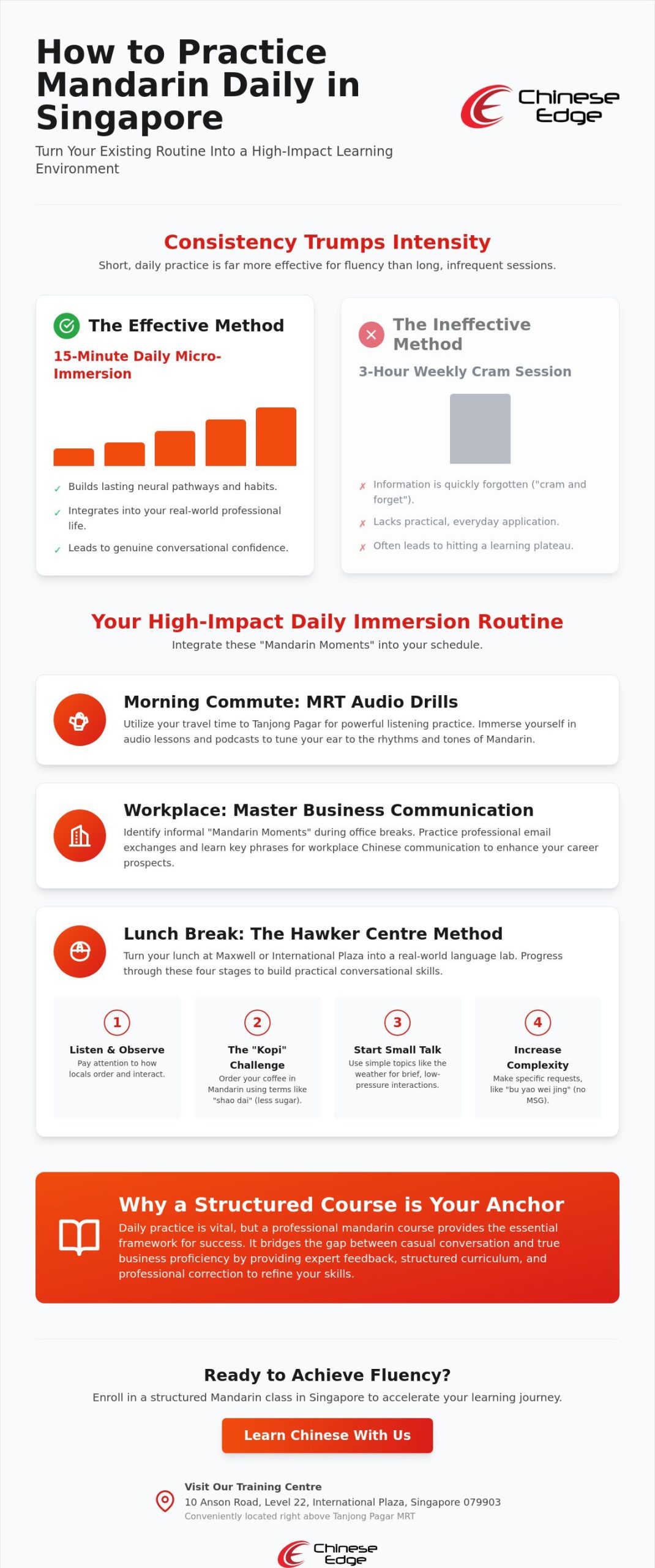
Living in Singapore offers a unique paradox for language learners. While the sounds of Mandarin are everywhere, the sheer convenience of English acts as a barrier to real progress. This is the “English-First” trap. It’s why many professionals hit a plateau after only a few months of study. Learning how to practice mandarin daily in Singapore requires a shift toward “Micro-Immersion.” This approach proves that 15 minutes of daily local interaction is significantly more effective than a three-hour weekly cram session. By making Mandarin a functional part of your day, you move beyond “survival mode” and toward genuine conversational confidence.
To better understand how these daily habits lead to success, watch this helpful breakdown of language learning hacks:
The Psychology of the Language Switch
Overcoming the fear of “losing face” is essential for any professional. Making small mistakes at a local coffee shop or market is your most valuable learning tool. Understanding how to practice mandarin daily in Singapore also involves managing the psychological transition between different speech styles. You’ll need to navigate the nuances of Singaporean Mandarin, which often blends local dialects with standard structures. Moving from Singlish-influenced speech to professional grammar requires a disciplined approach. In a high-pressure city like ours, consistency always beats intensity.
Mandarin as a Career Catalyst in Singapore
By 2026, regional headquarters in Singapore will increasingly prioritize bilingual talent for leadership roles. Developing a “language-first” mindset allows you to connect more deeply with regional partners and clients. If you’re searching for a mandarin course near the CBD, our center at 10 Anson Road, level 22, International Plaza, right above Tanjong Pagar MRT, provides the structured environment needed for this growth. Daily practice compounds into professional authority by demonstrating a deep commitment to cultural nuance and clear communication.
The Hawker Center Method: Real-World Conversational Practice
Your daily lunch break is more than just a meal; it’s a high-frequency training ground. If you want to master how to practice mandarin daily in Singapore, you must step into the city’s hawker centers with a strategic mindset. These hubs offer a low-stakes environment where you can test your skills away from the pressure of the boardroom. It’s about turning a routine activity into a practical language lab.
Begin with Step 1: Listening Mode. Spend five minutes at Maxwell or Amoy Street Food Centre simply observing how locals interact. Pay attention to the rhythm of their speech and the specific shorthand they use to order. Next, take Step 2: The “Kopi” Challenge. Instead of ordering your morning coffee in English, use Mandarin descriptors like “shao dai” (less sugar) or “re de” (hot). This small switch builds the neural pathways needed for spontaneous speech.
As you get comfortable, move to Step 3: Small talk with “Uncles” and “Aunties.” Use the weather or the quality of the food as an easy entry point. These interactions are brief, making them perfect for busy professionals. Finally, reach Step 4 by increasing complexity. Try asking for specific dietary adjustments, such as “bu yao wei jing” (no MSG) or “shao yao” (less oil), entirely in Mandarin. This progression ensures you aren’t just memorizing scripts but actually communicating needs.
Essential Phrases for Daily Interactions
Mastering numbers and currency is the foundation of seamless transactions. When you can calculate change and prices mentally in Mandarin, your confidence in local shops will soar. Use polite particles and social cues to make your speech sound more natural and respectful. If a vendor replies in English, don’t automatically revert. Continue in Mandarin politely; they’ll often recognize your effort and switch back to help you practice.
From Survival to Social
Building rapport with service staff helps you practice repetitive, high-frequency vocabulary. Use the “Point and Name” technique: point to an item, ask for its name in Mandarin, and repeat it back immediately. This expands your noun database in real-time. For those who need a structured list of foundational phrases before heading out, our Adult Conversational Mandarin Course provides the perfect academic anchor. Practicing these micro-interactions daily ensures that your skills remain sharp between your formal lessons at International Plaza, right above Tanjong Pagar MRT.
Mastering Workplace Chinese Communication in the CBD
While the hawker center provides a foundation for casual speech, the office is where you refine your professional identity. For many executives, the challenge isn’t a lack of vocabulary but a lack of confidence to use it in a high-stakes environment. Learning how to practice mandarin daily in Singapore within your workplace requires identifying “Mandarin Moments.” These are low-pressure windows, such as a quick chat in the pantry or informal talk during a team lunch, where you can switch from English to Mandarin without disrupting the flow of business. These micro-interactions build the muscle memory needed for more formal scenarios.
Navigating bilingual emails is another practical way to integrate the language into your routine. You don’t need to write an entire proposal in Mandarin to make an impact. Using professional greetings like “Zun jing de” (Respected) or specific sign-offs such as “Zhu gong zuo shun li” (Wishing you success in your work) signals cultural competence to regional partners. This subtle integration is a core component of business chinese singapore, helping you build rapport before a meeting even begins. When you use industry-specific terminology naturally, you move away from sounding like a textbook and start sounding like a local peer.
Professional Etiquette and Tones
In a business pitch, a single misplaced tone can alter the entire meaning of your sentence. This is why professional correction is vital. Our Expert Mentor approach at 10 Anson Road, level 22, International Plaza, ensures that you practice these nuances in a safe environment. Instructors simulate real-world Singaporean business scenarios, from contract negotiations to client presentations. If your organization values collective growth, corporate mandarin training offers a structured way for teams to practice together right above Tanjong Pagar MRT. This group dynamic creates a supportive ecosystem that encourages daily usage among colleagues.
Networking in Mandarin
Networking events in Singapore are often bilingual. Having a standard introduction ready in Mandarin allows you to bridge the gap with Chinese-speaking clients immediately. Simple questions about a colleague’s weekend or the status of a project can be handled in conversational Mandarin to build deeper social bonds. Understanding how to practice mandarin daily in Singapore means recognizing that every interaction is a chance to refine your pitch. Workplace Chinese communication is the definitive skill that will distinguish high-performing leaders in Singapore’s 2026 international business environment.
Building a 15-Minute Daily Immersion Routine for Busy Professionals
For a professional working in the heart of the CBD, time is the most valuable commodity. You don’t need hours of free time to see results. Fifteen minutes sounds negligible, yet when applied consistently, it transforms your linguistic capacity. The secret to how to practice mandarin daily in Singapore lies in stacking small habits onto your existing schedule. This method ensures that your progress doesn’t stall when your workload increases. It’s about making the language an unavoidable part of your environment rather than a separate task on your to-do list.
Your morning MRT ride to Tanjong Pagar is the perfect window for five minutes of audio drills. Listening to professional podcasts helps you internalize the rhythm of native speech before you even reach the office. During your lunch hour, spend five minutes in “active listening” mode. Whether you’re at the hawker stalls inside International Plaza or nearby at Tanjong Pagar Plaza, focus on the specific vocabulary used by others. Finally, dedicate the last five minutes of your day to reviewing notes from your mandarin course. This evening review solidifies what you’ve learned and prepares your brain for the next day’s interactions.
Digital Tools for the Singaporean Learner
Modern learners have a significant advantage with mobile technology. Use apps that allow you to toggle between traditional and simplified characters, as both are visible in various Singaporean contexts. If your schedule is too unpredictable for physical travel, online mandarin classes singapore offer the flexibility to maintain your routine from any location. You can also set “Language Alarms” on your phone. These are hourly reminders that prompt you to spend just 60 seconds thinking or speaking a sentence in Mandarin, keeping the language at the front of your mind throughout the day.
Leveraging Your Surroundings
Singapore’s infrastructure is a living textbook for those who know where to look. Every MRT sign and public notice is a character recognition exercise waiting to happen. Try reading the Mandarin translation of government posters before looking at the English text. For auditory practice, tune into local radio stations like Capital 958 during your commute. This exposes you to the specific speed and accent used in local news and business reports. Following a structured roadmap for learning chinese ensures these daily efforts lead toward a clear goal. If you’re ready to accelerate this journey with professional guidance, visit our training center at International Plaza for a conversational chinese course today.
Structured Support: Why a Mandarin Course in Singapore is the Anchor
Daily immersion is a powerful tool, but without a formal framework, learners often find themselves repeating the same errors. This is where many self-taught professionals hit a wall. They develop “Broken Mandarin” because they lack the real-time correction that only a professional environment provides. If you’re committed to learning how to practice mandarin daily in Singapore, a structured course serves as your necessary anchor. It provides the grammatical skeleton upon which you can hang your daily interactions at the hawker center or the office. Without this foundation, your progress may plateau despite your best efforts at micro-immersion.
Our native-speaking instructors bring more than just linguistic expertise; they possess a deep understanding of the Singaporean corporate landscape. They know how to bridge the gap between casual speech and the high-stakes communication required in the CBD. By attending a conversational chinese course, you gain access to an Expert Mentor who ensures your daily practice remains accurate and professional. This structured support prevents the habituation of mistakes, ensuring that the 15 minutes you spend practicing each day actually moves you closer to fluency.
The Chinese Edge Advantage
We prioritize small group sizes to maximize your speaking time. This ensures you receive personalized feedback on your tones and sentence structures during every session. Our curriculum is designed exclusively for adults and professionals. You won’t find any primary school topics here; every lesson focuses on real-world application and workplace chinese communication. We also offer flexible scheduling to accommodate the busy lives of our students. You can transition between in-person sessions and online Mandarin classes as your work week demands, ensuring you never miss a beat in your learning journey.
Visit Our Training Center
Convenience is vital to maintaining a long-term habit. Our training center is located at 10 Anson Road, level 22, International Plaza, Singapore 079903. Being situated right above Tanjong Pagar MRT makes it the ideal “mandarin class near me” for those working in the city. You can finish your workday and step directly into a supportive learning environment without a lengthy commute. This physical presence in the heart of the business district reflects our commitment to serving the professional community. Understanding how to practice mandarin daily in Singapore becomes much simpler when your training center is a natural part of your CBD routine. We invite you to join a trial session today to kickstart your daily practice habit and experience our methodical approach firsthand.
Accelerate Your Professional Fluency in 2026
Achieving fluency in Singapore’s English-centric environment requires more than passive listening. It demands a strategy built on micro-habits and real-world application. By identifying “Mandarin Moments” in your daily CBD routine and utilizing the Hawker Center Method, you turn every interaction into a learning opportunity. Consistency is vital, but professional correction is the anchor that prevents the habituation of errors. Understanding how to practice mandarin daily in Singapore is the first step toward transforming your career prospects and building genuine conversational confidence.
To ensure your progress remains disciplined and accurate, work with native-speaking instructors who possess deep corporate experience. Our specialized curriculum for adult learners is designed to bridge the gap between classroom theory and workplace reality. Visit us at our prime CBD location, 10 Anson Road, level 22, International Plaza, right above Tanjong Pagar MRT. Take the next step in your linguistic journey and Join our Adult Conversational Mandarin Course at Tanjong Pagar today! With the right methodology and steady support, professional fluency is an attainable goal.
Frequently Asked Questions
How can I practice Mandarin if my colleagues only want to speak English?
Initiate small, low-pressure switches during the day. Use Mandarin for morning greetings, coffee runs, or simple internal chat messages. This is a highly effective way of how to practice mandarin daily in Singapore without disrupting the professional workflow. If you demonstrate a consistent commitment to the language, your colleagues will often reciprocate by helping you practice during lunch breaks or informal pantry talks.
Is it better to learn simplified or traditional characters for use in Singapore?
Simplified characters are the primary standard used in Singapore. While traditional characters appear in certain cultural or historical contexts, all official business, government communications, and news media utilize the simplified system. A professional mandarin course singapore will prioritize simplified characters to ensure your reading and writing skills align with the local corporate environment.
How long does it take to become conversational in Mandarin with 15 minutes of daily practice?
Consistency is the most critical factor for success. With 15 minutes of focused daily practice supplemented by a weekly conversational chinese course, most adult learners achieve basic conversational proficiency within six to nine months. This methodical approach to how to practice mandarin daily in Singapore ensures that you build sustainable habits and retain information better than through irregular, intensive study sessions.
Are there specific Mandarin meetups for professionals in the Singapore CBD?
Many professional networking groups operate within the Tanjong Pagar district. You’ll find that informal language exchange often happens during lunch hours at International Plaza or nearby social mixers. Our training center at 10 Anson Road, level 22, serves as a central hub for those seeking a mandarin class singapore to connect with other like-minded professionals right above Tanjong Pagar MRT.
What are the most common mistakes English speakers make when practicing Mandarin daily?
Neglecting tones and applying English sentence structures to Mandarin are the most frequent errors. These mistakes can lead to significant misunderstandings in a professional setting. Receiving expert feedback during a business chinese course is essential to correct these habits early. Our instructors focus on workplace chinese communication to ensure your speech is both accurate and culturally appropriate.
Can I learn Mandarin effectively through online classes while working in Singapore?
Online training is an excellent solution for busy executives. Our online classes provide the same academic rigor and native-speaker interaction as our in-person sessions, allowing you to learn chinese from your office or home. This flexibility is vital for professionals who need to maintain their learning rhythm despite an unpredictable work schedule.
How do I overcome the fear of speaking Mandarin to strangers at a hawker center?
Focus on the transaction rather than your performance. Hawker vendors value efficiency, so using short, functional phrases is a perfect, low-stakes way to build your confidence. Start with simple drink orders before moving to more complex food requests. This gradual exposure helps you manage the psychological barrier of “losing face” while practicing in a real-world environment.
Why should I choose a structured course over just using language apps?
Apps often lack the nuanced correction and cultural context required for professional fluency. A structured mandarin course provides the “Expert Mentor” guidance needed to master complex workplace chinese communication. Real-time feedback from native speakers at our International Plaza center ensures you develop a sophisticated vocabulary rather than just memorizing basic, disconnected phrases.
Disclaimer
Disclaimer
The Chinese articles on this website are provided for general information and learning purposes only. While we strive for accuracy, we make no guarantees regarding completeness or reliability. The content does not constitute professional advice, and we are not liable for any loss arising from its use. External links or third-party content are for reference only. By using this website, you agree to this disclaimer.