

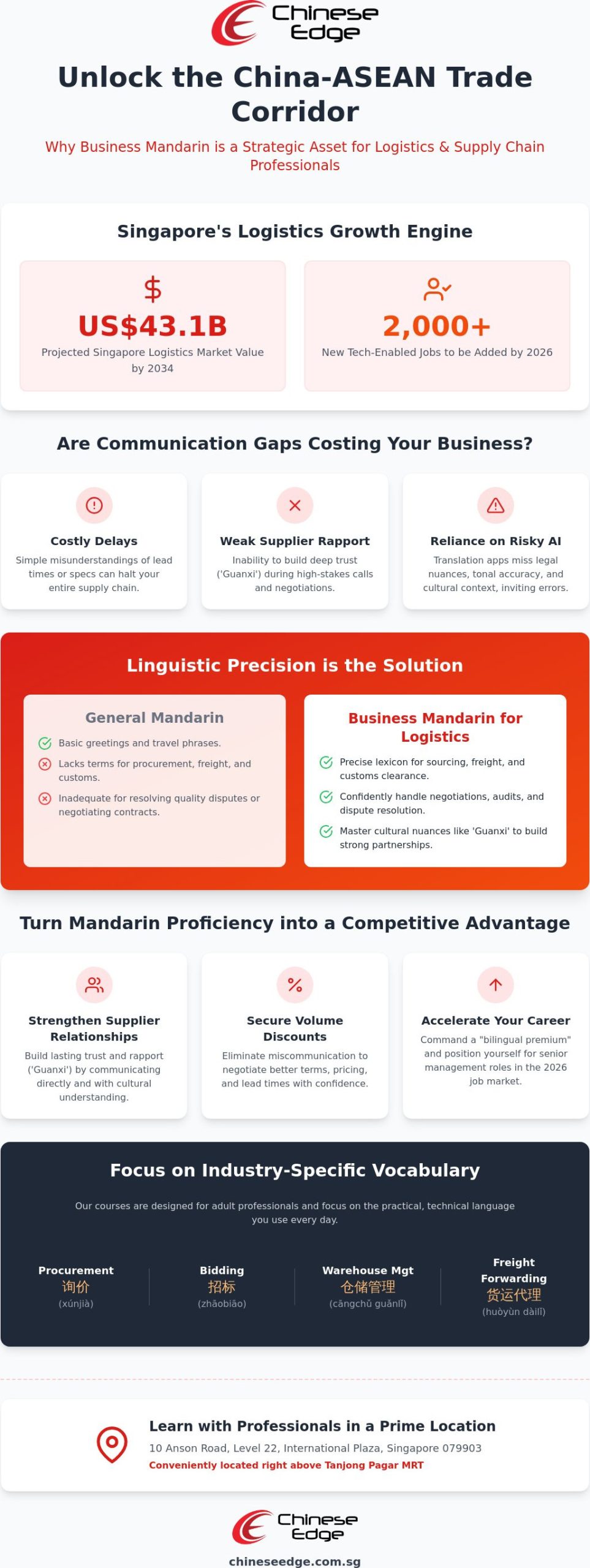
Did you know the Singapore logistics market is projected to reach a value of US$43.1 billion by 2034? As our local industry adds 2,000 new, tech-enabled jobs by 2026, the ability to communicate with precision in the Singapore-China trade corridor is no longer just a soft skill; it’s a strategic operational asset. You’ve likely experienced the stress of costly delays caused by a simple misunderstanding of lead times or felt the frustration of being unable to build deep rapport with a key supplier during a high-stakes call. It’s common to feel “lost in translation” when the pressure is on, but these communication gaps don’t have to be a permanent barrier to your success.
Mastering business mandarin for logistics and supply chain is the most effective way to eliminate these bottlenecks and secure the volume discounts your business deserves. At our training center located at 10 Anson Road, level 22, International Plaza, right above Tanjong Pagar MRT, we help professionals bridge this linguistic gap with confidence and academic rigor. This guide provides a comprehensive roadmap to the essential terminology and cultural nuances you need for successful supplier audits and negotiations. We’ll break down industry-specific vocabulary and share proven methods to turn your Mandarin proficiency into a measurable competitive advantage in 2026.
Key Takeaways
- Understand why linguistic precision is a strategic operational asset for Singapore professionals navigating the China-ASEAN trade corridor in 2026.
- Gain a competitive edge by mastering technical Mandarin terms for procurement, warehouse management, and freight forwarding that general courses often overlook.
- Learn how to apply the cultural concept of ‘Guanxi’ to strengthen supplier relationships and handle high-stakes negotiations with confidence.
- Identify the key features of an effective business mandarin for logistics and supply chain program designed specifically for the needs of adult professionals.
- Discover how specialized training at 10 Anson Road, International Plaza, right above Tanjong Pagar MRT, can eliminate miscommunication and streamline your global supply chain.
Why Business Mandarin is the Missing Link in Singapore’s 2026 Supply Chains
Singapore serves as the critical bilingual gateway for the China-ASEAN trade corridor. While many professionals rely on basic translation tools, the complexity of China’s transport system requires more than just high-school level vocabulary. Misinterpreting a single term in a bill of lading or a warehouse agreement can lead to delays that ripple through the entire supply chain. In 2026, proficiency in business mandarin for logistics and supply chain has transitioned from an optional advantage to a fundamental tool for operational efficiency. When you can speak the language of your suppliers, you eliminate the friction that usually slows down procurement cycles.
To better understand the scale and speed of modern logistics operations, watch this helpful video:
General conversational Mandarin often fails when procurement stakes are high. Knowing how to order food won’t help you resolve a quality dispute or negotiate a lead time extension during a high-pressure call. A specialized business chinese course focuses on the specific lexicon of sourcing, freight forwarding, and customs clearance. This precision ensures that your instructions are followed exactly, reducing the risk of expensive errors. We’ve seen cases where a simple misunderstanding of “lead time” versus “transit time” resulted in thousands of dollars in lost retail revenue. Linguistic precision is the ultimate safeguard against these preventable costs.
The Shift from Translation Apps to Linguistic Precision
Relying on AI translation often invites significant risk. Algorithms frequently miss the legal nuances of Incoterms or the specific clauses in force majeure agreements. Tonal accuracy is another critical factor; a slight mispronunciation can change the meaning of technical terms entirely. Moving toward effective workplace chinese communication means understanding the intent behind the words. It allows you to catch errors before they leave the warehouse floor, ensuring that your corporate mandarin training translates into real-world results.
Career Advancement for Bilingual Supply Chain Professionals
The Singapore logistics job market in 2026 highly values professionals who can bridge the gap between regional offices and partners in mainland China, Taiwan, and Hong Kong. Professionals who complete a specialized mandarin course often command a “bilingual premium” because they can manage complex regional projects without external translators. By enrolling in a mandarin course singapore at our center at 10 Anson Road, level 22, International Plaza, you position yourself for senior management roles. Our location right above Tanjong Pagar MRT makes it easy for busy professionals to attend classes after work and build the trust necessary for long-term Guanxi with international stakeholders.
Essential Mandarin Terminology for Procurement and Warehouse Management
Success in regional trade depends on your ability to handle technical details without a translator. In 2026, Singaporean professionals are increasingly expected to manage the entire sourcing lifecycle using precise terminology. Mastering business mandarin for logistics and supply chain begins with the Request for Quotation (询价 – xúnjià) and the bidding process (招标 – zhāobiāo). Understanding these terms allows you to vet suppliers more effectively and ensures that your requirements aren’t lost in a sea of generic translations. By integrating business mandarin for logistics and supply chain into your professional toolkit, you demonstrate a level of commitment that often leads to better pricing and priority service.
Key Phrases for Procurement Managers
Effective procurement relies on three pillars: timing, cost, and quality. You must be able to discuss the ‘lead time’ (交货期 – jiāohuò qī) and ‘unit price’ (单价 – dānjià) with absolute clarity to avoid inventory stockouts. When negotiating volume discounts, it’s vital to clarify ‘payment terms’ (付款条件 – fùkuǎn tiáojiàn) to manage your cash flow. Beyond the numbers, Navigating Cultural Nuances in Chinese Sourcing is critical when establishing ‘quality control’ (质量控制 – zhìliàng kòngzhì) benchmarks. If you don’t set these expectations early in Mandarin, you risk receiving sub-standard batches that can derail your entire production schedule.
Navigating Logistics and Shipping Documents
Managing a warehouse or a distribution network requires a deep understanding of standard shipping documentation. You should be familiar with terms like ‘Bill of Lading’ (提单 – tídān), ‘Packing List’ (装箱单 – zhuāngxiāng dān), and ‘Certificate of Origin’ (原产地证明 – yuánchǎndì zhèngmíng). In the context of 2026’s digital logistics, you’ll also need to communicate regarding ‘just-in-time’ delivery (准时制生产 – zhǔnshí zhì shēngchǎn) to maintain lean operations. Understanding how Incoterms are applied in a Chinese business environment helps you avoid unexpected liability gaps during transit. If you’re looking to sharpen these skills, joining a mandarin course singapore can provide the structured practice you need.
The logistics landscape is also shifting toward sustainability. You’ll likely encounter terms like ‘green supply chain’ (绿色供应链 – lǜsè gōngyìngliàn) and ‘carbon footprint’ (碳足迹 – tàn zújì) during supplier audits. Professionals who can navigate these digital and environmental trends in Mandarin are becoming indispensable assets to their firms. If you want to master these high-level discussions, consider exploring the specialized training at Chinese Edge, located at 10 Anson Road, level 22, International Plaza, Singapore 079903, right above Tanjong Pagar MRT.
Navigating Cultural Nuances in Chinese Sourcing and Logistics Negotiations
In the Singaporean business context, a signed contract is often viewed as the final step. However, for those managing a supply chain in the Greater China region, the contract is merely the baseline. Success depends on ‘Guanxi’ (关系), a complex system of social networks and reciprocal influence. For professionals using business mandarin for logistics and supply chain, Guanxi isn’t just a buzzword; it’s an operational strategy that ensures your orders are prioritized when factory capacity is tight. Research confirms The Strategic Role of Mandarin as a necessity for multinational firms to strengthen partner relationships and improve efficiency.
Building Long-Term Supplier Relationships
Effective workplace chinese communication often happens outside the boardroom. In 2026, the ‘pre-meeting’ on WeChat is where the real decisions are made. A specialized business chinese course helps you navigate these informal channels while respecting social hierarchies. When you conduct an on-site factory audit, your ability to participate in a supplier dinner with proper banquet etiquette signals that you aren’t just a buyer, but a partner. Knowing when to offer a modest gift or how to toast the factory manager can be more influential than a hundred emails. These social nuances are a core part of our corporate mandarin training programs.
Negotiation Tactics for Supply Chain Leads
Negotiating price or lead times requires a deep understanding of ‘Mianzi’ (Face). Directly pointing out a supplier’s error can cause them to ‘lose face’, leading to defensive behavior and further delays. Instead, use Mandarin to signal your commitment to a long-term partnership while indirectly addressing the issue. Establishing linguistic rapport with factory owners can lead to a 10-15% reduction in sourcing costs through better volume discounts and waived molding fees. This level of nuance is why many professionals look for a mandarin course singapore that focuses on high-stakes business environments.
Conflict resolution is another area where cultural fluency pays off. If a shipment is late, avoid aggressive legal threats immediately. Use your mandarin course skills to ask about the challenges the factory is facing. This ‘Art of the No’ involves interpreting indirect communication to find the root cause of quality issues without damaging the relationship. Our training center at 10 Anson Road, level 22, International Plaza, Singapore 079903, is located right above Tanjong Pagar MRT, making it easy for you to master these skills. Whether you choose a conversational chinese course or a more technical program, we provide the tools to lead negotiations with confidence.
Choosing the Right Business Chinese Course for Logistics Professionals
Selecting the right program is a critical decision for your career trajectory. Many institutions in Singapore offer generalized diplomas that span six to twenty-four months, but logistics professionals often require more immediate, targeted results. A high-quality business mandarin for logistics and supply chain course should prioritize technical vocabulary over basic social pleasantries. You need a curriculum that mirrors your daily operations, from managing procurement cycles to resolving warehouse discrepancies. Learning in an adult-only environment also ensures that you are surrounded by peers who share your professional challenges. This provides networking opportunities that a standard classroom cannot offer. It’s about finding a partner that understands the high-stakes nature of your work.
The expertise of your trainer is just as important as the curriculum. Native-speaking instructors with actual corporate experience can provide context that a textbook simply can’t. They understand the subtle differences between formal written agreements and the informal workplace chinese communication used on factory floors. When your trainer has a background in international trade, they can guide you through the nuances of negotiation and conflict resolution discussed in previous sections. This practical approach ensures that every hour you spend in a mandarin course contributes directly to your operational efficiency.
Flexible Learning for Busy Professionals
Logistics roles often involve unpredictable schedules and frequent travel for site audits. If you’re constantly on the move, online mandarin classes offer the flexibility to learn from any location without sacrificing quality. You can pair technical training with a conversational chinese course to build the rapport needed for successful supplier dinners. Setting realistic goals is essential. You don’t need to be a literary scholar; you need to be a functional, confident communicator in a professional setting. Our chinese for professionals programs are designed to take you from zero to hero in specific, manageable stages.
Corporate Training Solutions for Logistics Teams
For firms looking to upskill entire departments, corporate mandarin training offers the best return on investment. Customizing a mandarin course singapore for your procurement or operations team ensures everyone uses standardized terminology, which significantly reduces internal errors. Measuring the ROI becomes simple when you see a reduction in miscommunication-related delays. Integrating these classes into annual development goals shows a commitment to global excellence. If you want to streamline your team’s communication, consider our tailored business chinese course options at International Plaza.
Our training center is conveniently located at 10 Anson Road, level 22, International Plaza, Singapore 079903, right above Tanjong Pagar MRT. This central location makes it easy for professionals in the CBD to attend sessions before or after work. Whether you prefer in-person interaction or the convenience of digital platforms, we provide a structured path to fluency. It’s time to stop feeling lost in translation and start leading your supply chain with linguistic precision. To find the perfect fit for your schedule, you can learn chinese with our expert mentors today.
Mastering Workplace Chinese Communication with Chinese Edge
Achieving fluency in business mandarin for logistics and supply chain requires a training partner that understands the high-velocity nature of your industry. At Chinese Edge, we’ve designed our curriculum to move beyond rote memorisation, focusing instead on the practical application of language in real-world procurement and distribution scenarios. Our boutique school is located at 10 Anson Road, level 22, International Plaza, Singapore 079903, situated right above Tanjong Pagar MRT. This strategic placement in the Central Business District allows you to transition seamlessly from your office to our classrooms. We maintain a strict focus on adult learners, ensuring that your learning environment is professional, quiet, and free from the distractions of general language programmes for younger students.
Why Singapore Professionals Choose Chinese Edge
Professionals choose our mandarin course singapore because we strike a balance between academic rigor and modern accessibility. Our native-speaking trainers are more than just teachers; they act as expert mentors who understand the intricacies of the Singapore business context. By keeping our group sizes small, we guarantee that you receive the speaking practice necessary to lead a high-stakes meeting or a factory audit with confidence. This interaction is vital for mastering the tonal accuracy required in workplace chinese communication. If you’re ready to enhance your professional toolkit, you can check the latest schedule for our Group Chinese Courses to find a start date that aligns with your project timelines.
Start Your Professional Mandarin Journey Today
Starting your journey toward linguistic precision is a straightforward process designed for busy schedules. We offer a variety of learning modes, including online mandarin classes for those who travel frequently and in-person sessions for those who value face-to-face networking. For firms looking to upskill their operations teams, our corporate mandarin training provides a structured way to reduce miscommunication and improve supply chain resilience. You can book a trial lesson or a corporate consultation today to experience our results-oriented approach first-hand.
Future-proofing your logistics career in 2026 means being able to communicate effectively across borders. Don’t let a language barrier limit your growth; join us at International Plaza and master the Mandarin skills you need to lead in the global marketplace. Whether you’re looking for a conversational chinese course to improve social rapport or a technical business chinese course to manage complex contracts, we provide a reliable path to success. We’re here to support your growth every step of the way, ensuring that fluency is an attainable and rewarding goal.
Future-Proof Your Supply Chain Strategy for 2026
The landscape of global trade is shifting toward deeper integration within the China-ASEAN corridor. Professionals who possess a mastery of business mandarin for logistics and supply chain will be the ones leading this transition. By securing your technical vocabulary and understanding the unspoken cultural rules of negotiation, you don’t just avoid delays; you create a measurable competitive advantage for your firm. Your ability to communicate with precision is your most valuable asset when navigating complex warehouse agreements or building long-term Guanxi with regional suppliers.
We invite you to take the next step in your professional development at our 100% adult-focused learning center. Our native-speaking trainers bring real-world corporate experience to every lesson, ensuring your training is immediately applicable to your daily operations. We are located at 10 Anson Road, level 22, International Plaza, conveniently situated right above Tanjong Pagar MRT. Elevate your logistics career with our Business Chinese Course at Tanjong Pagar today and bridge the gap to your next professional milestone. Success in the international marketplace is well within your reach.
Frequently Asked Questions
Is a business chinese course better than a general mandarin course for logistics?
A specialized business chinese course is significantly more effective because it prioritizes the technical lexicon of global trade. While a general course focuses on daily social interactions, a specialized program ensures you can navigate complex shipping documentation and operational agreements. This targeted approach saves valuable time by skipping irrelevant topics and focusing on the phrases you’ll actually use during a warehouse audit or a high-stakes negotiation.
How long does it take to learn logistics-specific Mandarin for a beginner?
Beginners can usually achieve functional proficiency in logistics-specific terms within 20 to 40 hours of structured study. While full fluency takes longer, mastering the core vocabulary for business mandarin for logistics and supply chain allows you to handle basic procurement tasks quickly. Our methodical approach ensures you build a solid foundation that you can immediately apply to your workplace interactions and supplier communications.
Can I take online mandarin classes if I travel frequently for supplier audits?
Yes, our online mandarin classes are specifically designed to accommodate the erratic schedules of supply chain professionals. If you’re traveling for factory audits or visiting regional hubs, you can join your sessions from any location with an internet connection. This flexibility ensures that your progress remains consistent; you don’t have to worry about missing lessons when your job requires you to be away from Singapore.
What are the most important Mandarin terms for procurement managers to know?
Procurement managers should prioritize terms related to the sourcing lifecycle, such as bidding processes and contract specifications. Understanding phrases for quality assurance and liability is essential for effective risk management. Mastering these terms in a mandarin course allows you to vet suppliers with greater precision; it ensures that technical requirements are fully understood by all parties before any production or shipping begins.
Do you offer corporate mandarin training specifically for logistics companies in Singapore?
We provide customized corporate mandarin training tailored to the unique operational needs of logistics and supply chain firms. These programs can be delivered at your office or our training center at 10 Anson Road, level 22, International Plaza. By training your entire team together, you ensure standardized communication across your procurement and operations departments, which significantly reduces internal errors and improves overall efficiency.
How does learning Mandarin help with supplier relationship management (Guanxi)?
Proficiency in Mandarin allows you to engage directly with stakeholders, which is the cornerstone of building strong Guanxi. When you speak the language, you show a level of respect and commitment that a translator cannot convey. This direct rapport often leads to better transparency regarding production challenges. It also results in more favorable outcomes during difficult negotiations or when resolving sensitive lead time disputes.
Are the classes at International Plaza suitable for working professionals?
Our training center is ideally suited for professionals, as it’s located at 10 Anson Road, level 22, International Plaza, right above Tanjong Pagar MRT. We offer flexible class timings that fit before or after standard office hours in the CBD. The 100% adult-oriented environment ensures that you can study alongside other motivated professionals, fostering a serious and productive atmosphere that respects your time and professional goals.
What is the difference between conversational chinese and business chinese for professionals?
A conversational chinese course focuses on informal social skills, while business chinese for professionals emphasizes formal address and industry-specific jargon. While conversational skills are great for building initial rapport, business-level training ensures you can handle formal presentations and complex problem-solving. Both are valuable, but professional training provides the linguistic precision required for high-stakes business mandarin for logistics and supply chain management.
Disclaimer
Disclaimer
The Chinese articles on this website are provided for general information and learning purposes only. While we strive for accuracy, we make no guarantees regarding completeness or reliability. The content does not constitute professional advice, and we are not liable for any loss arising from its use. External links or third-party content are for reference only. By using this website, you agree to this disclaimer.