
Bilingual IT engineers in Singapore are currently commanding salary premiums of up to 18 percent compared to their monolingual peers. You probably already know that general language classes don’t provide the specific vocabulary needed for a structural briefing or a complex software deployment. To truly excel, you need specialized technical mandarin for engineers in Singapore that goes beyond simple greetings. It is frustrating when you can handle basic conversation but struggle to explain system architecture bottlenecks to your regional headquarters.
This professional guide will show you how to master these linguistic tools, helping you bridge the gap between basic speech and industry-specific fluency. By focusing on the precise jargon and communication protocols used in the 2026 tech landscape, you can gain the confidence to lead high-stakes meetings and secure senior roles in the city’s most competitive firms.
We will examine the essential terminology for modern engineering, effective strategies for workplace communication, and how our specialized training at 10 Anson Road, level 22, International Plaza, Singapore 079903, right above Tanjong Pagar MRT, provides the structured support you need to excel.
Key Takeaways
- Understand why Singapore’s growth as a regional R&D hub makes technical mandarin for engineers in Singapore a vital strategic skill for 2026.
- Learn to distinguish between general conversational phrases and the specialized syntax required for complex engineering documentation and briefings.
- Recognize the professional risks of relying on social Mandarin during high-stakes technical negotiations or system architecture discussions.
- Implement a structured roadmap to audit your industry-specific vocabulary and select a training program that aligns with your technical niche.
- Discover how a business mandarin course designed for professionals can provide the linguistic tools needed to lead regional teams and secure senior-level roles.
The Rising Demand for Technical Mandarin in Singapore’s Engineering Sector
Singapore’s engineering landscape has undergone a significant transformation as we move through 2026. The city-state has solidified its position as the primary strategic bridge between North Asian tech giants and the global market. While English remains the primary language of administration, Mandarin is one of the four official languages of Singapore and has become the functional language of innovation for many regional teams. The influx of R&D centers from tech hubs like Shenzhen and Beijing into the Tanjong Pagar and Jurong corridors has changed the hiring criteria for senior technical roles. Engineers are no longer just expected to code or design; they are expected to communicate across borders with precision.
To better understand how specific terminology applies in a field like civil or structural engineering, watch this helpful video:
Singapore as a Regional Tech Hub
The growth of AI and semiconductor manufacturing in Singapore has created a unique linguistic demand. Many regional headquarters now require engineers to act as the primary point of contact for cross-border technical communication. If you are working in a semiconductor lab or a data center, you aren’t just managing hardware. You are acting as the linguistic frontline for corporate expansion. This shift means that technical mandarin for engineers in Singapore is no longer a “nice-to-have” skill. It’s a fundamental requirement for anyone aiming to bridge the gap between high-level design in China and local implementation in Southeast Asia. The Jurong Innovation District and the Tanjong Pagar commercial hub have seen a 2026 surge in specialized R&D facilities that prioritize bilingual talent.
The Career ROI of Professional Mandarin
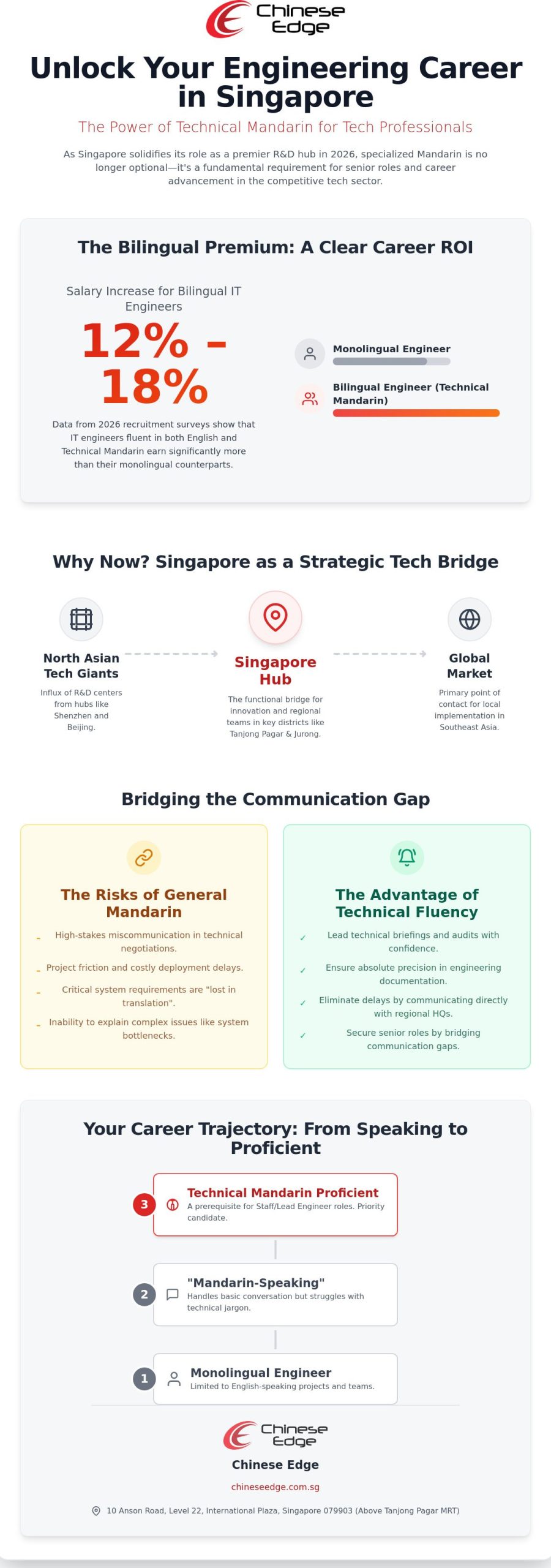
Data from recruitment surveys in 2026 indicates a clear “bilingual premium” for tech professionals. IT engineers who are fluent in both English and Mandarin can earn between 12% and 18% more than their monolingual counterparts. This isn’t just about being able to order lunch. It’s about reducing project friction. When you can lead a technical briefing without a translator, you eliminate deployment delays and ensure that complex system requirements aren’t lost in translation. This is why technical mandarin for engineers in Singapore has become a prerequisite for Staff and Lead Engineer roles.
Hiring managers in the Tanjong Pagar tech belt often prioritize candidates who are “Technical Mandarin Proficient.” This level of fluency allows you to navigate high-stakes negotiations and technical audits with confidence. If you want to join these high-earning ranks, a structured group chinese course can provide the foundational rigor needed to master professional syntax. Moving from “Mandarin-speaking” to “Technical Mandarin Proficient” is the most direct path to career advancement in today’s market.
Decoding Technical Mandarin: Essential Vocabulary for Modern Engineers
Technical Mandarin is the intersection of engineering principles and specialized Chinese linguistics. Unlike conversational speech, this professional subset of the language focuses on standardizing nomenclature to ensure absolute precision across global engineering teams. In a high-stakes environment, a minor misunderstanding regarding system states or material specifications can lead to costly delays or safety compromises. Mastering technical mandarin for engineers in Singapore allows you to move beyond basic translation and into the realm of functional, high-level technical collaboration.
Standardizing how your team describes complex systems is a primary goal of professional training. Whether you’re working in a data center in Jurong or an R&D lab in Tanjong Pagar, using the correct professional syntax establishes your authority. This linguistic accuracy is increasingly recognized as one of the most in-demand skills for the engineering sector according to recent national industry reports. Professionals who can articulate system requirements clearly are the ones who lead regional projects.
Software Engineering and AI Terminology
In the software world, precision is everything. You don’t just talk about “making it work”; you discuss “backend architecture” (后端架构) and “API integration” (API 集成). When your team addresses “latency” (延迟) or “scalability” (可扩展性), using the formal professional terms ensures that the deployment remains stable. You’ll also need to navigate the nuances of local tech slang versus formal documentation. While developers might use shorthand in a Slack channel, your official briefings must remain rigorous. Many developers find that they learn better in a structured group environment where they can practice these specific AI and software phrases with peers.
Construction and Infrastructure Vocabulary
For engineers in the physical sectors, the vocabulary shifts toward structural and safety requirements. Terms like “structural integrity” (结构完整性) and “safety protocols” (安全协议) are essential when communicating with regional contractors or material suppliers. Reviewing “project blueprints” (项目蓝图) requires more than just looking at drawings; it requires the ability to discuss Singapore-specific standards and building codes in Mandarin. If you can’t explain a compliance issue to a regional headquarters, you risk project friction. Bridging this gap is a core component of technical mandarin for engineers in Singapore, ensuring that every bolt and beam meets the required specification.
If you’re ready to start mastering these essential terms, you can find our training center at 10 Anson Road, level 22, International Plaza, Singapore 079903, located right above Tanjong Pagar MRT. Taking the step to join a business mandarin course tailored for your industry is the most effective way to ensure your skills remain relevant in the 2026 market.
General vs. Technical Mandarin: Why Standard Courses Aren’t Enough
Ordering a coffee at a local cafe requires a vastly different linguistic toolkit than troubleshooting a failing server cluster in a high-security data center. While a standard conversational chinese course provides the foundation for daily life, it rarely equips you with the specialized vocabulary needed for a structural briefing. Relying on “social Mandarin” during high-stakes technical negotiations is a professional risk that can lead to costly misunderstandings. General vocabulary often fails to describe the complex logic and physical mechanics inherent in 2026 engineering projects.
Transitioning from basic speech to professional application requires a targeted approach. If you aim to lead regional teams, you must move beyond the limitations of standard language programs. This is why technical mandarin for engineers in Singapore is treated as a specialized skill set rather than a general elective. You need to communicate system states and material tolerances with absolute clarity to maintain your professional authority. A generic mandarin course might cover travel and dining, but it won’t help you explain a logic gate failure or a load-bearing discrepancy.
HSK Levels vs. Workplace Proficiency
Academic benchmarks like HSK 4 or 5 are excellent for establishing grammar, but they often leave an engineer struggling in a technical scrum. These levels focus on social fluency rather than the “Business Mandarin” frameworks required for complex engineering reports. To stay competitive, many professionals are participating in the national movement for continual upskilling to gain functional fluency. This means prioritizing the ability to explain “multimodal capabilities” or “structural load” over general academic topics. If you want to learn chinese that actually impacts your career, you need a curriculum that mirrors your workplace reality.
The Danger of Miscommunication in Engineering
In the engineering sector, precision is the difference between success and failure. Small linguistic errors in technical syntax can lead to large-scale technical failures or deployment delays. For instance, a slight confusion between “series” and “parallel” in an electrical system isn’t just a grammar slip; it’s a critical safety hazard. Beyond the technical jargon, you must also navigate the culture gap in professional etiquette. Learning how to deliver a technical critique without causing a “loss of face” is essential for smooth cross-border collaboration. This nuanced business chinese course approach ensures that your workplace chinese communication remains both effective and respectful.
Our training center at 10 Anson Road, level 22, International Plaza, Singapore 079903, right above Tanjong Pagar MRT, provides the disciplined environment needed to master these nuances. We focus on the practical application of the language, ensuring that every lesson contributes directly to your professional growth in the engineering field.
A 5-Step Roadmap to Mastering Technical Mandarin for Singapore Professionals
Transitioning from general awareness to professional competence requires a disciplined strategy. Mastering technical mandarin for engineers in Singapore is a journey that moves from passive understanding to active leadership in technical scrums. You don’t need to be a linguist to succeed; you need a structured framework that respects your time and mirrors your workplace reality. This roadmap provides the specific steps necessary to bridge the gap between basic conversation and high-level engineering communication.
- Step 1: Audit your specific technical niche. Identify the core vocabulary you use daily, whether it’s structural load calculations or API endpoints.
- Step 2: Enroll in a Business Mandarin Course tailored for professionals. This ensures your learning is grounded in workplace chinese communication rather than general travel phrases.
- Step 3: Practice documentation translation. Take your existing technical reports and attempt to draft summaries in Mandarin to build your professional syntax.
- Step 4: Engage in role-play technical scrums. Simulate project presentations or troubleshooting sessions with peers to build your confidence under pressure.
- Step 5: Seek feedback from native-speaking technical mentors. Use your workplace interactions as a feedback loop to refine your industry-specific phrasing.
Leveraging Professional Training
Speed is a critical factor in the 2026 job market. While self-study apps are useful for basic vocabulary, they lack the nuance required for corporate Singapore culture. Enrolling in structured Mandarin classes in Singapore is significantly faster because it provides immediate feedback from instructors who understand the engineering mindset. Our training center at 10 Anson Road, level 22, International Plaza, Singapore 079903, right above Tanjong Pagar MRT, offers an environment where you can balance online training with in-person professional networking.
Immersive Technical Learning
To truly excel, you should supplement your lessons with immersive technical content. Reading Chinese technical blogs like CSDN or Zhihu keeps you updated on the latest industry trends and the specific jargon used by developers in Beijing and Shenzhen. Attending bilingual tech meetups in the Tanjong Pagar area is another excellent way to practice your technical mandarin for engineers in Singapore in a low-stakes social setting. We recommend creating a personal technical glossary for your specific role to track the phrases that provide the most value in your daily meetings.
If you’re ready to advance your career and secure those high-paying bilingual roles, it’s time to take the first step. You can explore our group chinese courses to find a schedule that fits your professional life.
Professional Training at Chinese Edge: Tailored for Singapore’s Tech Talent
Mastering the nuances of technical mandarin for engineers in Singapore requires more than just a standard vocabulary list. It demands a curriculum designed with the engineering mindset in view. At Chinese Edge, we recognize that professionals in the tech and infrastructure sectors value logic, structure, and practical application. Our Mandarin courses are built to bridge the gap between academic theory and the high-pressure reality of a regional technical briefing. We don’t just teach you how to speak; we teach you how to lead in a bilingual professional environment.
Our focus is exclusively on adult learners and corporate clients. We understand that your time is a finite resource, especially when managing complex project deadlines. This is why our training center is strategically located at 10 Anson Road, level 22, International Plaza, Singapore 079903. Situated right above Tanjong Pagar MRT, our facility is easily accessible for those working in the central business district or the surrounding tech corridors. Whether you prefer a mandarin course in a group setting or private sessions, our methodical approach ensures that every hour spent in the classroom translates to improved workplace performance.
Corporate Solutions for Engineering Firms
For organizations looking to upskill their entire workforce, we offer specialized corporate mandarin training. These solutions are customized to your firm’s specific niche, whether you’re focusing on civil engineering, AI development, or semiconductor manufacturing. We provide flexible delivery options, including on-site training at your office or online mandarin classes to accommodate regional teams. By establishing professional communication benchmarks, we help firms measure progress and ensure that their engineers can handle technical mandarin for engineers in Singapore with absolute precision. This reduces the risk of project friction and enhances your company’s competitive edge in the North Asian market.
Why Choose Chinese Edge?
Success in professional language learning depends on the quality of instruction. Our native-speaking instructors aren’t just language experts; they have backgrounds in business and technical fields. This allows them to provide the “Expert Mentor” guidance that adult learners need to achieve rapid professional fluency. We use a result-oriented curriculum that prioritizes functional application over abstract grammar. You’ll find a steady support system here that treats your career advancement as our primary objective.
Choosing the right business mandarin course is a strategic investment in your future. If you’re looking for a chinese course singapore professionals trust, we invite you to visit our Tanjong Pagar center. Let us help you master the linguistic tools needed to excel in the 2026 engineering landscape.
Elevate Your Engineering Career in 2026
The 2026 job market is rewarding those who bridge the gap between technical expertise and linguistic precision. You’ve seen how Singapore’s role as a regional tech hub makes specialized communication indispensable for senior roles. Moving beyond basic conversational skills is the most effective way to secure a seat at the table during high-stakes regional briefings. Mastering technical mandarin for engineers in Singapore isn’t just about learning new words; it’s about gaining the confidence to lead complex projects across borders.
Our specialized Business Mandarin curriculum is designed specifically for the analytical mind. With expert native-speaking mentors and a results-oriented approach, we provide the steady support you need to achieve professional fluency. Our training center is conveniently located at 10 Anson Road, level 22, International Plaza, right above Tanjong Pagar MRT. This makes it easy for busy professionals to integrate learning into their daily schedules without disruption.
Take the next step in your professional growth today. Master Technical Mandarin with Chinese Edge today and position yourself at the forefront of Singapore’s engineering sector. Your path to bilingual leadership starts with a single, decisive step.
Frequently Asked Questions
Is technical Mandarin harder to learn than conversational Mandarin?
Technical Mandarin is not necessarily more difficult, but it requires a higher degree of precision and specific focus. While a conversational chinese course helps with social interactions, technical language is built on logical industry frameworks that many engineers find intuitive once they understand the underlying syntax. The challenge lies in mastering standardized nomenclature rather than the broad, informal vocabulary used in daily life.
How long does it take an engineer to become proficient in technical Mandarin?
Proficiency usually takes six months to a year of disciplined study, though many students see a measurable impact on their workplace chinese communication within the first 20 hours of training. Achieving the level of fluency needed to lead a technical briefing or manage a regional deployment depends on your starting level and your commitment to practicing industry-specific scrums and reports.
Do I need to know Chinese characters for technical roles in Singapore?
Recognizing Chinese characters is a significant professional advantage for reading technical specifications, project blueprints, and regional documentation. While verbal communication is vital for meetings, being able to decode written software requirements or safety protocols without a translator establishes your authority. Mastering character recognition for your specific engineering niche ensures you can navigate official reports with confidence.
Are there specific Mandarin courses for software engineers in Singapore?
Yes, our curriculum includes specialized modules designed for the software and AI sectors. These lessons focus on the jargon used in backend architecture, API integration, and multimodal system capabilities. This targeted approach ensures that you are learning technical mandarin for engineers in Singapore that applies directly to your daily development environment and regional headquarters briefings.
Can I learn technical Mandarin online through Chinese Edge?
You can certainly master these skills through our online mandarin classes, which offer the same rigorous curriculum as our in-person sessions. This flexibility is ideal for engineers managing tight project deadlines or those who prefer remote training. Each session is led by our expert mentors, providing the same result-oriented experience you would receive at our center near Tanjong Pagar MRT.
What are the most in-demand engineering sectors for Mandarin speakers in 2026?
The AI development, semiconductor manufacturing, and sustainable infrastructure sectors are currently seeing the highest demand for bilingual talent. As R&D centers continue to expand in the Jurong and Tanjong Pagar corridors, firms are prioritizing candidates who can handle technical mandarin for engineers in Singapore. These high-growth fields offer the most significant salary premiums for professionals who can bridge the gap between global headquarters and local teams.
Disclaimer
Disclaimer
The Chinese articles on this website are provided for general information and learning purposes only. While we strive for accuracy, we make no guarantees regarding completeness or reliability. The content does not constitute professional advice, and we are not liable for any loss arising from its use. External links or third-party content are for reference only. By using this website, you agree to this disclaimer.