

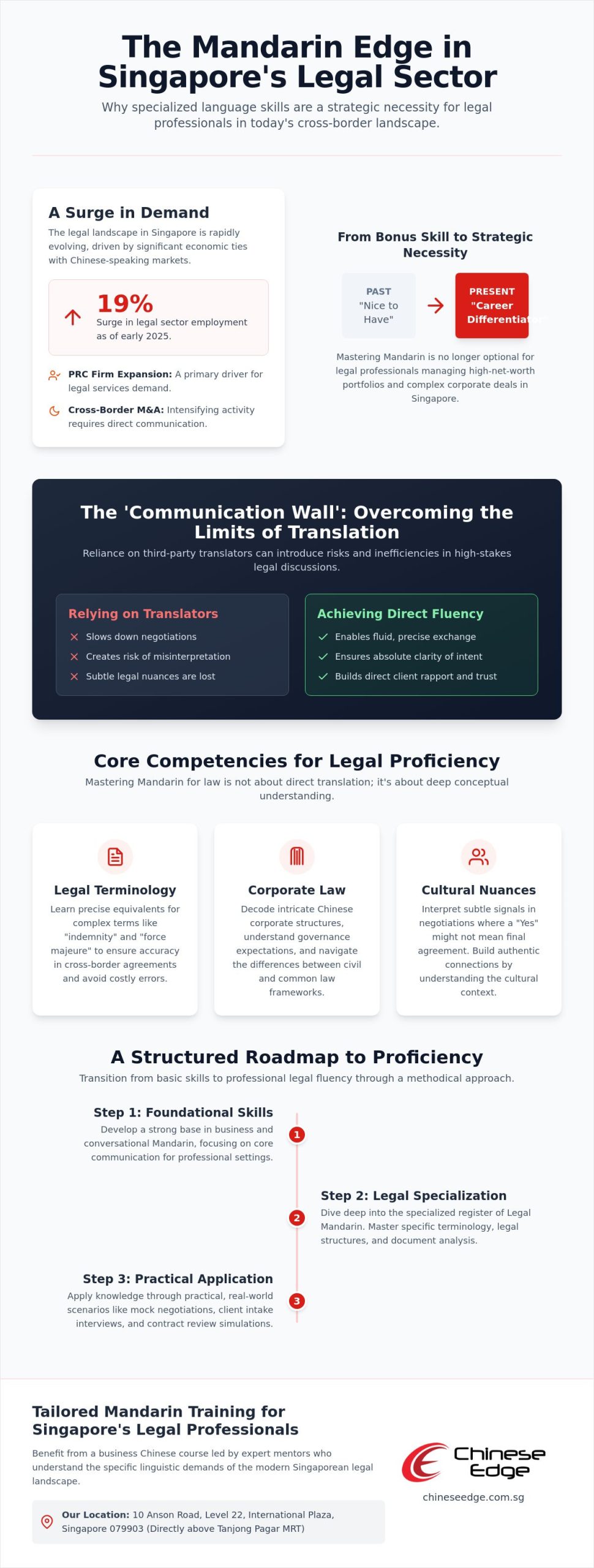
Did you know that employment in Singapore’s legal sector surged by 19% in early 2025? As PRC firms expand their footprint and cross-border M&A activity intensifies, the ability to communicate without a translator has become a critical career differentiator. Mastering mandarin for legal professionals Singapore is no longer just a bonus; it’s a strategic necessity for those managing high-net-worth portfolios and complex corporate structures. You likely feel the pressure of building direct rapport with Chinese-speaking clients while fearing the risks of misinterpreting technical legal terms. It’s difficult to find the time for a general mandarin course when your schedule is dictated by back-to-back hearings and closings.
This guide will show you how to bridge that gap by focusing on specialized terminology and cultural nuances that build immediate trust. We’ll explore how to conduct intake interviews with confidence, decode intricate Chinese corporate structures, and lead negotiations with precision. Whether you are looking for a business chinese course at our center at 10 Anson Road, level 22, International Plaza, Singapore 079903, located right above Tanjong Pagar MRT, or searching for chinese classes near me to improve your chinese for professionals, professional fluency is an attainable goal through our structured, results-oriented approach.
Key Takeaways
- Understand how Singapore’s position as a regional hub for Chinese corporate expansion makes mandarin for legal professionals Singapore a vital tool for career progression.
- Master specialized vocabulary for contract law, including precise equivalents for “indemnity” and “force majeure,” to ensure accuracy in cross-border agreements.
- Learn to navigate high-stakes negotiations by interpreting subtle cultural signals where a “Yes” might not always signify a final legal agreement.
- Develop a practical roadmap to transition from basic conversational skills to professional legal proficiency through a structured and methodical learning approach.
- Benefit from a business chinese course led by expert mentors who understand the specific linguistic demands of the modern Singaporean legal landscape.
The Growing Necessity of Mandarin for Legal Professionals in Singapore
Singapore has cemented its status as the primary gateway for Chinese enterprises looking to scale into Southeast Asia. With Mandarin being one of the official languages of Singapore, the ability to interpret and negotiate in this tongue is a high-value asset. While English remains the language of the courts, the commercial reality in 2026 is that many multi-million dollar deals originate from Chinese-speaking stakeholders. Relying on third-party translators often creates a “communication wall” that slows down the pace of high-stakes discussions. It can lead to subtle but dangerous misinterpretations of intent. When you speak the language yourself, you remove the filter, allowing for a more fluid and precise exchange of legal ideas.
To better understand how the legal landscape is evolving with new technology and linguistic demands, watch this discussion on the future of Singapore’s courts:
It is vital to distinguish between general conversational skills and professional proficiency. Legal Mandarin is a specialized register. It requires a deep understanding of civil law terminology used in Mainland China versus the common law framework used here. Without this specific training, a lawyer might understand the words but miss the legal weight behind them. Mastering mandarin for legal professionals Singapore provides a clear competitive advantage, allowing you to offer seamless advisory services that resonate with a client’s native logic.
Bridging the Gap in Cross-Border Transactions
Handling M&A and venture capital deals involves more than just reading a contract. You need to understand the underlying corporate governance and the specific expectations of Chinese investors. Direct communication in high-stakes dispute resolution ensures that no nuance is lost in the heat of a negotiation. Mandarin fluency serves as a critical risk-management tool by ensuring that legal advice is delivered and understood with absolute clarity.
Building Direct Client Trust
Rapport in the legal sector is rarely built in formal boardrooms alone. It often happens during “off-the-record” conversations where a translator would be intrusive. Demonstrating language proficiency shows a profound respect for the client’s cultural background. It positions your firm as a specialized partner rather than just another service provider. If you are looking to join a mandarin course specifically designed for busy professionals, our boutique school at 10 Anson Road, level 22, International Plaza, Singapore 079903, right above Tanjong Pagar MRT, offers the structured environment you need to succeed.
Core Competencies: Navigating Legal Terminology and Corporate Law
To excel in the competitive Singaporean legal market, you must understand that translating legal concepts isn’t a word-for-word process. It’s about conceptual mapping. Mastering mandarin for legal professionals Singapore requires a deep dive into the structural differences between civil law systems and the common law framework used here. If you use a general term where a specific legal noun is required, you risk misrepresenting the entire scope of a client’s liability. Many practitioners find that a structured Business Mandarin for Legal Professionals approach helps them avoid the common pitfalls of literal translation by providing a clear bridge between these two worlds.
Navigating corporate law also means mastering the vocabulary of specific entities. You’ll need to discuss Wholly Foreign-Owned Enterprises (WFOEs), Joint Ventures (JVs), and State-Owned Enterprises (SOEs) with precision. Understanding these nuances allows you to advise clients on cross-border compliance without the friction of a language barrier. For those looking to refine these skills, joining a mandarin course tailored for the workplace can provide the disciplined environment necessary for mastery. Our training center at 10 Anson Road, level 22, International Plaza, Singapore 079903, is conveniently located right above Tanjong Pagar MRT, making it easy for busy lawyers to attend sessions between meetings.
Contractual Language and Drafting
Translating complex legal concepts without losing the original intent is perhaps the greatest challenge in legal drafting. A common pitfall involves the translation of “shalls” and “mays.” In Mandarin, using yīngdāng (应当) versus kěyǐ (可以) can fundamentally change the nature of a contractual obligation. You must also be able to review standard Chinese business contracts to identify underlying risks, such as vague “force majeure” clauses or poorly defined “indemnity” equivalents. Precise language ensures that your client’s interests are protected in every clause.
Intellectual Property and Compliance
Protecting intellectual property in Chinese-speaking regions requires a specific set of terminology for trademark protection and patent filings. You’ll need to navigate compliance and regulatory frameworks that often use language distinct from everyday business talk. While a general business term might describe an “agreement” broadly, a legal noun specifically defines the “enforceable obligation” within a statutory framework. If you’re ready to elevate your practice, you might consider how a specialized business chinese course can help you navigate these high-stakes regulatory environments with absolute confidence.
- Civil Litigation: Key phrases for courtroom decorum and mediation settings.
- Arbitration: Specific vocabulary for international dispute resolution protocols.
- Regulatory Filings: Standardized terms for submitting documents to regional authorities.
Beyond Translation: Mastering Cultural Nuances in Legal Negotiations
Legal excellence in Singapore’s cross-border market isn’t just about knowing the law. It’s about knowing the person across the table. When you study mandarin for legal professionals Singapore, you’re learning a sophisticated communication strategy rather than just a vocabulary list. Many practitioners make the mistake of assuming that a perfect literal translation is enough. In reality, a direct translation of a legal demand can sometimes feel abrasive or confrontational, leading to unnecessary negotiation deadlocks. Understanding the cultural logic behind the language allows you to frame your legal arguments in a way that invites cooperation rather than resistance.
In the context of legal settlements, two concepts reign supreme: Mianzi (Face) and Guanxi (Relationships). If you challenge a counterparty too aggressively in front of their subordinates, you damage their Mianzi. This often results in a defensive stance that has little to do with the legal merits of the case. Similarly, Guanxi isn’t just about networking; it’s a foundational trust that must be nurtured before a pen even touches the paper. The importance of Mandarin education in Singapore’s professional landscape is rooted in this need to bridge cultural divides to ensure commercial success.
The Art of the Chinese Negotiation
One of the most common pitfalls for lawyers is misinterpreting an affirmative response. In a Chinese negotiation, a “Yes” often signifies “I hear you” or “I understand your point,” rather than “I agree to this specific clause.” You must also be sensitive to the hierarchy of the room. Decisions are rarely made by the most vocal person; they often rest with the senior figure who may remain quiet for most of the meeting. Addressing individuals with formal titles and using the polite “Nin” (您) instead of the casual “Ni” (你) demonstrates a level of professional respect that can de-escalate tension during contentious disputes.
Ethical and Professional Etiquette
Building rapport often happens outside the boardroom. While you must always adhere to your firm’s compliance standards, understanding the social expectations of dining and gift-giving is essential. A lawyer’s role often extends to being a cultural bridge during these social interactions. If you’re interested in refining these skills, our guide on Business Chinese in Singapore provides deeper insights into professional fluency. Our boutique school at 10 Anson Road, level 22, International Plaza, Singapore 079903, located right above Tanjong Pagar MRT, offers a results-oriented environment where you can master these nuances through a structured mandarin course designed for the legal industry.
Practical Roadmap: How Singapore Lawyers Can Master Mandarin Efficiently
Mastering mandarin for legal professionals Singapore requires a disciplined roadmap that respects the unpredictable nature of a lawyer’s schedule. You don’t need to become a linguist overnight. The goal is to move from basic conversational skills to a state of “legal proficiency” where you can handle client intake and understand the gist of regional corporate filings. Choosing between group classes and one-on-one private coaching depends entirely on your specific practice needs. While group sessions offer a collaborative environment, private coaching allows you to focus exclusively on the terminology relevant to your current caseload.
Flexible Learning for Busy Practitioners
If your days are consumed by court appearances and back-to-back hearings, Online Mandarin Classes are often the most practical solution. These sessions provide the flexibility to learn from your office or home without the need for a commute. You can also leverage your travel time by using auditory legal Mandarin immersion tools, turning your morning transit into a productive study session. For those who prefer a deeper dive, weekend intensive sessions offer rapid progress by allowing you to focus without the distraction of daily billable tasks.
Corporate Training for Law Firms
Many forward-thinking firms now opt for Group Chinese Courses specifically customized for their practice groups. A banking associate needs a different vocabulary set than a family lawyer or a criminal defense attorney. We can tailor a curriculum that addresses these specific nuances, ensuring the training is immediately applicable to your workplace Chinese communication. On-site training at your firm maximizes associate participation and fosters a culture of continuous professional development. If you are looking for a center in the heart of the CBD, our facility at 10 Anson Road, level 22, International Plaza, Singapore 079903, right above Tanjong Pagar MRT, is perfectly positioned for your team.
Integrating Mandarin into your daily workflow is the final piece of the puzzle. Start by reading headlines from regional financial news or drafting short, internal emails in Mandarin to build muscle memory. If you’re ready to take the next step in your professional growth, explore our specialized business chinese course today to secure your competitive advantage in the 2026 legal market.
Tailored Mandarin Training at Chinese Edge: The Legal Advantage
Achieving professional fluency in mandarin for legal professionals Singapore requires a partner that understands the high-stakes nature of your work. At Chinese Edge, we don’t just teach a language; we provide a sophisticated bridge to the Chinese-speaking business world. Our Expert Mentor approach ensures you learn from native speakers who possess extensive experience in professional Chinese. This means your training goes beyond basic grammar to include the nuanced communication strategies required for courtroom decorum and boardroom negotiations. If you’re looking for a mandarin course that respects your time and career objectives, our structured methodology is designed to deliver measurable results.
Our training center is strategically located at 10 Anson Road, level 22, International Plaza, Singapore 079903. For busy CBD lawyers, this offers unparalleled convenience as we are situated right above Tanjong Pagar MRT. Whether you prefer to attend a session before your first morning hearing or during a lunch break between meetings, our central location makes it easy to maintain a consistent learning schedule. Every business chinese course we offer is carefully adapted to meet the specific linguistic demands of the legal industry, ensuring that every hour you spend with us directly contributes to your professional growth.
Why Choose Chinese Edge?
Since our founding in 2012, we’ve remained steadfast in our commitment to adult learners and corporate clients. We avoid rote memorization in favor of practical, workplace-ready communication. Our curriculum is designed to solve real-world problems, such as managing client intake or understanding regional corporate filings. When you choose our Business Mandarin Course, you’re joining a premium boutique school that takes pride in the individual success of every student. We provide a supportive environment where fluency feels like an attainable, logical progression of your existing skill set.
Start Your Legal Mandarin Journey
Taking the first step toward professional fluency is straightforward. You can book a consultation with our team to assess your current level and identify the specific areas of legal Mandarin you need to master. For law firms seeking a competitive edge in the 2026 market, we offer customized corporate packages that can be delivered on-site or through our Group Chinese Courses. Our goal is to help your firm build stronger, more direct relationships with Chinese-speaking clients through superior workplace chinese communication. Explore our comprehensive guide to Mandarin Classes in Singapore today and discover how we can help you navigate the complexities of the regional legal landscape with absolute confidence.
Secure Your Competitive Edge in Singapore’s Legal Market
Mastering mandarin for legal professionals Singapore is a strategic investment that transforms how you manage cross-border disputes and high-value transactions. By moving beyond literal translation to grasp conceptual mapping and cultural nuances like Mianzi, you build a level of trust that a third-party translator simply cannot provide. Whether you are navigating complex corporate structures or leading intense negotiations; your ability to communicate directly in a client’s native tongue ensures that no detail is lost and no rapport is broken.
Since 2012, we’ve helped corporate clients achieve their professional goals through a results-oriented approach. Our native-speaking mentors specialize in business Mandarin and understand the specific demands of the legal industry. Located at 10 Anson Road, level 22, International Plaza, Singapore 079903, our center is right above Tanjong Pagar MRT, providing effortless access for busy lawyers in the CBD. It’s time to bridge the linguistic gap and unlock new opportunities in the regional market.
Book Your Legal Mandarin Consultation at International Plaza and start your journey toward professional fluency today. We are here to support your growth every step of the way.
Frequently Asked Questions
Is it possible for a beginner to learn legal Mandarin?
Yes, beginners can certainly begin their journey toward professional fluency. We recommend starting with a foundational conversational chinese course to master basic grammar and phonetics before progressing into specialized legal terminology. Our structured approach ensures that even those with zero prior knowledge can build the necessary linguistic framework to handle professional interactions with confidence.
How long does it take to become proficient in Mandarin for legal meetings?
Proficiency levels depend on your starting point and the frequency of your lessons. Most professionals see significant progress in their workplace chinese communication within six to nine months of consistent, twice-weekly sessions. Our results-oriented methodology focuses on high-frequency legal scenarios, which accelerates the learning curve for busy practitioners who need to lead meetings or conduct client intake.
Can I focus only on speaking and listening without learning to write characters?
Yes, many of our students prioritize oral and aural skills to meet immediate professional needs. While recognizing key characters in legal documents is beneficial, you can choose to focus exclusively on speaking and listening. This allows you to build rapport and handle verbal negotiations effectively without the time commitment required to master the stroke order of complex legal characters.
Does Chinese Edge offer customized Mandarin training for specific law firms?
We provide tailored corporate mandarin training solutions designed to meet the specific needs of law firms. Our expert mentors can customize the curriculum to focus on practice areas such as intellectual property, family law, or corporate finance. These sessions can be conducted on-site at your firm or at our training center to ensure maximum convenience for your associates.
What is the difference between General Business Mandarin and Legal Mandarin?
General Business Mandarin covers broad professional interactions like networking and administrative tasks. In contrast, mandarin for legal professionals Singapore involves a specialized register with precise conceptual mapping. It requires understanding specific legal nouns and the nuances between different statutory obligations, ensuring that your advice remains accurate and enforceable within a legal framework.
Are there online options for lawyers who cannot travel to Tanjong Pagar?
We offer comprehensive online mandarin classes for professionals who require maximum flexibility. These synchronous sessions provide the same academic rigor as our in-person training, allowing you to interact with your mentor in real-time from any location. This is an ideal solution for court-bound lawyers or those managing regional portfolios across different time zones.
How does Chinese Edge handle terminology for different legal systems (Common Law vs. Civil Law)?
Our curriculum specifically addresses the linguistic bridge between the Singapore Common Law system and the Civil Law systems often found in Chinese-speaking regions. We teach students how to map concepts correctly so that terms like “indemnity” or “fiduciary duty” are translated with their full legal weight. This prevents the common pitfalls associated with literal translations that lack legal context.
Can I attend classes during my lunch hour in the CBD?
Our center at 10 Anson Road, level 22, International Plaza, Singapore 079903, is perfectly situated for lunch-hour sessions. Since we’re located right above Tanjong Pagar MRT, you can easily walk over from nearby firms in the Raffles Place or Shenton Way areas. We offer flexible scheduling to accommodate the demanding billable hours and unpredictable meetings of the legal profession.
Disclaimer
Disclaimer
The Chinese articles on this website are provided for general information and learning purposes only. While we strive for accuracy, we make no guarantees regarding completeness or reliability. The content does not constitute professional advice, and we are not liable for any loss arising from its use. External links or third-party content are for reference only. By using this website, you agree to this disclaimer.