

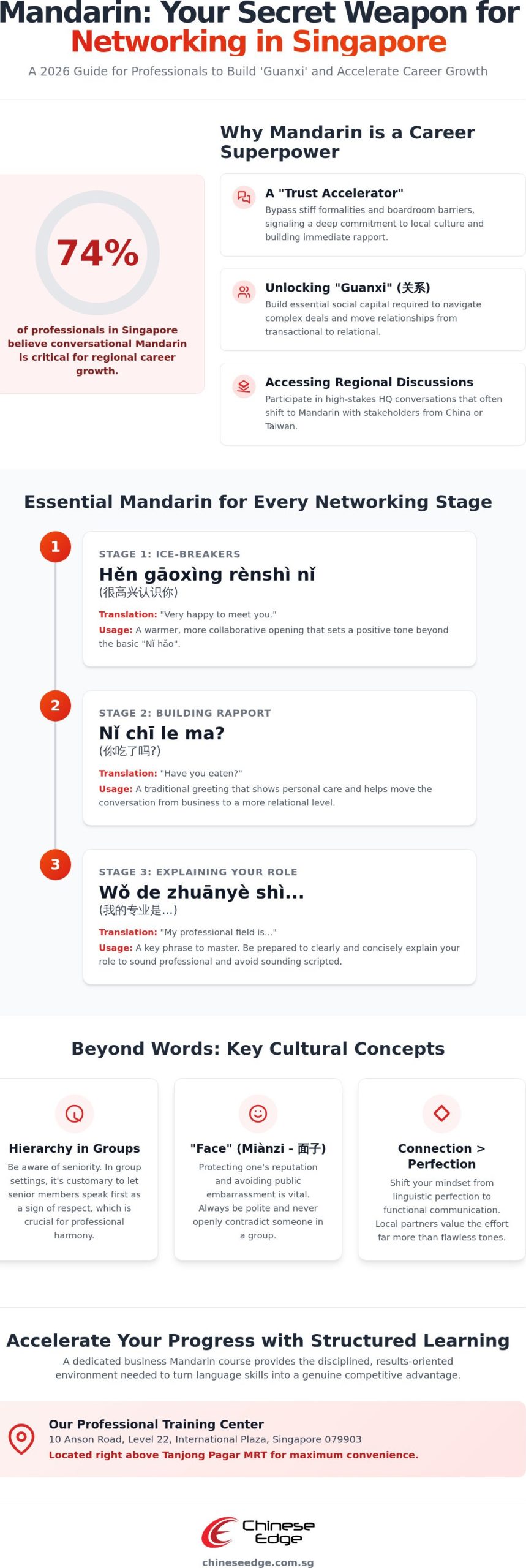
Did you know that 74% of professionals in Singapore now believe conversational Mandarin is the most critical skill for regional career growth? You’ve likely felt that quiet frustration when a promising business conversation shifts into Mandarin, leaving you sidelined from the “off-the-record” insights that often seal a deal. It’s challenging to build authentic “Guanxi” or feel fully integrated into the local corporate landscape when you’re worried about making a tonal mistake in front of a potential partner.
This 2026 guide to learning mandarin for networking events in Singapore is designed to help you reclaim your confidence. We’ll show you how to master the specific phrases and cultural nuances that transform a brief introduction into a lasting professional relationship. You’ll learn the essential vocabulary needed to follow the gist of high-stakes discussions and build deeper rapport with your clients.
We’ll also preview how a structured business Mandarin course at our professional training center, located at 10 Anson Road, Level 22, International Plaza, can accelerate your progress. Being situated right above Tanjong Pagar MRT, we provide the disciplined, results-oriented environment you need to turn language skills into a genuine competitive advantage.
Key Takeaways
- Understand why Mandarin acts as a “trust accelerator” in the Singaporean business landscape, allowing you to bypass formal barriers and access regional HQ discussions.
- Master actionable phrases for learning mandarin for networking events in Singapore, from making a natural first impression to explaining your professional role without sounding scripted.
- Navigate complex cultural nuances such as the hierarchy of speaking in group settings and the concept of “Face” (Mianzi) to maintain professional harmony.
- Shift your mindset from linguistic perfection to functional communication, using context clues to remain effective even if your tones are not flawless.
- Discover how a structured business Mandarin course at our International Plaza center, located right above Tanjong Pagar MRT, provides the professional support needed for CBD career growth.
Why Mandarin is the Secret Weapon for Networking in Singapore
Singapore’s business world operates on a dual track. While English facilitates daily transactions, Mandarin often acts as a powerful trust accelerator during high-stakes interactions. Using a few well-placed phrases during a networking mixer can bypass the stiff formalities of a typical boardroom setting. It signals a deep commitment to local culture and a respect for the heritage of your partners. Since Mandarin is one of the four official languages in Singapore, it remains foundational to the city-state’s identity and its commercial pulse.
In the high-stakes environment of the Singapore CBD, “Guanxi” represents the social capital required to navigate complex deals. While your technical expertise gets you in the door, your ability to build rapport determines how long you stay in the room. Understanding the nuances of Mandarin allows you to participate in regional HQ discussions that often drift into the language when stakeholders from China or Taiwan are present. In the 2026 Singaporean economy, proficiency in Mandarin serves as a high-yield strategic asset that bridges the gap between formal corporate interactions and meaningful commercial partnerships.
To better understand how these language skills apply in a professional context, watch this helpful video:
The Shift from Transactional to Relational Business
Local partners in Singapore value the effort of language learning far more than they demand perfect fluency. When you attempt to speak the language, you move the relationship from a purely transactional exchange to a relational one. This shift is most evident in Singapore’s “Kopi” culture. Many significant business decisions are actually finalized over informal lunches or coffee sessions where the atmosphere is relaxed. Learning mandarin for networking events in Singapore gives you the tools to thrive in these settings. It also provides a vital bridge to regional markets like Malaysia and Taiwan, allowing you to manage regional operations more effectively from your Singapore base.
Singapore as a Bilingual Business Hub
The local networking scene often features a unique blend of Singlish and Mandarin. Professionals who can navigate this linguistic landscape find it much easier to integrate into senior leadership circles. Today, a conversational chinese course is no longer just a hobby; it’s a career requirement for those aiming for the C-suite. There is a massive competitive advantage for non-native speakers who make the effort to learn. It demonstrates cultural intelligence and a proactive mindset, qualities that are highly prized by regional stakeholders. By choosing a mandarin course at our center at 10 Anson Road, International Plaza, you position yourself right at the heart of this bilingual hub, just steps away from Tanjong Pagar MRT.
Essential Mandarin Phrases for Every Networking Stage
Mastering the art of networking requires more than just memorizing a list of words; it involves understanding the rhythm of professional interaction. When you’re learning mandarin for networking events in Singapore, the goal is to move past the robotic “Hello, how are you?” found in basic apps. Instead, focus on phrases that signal your role as a sophisticated professional who values cultural depth. By breaking your interactions into logical phases, you can maintain a steady flow of conversation without feeling overwhelmed by complex grammar.
Ice-Breakers and Warm Introductions
A common mistake for beginners is sticking to overly formal textbook greetings. While “Nǐ hǎo” is safe, a warmer approach like “Hěn gāoxìng rènshì nǐ” (Very happy to meet you) sets a more collaborative tone. You might hear the classic “Nǐ chī le ma?” (Have you eaten?), which is a traditional way to show care in local culture. In a professional CBD setting, it’s often better to express interest in their work. Try saying, “Wǒ duì nǐde hángyè hěn gǎn xìngqù” (I’m very interested in your industry). If you’re feeling stuck, use the professional disclaimer: “Wǒ de Pǔtōnghuà hái zài jìnbù zhōng” (My Mandarin is still improving). This transparency builds immediate rapport and often encourages your partner to help you along.
Navigating the Business Card Exchange (Meishi)
The exchange of business cards, or “Míngpiàn,” is a critical ritual. Always offer and receive cards with both hands as a sign of respect. When you receive a card, don’t put it away immediately. Take a moment to review the details and use a phrase like “Xièxiè, qǐng duō zhǐjiào” (Thank you, please give me your guidance). This humble expression is highly valued in Singaporean business circles. You can then bridge to their current work by asking, “Nǐmen zuìjìn yǒu shéme xīn xiàngmù ma?” (Do you have any new projects recently?). This shows you’re focused on the future of their business, not just the card in your hand.
As you progress through the event, your “pitch” should remain conversational. Instead of a long monologue, simplify your role. “Wǒ zài [Company] gōngzuò” (I work at…) followed by “Wǒ fùzé [Department]” (I am responsible for…) is usually sufficient to spark further questions. To ensure you’re prepared for these high-stakes moments, consider enrolling in a structured mandarin course that focuses on workplace communication. Our center at 10 Anson Road, International Plaza, is conveniently located right above Tanjong Pagar MRT, making it easy to practice these skills after office hours.
Finally, end the interaction gracefully. Asking for a social connection is now standard practice in 2026. Use “Wǒmen kěyǐ jiā gè Wéixìn ma?” (Can we add WeChat?) or mention LinkedIn. Avoid the mistake of rushing the exit; a polite “Bǎochí liánxì” (Let’s stay in touch) ensures the door remains open for future collaboration.
Beyond Words: Etiquette and Cultural Nuance in SG Networking
Linguistic proficiency is only one part of the equation. When learning mandarin for networking events in Singapore, professionals often discover that what remains unsaid is just as important as the vocabulary itself. The city’s business culture is a sophisticated blend of traditional values and modern corporate standards. Understanding the unwritten rules of engagement allows you to navigate high-stakes environments without inadvertently causing friction. It’s about demonstrating cultural intelligence, which often speaks louder than a perfect accent.
Hierarchy plays a significant role in group settings. During a networking session, always allow the most senior person to initiate the conversation or lead the introductions. This respect for seniority is closely tied to the concept of “Face” or Mianzi. In a Singaporean boardroom, maintaining “Face” is a strategic necessity where public consensus is prioritized and critical feedback is delivered discreetly to preserve professional dignity. If you must disagree or ask a difficult question, do so in a way that offers the other party a graceful exit. This approach builds long-term trust and marks you as a reliable partner.
Reading the Room: Non-Verbal Cues
Mastering non-verbal communication is essential for workplace chinese communication. You might encounter a “Yes” that actually functions as a polite “Maybe” or “I’ll consider it.” This indirectness is a way to avoid conflict. Pay close attention to silence and pausing. In many Mandarin-led discussions, a pause before answering isn’t a sign of hesitation; it’s a sign of thoughtful consideration. Learn to interpret body language, such as a slight tilt of the head or a brief break in eye contact, which can signal that a proposal needs further refinement before a deal is reached.
Dining Etiquette at Business Mixers
Many professional connections in Singapore are solidified over a meal. If you’re at a communal table with a “Lazy Susan,” wait for the host to start the rotation. Never take the last piece of food on a platter, as this can be seen as greedy. Toasting is another critical area. When engaging in “Ganbei” (dry the glass), it’s a sign of respect to keep your glass slightly lower than your partner’s during the clink. If you have dietary restrictions, explain them simply in Mandarin. This small talk about food often serves as the perfect “ice-breaker” before moving back to business objectives.
At our business mandarin course, we integrate these cultural nuances into every lesson. Our instructors are native speakers who understand the local corporate landscape. Located at 10 Anson Road, level 22, International Plaza, our center is situated right above Tanjong Pagar MRT, making it easy for CBD professionals to refine both their language skills and their cultural etiquette in a structured, professional environment.
Overcoming the “Fear of Tones” in Professional Settings
Many professionals hesitate to start learning mandarin for networking events in Singapore because they fear the four tones. The worry of saying “mother” (mā) when you meant “horse” (mǎ) is a common psychological barrier. However, in a business context, “perfect” is often the enemy of “profitable.” Your goal isn’t to win a linguistic competition; it’s to build a bridge. Most native speakers are incredibly forgiving and will prioritize your intent over your pitch. They value the effort you’ve made to step into their world, which immediately sets a positive tone for the relationship.
The secret weapon for every learner is the power of context. If you’re at a fintech mixer and use the word for “investment” with a slightly off tone, your partner will still understand you perfectly. The surrounding conversation provides all the clues they need. By focusing on high-frequency business introductions and common industry terms, you can build a “Mandarin Persona” that feels authentic. This persona doesn’t need to be flawless; it just needs to be confident and consistent. This confidence is what truly accelerates your career growth in the competitive Singaporean market.
Tools for Rapid Tonal Improvement
You can sharpen your pronunciation using shadow-reading techniques. This involves listening to Business Mandarin recordings and repeating them immediately, mimicking the rhythm and inflection of the speaker. It’s a highly effective way to internalize the natural flow of the language. To practice in a low-stakes environment before a major event, many executives utilize our Online Mandarin Classes. These sessions allow you to receive real-time feedback from native-speaking instructors from the comfort of your office. Additionally, the “Record and Listen” method is an excellent tool for self-correction. Recording your elevator pitch and listening back helps you identify specific areas where your tones might be slipping.
Handling Mistakes with Grace
Making a mistake in front of a potential partner can actually be a strategic advantage. It shows vulnerability, which is a key component of building “Guanxi.” If you realize you’ve made a slip-up, acknowledge it with a smile. A lighthearted comment like “Wǒ hái zài nǔlì xuéxí” (I am still working hard on my studies) often builds more rapport than a perfect, cold delivery. It humanizes you and invites your partner to help, turning a potential embarrassment into a bonding moment. Knowing when to persevere in Mandarin and when to switch back to English is a skill you’ll refine over time. The key is to keep the conversation moving forward without losing your professional poise.
If you’re ready to master these nuances with the guidance of an expert mentor, explore our Business Mandarin Course at International Plaza. Located at 10 Anson Road, level 22, we are situated right above Tanjong Pagar MRT, providing the structured and disciplined approach needed for professional success.
Mastering Conversational Mandarin with Chinese Edge
Building a professional network is an investment in your future. While the cultural nuances and phrases we’ve discussed provide the foundation, achieving true fluency requires a structured methodology. Our Adult Conversational Mandarin Course is specifically designed for the busy CBD professional who needs practical results without the fluff of academic-only programs. We prioritize conversational fluency because we know that in a networking setting, the ability to speak and listen effectively is what closes deals.
The convenience of your learning environment is a critical factor in your success. Our training center is located at 10 Anson Road, level 22, International Plaza, Singapore 079903. Being situated right above Tanjong Pagar MRT means you can transition from your office to our classroom in minutes. This strategic location allows you to integrate your studies into your professional life seamlessly, ensuring that your commitment to learning mandarin for networking events in Singapore remains a priority. Our native-led instruction ensures you learn the subtle nuances that textbooks often miss, giving you the confidence to interact with regional stakeholders naturally.
Tailored for the Singaporean Professional
Our curriculum isn’t a generic language program. It’s a focused approach to workplace chinese communication. You’ll learn in a group of like-minded peers, creating a secondary networking opportunity within the classroom itself. This collaborative environment helps you practice high-stakes interactions before you face them in the real world. If you’re looking for more industry-specific depth, you can learn more about our Business Chinese Course, which dives into the terminology used in finance, legal, and tech sectors.
Corporate Training Solutions
For organizations looking to upskill their teams, we offer customized Corporate Mandarin Training. Data from a LinkedIn Global Workforce Survey indicates that Mandarin-speaking professionals experience a 74% faster career advancement compared to their monolingual peers. Additionally, proficiency can lead to a 15-25% average salary increase. These statistics highlight the clear ROI for both individuals and companies. We help you measure this growth through practical assessments and real-world workplace application. Visit us at level 22, International Plaza for a consultation to see how we can align our training with your specific business objectives and regional growth plans.
Elevate Your Career with Strategic Mandarin Proficiency
Mastering the art of workplace communication is the most effective way to turn a brief introduction into a long term partnership. You’ve seen that “Guanxi” is built on mutual respect and that your effort to speak the language is often more important than tonal perfection. By combining essential phrases with a deep appreciation for cultural nuances like “Face,” you’ll gain a significant edge in Singapore’s competitive business environment.
Learning mandarin for networking events in Singapore is a high value investment in your professional future. Our native speaking expert mentors provide a specialized adult and corporate curriculum designed to deliver practical results for the busy CBD professional. We take pride in individual student success and offer a sophisticated bridge to the linguistic world.
Join our next Conversational Mandarin intake at Tanjong Pagar and experience our structured methodology at 10 Anson Road, level 22, International Plaza, located right above Tanjong Pagar MRT. We’re committed to being your reliable partner as you bridge the gap between simple conversation and sophisticated professional networking. We look forward to seeing you in class.
Frequently Asked Questions
How long does it take to learn basic Mandarin for networking?
It typically takes 20 to 40 hours of structured instruction to master basic greetings and professional introductions. While deep fluency takes longer, our courses focus on the high-frequency vocabulary needed for immediate workplace impact. Professionals who commit to a consistent weekly schedule often find they can navigate a standard business mixer with confidence within a few months of starting their training at International Plaza.
Do I really need to learn Mandarin if most Singaporeans speak English?
While English is the primary language of business, Mandarin serves as a critical trust accelerator that deepens professional relationships. According to a 2026 industry survey, 74% of professionals in Singapore believe conversational Mandarin is the most critical skill for regional career growth. Learning mandarin for networking events in Singapore allows you to bypass formal barriers and participate in the “off-the-record” conversations that often happen in regional HQ discussions.
Is it better to learn Simplified or Traditional Chinese for business in Singapore?
Simplified Chinese is the standard for business in Singapore, Malaysia, and Mainland China. If your professional network primarily involves regional stakeholders in these markets, Simplified characters are the most practical choice. Our curriculum focuses on this standard to ensure that your written and spoken skills align with the official benchmarks used throughout the city-state’s financial and commercial districts.
What is the best way to practice Mandarin if I don’t have Chinese-speaking colleagues?
The best way to practice is to immerse yourself in environments where the language is naturally used, such as business mixers or local coffee shops. If you lack native-speaking colleagues, joining a conversational Chinese course provides a safe space to practice with like-minded peers. Our center at Tanjong Pagar MRT offers a convenient hub where you can refine your skills alongside other motivated professionals in the heart of the CBD.
Can I learn Business Mandarin online effectively?
Yes, you can learn Business Mandarin online effectively through real-time, native-led sessions that prioritize interactive communication. Our Online Mandarin Classes are designed to mirror the academic rigor of our in-person lessons while providing the flexibility needed by busy executives. These digital sessions focus on workplace Chinese communication, allowing you to receive immediate feedback on your tones and delivery from anywhere in the world.
What should I do if I forget a word in the middle of a Mandarin introduction?
If you forget a word, simply remain calm and use a professional disclaimer or switch briefly to English to maintain the conversation’s rhythm. You can say “Wǒ de Pǔtōnghuà hái zài jìnbù zhōng” (My Mandarin is still improving) to show humility. This transparency often builds rapport and “Guanxi” because it demonstrates your genuine effort. Remember that learning mandarin for networking events in Singapore is about building a bridge, not achieving linguistic perfection.
Disclaimer
Disclaimer
The Chinese articles on this website are provided for general information and learning purposes only. While we strive for accuracy, we make no guarantees regarding completeness or reliability. The content does not constitute professional advice, and we are not liable for any loss arising from its use. External links or third-party content are for reference only. By using this website, you agree to this disclaimer.