
Did you know that while English is the primary language for nearly half of Singapore’s households, over 74% of our residents are of Chinese descent? You likely feel the limitations of staying within English-only circles when trying to secure high-stakes deals or regional partnerships. It is common to feel stuck in a professional bubble, especially when you realize that the deepest connections are often formed through the subtle nuances of a shared tongue. Mastering business mandarin for relationship building is no longer just a secondary skill; it is a strategic asset for any professional navigating Singapore’s S$144 billion MICE industry.
We understand that building authentic guanxi can feel daunting when you are worried about cultural etiquette or linguistic barriers. This guide will help you overcome that anxiety by identifying the most effective networking platforms in Singapore for 2026, from the Singapore FinTech Festival to high-impact events like SWITCH. You will learn how to improve your networking efficiency and discover how targeted language skills can accelerate your career growth. We have curated a clear roadmap of where to show up and how to communicate with the confidence of a seasoned local leader.
Key Takeaways
- Explore why Singapore’s 2026 networking landscape prioritizes deep relationship building over simple transactional exchanges.
- Identify the most effective professional platforms and international chambers of commerce to focus your networking efforts.
- Learn how mastering business mandarin for relationship building provides a unique competitive edge and increases your professional ROI.
- Gain actionable tips for preparing for high-stakes events, including how to set clear goals and use cultural ice-breakers effectively.
- Discover how a structured, mentor-led approach to language learning can bridge the gap between basic conversation and professional influence.
The Evolution of Business Networking Events in Singapore (2026)
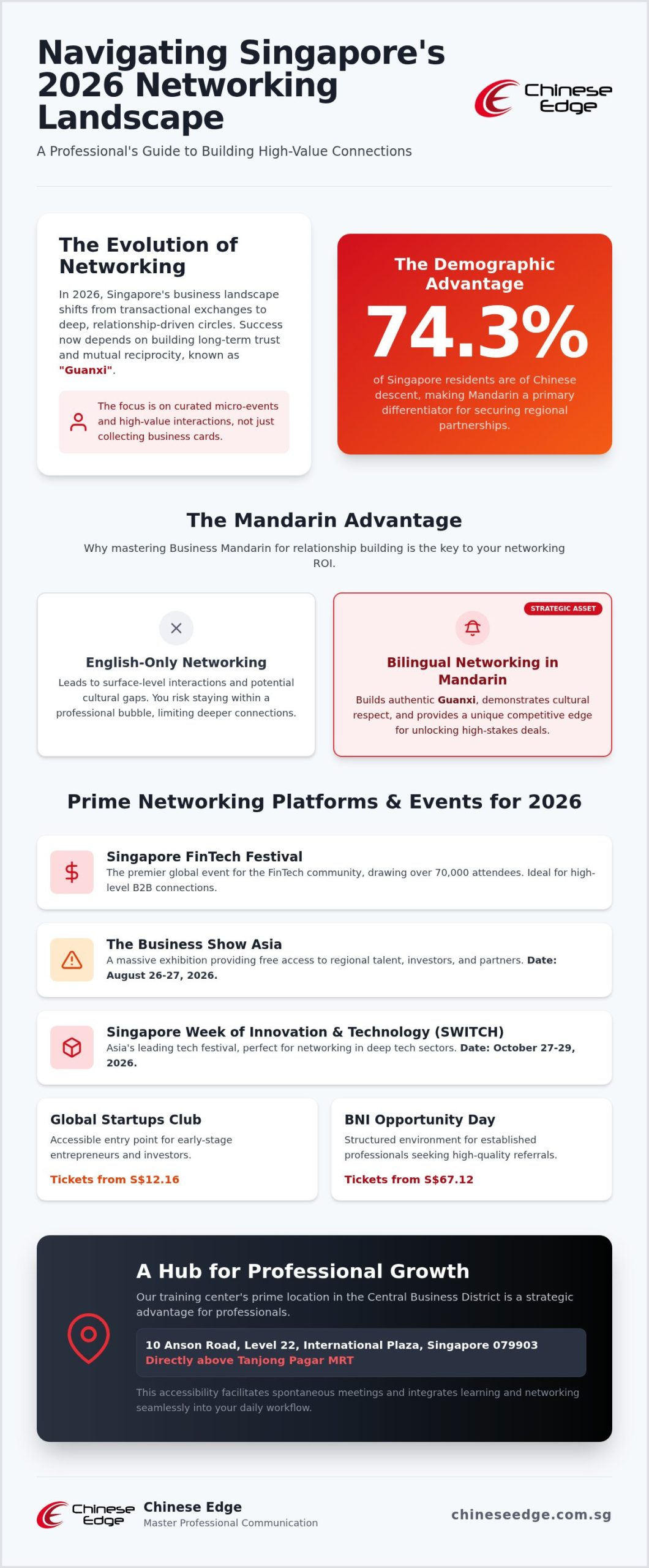
Singapore’s business environment in 2026 is defined by a fundamental shift from broad, transactional interactions to intentional, relationship-driven circles. While the city remains a premier global gateway, the competition for professional attention has intensified. Professionals now prioritize Building Guanxi, a concept that emphasizes long-term trust and mutual reciprocity over a quick sales pitch. This evolution is particularly evident in the way leaders use business mandarin for relationship building to bridge cultural gaps that English alone cannot always reach. In a market where 74.3% of residents are of Chinese descent, linguistic agility has become a primary differentiator for those looking to secure regional partnerships.
Digital tools have streamlined the administrative side of professional gatherings. Professionals now use AI-powered platforms to manage RSVPs and scan business cards instantly, ensuring that no lead is lost in the shuffle. While these digital tools provide the necessary framework for interaction, the human element remains the deciding factor for success. Success in 2026 relies on your ability to transition from a digital connection to a face-to-face relationship with confidence and cultural poise.
To better understand how these conversations flow in a professional setting, watch this helpful video:
Why Traditional Networking is Evolving
Large, unfocused mixers are being replaced by curated micro-events that offer higher value for your time. In 2026, we see a rise in niche gatherings where AI matchmaking apps connect attendees based on specific industry goals and shared interests. These events often focus on high-growth sectors like fintech and deep tech. For example, the Singapore FinTech Festival continues to draw over 70,000 global attendees, but the most significant deals often happen in private, invitation-only side rooms. Professionals are seeking deeper cultural alignment, moving away from the old model of “card-collecting” toward high-value interactions that respect regional business etiquette.
Singapore’s Unique Networking Ecosystem
The Central Business District (CBD) serves as the heartbeat of these professional interactions. Strategic locations, such as International Plaza situated right above Tanjong Pagar MRT, facilitate the spontaneous networking that defines the local business culture. The physical layout of the city plays a vital role. If you are working in the CBD, the ease of meeting for a quick tea or a business session near the Tanjong Pagar MRT means that networking is integrated into your daily workflow. In the 2026 economy, cross-industry collaboration is essential. Whether you are attending a startup mixer with tickets starting at S$12.16 or a high-level BNI session with tickets from S$67.12, your ability to navigate these spaces with cultural and linguistic agility is paramount. If you want to excel in these settings, joining a group Chinese course can prepare you for the nuances of local communication and help you stand out in a crowded market.
Prime Venues and Platforms for Professional Networking
Identifying the right environment is the first step toward building a high-value professional circle. In 2026, Singapore offers a diverse range of platforms that cater to different career objectives. For those in the early stages of entrepreneurship, events like the Global Startups Club offer accessible entry points with tickets starting from S$12.16. Meanwhile, established professionals often gravitate toward more structured environments like the BNI Ambitious Business Opportunity Day, where entry starts at S$67.12. High-impact exhibitions such as The Business Show Asia (August 26-27, 2026) and the Singapore Week of Innovation and Technology (October 27-29, 2026) provide free access to massive pools of regional talent and investors.
Chambers of Commerce and Trade Associations
International Chambers of Commerce remain vital for both expats and locals looking to expand their reach. These organizations provide a sense of security through curated ‘Business After Hours’ mixers and formal trade dialogues. The Singapore Chinese Chamber of Commerce & Industry (SCCCI) is particularly influential for those targeting regional expansion. Utilizing business mandarin for relationship building at SCCCI events allows you to navigate traditional protocols and demonstrate a deep respect for local heritage. This linguistic effort often transforms a standard introduction into a meaningful partnership. Understanding the nuances of cultural etiquette during these formal mixers is essential for anyone aiming to move beyond surface-level interactions.
Modern Networking Hubs in the CBD
The geographic focus of Singapore’s business world remains firmly rooted in the Central Business District. International Plaza, located directly above the Tanjong Pagar MRT, has evolved into a premier hub for C-suite executives and decision-makers. Its proximity to Raffles Place and Anson Road makes it an ideal location for ‘Lunch and Learn’ sessions and spontaneous coffee meetings. These physical spaces bridge the gap between digital connections and real-world trust. Many professionals now use LinkedIn Local events to meet their online connections in person within these CBD corridors. Enrolling in a group Chinese course can provide the practical skills needed to thrive in these high-pressure settings. When you can converse naturally in a professional hub, you increase your visibility and your ability to influence the conversation.
Professional clubs and co-working spaces also offer daily opportunities for organic interaction. These venues host niche, industry-specific circles that allow for consistent follow-ups. By positioning yourself in these high-traffic areas, you ensure that your networking efforts are both efficient and sustainable. Success in the 2026 market requires being present where the decisions are made, and in Singapore, that means mastering the CBD networking corridor.
The Mandarin Advantage: Why Language is the Key to Networking ROI
In a global financial hub like Singapore, technical expertise is often the baseline for entry. Real professional growth occurs when you can move beyond transactional data to establish genuine trust. Enrolling in a business chinese course is a strategic investment because it equips you with the tools to navigate the Guanxi Factor. This cultural framework focuses on the quality of your personal connections rather than just the strength of your contract. When you speak the language of your regional partners, you transform a cold lead into a trusted collaborator. You aren’t just exchanging business cards; you’re signaling respect and a commitment to a long-term partnership.
Professionals often encounter an English-only barrier when dealing with stakeholders from Greater China. While English is the official business language in Singapore, the most critical negotiations often happen during informal networking. Using business mandarin for relationship building allows you to capture subtle workplace chinese communication that English translations might miss. It’s the difference between being a spectator and an active participant in the room’s most important conversations. This linguistic bridge is essential for anyone looking to maximize their networking ROI in the 2026 market.
Building Trust Through Cultural Nuance
The psychological impact of using Mandarin as an ice-breaker is profound. It demonstrates effort and cultural empathy, which are highly valued in Chinese business etiquette. If you understand the subtle cues of hierarchy and respect, you’ll avoid common pitfalls that English-only speakers face. Mastering chinese for professionals helps you navigate high-stakes dinners where real decisions are made. These settings require more than just technical vocabulary. They demand an understanding of when to speak and how to toast, ensuring your presence is both professional and culturally aligned.
Networking Beyond the Surface Level
Conversational fluency is often more valuable than perfect grammar in a networking environment. Your ability to bridge the linguistic gap gives you a massive competitive edge. It allows you to access exclusive, Mandarin-speaking business circles in Singapore that remain closed to those who rely solely on translators. When you can share a laugh or a personal anecdote in Mandarin, you build a level of rapport that data points can’t replicate. This level of communication is what truly accelerates your professional growth. If you’re looking to start this journey, consider a group Chinese course to practice in a supportive, professional environment. By mastering these skills, you ensure that you aren’t just another face in the crowd at the next CBD mixer.
5 Essential Strategies for Success at Singapore Networking Events
Preparation transforms a standard networking encounter into a high-value opportunity. Before you arrive at a venue like International Plaza or a major conference center, research the guest list and speakers. Setting a specific goal, such as securing three follow-up coffee meetings with regional directors, provides your evening with a clear focus. This discipline ensures you don’t spend the night in aimless conversation but instead move toward measurable professional outcomes.
Active listening is perhaps the most underrated skill in the Singaporean business environment. By focusing entirely on the speaker, you demonstrate a level of respect that is central to building long-term trust. This approach allows you to identify the subtle pain points of your partners, which you can later address in your follow-up. Using business mandarin for relationship building during these moments of deep listening helps you pick up on nuances that English-only speakers often miss, providing you with a significant advantage in competitive settings.
- Research the Guest List: Use platforms like LinkedIn or event apps to identify key stakeholders before the event begins.
- Set Specific Goals: Aim for a certain number of high-quality connections rather than collecting as many cards as possible.
- Practice Active Listening: Focus on understanding the other person’s business challenges before offering your own solutions.
- Develop a Follow-up System: Have a clear process for reaching out to new contacts within 24 to 48 hours.
- Maintain Consistency: Attend industry-specific events regularly to become a recognized and trusted figure in your professional circle.
Mastering the First 60 Seconds
Your elevator pitch should be concise and resonate with a diverse, multi-cultural audience. A bilingual introduction can be a powerful tool, even if the rest of the conversation continues in English. It signals your cultural agility and your commitment to the region. Your body language should be open and professional, respecting local norms regarding personal space and formal greetings. For a 2026 Singapore networking event, the perfect ice-breaker is: “I noticed your firm’s proactive approach to the new Beverage Container Return Scheme; how has that shifted your operational priorities for this year?”
The Post-Event Workflow
The real work begins after the event concludes. Use CRM tools to track your leads and set reminders for follow-up timelines. When you send a follow-up message, ensure it adds value by sharing a relevant article or a resource discussed during your meeting. LinkedIn serves as a vital tool for reinforcing these physical connections, allowing you to stay on their radar through consistent engagement. If you want to enhance your professional toolkit, consider enrolling in a group Chinese course to refine your communication skills. To truly master these interactions and secure your place in Singapore’s elite business circles, explore our specialized Business Mandarin Course today.
Master Professional Communication with Chinese Edge at International Plaza
Achieving professional fluency requires more than just vocabulary memorization. It demands a structured approach that respects your time and specific career goals. Chinese Edge serves as your dedicated partner in this journey, offering a curriculum specifically designed for the high-stakes environment of Singapore’s commercial districts. Our focus on business mandarin for relationship building ensures that you don’t just learn a language, but you gain a strategic tool for career advancement. We understand that for an adult learner, every hour spent in the classroom must translate to immediate value in the boardroom.
Tailored Courses for Busy Professionals
We recognize the demands of a CBD-based career. Our school at 10 Anson Road offers flexible schedules that include lunch-hour sessions and after-work classes to fit seamlessly into your professional routine. Our native-speaker instructors bring a wealth of experience, helping you navigate the delicate nuances of local business culture. This isn’t just about grammar; it’s about practical communication that works in real-world scenarios. Our conversational chinese course prioritizes the listening and speaking skills you need to lead meetings and close deals with confidence.
For organizations looking to upskill their workforce, we provide customized corporate mandarin training. These programs are designed to align with your company’s specific industry goals, ensuring your team can engage effectively with regional stakeholders. By investing in collective linguistic agility, your business can significantly reduce the risk of cultural misunderstandings and enhance its regional footprint.
The Strategic Advantage of Our CBD Training Center
Location is a critical factor for consistent learning. Our training center is situated at International Plaza, right above the Tanjong Pagar MRT station. This eliminates commute stress, allowing you to transition from your office to our level 22 facility in minutes. You’ll join a community of like-minded professionals who are also committed to personal and professional growth. This environment fosters a sense of shared purpose, making the path to fluency feel like a collective achievement rather than an isolated task.
We invite you to experience our methodology firsthand. Taking a trial lesson at our CBD center is the first step toward mastering business mandarin for relationship building. You’ll see how our disciplined, results-oriented approach can transform your networking potential. Let us help you bridge the gap between where you are now and the professional influence you aim to achieve in Singapore’s competitive 2026 landscape.
Secure Your Professional Influence in Singapore’s 2026 Economy
Navigating Singapore’s professional landscape requires more than just showing up at the right venues. Success in 2026 hinges on your ability to move beyond transactional interactions and foster deep, lasting trust. By combining strategic event selection with a commitment to business mandarin for relationship building, you position yourself as a culturally agile leader. You’ll find that the most significant opportunities often arise when you can communicate with nuance and respect.
We’re here to support your growth from our premium location at International Plaza, Level 22, situated right above Tanjong Pagar MRT. Our expert native-speaking mentors specialize in adult conversational fluency, helping you achieve practical results that you can apply at your next networking mixer. We’ve built a proven track record of empowering both corporate clients and individual professionals to lead with confidence in any setting.
Elevate your networking game with a Business Mandarin course at Chinese Edge today! Your path to professional influence starts with a single conversation, and we’re ready to help you master it.
Frequently Asked Questions
Where are the best places for business networking in Singapore?
The Central Business District (CBD) remains the premier location for professional interaction, specifically around the Raffles Place and Tanjong Pagar corridors. High-impact platforms include The Business Show Asia and the Global Startups Club, which offers networking opportunities for as little as S$12.16. These venues provide a mix of formal exhibitions and informal coffee spots that are ideal for meeting C-suite executives and regional decision-makers.
How do I start networking in Singapore as an expat?
Expats should leverage International Chambers of Commerce and professional associations to build a solid local foundation. Attending structured events like the BNI Mastermind Business Opportunity Day, with entry starting from S$58.73, is an excellent way to meet local entrepreneurs and established leaders. Focus on building a consistent presence in the Tanjong Pagar area, where spontaneous interactions often occur near major transport hubs like International Plaza.
Is Mandarin necessary for business networking in Singapore?
Mandarin isn’t strictly mandatory for entry since English is the primary language for business, but it’s a vital tool for business mandarin for relationship building. In a city where nearly 30% of the population speaks Mandarin as their primary home language, linguistic agility allows you to navigate informal settings and high-stakes dinners. Mastering the language signals a long-term commitment to your regional partners and helps you access exclusive circles.
What should I bring to a networking event in Singapore?
You should bring a mix of physical business cards and a digital backup, such as an AI-powered scanning app to manage your new contacts. A well-prepared elevator pitch that addresses current market trends, such as the 2026 Beverage Container Return Scheme, shows that you are well-informed about local regulations. Don’t forget a proactive mindset; your primary goal is to secure a meaningful follow-up meeting rather than just distributing cards.
How can I improve my business Chinese for networking?
Improving your skills requires a focus on practical workplace communication rather than just academic theory. Enrolling in a course that emphasizes conversational fluency allows you to handle real-world business scenarios with confidence. Practice using specific industry terminology and cultural ice-breakers during your lessons to demonstrate your commitment to your partners’ interests and values when you eventually meet them in person.
Where can I find professional Mandarin classes near Tanjong Pagar?
Professional Mandarin classes are available at Chinese Edge, located at International Plaza, Level 22. This facility is situated directly above the Tanjong Pagar MRT station, making it highly convenient for professionals working in the Anson Road or Raffles Place areas. The center specializes in adult-focused training that fits into the busy schedules of city-based learners, offering both lunch-hour and after-work sessions.
What are the common networking mistakes to avoid in Singapore?
A common mistake is treating networking as a transactional “card-collecting” exercise without any intent to build a relationship. Professionals also often fail to follow up via LinkedIn or CRM tools within the critical 24 to 48-hour window. You should also avoid ignoring cultural etiquette, such as the proper way to present a business card or acknowledging hierarchy during formal introductions at chamber events.
Are there networking events specifically for Chinese-speaking professionals?
Yes, organizations like the Singapore Chinese Chamber of Commerce & Industry (SCCCI) frequently host Mandarin-centric mixers and trade dialogues. These gatherings provide an excellent platform for business mandarin for relationship building, allowing you to connect with established local business leaders and regional stakeholders. Participating in these circles demonstrates cultural empathy and a serious intent to integrate into the local and regional business ecosystem.
Disclaimer
Disclaimer
The Chinese articles on this website are provided for general information and learning purposes only. While we strive for accuracy, we make no guarantees regarding completeness or reliability. The content does not constitute professional advice, and we are not liable for any loss arising from its use. External links or third-party content are for reference only. By using this website, you agree to this disclaimer.