

By 2026, 85% of regional leadership roles in Singapore are expected to require high-level bilingual communication. You’ve likely felt the awkward silence at a business dinner or the subtle anxiety of misinterpreting indirect feedback from a partner in Shanghai. It’s common to worry about causing a loss of face, especially when you’re trying to move a relationship beyond the initial contract. Building rapport with chinese clients is not a skill that develops overnight; it requires a disciplined approach to cultural intelligence and functional language use.
You likely recognize that in our regional market, deep trust is the true currency of sustainable trade. This guide provides the strategic framework you need to master Guanxi and navigate the latest 2026 economic shifts, such as the upgraded China-Singapore Free Trade Agreement. We’ll examine how a professional business chinese course can sharpen your workplace communication, helping you close regional deals with greater ease. From our training center at 10 Anson Road, level 22, International Plaza, Singapore 079903, right above Tanjong Pagar MRT, we’ve helped many learners find success through specialized chinese for professionals. Whether you want to learn chinese for social settings or need a structured mandarin course for the boardroom, we’ll show you how to transform transactional interactions into lasting partnerships.
Key Takeaways
- Understand why Guanxi is the foundation of every successful deal and how to transition from a transactional mindset to a relationship-based approach.
- Learn to navigate complex social hierarchies and the concept of Mianzi to ensure you’re giving and saving face during high-stakes negotiations.
- Master the art of building rapport with chinese clients by decoding high-context communication and identifying the subtle meanings behind indirect responses.
- Discover how making a strategic effort in Mandarin serves as a powerful signal of respect and helps bridge the gap between social and professional settings.
- Learn how a business chinese course at our center above Tanjong Pagar MRT can refine your workplace communication and increase your closing rates on regional deals.
The Foundation of Guanxi: Why Relationships Precede the Contract
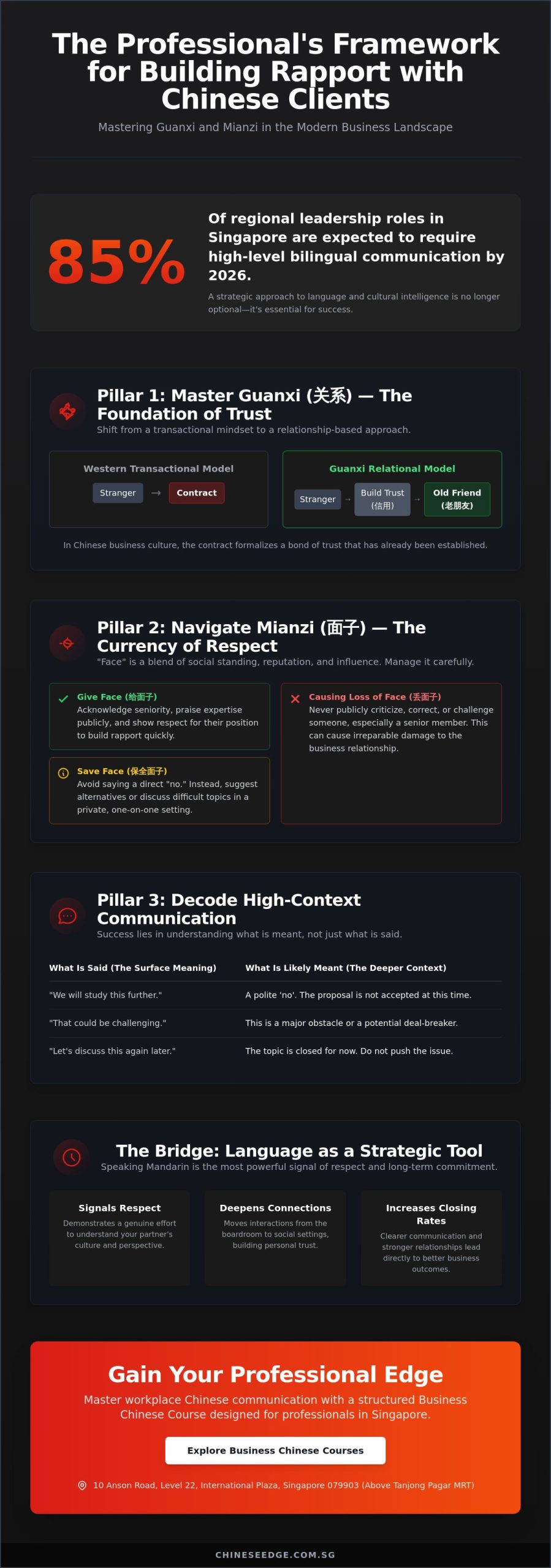
In the high-stakes environment of 2026, building rapport with chinese clients requires more than a polite handshake and a business card. Success depends on understanding The Foundation of Guanxi, a sophisticated system of social networks and influential relationships that dictates how business is conducted. While Western markets often prioritize the legal contract, Chinese business culture views the contract as a secondary document that formalizes an existing bond of trust. Since China has remained Singapore’s largest trading partner since 2013, with bilateral trade exceeding S$175 billion annually, mastering this cultural pillar is essential for any professional based in the city-state.
The business landscape has shifted significantly since the upgraded China-Singapore Free Trade Agreement (CSFTA) came into full effect in late 2024. This agreement adopted a negative list approach for foreign investment, which actually places a higher premium on personal reliability. Before a single signature is placed on a document, your partners will look for Xin-yong, or trust. They want to move you from the category of a stranger to that of a Lao Peng You (old friend). This transition isn’t just social; it’s a strategic risk-mitigation tool that ensures both parties are committed to a long-term, mutual benefit rather than a one-off transaction.
To better understand how these relationships translate into digital and social engagement, watch this helpful video:
Understanding the Reciprocity Loop
Guanxi is maintained through a continuous cycle of reciprocity. Small favors, social gestures, and even the sharing of industry insights build a reservoir of social capital known as Renqing. When you provide value without an immediate demand for return, you’re signaling that you’re a partner of high character. This social validation is what allows rapport to grow beyond the boardroom. Guanxi operates as a professional currency for 2026 business, where social capital is traded for commercial reliability.
Rapport in the Singapore Context
Singapore serves as the premier bridge for regional deals, especially with 85% of multinational corporations here now prioritizing business Mandarin proficiency for leadership roles. Building rapport with chinese clients is significantly easier when you can communicate with nuance. Professionals who learn chinese are better equipped to handle the regional HQ dynamics that define our local economy. Our training center is strategically located at 10 Anson Road, level 22, International Plaza, Singapore 079903, right above Tanjong Pagar MRT. This physical presence in the heart of the business district allows us to support professionals in developing the linguistic precision needed for deep cultural connection.
Navigating Mianzi (Face) and Hierarchy in Professional Meetings
Building rapport with chinese clients hinges on your ability to manage Mianzi, or “face.” Think of face as a combination of social standing, reputation, and influence. In a professional setting, saving face isn’t just about politeness; it’s about protecting the dignity of your partners. If you inadvertently cause someone to lose face, you risk damaging the relationship beyond repair. Conversely, “giving face” (gei mianzi) by acknowledging a client’s status or expertise can accelerate the trust-building process and solidify your professional standing.
Hierarchy governs every interaction. Decisions usually flow from the top down, and communication styles reflect this structure. High-Context Communication often means that the most senior person in the room might speak the least, observing the dynamics before giving a final nod. Publicly disagreeing with a senior stakeholder is a significant error. If you have concerns, address them in a private, one-on-one setting to preserve the group’s harmony. This disciplined approach ensures that building rapport with chinese clients remains a smooth, respectful process.
Meeting Etiquette and Seating Protocols
Identifying the decision-maker starts with seating arrangements. The seat of honor is usually the one facing the door or positioned in the center of the table. When exchanging business cards, use both hands and study the card before placing it respectfully on the table. Never shove it into a pocket. Use formal titles like “General Manager Wang” rather than first names until you’re explicitly invited to be more casual.
Giving Face through Preparation
Deep research into a client’s corporate milestones shows you’ve invested time in the partnership. Before discussing the contract, engage in purposeful small talk about the local economy or travel. Avoid diving straight into business, as this can feel transactional. Enrolling in a mandarin course helps you master the specific vocabulary needed for these formal introductions. Our instructors at 10 Anson Road, level 22, International Plaza, right above Tanjong Pagar MRT, specialize in helping professionals navigate these nuances. If you want to refine your professional presence, consider exploring our corporate mandarin training options.
High-Context Communication: Reading Between the Lines
High-context communication is a fundamental shift for many Singapore based professionals. While Western business relies on explicit, direct statements, building rapport with chinese clients requires you to decode the meaning behind what isn’t said. In this environment, the context of the conversation, including who is present, the setting, and the history of the relationship, carries as much weight as the words themselves. Understanding these layers is essential for navigating the regional market in 2026.
A common pitfall is misinterpreting a “yes.” In many instances, an affirmative response simply means your partner is listening or understands your point. It doesn’t guarantee agreement. Similarly, silence shouldn’t be viewed as a void to be filled with more talking. It often signals that the other party is carefully weighing your proposal or seeking internal consensus. Mastering these cues is a core part of any business chinese singapore curriculum, as it allows you to maintain harmony while moving toward a deal. Much of this real rapport happens at the dinner table, where the formal hierarchy relaxes and personal trust is tested through social interaction.
The Art of Indirect Refusal
You’ll rarely hear a flat “no” in a Chinese boardroom. Instead, you’ll encounter phrases like “it might be slightly inconvenient” or “we shall study this further.” These are polite deflections designed to save face for everyone involved. If you encounter this, don’t press for immediate clarity. Instead, ask “What are the potential challenges we should address together?” This demonstrates patience and respect for their internal process, which is vital for building rapport with chinese clients over the long term.
Communication Styles Comparison
Adapting your pitch requires a balance between clarity and cultural sensitivity. The following table highlights how to adjust your approach for a high-context audience:
| Feature | Direct Feedback (Low-Context) | Indirect Guidance (High-Context) |
|---|---|---|
| Disagreement | Stated clearly to save time. | Hinted at through silence or deflecting. |
| Decision Speed | Rapid, based on facts and data. | Deliberate, based on group consensus. |
| Primary Goal | Efficiency and explicit clarity. | Harmony and long-term trust. |
Success in these settings often comes down to your level of preparation and linguistic nuance. Our center at 10 Anson Road, level 22, International Plaza, Singapore 079903, located right above Tanjong Pagar MRT, provides the specialized training needed to master these subtle workplace dynamics through structured lessons.
Language as a Bridge: Using Mandarin to Build Trust
Building rapport with chinese clients often comes down to your willingness to step outside your linguistic comfort zone. While some industry professionals suggest relying on translators, this approach can create a cold, transactional barrier between you and your partner. When you make a personal effort to speak Mandarin, you’re signaling a deep level of respect and giving face to your counterparts. It demonstrates that you view the relationship as a long-term commitment rather than a temporary arrangement. This personal investment is a powerful signal of sincerity that resonates far more than a perfectly translated document.
In the 2026 business environment, where 85% of regional leadership roles require bilingual communication, moving beyond a simple “Ni Hao” is critical. Making an effort to learn the language shows that you’re willing to meet your clients halfway. This linguistic effort acts as a primary ice-breaker, especially during the social dinners where real Guanxi is forged. It shifts the dynamic from a formal negotiation to a shared cultural experience, allowing trust to develop naturally through mutual effort.
Mandarin for Professional Socialising
Social dinners are the testing ground for any professional relationship. Mastering specific phrases for toasts, such as “Ganbei” (bottoms up), and learning how to express professional gratitude shows you understand the social rhythm of the Chinese boardroom. You don’t need to be perfectly fluent to have a significant psychological impact. Using a client’s native tongue to discuss shared goals or acknowledge a successful milestone creates an immediate sense of camaraderie. This rapport helps bridge the gap between formal business sessions and the informal moments where the real decisions are often made.
Bridging the Gap with Structured Learning
Developing this level of cultural and linguistic precision requires a disciplined approach. A conversational chinese course focuses on the practical rapport needed for the Singapore corporate landscape. Our lessons are led by native speakers who understand the specific nuances of corporate etiquette, ensuring you learn language that is both accurate and appropriate. Just 15 minutes of Mandarin conversation at the start of a meeting can save 15 hours of negotiation later by establishing an immediate foundation of trust. If you’re ready to enhance your professional influence, consider enrolling in our business mandarin course at our center located at 10 Anson Road, level 22, International Plaza, Singapore 079903, right above Tanjong Pagar MRT.
Mastering Rapport with Chinese Edge in Singapore
Building rapport with chinese clients is a strategic professional requirement in 2026. Success in the regional market depends on more than just technical expertise; it requires the cultural intelligence to navigate complex social networks and high-context communication. Chinese Edge provides the authoritative guidance needed to bridge this gap. Our training is specifically tailored for the unique corporate landscape of Singapore, where 85% of regional leadership roles now demand high-level bilingual proficiency. We position ourselves as your expert mentor, offering the steady support required to achieve fluency through a disciplined, results-oriented framework that respects your professional time.
If you’re searching for a chinese course singapore professionals trust, our center offers the ideal environment for professional growth. We focus on practical application, ensuring that your investment in a business chinese course leads to tangible results in the boardroom. Our curriculum is specifically designed for adults who need to master workplace chinese communication quickly and effectively. By choosing a mandarin course at Chinese Edge, you’re choosing a partner dedicated to your individual success in the global marketplace. We understand the challenges of the modern workplace and provide the tools to overcome them.
Our Training Methodology
We prioritize practical, real-world application over abstract theory. Our sessions include interactive simulations of business dinners and corporate negotiations, allowing you to practice the nuances of giving and saving face in a controlled environment. This methodology ensures that your chinese for professionals training is immediately useful for your next regional deal. We provide flexible options, including online classes and in-person Mandarin classes Singapore modules, to suit your busy schedule. Whether you need a conversational chinese course for social networking or specialized corporate mandarin training for your entire team, our programs are built to deliver the confidence needed to excel in regional trade.
Join Us at International Plaza
Our training center is located at 10 Anson Road, level 22, International Plaza, Singapore 079903, which is right above Tanjong Pagar MRT. This central location makes us the most accessible choice for those looking for chinese classes near me within the heart of the business district. We take pride in being a premium boutique school that offers a sophisticated learning experience for the modern professional. Building rapport with chinese clients is a journey of continuous improvement, and our instructors are dedicated to your linguistic and cultural growth. If you’re ready to learn chinese with a methodology that works, book a trial session for your corporate team today and see the difference that expert mentorship makes in your professional trajectory.
Strategic Relationships for a Regional Future
Mastering the art of building rapport with chinese clients is a decisive advantage for professionals in Singapore. You now understand that Guanxi is the bedrock of trust and that protecting face is essential for maintaining long-term harmony. By decoding high-context signals and making a personal effort in Mandarin, you demonstrate a level of commitment that transactional competitors simply cannot match. These skills are the keys to unlocking growth under the upgraded China-Singapore Free Trade Agreement.
At Chinese Edge, part of the established Language Edge Group, we specialize in helping adults achieve these goals through a proven, systematic approach. Our native-speaking instructors possess deep corporate expertise, ensuring your training is relevant to the boardroom. We’re located at 10 Anson Road, level 22, International Plaza, Singapore 079903, situated right above Tanjong Pagar MRT for your convenience.
Elevate your professional rapport with our Business Mandarin courses. With the right linguistic tools and cultural insights, you’ll navigate regional partnerships with total confidence and lead your organization to new heights.
Frequently Asked Questions
What is the most important thing to remember when meeting a Chinese client for the first time?
Respect for hierarchy and the formal exchange of business cards are the most critical elements of a first meeting. You should always present and receive cards with both hands while taking a moment to study the information provided. Addressing the most senior person first and using their proper professional title demonstrates that you understand the social structure of their organization.
How do I avoid causing my client to lose face during a high-stakes meeting?
You must avoid direct public disagreement or criticism to ensure your partner does not lose face. If you have concerns about a proposal, it is better to use indirect language or save the discussion for a private, one on one setting. Preserving group harmony is a non negotiable aspect of building rapport with chinese clients and protecting their professional standing.
Do I need to be fluent in Mandarin to build genuine rapport with Chinese clients?
You don’t need to be fully fluent to establish a deep bond of trust with your partners. Making a sincere effort to use basic conversational phrases shows a level of respect that resonates more than technical perfection. This personal investment signals that you value the relationship enough to step outside your linguistic comfort zone to bridge the cultural gap.
What are the common pitfalls in high-context communication for Western professionals?
The most common pitfall is being too direct or failing to read non verbal cues such as silence and posture. Western professionals often interpret a polite “yes” as a firm agreement, when it may only mean the client is listening. Ignoring these subtle signals can lead to misunderstandings that stall negotiations and damage the underlying trust you’ve worked to build.
How does the concept of Guanxi apply to professionals working in Singapore in 2026?
Guanxi serves as a vital system of social capital that facilitates smoother trade under the upgraded China Singapore Free Trade Agreement. In the 2026 landscape, these social networks allow Singapore based professionals to navigate regional headquarters dynamics with greater ease. Strong relationships act as a buffer against market volatility and provide a reliable foundation for long term commercial cooperation.
Is it appropriate to discuss business during a formal dinner with Chinese partners?
Direct business negotiations should generally be avoided during the main course of a formal social dinner. These gatherings are intended for building rapport and assessing your character rather than closing a contract. You should wait for your host to initiate professional topics or use the time to strengthen the personal bond that will make future office meetings more productive.
What are some simple Mandarin phrases that can help build rapport instantly?
Using phrases like “Qing duo guan zhao,” which translates to a request for mutual care and cooperation, can instantly elevate your professional standing. Simple expressions of gratitude or well wishes during a toast also show deep cultural awareness. A structured conversational chinese course can provide you with the correct tones and context to use these phrases effectively in a business setting.
How can a Business Mandarin course help my career progression in Singapore?
A business chinese course makes you an indispensable asset for regional leadership roles that require high level bilingual communication. Since 85% of these roles in Singapore are expected to require such skills by 2026, proficiency allows you to lead deals without relying on third party translators. Our training center at 10 Anson Road, level 22, International Plaza, right above Tanjong Pagar MRT, provides the specific workplace chinese communication skills needed for these senior promotions.
Disclaimer
Disclaimer
The Chinese articles on this website are provided for general information and learning purposes only. While we strive for accuracy, we make no guarantees regarding completeness or reliability. The content does not constitute professional advice, and we are not liable for any loss arising from its use. External links or third-party content are for reference only. By using this website, you agree to this disclaimer.