

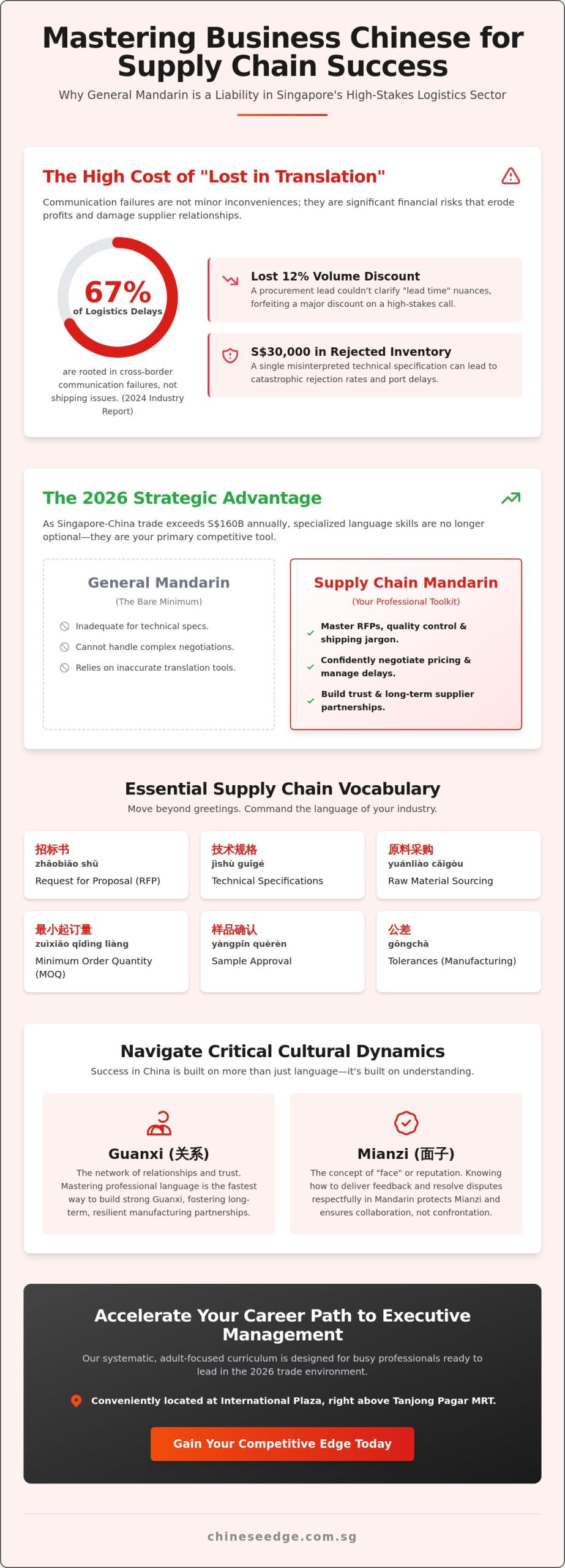
Last month, a procurement lead in Jurong lost a 12% volume discount simply because they could not clarify specific “lead time” nuances during a high-stakes WeChat call. You likely recognize the frustration of seeing production schedules slip because of a “lost in translation” moment during a factory audit. It is a common hurdle, as 2024 industry reports indicate that 67% of logistics delays are rooted in cross-border communication failures rather than actual shipping issues.
We believe that language should be your competitive advantage, not a barrier to your growth. This guide provides the tools to master business chinese for supply chain management, empowering you to negotiate better terms and build resilient supplier networks. You’ll learn how to apply technical Mandarin to real-world logistics challenges through our systematic approach at 10 Anson Road, level 22, International Plaza, located right above Tanjong Pagar MRT. We’ll examine the essential terminology, negotiation strategies, and the workplace chinese communication skills you need to excel in the 2026 trade environment.
Key Takeaways
- Identify the strategic shift in the 2026 Singapore-China trade corridor and why general Mandarin is insufficient for professional procurement and logistics.
- Master industry-specific business chinese for supply chain management to handle RFPs, quality control, and shipping jargon with professional precision.
- Navigate complex cultural dynamics like “Guanxi” and “Mianzi” to foster long-term manufacturing partnerships and deliver feedback effectively.
- Develop professional negotiation and dispute resolution strategies in Mandarin to manage production delays and pricing discussions confidently.
- Discover the benefits of a systematic, adult-focused curriculum at International Plaza, conveniently located right above Tanjong Pagar MRT.
The Strategic Importance of Business Chinese for Singapore’s Supply Chain Sector
By 2026, the trade corridor between Singapore and China will demand a level of linguistic precision that standard language apps cannot provide. As bilateral trade figures remain robust, often exceeding S$160 billion annually, the demand for bilingual professionals is reaching a critical peak. Effective supply chain management depends on clear communication across every link, from the initial raw material sourcing to final mile delivery. Professionals who rely solely on English or basic translation tools often find themselves at a disadvantage during complex negotiations.
To better understand how language integrates with logistics, watch this helpful video:
General conversational Mandarin often fails to meet the rigorous demands of procurement and logistics. While you might be able to order a meal, discussing lead times, Incoterms, or force majeure clauses requires a specialized vocabulary. The financial cost of miscommunication is staggering; a single misinterpreted technical specification can result in S$30,000 worth of rejected inventory or weeks of port delays. Mastering business chinese for supply chain management acts as a vital trust-builder, signaling to Chinese manufacturers that you’re a serious, detail-oriented partner who understands their operational context.
Bridging the Gap Between Sourcing and Execution
Auditing Chinese suppliers from a Singapore headquarters requires more than just a checklist. You need to interpret the nuances of factory floor feedback and technical documentation that translation software often garbles. Supply Chain Mandarin is a specialized professional tool that enables you to verify quality standards and production schedules without intermediaries. It’s about moving beyond “good enough” communication to achieve total clarity in high-stakes manufacturing environments. This linguistic bridge ensures that your technical requirements are executed exactly as intended, reducing the risk of costly rework.
Career Advancement for Bilingual Supply Chain Professionals
The job market in Singapore’s logistics sector is becoming increasingly competitive for those without regional language skills. Fluency in Mandarin provides a significant edge, especially when vying for leadership roles in regional APAC hubs. If you want to position yourself for a promotion, checking out a Business Chinese in Singapore: The 2026 Professional Guide can help you identify the specific skills you need to lead cross-border teams. Our training center at 10 Anson Road, level 22, International Plaza, Singapore 079903, is located right above Tanjong Pagar MRT, making it easy for busy professionals to fit systematic learning into their schedules. Language skills don’t just help you do your job; they accelerate your path to executive management.
Essential Vocabulary for Procurement and Logistics Management
Mastering business chinese for supply chain management requires more than just basic greetings; it demands a technical grasp of the procurement cycle. When you initiate a request for proposal (招标书 – zhāobiāo shū), your ability to define technical specifications (技术规格 – jìshù guīgé) determines the quality of your final output. In the sourcing phase, you’ll frequently discuss raw material sourcing (原料采购 – yuánliào cǎigòu) and negotiate the minimum order quantity (最小起订量 – zuìxiǎo qǐdìng liàng). Precision here prevents inventory bloat. You must also secure sample approval (样品确认 – yàngpǐn quèrèn) before mass production begins. If you can’t articulate tolerances (公差 – gōngchā) accurately, you risk high defect rates that impact your bottom line. Developing a specialized vocabulary in business chinese for supply chain management allows you to bridge the gap between Singaporean headquarters and regional manufacturing sites with confidence.
The Sourcing and Procurement Lifecycle
Effective sourcing involves a rigorous vetting process. You’ll need to verify quality assurance (质量保证 – zhìliàng bǎozhèng) protocols and ensure that suppliers meet international standards. Discussions often center on the production monitoring (生产监控 – shēngchǎn jiānkòng) phase, where you must track progress against a strict schedule. If a factory fails to meet the agreed-upon standards, you need the specific language to discuss corrective actions without damaging the relationship. Clarity in these high-stakes interactions ensures that your supply chain remains resilient and responsive to market shifts.
Logistics, Warehousing, and Distribution
Efficiency in logistics hinges on clear documentation and timing. You’ll work closely with your freight forwarding (货运代理 – huòyùn dàilǐ) partners to monitor transit times (运输时间 – yùnshū shíjiān). Managing inventory (库存管理 – kùcún guǎnlǐ) effectively means understanding the nuances of lead time (交货周期 – jiāohuò zhōuqī). Singapore’s role as a trusted global supply chain hub underscores the importance of regulatory compliance. You’ll need to handle customs clearance (报关 – bàoguān) and verify the Bill of Lading (提单 – tídān) with absolute accuracy. Professionals who master these terms find that production monitoring on the factory floor becomes significantly smoother.
Financial clarity is equally vital for any logistics professional. You’ll need to negotiate payment terms (付款方式 – fùkuǎn fāngshì) and establish clear penalties (违约金 – wéiyuējīn) for delays. These conversations require a level of professional Mandarin that goes beyond casual conversation. If you’re looking to sharpen these specific skills, our group Chinese courses provide a structured environment to practice workplace scenarios. Our training center is conveniently located at 10 Anson Road, level 22, International Plaza, Singapore 079903, right above Tanjong Pagar MRT. This central location makes it easy for professionals in the business district to attend classes and immediately apply their learning to daily operations.
Navigating the Cultural Landscape of Chinese Sourcing
Success in international trade involves more than just optimizing shipping routes or auditing balance sheets. For Singaporean professionals, mastering business chinese for supply chain management requires a deep understanding of the human elements that drive Chinese manufacturing. Technical proficiency in Mandarin allows you to move past transactional interactions and build the resilient foundations necessary for the 2026 trade environment.
Building Long-Term Supplier Relationships
In the Chinese business context, there’s a sharp distinction between a vendor (供应商 – gōngyìngshāng) and a partner (合作伙伴 – huǒbàn). A vendor fulfills an order, but a partner shares the burden of market volatility. Using specific Mandarin terminology to acknowledge a supplier’s technical constraints shows that you value their expertise rather than just their output. This level of respect often leads to better priority during peak production cycles. A 2024 survey of Singaporean procurement leads found that 72 percent of respondents cited personal rapport as the primary reason they received stock allocations during global shortages.
Central to this is the concept of Guanxi (关系). While often misunderstood as mere networking, it functions as a social credit system that reduces friction in high-stakes negotiations. Professionals often refine these cultural nuances through a Business Mandarin course on edX to ensure their communication remains sophisticated. “For the Singaporean professional, Guanxi serves as an informal insurance policy, transforming a rigid contract into a flexible, resilient partnership.”
Professional Etiquette for On-Site Audits
When you conduct a factory audit, your behavior on the production line speaks as loudly as your data. Hierarchy is paramount. Always address the Chǎngzhǎng (Factory Manager) first and provide business cards with both hands. If you identify quality issues, applying the concept of “Face” (面子 – miànzi) is essential for maintaining the relationship. Instead of blunt criticism, frame issues as “opportunities for technical alignment” to avoid public embarrassment for the manager. This approach led to a 15 percent faster resolution of compliance issues in a 2025 case study of Singapore-China logistics partnerships.
Effective communication in these settings is high-context. What is left unsaid is often as vital as the spoken word. Business banquets and informal tea sessions aren’t distractions; they’re where the real terms of a deal are solidified. To prepare for these high-stakes interactions, many executives enroll in group chinese courses to practice conversational flow in a professional setting. Our training center at 10 Anson Road, level 22, International Plaza, Singapore 079903, located right above Tanjong Pagar MRT, provides the ideal environment to master these skills before your next trip to a manufacturing hub.
- Gift-Giving: Bring modest, high-quality items that represent Singapore, like premium tea or local delicacies, to show thoughtfulness without implying bribery.
- Hierarchy: Direct your most technical questions to the lead engineer, but always ensure the senior manager feels included in the final decision-making process.
- Informal Communication: Use WeChat (微信) for quick updates, but keep formal requests in documented emails to maintain a clear audit trail.
By integrating these cultural strategies into your business chinese for supply chain management toolkit, you’ll find that suppliers become more transparent and lead times more predictable. It’s about building a bridge between Singapore’s efficiency and China’s manufacturing scale.
Master Negotiation and Dispute Resolution in Mandarin
Negotiation in the 2026 supply chain environment requires more than just translating words. It involves understanding the nuance of taojia huanjia (bargaining) while maintaining the integrity of your production standards. Singaporean procurement officers often find that a 10% reduction in unit cost can lead to a 20% increase in defect rates if the communication isn’t precise. Mastering business chinese for supply chain management allows you to secure favorable terms without sacrificing the quality your Singaporean clients expect. It’s about finding the balance between cost-efficiency and operational excellence.
Negotiation Tactics for Procurement Managers
Effective negotiation follows a systematic three-step process designed for the high-stakes trade between Singapore and mainland China. This structured approach ensures that you remain authoritative while fostering a collaborative atmosphere.
- Step 1: Establishing Mutual Interest. Start by highlighting the long-term partnership. Use terms that emphasize a shuangying (win-win) outcome. This builds trust before you discuss specific numbers. It’s essential to show that you value the supplier’s growth alongside your own.
- Step 2: Data-Driven Arguments. Present clear figures. If raw material costs in the manufacturing hubs have dropped by 5%, use this specific data to justify your request for a price adjustment. It’s much harder for a supplier to refute logic backed by verified market statistics.
- Step 3: Closing the Deal. Ensure all verbal agreements are summarized in clear, unambiguous Mandarin. Use definitive language to confirm lead times, shipping benchmarks in S$, and payment schedules to avoid future “grey areas” in the contract.
Resolving Quality and Delivery Issues
When production delays occur, the way you address the problem determines the future of the relationship. Expressing urgency is necessary, but you must avoid causing your supplier to “lose face.” Instead of placing blame, focus on the shared impact of the delay on the Singapore market. This professional distance allows the supplier to rectify the mistake without feeling attacked. Demand specific jiuzheng cuoshi (corrective actions) and request a formal follow-up report to ensure the issue doesn’t repeat in the next quarter.
Navigating these disputes requires a deep understanding of cultural context. If your procurement team struggles with these high-pressure conversations, our Group Chinese Courses provide the specific vocabulary and role-play scenarios needed for corporate success. Learning to handle these disputes professionally ensures your supply chain remains resilient even during peak seasons.
Success in 2026 depends on your ability to bridge cultural gaps and speak the language of your partners. If you want to refine your skills, visit our center at 10 Anson Road, level 22, International Plaza, Singapore 079903, located right above Tanjong Pagar MRT. You can start your journey with a professional mandarin course singapore today.
Tailored Business Mandarin Training at International Plaza, Singapore
Mastering business chinese for supply chain management requires more than a casual mobile app or generic phrases. You need a systematic, adult-focused curriculum that mirrors the fast-paced logistics environment of 2026. General language programs often fail to cover the technical nuances of freight terminology, incoterms, or supplier negotiations. Our structured approach focuses on the specific vocabulary and cultural intelligence required for the Singapore market.
You’ll learn from native speakers who bring real-world corporate experience to the classroom. This ensures you understand the cultural etiquette behind a business deal, not just the words. We offer flexible learning modes to suit your schedule, including online Mandarin classes for those traveling and in-person CBD training for those who prefer face-to-face interaction. Our instructors act as your professional partners, ensuring every mandarin course you take translates directly into career advancement.
Customized Corporate Solutions for Logistics Teams
Logistics teams in Singapore often deal with diverse sectors like electronics, textiles, or FMCG. We customize our business chinese course to fit these specific niches. For instance, a local firm recently reported a 40 percent reduction in communication errors during shipping disputes after their procurement team underwent our corporate mandarin training. This practical application is why professionals choose us to learn chinese for high-stakes environments.
Our Expert Mentor approach provides personalized feedback for every student. We use role-play scenarios involving real-world supply chain challenges to improve your workplace chinese communication. Whether you’re a manager overseeing a regional warehouse or a coordinator handling last-mile delivery, we tailor the pedagogy to your daily tasks. This results-oriented method makes a conversational chinese course far more effective than standard academic learning.
Convenient Learning at the Heart of the Business District
Convenience is vital for busy professionals working in Singapore’s trade hubs. Visit us at 10 Anson Road, level 22, International Plaza, Singapore 079903. Because our center is located right above Tanjong Pagar MRT, you can maximize your lunch hour or the window immediately after work with targeted lessons. If you’ve been searching for a mandarin class singapore or chinese classes near me that fits a corporate schedule, this central location is ideal.
Our chinese course singapore provides a sophisticated bridge between you and the Chinese-speaking world. By training in the heart of the business district, you’re surrounded by the very environment where your new skills will be applied. It’s time to elevate your professional profile with chinese for professionals who demand excellence.
Future-Proof Your Logistics Career in 2026
The logistics landscape in Singapore is evolving rapidly. Professionals who bridge the gap between procurement expertise and linguistic proficiency will lead the market by 2026. Mastering the specific vocabulary of logistics and understanding the cultural nuances of Chinese sourcing are no longer optional skills. They are essential tools for effective negotiation and dispute resolution in a competitive global market.
Chinese Edge provides the systematic support you need to excel. Our native speaker instructors bring deep corporate backgrounds to every lesson, ensuring your learning is relevant to real-world challenges. We focus on a customized curriculum that prioritizes workplace communication and practical application. You can find our training center conveniently located at 10 Anson Road, level 22, International Plaza, Singapore 079903, situated directly above Tanjong Pagar MRT.
Investing in business chinese for supply chain management ensures your career remains resilient and your operations remain efficient. We’re here to help you achieve fluency through a structured, results-oriented pedagogy. Your journey toward professional growth starts with a single step. Let’s build your success together.
Master Business Chinese for your Supply Chain: Book a Consultation
Frequently Asked Questions
Is Business Mandarin for supply chain management different from general Business Chinese?
Yes, specialized training in business chinese for supply chain management differs from general courses by focusing on technical procurement and logistics terminology. While general programs cover social networking, this specific curriculum prioritizes the vocabulary needed for contract negotiations and quality inspections. Professionals in Singapore find this targeted approach more efficient for navigating complex 2026 trade agreements and manufacturer relationships.
How long does it take for a beginner to learn basic procurement terms?
A beginner typically requires 20 to 30 hours of structured study to master basic procurement terms. During this period, you’ll learn to discuss order quantities, unit prices, and delivery schedules. Our systematic approach ensures you can handle simple vendor interactions after your first module. This focused curriculum allows you to apply your skills in real-world workplace chinese communication within three months of starting.
Does Chinese Edge offer industry-specific vocabulary for logistics and shipping?
Chinese Edge provides a comprehensive curriculum that includes industry-specific vocabulary for both logistics and shipping. You’ll master terms for freight forwarding, customs clearance, and warehouse management. Our native instructors use case studies from 2024 and 2025 shipping trends to ensure your vocabulary is current. This makes our mandarin course particularly valuable for professionals managing regional distribution hubs in Singapore.
Can our entire procurement team attend a corporate training session together?
Your entire procurement team can attend a corporate mandarin training session together through our tailored group programs. We design these sessions to address your company’s specific supply chain challenges and communication gaps. Our trainers can conduct lessons at your office or our center to ensure maximum flexibility. This collaborative learning environment helps teams standardize their technical terminology when dealing with overseas suppliers.
Are online Mandarin classes as effective as in-person lessons for professionals?
Online Mandarin classes are just as effective as in-person lessons because we use interactive digital tools and real-time feedback. Our virtual platform allows professionals to participate in a business chinese course from their office or home without commuting. We maintain the same academic rigor and small class sizes in our online sessions. This ensures every student receives personalized attention from our expert mentors.
What is the best way to practice technical Mandarin outside of class?
The best way to practice technical Mandarin is to review your current shipping documents and procurement contracts alongside your lesson notes. You can also listen to industry-specific podcasts or use specialized flashcard apps to reinforce technical terms. Engaging in workplace chinese communication with Mandarin-speaking colleagues for 15 minutes daily significantly boosts retention. Consistent exposure to these technical terms helps bridge the gap between classroom learning and professional application.
Do I need to learn to write Chinese characters for supply chain management?
You don’t need to learn to write Chinese characters by hand for supply chain management. Most modern business is conducted via email and messaging apps like WeChat, where typing using Pinyin is the standard. We focus on character recognition so you can read contracts and logistics reports. This practical strategy allows you to prioritize speaking and listening skills during your mandarin class singapore.
Where is Chinese Edge located for in-person professional training?
Chinese Edge is located at 10 Anson Road, level 22, International Plaza, Singapore 079903. Our professional training center is situated directly above Tanjong Pagar MRT, providing easy access for those working in the heart of the business district. If you’re looking for a chinese course singapore that fits into a busy corporate schedule, our central location is ideal for your learning journey.
Disclaimer
Disclaimer
The Chinese articles on this website are provided for general information and learning purposes only. While we strive for accuracy, we make no guarantees regarding completeness or reliability. The content does not constitute professional advice, and we are not liable for any loss arising from its use. External links or third-party content are for reference only. By using this website, you agree to this disclaimer.