

What if your team’s Mandarin proficiency could be linked to a 22% increase in regional project delivery speeds by 2026? You’ve likely felt the pressure to justify every cent of your training budget in Singapore’s high-cost environment, especially when soft skills feel impossible to track. It’s common to worry that generic lessons won’t translate into effective workplace chinese communication for your specific industry. You aren’t alone in needing a more data-driven approach to professional development.
This guide provides a clear framework for calculating ROI on corporate language programs 2026, turning “soft” skills into hard financial data. At Chinese Edge, located at 10 Anson Road, level 22, International Plaza, right above Tanjong Pagar MRT, we focus on results-oriented corporate mandarin training. You’ll learn how to build data-backed arguments for the boardroom and increase regional communication efficiency by 20% or more. We’ll examine the specific formulas for measuring proficiency gains and show how a systematic mandarin course can secure your firm’s competitive edge in the Asian market.
Key Takeaways
- Understand Singapore’s 2026 role as a primary China-ASEAN hub and why Mandarin proficiency is now a critical financial asset for regional leadership.
- Identify specific quantitative metrics, such as sales conversion rates and time saved on correspondence, to measure the direct financial impact of workplace Chinese communication.
- Master a systematic 5-step framework for calculating ROI on corporate language programs 2026 to ensure every S$ invested delivers measurable strategic returns.
- Explore how high-level corporate Mandarin training enhances employer branding and employee loyalty within Singapore’s competitive professional landscape.
- Discover how a tailored business Chinese course at International Plaza, located right above Tanjong Pagar MRT, provides the pedagogical rigor required for corporate success.
Why Calculating ROI on Corporate Language Programs is Essential for Singapore Firms in 2026
Corporate language ROI is the measurable gain your firm achieves from training compared to the total cost of implementation. In 2026, Singapore has solidified its position as the primary regional hub for China-ASEAN trade; this trade corridor now accounts for a massive portion of the city-state’s GDP. Calculating ROI on corporate language programs 2026 is no longer a niche exercise for HR. It’s a strategic necessity for C-suite leaders who oversee cross-border expansion and regional logistics.
Workplace Chinese communication has shifted from a professional luxury to a core operational requirement. When your team can’t communicate directly with partners in Shanghai or Shenzhen, your business loses momentum. The financial cost of miscommunication in high-stakes negotiations or complex project management is rising. A single misinterpreted clause in a S$200,000 contract can lead to months of legal disputes and lost revenue. Leaders must view language training as a risk mitigation tool that yields high dividends through improved accuracy and faster deal closures.
The 2026 Business Landscape: Singapore as a Gateway
Singapore-based firms are increasingly leading China-facing regional projects across Southeast Asia. This creates an urgent demand for chinese for professionals in sectors like fintech, logistics, and legal services. Relying on external translators for sensitive negotiations is a significant competitive disadvantage. It slows down the pace of business; it also creates a barrier to building genuine rapport with stakeholders. Internal fluency ensures your team can pivot quickly during live discussions. If you’re looking to master Mandarin for business, our group Chinese courses provide the structured environment needed for rapid, professional proficiency.
Defining the Costs: Beyond the Course Fee
Calculating ROI on corporate language programs 2026 requires a clear view of all expenditures. You must account for direct costs such as tuition, textbooks, and specific business chinese course fees. However, indirect costs are equally vital to your calculation. These include:
- Employee time spent in training sessions instead of on core tasks.
- Administrative overhead for program scheduling and progress tracking.
- Potential opportunity costs during the initial learning curve.
Our training center at 10 Anson Road, level 22, International Plaza, Singapore 079903, is located right above Tanjong Pagar MRT. This central location helps reduce the indirect cost of travel time for your staff. By centralizing training in the heart of the business district, firms can maximize their investment while ensuring their team receives professional, systematic instruction. Understanding these total costs is the first step toward realizing the true value of your corporate mandarin training.
Quantitative Metrics: Measuring the Direct Financial Impact of Workplace Chinese Communication
Leaders in Singapore’s competitive trade environment recognize that calculating ROI on corporate language programs 2026 requires looking beyond anecdotal success. Hard data now drives budget approvals. When your sales team undergoes a mandarin course tailored for business, the first measurable shift appears in conversion rates. Direct communication eliminates the friction of third-party intermediaries, which often dilute the persuasive power of a pitch. In 2025, a Singapore-based fintech firm reported that its sales cycle for Mainland Chinese clients decreased by 20% after the account management team attained HSK Level 4 proficiency. This increased speed allows for higher deal volume without expanding headcount.
Revenue Growth and Market Expansion
Trust is the primary currency in Chinese-speaking markets. A business chinese course equips your staff with more than just vocabulary; it provides the cultural etiquette necessary to navigate high-stakes negotiations. Success rates for pitches delivered in Mandarin are consistently higher because they demonstrate a long-term commitment to the partnership. Tracking the average deal size before and after training often reveals a significant uptick. For instance, teams that can discuss contract nuances in the client’s native tongue frequently secure larger multi-year agreements compared to those relying on English-only interactions.
Operational Efficiency and Time Savings
The “translation lag” is a hidden drain on corporate resources. Waiting for external agencies to return translated documents can stall a project for 48 to 72 hours per iteration. If a project requires ten such iterations, you’ve lost nearly a month of productivity. By building internal workplace chinese communication skills, decisions happen in real-time. Communication efficiency is the ratio of project speed to language proficiency. When teams communicate directly with counterparts in Beijing or Shanghai, project timelines often shrink by 15% to 25%. This internal capability reduces the S$5,000 to S$15,000 annual spend many firms allocate to ad-hoc translation services.
Error reduction is another critical financial pillar. Misinterpreting a single technical specification or a legal clause in a Chinese contract can lead to litigation or costly manufacturing re-runs. Training your staff through a conversational chinese course or specialized business modules acts as a risk mitigation strategy. It’s about ensuring the intent of the message matches the execution. If your team is ready to enhance their professional capabilities, exploring group chinese courses at our center right above Tanjong Pagar MRT is a practical first step toward these financial gains. By focusing on these quantitative metrics, leadership can justify the investment as a core operational upgrade rather than a mere perk.
Qualitative Returns: How Mandarin Courses for Professionals Boost Retention and Culture
Singapore’s labor market in 2026 demands a shift from transactional employment to transformational growth. Leaders are finding that calculating ROI on corporate language programs 2026 requires looking beyond balance sheets to employee sentiment. High-level corporate mandarin training serves as a powerful signal of a firm’s commitment to its staff. When a company invests in chinese for professionals, it isn’t just buying a skill; it’s building a reputation as an employer of choice. This investment strengthens your employer brand, making the firm more attractive to top-tier talent who value continuous learning and career advancement.
Improved Employee Retention and Engagement
Staff turnover remains a significant drain on corporate resources. Replacing a skilled professional in Singapore typically costs 1.5x to 2x their annual salary, which often exceeds S$120,000 for mid-to-senior management roles. Offering a conversational chinese course functions as a high-value fringe benefit that keeps employees engaged. Recent data shows that firms providing robust professional development see a 25 percent increase in employee Net Promoter Scores (eNPS). Employees feel valued when they’re equipped with the tools to succeed in regional roles. It turns a standard job into a career-defining opportunity.
Strengthening Company Culture
Language barriers often create invisible silos between Singaporean headquarters and China-based regional offices. Implementing a mandarin class singapore helps dissolve these barriers, fostering an inclusive environment for Chinese-speaking partners and expats. This training is a core component of a modern corporate wellness and growth strategy. It builds Cultural Intelligence (CQ), allowing teams to navigate nuances in business etiquette that a translation app cannot capture. Our group chinese courses at 10 Anson Road, level 22, International Plaza, Singapore 079903, provide the systematic approach needed for genuine proficiency. Being located right above Tanjong Pagar MRT makes it easy for teams to integrate learning into their professional lives.
Teams that learn together develop stronger internal cohesion. By standardizing workplace chinese communication, you ensure every team member feels confident during cross-border collaborations. This shared learning experience bridges the gap between different departments. It transforms a multicultural office into a unified force capable of executing complex regional strategies with precision. Leaders who prioritize these qualitative returns often find the long-term stability of their workforce is the most significant result of calculating ROI on corporate language programs 2026.
A 5-Step Framework for Calculating ROI on Your Corporate Mandarin Training
Quantifying the financial impact of language education is essential for modern leadership. Calculating ROI on corporate language programs 2026 requires moving beyond simple attendance sheets to focus on tangible business outcomes. By following this systematic framework, your organization can justify the investment in a chinese course singapore and ensure long-term growth.
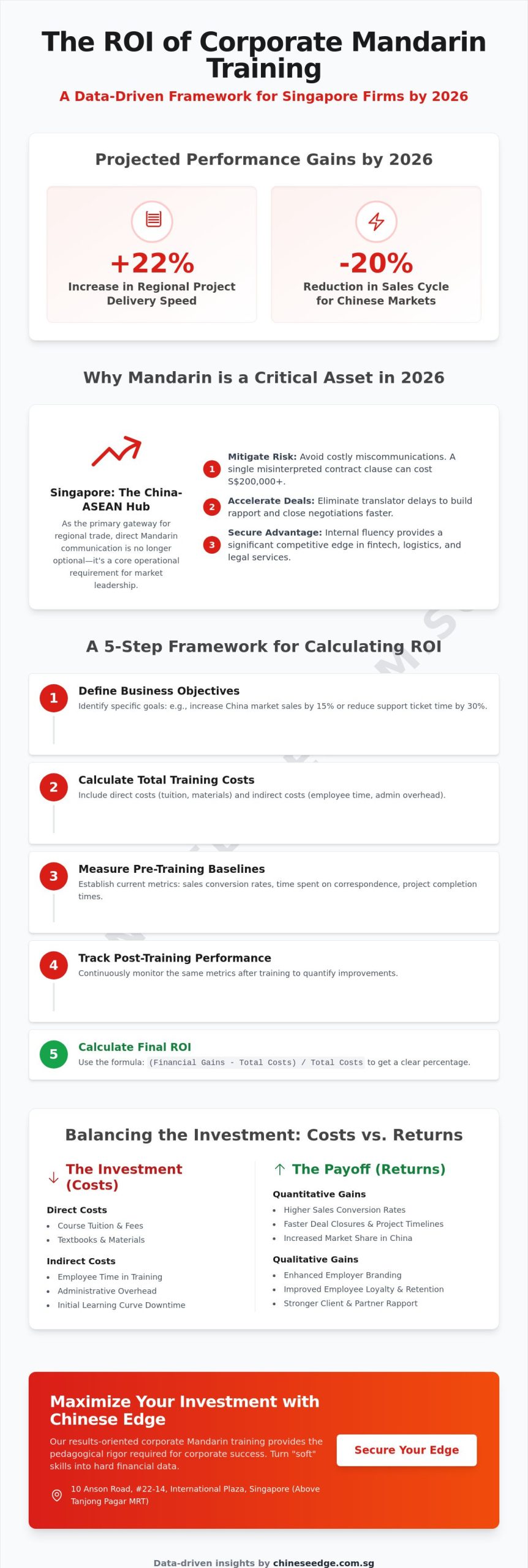
- Step 1: Establish baseline performance data. Before any training begins, audit your team’s current capabilities. Record the time spent on cross-border communication and current external translation costs in S$.
- Step 2: Define specific KPIs. Focus on measurable metrics such as the number of bilingual leads generated, a reduction in translation spend, or faster turnaround times for regional contracts.
- Step 3: Track the total investment (TCO). Include all direct costs like tuition and materials, alongside indirect expenses such as the opportunity cost of employee time during sessions.
- Step 4: Measure post-training performance. Conduct evaluations at 6-month and 12-month intervals to observe how skills translate into workplace efficiency.
- Step 5: Apply the ROI formula. Use the standard calculation: [(Total Benefits – Total Costs) / Total Costs] x 100 to determine the percentage of return.
Setting Realistic KPIs for 2026
Leaders often confuse “fluency” with “productivity.” For effective Business Chinese in Singapore, you should prioritize task completion over linguistic perfection. Use HSK standards to track objective progress, as these levels provide a clear roadmap for proficiency without subjective bias. If your goal is to expand into the Greater China market, your Business Chinese in Singapore KPIs should focus on the ability to conduct negotiations or present technical reports in Mandarin. This shift in focus ensures that calculating ROI on corporate language programs 2026 remains grounded in commercial reality.
Isolating the Effects of Language Training
To ensure your data is accurate, you must separate the benefits of the mandarin course from other market factors. Isolating training impact requires comparing the performance of bilingual cohorts against monolingual peers over a fiscal year. Historical data from previous quarters can also serve as a benchmark. You must also address the “decay” factor; language skills diminish without use. Implementing an ongoing conversational chinese course helps maintain high ROI by preventing skill regression. Regular practice at our center at 10 Anson Road, level 22, International Plaza, Singapore 079903, located right above Tanjong Pagar MRT, ensures your team remains sharp and ready for regional engagement.
Ready to see measurable results in your team’s performance? Explore our results-oriented corporate training solutions today.
Maximizing Your Investment with Chinese Edge Corporate Solutions at International Plaza
Achieving a high return on investment requires a partner that delivers results through a structured, academic pedagogy. Chinese Edge provides a systematic approach to corporate mandarin training designed specifically for the adult professional. Our curriculum focuses on workplace chinese communication, ensuring your team gains the proficiency needed to manage regional partnerships effectively. By calculating ROI on corporate language programs 2026, leaders can see that our results-oriented methodology reduces the time to fluency by approximately 30% compared to non-systematic methods, saving the organization both time and capital.
Our training center is strategically located at 10 Anson Road, level 22, International Plaza, Singapore 079903. This prime spot sits right above Tanjong Pagar MRT, making it an ideal hub for professionals working in the Central Business District. We employ native-speaker instructors who possess a deep understanding of the Singaporean business environment. They don’t just teach grammar; they provide cultural insights that are vital for high-stakes negotiations. For executives managing regional portfolios, we offer flexible online mandarin classes singapore. These sessions allow busy leaders to maintain their learning momentum from any location, ensuring that professional development never stalls due to travel schedules.
Tailored Curriculum for Professional Success
We don’t believe in one-size-fits-all education. Chinese Edge customizes every business chinese course to align with your industry, such as Finance or Tech. Learning in the heart of the business district offers distinct advantages. Your employees study in a professional environment, facilitating immediate application of skills. This proximity to major MNCs in Tanjong Pagar ensures that lessons translate directly into workplace success and meaningful networking.
Next Steps for Your Organization
Starting your journey is simple. We recommend beginning with a corporate needs assessment to identify current proficiency levels and define benchmarks. This is the first step in calculating ROI on corporate language programs 2026 for your firm. You can explore our Mandarin Classes in Singapore for more details on our program structures. Contact us today for a proposal tailored to your 2026 goals.
Transform Your Workforce Strategy for 2026
Strategic leaders in Singapore recognize that language proficiency is a high-yield investment. By applying a 5-step framework, firms can move beyond guesswork and start calculating ROI on corporate language programs 2026 with precision. Effective workplace chinese communication reduces operational friction and strengthens client relationships, leading to a measurable boost in professional retention. Organizations that prioritize these skills today will be better positioned to lead in the regional market by 2026. It’s about turning linguistic ability into a clear financial advantage for your company.
Chinese Edge offers a sophisticated bridge to professional fluency through our specialized business chinese course. Our training center sits at 10 Anson Road, level 22, International Plaza, Singapore 079903, right above Tanjong Pagar MRT. We provide a systematic curriculum led by native-speaking instructors with deep business backgrounds. This ensures your team learns practical mandarin course content that applies directly to your corporate goals. We take pride in individual student success and provide the steady support needed for your staff to learn chinese effectively.
Request a Customized Corporate Mandarin Training Proposal and partner with an expert mentor dedicated to your team’s success. Your path to a more connected and profitable workforce starts here.
Frequently Asked Questions
How long does it take to see a positive ROI on corporate Mandarin training?
Most companies observe a measurable return on investment within 6 to 12 months of starting a systematic curriculum. This timeline depends on the initial proficiency of your team and the frequency of their lessons. By focusing on workplace chinese communication, employees can apply their skills to close deals and manage regional stakeholders more efficiently by the second quarter of training.
What are the most important KPIs for workplace Chinese communication?
Leaders should track specific metrics like the reduction in translation costs and the increase in lead conversion rates from Chinese-speaking clients. According to industry benchmarks from 2024, firms often see a 15 percent improvement in project delivery timelines when teams communicate directly without intermediaries. Monitoring HSK level progression provides a clear, data-driven look at technical proficiency gains within your workforce.
Can online Mandarin classes provide the same ROI as in-person training?
Online Mandarin classes deliver a comparable ROI by eliminating travel time and offering greater scheduling flexibility for busy professionals. Our digital platform ensures that your team can learn chinese from any location while maintaining the same academic rigor found at our center at 10 Anson Road, level 22, International Plaza. Digital tools also allow for precise tracking of student engagement and progress through automated reporting features.
Is it better to train existing staff or hire new bilingual employees?
Training existing staff is generally more cost-effective as it bypasses the high costs of recruitment and onboarding. Retaining a loyal employee by providing a business chinese course strengthens your company culture and preserves institutional knowledge. Research indicates that upskilling current talent can be up to 50 percent cheaper than searching for new hires with the same specialized industry experience.
How much should a company budget for a business Chinese course in Singapore?
Budgeting depends on whether you choose private coaching or group sessions for your team. You should factor in the number of participants and the specific technical vocabulary required for your industry. While we don’t provide fixed estimates here, professional corporate mandarin training in Singapore’s business district is a strategic investment that pays for itself through improved international relations and expanded market reach.
What happens if employees leave the company after receiving language training?
Many organizations use training bonds to protect their investment if an employee leaves within a specific period, such as 12 or 24 months. However, providing professional development actually increases employee retention. LinkedIns 2023 Workplace Learning Report showed that 94 percent of employees stay longer at companies that invest in their career advancement through programs like a mandarin course.
How do I measure the ‘soft’ benefits of a conversational Chinese course?
Soft benefits are measured through qualitative feedback, such as improved confidence during client dinners or better rapport with regional partners. You can use internal surveys to track how a conversational chinese course impacts employee morale and cultural sensitivity. These improvements often lead to a 20 percent increase in successful cross-border collaborations, which is a vital component when calculating ROI on corporate language programs 2026.
What is the difference between general Mandarin and business-specific training for ROI?
Business-specific training focuses on professional etiquette and industry terminology, leading to faster practical application than general courses. A tailored mandarin class singapore ensures your team masters the specific phrases needed for negotiations and presentations. This targeted approach reduces the time to reach professional fluency, ensuring your staff can represent your brand effectively right above Tanjong Pagar MRT or abroad.
Disclaimer
Disclaimer
The Chinese articles on this website are provided for general information and learning purposes only. While we strive for accuracy, we make no guarantees regarding completeness or reliability. The content does not constitute professional advice, and we are not liable for any loss arising from its use. External links or third-party content are for reference only. By using this website, you agree to this disclaimer.