

Imagine standing in a sleek boardroom at International Plaza, ready to finalize a partnership, only to realize your casual seating choice has unintentionally insulted the senior executive. In a culture where respect and hierarchy are paramount, a single misunderstood gesture can stall months of negotiation. Mastering chinese business meeting etiquette is no longer just a “nice to have” skill; it’s a vital requirement for any professional looking to succeed in the 2026 economic environment.
You likely feel anxious about the intricate business card ritual or the subtle art of indirect communication. It’s natural to worry about causing offense when the stakes involve complex 2026 regulations like the updated Cybersecurity Law or the new outbound investment framework. This guide provides the clarity you need to project professionalism and build deep, lasting Guanxi. We’ll explore the essential protocols of the modern meeting room and show you how our business Mandarin course at 10 Anson Road, located right above Tanjong Pagar MRT, can give you the linguistic edge to lead with authority.
Key Takeaways
- Understand the core concepts of ‘Guanxi’ and ‘Mianzi’ to build mutual trust and protect professional reputations during high-stakes negotiations.
- Learn the precise protocols for greetings and hierarchy to ensure you project respect and competence from the moment you enter the room.
- Master the nuances of chinese business meeting etiquette by interpreting indirect communication and using strategic silence to your advantage.
- Navigate the complexities of business dining and gift-giving to solidify partnerships in social settings where key decisions are often finalized.
- Discover how a specialized business Mandarin course can provide the linguistic foundation necessary to apply these cultural protocols with confidence.
Mastering Chinese Business Meeting Etiquette: Why It Matters in 2026
In the professional landscape of 2026, chinese business meeting etiquette is far more than a set of polite gestures. It is a sophisticated system of social norms and professional protocols used to build Guanxi, the essential network of relationships that drives commercial success. When you follow these protocols, you send a clear signal to your partners that you are a reliable, long-term collaborator who respects their cultural values. This commitment is particularly vital as new regulations, such as the revised Foreign Trade Law passed in late 2025, place a higher premium on supply-chain compliance and mutual trust.
To better understand how these concepts manifest in a professional setting, watch this helpful video:
The Core Pillars: Guanxi and Mianzi
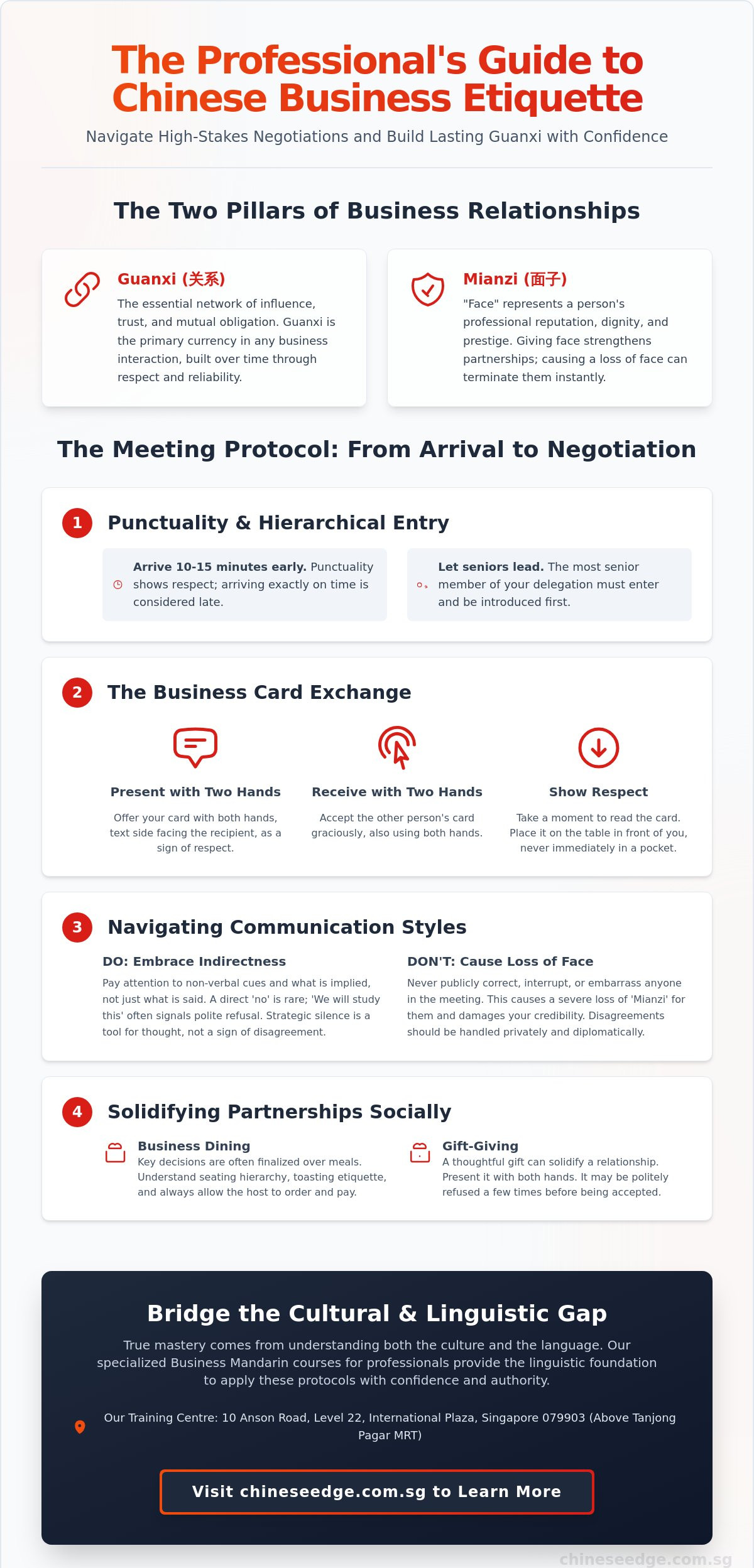
Guanxi is the intricate network of influence and trust that serves as the primary currency in any business interaction. Alongside this, the concept of Mianzi, or “face,” acts as the foundation of every meeting. Giving face by offering genuine praise or acknowledging a partner’s expertise is a strategic business move that strengthens your position. Conversely, losing face through public corrections or blunt refusals can terminate a partnership instantly. Understanding these nuances is a key component of Asian Business Etiquette, where maintaining harmony is often as important as the contract itself. Professionals who master these pillars find that negotiations proceed more smoothly and deals close with greater confidence.
The 2026 Shift: Modernity Meets Tradition
The business environment in 2026 is defined by a unique blend of high-tech efficiency and traditional values. While digital tools like WeChat are now fully integrated into formal meeting protocols for real-time data sharing, the underlying respect for hierarchy remains unchanged. Modern Chinese corporate culture moves at a rapid pace, yet traditional values are still the silent deciders in high-value deals. This is especially true with the “Regulations on Outbound Investment” becoming effective on July 1, 2026, which requires a deeper level of transparency and trust between parties.
To bridge this cultural gap effectively, many professionals enroll in a business Mandarin course to ensure their communication is both precise and respectful. At our training center at 10 Anson Road, International Plaza, we help adult learners master these complexities. Being located right above Tanjong Pagar MRT makes it convenient for busy executives to develop the cultural and linguistic mastery required for 2026. Mastery of chinese business meeting etiquette ensures you are prepared for the intensified regulatory scrutiny and the fast-evolving market access rules of the current year.
The Protocol of First Impressions: Hierarchy, Greetings, and Business Cards
The first five minutes of an encounter often dictate the success of a multi-million dollar negotiation. For professionals in Singapore, understanding chinese business meeting etiquette starts with impeccable punctuality. Arriving exactly on time is often viewed as being late; you should aim to be at least ten minutes early. This level of discipline reflects your respect for the host’s schedule and your own professional rigor. When entering the meeting room, always observe the hierarchy of entry. The most senior member of your delegation must lead the way. This order signals your internal organization and your respect for authority, which are critical traits in Chinese corporate culture.
Greetings follow a similarly structured pattern. You should address the most senior person first using their formal title and surname. Avoid overly familiar gestures or physical contact beyond a standard handshake. A slight nod or a soft handshake is appropriate, but you must maintain a respectful physical distance. This Chinese Business Etiquette Guide highlights that trust is built through these small, consistent acts of decorum. Professionals who ignore these subtle cues often find it difficult to establish the rapport necessary for long-term Guanxi.
The Art of the Business Card Exchange
The exchange of business cards, or Meishi, is a ritual that requires your full attention. It’s not a casual hand-off but a formal presentation of your professional identity. Follow these three steps to ensure you maintain respect:
- Step 1: Present your card using both hands. Ensure the text is facing the recipient so they can read it immediately without turning it over.
- Step 2: Receive their card with both hands. Take several seconds to study the details, such as their specific title and department, with visible focus.
- Step 3: Place the card on the table in front of you for the duration of the meeting. You must never slide it into your back pocket or a wallet while you’re still in their presence.
Seating Arrangements and Seniority
Seating is never random in a formal Chinese setting. The “Power Seat” is typically the one facing the door or positioned in the center of the table. As a guest, you should wait to be directed to your seat by your host. This prevents the awkwardness of accidentally occupying a chair reserved for a high-ranking official. During the flow of conversation, allow the senior leaders to set the tone. If you’re participating in a Q&A session, it’s wise to defer to your lead negotiator before speaking. This internal alignment is a hallmark of effective workplace chinese communication.
Mastering these physical protocols is the first step toward cultural mastery. If you want to refine your approach further, consider enrolling in a business Mandarin course at our center. Located at 10 Anson Road, level 22, International Plaza, we’re situated right above Tanjong Pagar MRT, making it easy for busy professionals to fit training into their schedules. Developing these skills ensures you navigate chinese business meeting etiquette with the poise required to close deals in 2026.
Navigating Communication Styles: Reading the Room and Saving Face
Effective chinese business meeting etiquette requires a deep understanding of high-context communication. Unlike Western professional styles that favor blunt transparency, Chinese business culture often utilizes indirect language to maintain harmony. If your partner says “Yes” during a proposal, they might simply be acknowledging your point rather than agreeing to the terms. This subtle distinction is where many deals falter. You must learn to listen for what isn’t said as much as what is spoken aloud. This approach prevents conflict and ensures that no one at the table feels pressured or embarrassed.
Silence is another powerful tool in the boardroom. Instead of rushing to fill a pause, view it as a sign that your counterparts are giving your ideas deep consideration. Rushing to speak can appear impatient or even disrespectful. You should also pay close attention to non-verbal cues. In 2026, even with the rise of digital integration and mobile payments like Alipay, these traditional signals remain the primary way to gauge a room’s temperature. Maintaining a composed posture and controlled facial expressions demonstrates your own reliability and emotional intelligence.
Delivering negative feedback requires extreme care to avoid causing a loss of face. Instead of pointing out errors directly in front of the group, address concerns privately or use softened language. Professionals who master these communication strategies find that their partnerships are more resilient and their negotiations more productive.
Decoding the “Chinese No”
In a formal setting, a direct “no” is rare. You are more likely to hear phrases like “We will consider it” or “It might be difficult.” These are common indicators of hesitation or disagreement. If you encounter this indirect resistance, do not push for an immediate answer. Instead, pivot your proposal to address potential concerns or seek clarification through a trusted middleman. This intermediary can help resolve communication deadlocks and facilitate a compromise without either party losing face.
Professional Vocabulary for Meetings
The use of formal honorifics and professional titles is a non-negotiable part of chinese business meeting etiquette. Addressing someone correctly shows you recognize their status within the corporate hierarchy. This linguistic precision is why Business Mandarin courses are essential for professionals who need to master these nuances. Using the right title at the right time can significantly impact how your message is received.
Our training programs at 10 Anson Road, level 22, International Plaza, focus on these practical applications. For a deeper dive into the local professional context, see our guide on Business Chinese in Singapore. Mastery of workplace chinese communication allows you to lead with authority while staying right above Tanjong Pagar MRT for your convenience.
Beyond the Boardroom: Business Dining and the Art of Gift-Giving
While the boardroom is the venue for formal presentations, the banquet table is where the foundation of trust is solidified. In 2026, chinese business meeting etiquette extends far beyond the office walls. The business banquet serves as a vital platform for your hosts to assess your character and reliability in a more relaxed setting. Mastering this environment is crucial. Many final decisions are reached over a shared meal rather than during a formal slide presentation. It is here that Guanxi is truly nurtured.
Dining etiquette involves specific rituals that demonstrate your cultural awareness. You should wait for the host to signal the start of the meal and the first toast. When using the “lazy susan” turntable, always ensure you aren’t rotating it while someone else is serving themselves. It is a small gesture of consideration that doesn’t go unnoticed. These social nuances are often the silent deciders in high-stakes partnerships.
The Protocol of the Business Banquet
The host-guest dynamic is strictly defined: the host always pays the bill. While you may offer to pay once as a sign of politeness, you shouldn’t insist. Doing so can cause the host to lose face. Toasting is a central part of the evening. You must toast to the health and success of the partnership, starting with the most senior person at the table. Keep the conversation light and relationship-focused. Avoid diving into complex contract details or sensitive political topics unless your host initiates the discussion. Focus on building a personal connection that transcends the transaction.
Gift Taboos and Best Practices
Gift-giving, or Liwu, is a delicate art that requires careful planning. You must avoid items that carry negative symbolic meanings. Never give clocks, as they symbolize death, or sharp objects like scissors, which represent the severing of a relationship. Avoid anything in sets of four; the number four sounds like the word for death in Mandarin. Stick to red or gold packaging to symbolize luck and prosperity. Avoid white or black wrapping, as these colors are associated with mourning.
When presenting a corporate gift, use both hands. It’s common for a recipient to decline a gift once or twice before accepting it. This is a display of humility, not a rejection. You should politely persist until they accept. If you’re giving to a team, ensure the gift is intended for the entire group. If the gift is for an individual leader, present it privately to avoid creating jealousy among their staff.
To truly excel in these social settings and lead with authority, consider enrolling in a business Mandarin course. Our instructors at 10 Anson Road, level 22, International Plaza, specialize in teaching workplace chinese communication tailored for professionals. Since our center is located right above Tanjong Pagar MRT, it’s a convenient way to refine your chinese business meeting etiquette and ensure your next business banquet is a resounding success.
Bridge the Cultural Gap with Professional Business Mandarin Training
Understanding the intricate rules of chinese business meeting etiquette is a powerful starting point, yet your cultural mastery remains incomplete without basic language proficiency. Relying solely on translators or non-verbal cues creates a subtle barrier that can prevent the formation of deep, personal Guanxi. When you make the effort to learn the language, you demonstrate a level of respect that goes beyond mere politeness. It shows a long-term commitment to the partnership that resonates deeply with Chinese executives in the 2026 business environment. Transitioning from an observer of culture to an active participant requires the confidence that only fluent communication provides.
Our approach at Chinese Edge focuses on the practical application of the language. We believe that fluency is an attainable goal for every professional when supported by a structured and proven methodology. By combining etiquette knowledge with a specialized business chinese course, you equip yourself with the tools to lead negotiations and build trust more effectively. This linguistic foundation allows you to navigate complex social hierarchies with ease, ensuring you never miss the subtle nuances of a high-stakes meeting.
Customized Corporate Training Solutions
We recognize that busy professionals have unique requirements and limited time. Our Mandarin courses for adults are specifically tailored to address corporate needs and workplace chinese communication. We focus on industry-specific terminology and the conversational chinese course elements needed for successful social banquets and networking. You can choose from flexible learning modes, including online Mandarin classes for those with demanding travel schedules or in-person sessions for a more immersive experience. For more insights on selecting the right program, read our 2026 Guide to Choosing a Mandarin Course.
Visit Our Singapore Training Center
Our training center is located at 10 Anson Road, level 22, International Plaza, Singapore 079903. This central location is situated right above Tanjong Pagar MRT, making it the most convenient choice for those looking for a mandarin class singapore within the Central Business District. You don’t have to worry about long commutes after a busy day at the office. Our premium boutique school offers a sophisticated environment where you can focus on your personal and professional growth. Contact our expert mentors today to begin your Business Mandarin journey and master chinese business meeting etiquette through authentic engagement.
Lead with Confidence in Your Next Chinese Business Engagement
Mastering the nuances of chinese business meeting etiquette is a transformative step for any professional operating in the 2026 global economy. We have explored how respecting hierarchy and perfecting the business card ritual sets a foundation of trust. You now understand that successful negotiations often rely on reading subtle non-verbal cues and navigating the social complexities of the business banquet. These skills ensure you project the reliability and respect necessary to secure high-value partnerships.
At Chinese Edge, we provide the tools you need to bridge the cultural gap through a customized Business Mandarin curriculum. Our native-speaking instructors bring extensive corporate experience to every lesson, ensuring your learning is practical and results-oriented. Our center is conveniently located at 10 Anson Road, level 22, International Plaza, situated right above Tanjong Pagar MRT. This makes it easy to transition from your office to our classroom for focused, professional growth. If you are ready to elevate your workplace communication, we are here to support your journey toward fluency.
Master Business Mandarin and Etiquette at Chinese Edge Today
Success in the Chinese business world is well within your reach when you combine cultural awareness with linguistic precision. We look forward to helping you achieve your professional goals with confidence.
Frequently Asked Questions
What is the most important rule of Chinese business etiquette?
Respect for hierarchy and the concept of saving face are the most critical rules of chinese business meeting etiquette. You must always acknowledge the seniority of your counterparts through your seating, speaking order, and greetings. Failing to show proper deference can cause a partner to lose face; this often results in the immediate breakdown of negotiations. Maintaining harmony and protecting professional reputations ensures a stable foundation for long term partnerships.
How should I address my Chinese business partners?
You should always use formal titles and surnames when addressing your partners. Avoid using first names unless you are specifically invited to do so after a long term relationship has been established. For example, address a manager as “Manager [Surname]” or a director as “Director [Surname].” This formal approach demonstrates your professionalism and your understanding of the organizational structure within their company, which is vital for building trust.
Is it mandatory to bring a gift to a first business meeting?
While not strictly mandatory, bringing a modest corporate gift to a first meeting is a highly effective way to build Guanxi. It serves as a tangible signal of your goodwill and interest in a long term collaboration. Ensure the gift is wrapped in red or gold and presented with both hands. This small investment in etiquette can significantly ease the initial stages of a business relationship and show your commitment.
What should I do if I am offered a drink or food I don’t like during a banquet?
If you are offered something you don’t like, the best approach is to accept it politely and take a very small taste. You don’t need to finish the entire portion or drink. Leaving the majority of it on your plate or in your glass is acceptable as long as you have shown the courtesy of trying it. This prevents the host from losing face while respecting your personal preferences during the meal.
How do I exchange business cards correctly in a group setting?
In a group setting, you must always exchange business cards starting with the most senior person in the room. Move down the hierarchy in order of rank. Use both hands to present your card and to receive theirs; take a moment to study each card with focus before placing it on the table. This systematic approach ensures that you show the appropriate level of respect to the leadership team before engaging with junior staff.
Can I use WeChat for professional business communication in 2026?
WeChat remains a cornerstone of professional communication in 2026. It’s used for everything from scheduling meetings to sharing documents and sending follow up notes after a banquet. However, you should still respect formal boundaries; keep your tone professional and avoid sending messages during late hours. Integrating WeChat into your workflow shows that you are adapted to the modern, digitalized landscape of Chinese commerce while maintaining necessary professional standards.
Is it necessary to learn Mandarin to be successful in Chinese business?
Learning Mandarin isn’t strictly mandatory for success, but it provides a massive competitive advantage in 2026. Basic proficiency allows you to engage in small talk and understand the nuances of chinese business meeting etiquette without a translator. At our training center at 10 Anson Road, level 22, International Plaza, we help professionals build these skills. Our location right above Tanjong Pagar MRT makes it easy to attend classes and gain this vital edge.
What is the appropriate dress code for a business meeting in China or with Chinese clients?
The appropriate dress code is formal and conservative. Men should wear dark colored business suits with a tie, while women should opt for professional suits or modest dresses. Avoid overly bright colors or casual attire, as these can be perceived as a lack of seriousness or respect for the occasion. Projecting a polished, professional image aligns with the high standards expected in Chinese corporate culture and signals your reliability as a partner.
Disclaimer
Disclaimer
The Chinese articles on this website are provided for general information and learning purposes only. While we strive for accuracy, we make no guarantees regarding completeness or reliability. The content does not constitute professional advice, and we are not liable for any loss arising from its use. External links or third-party content are for reference only. By using this website, you agree to this disclaimer.