
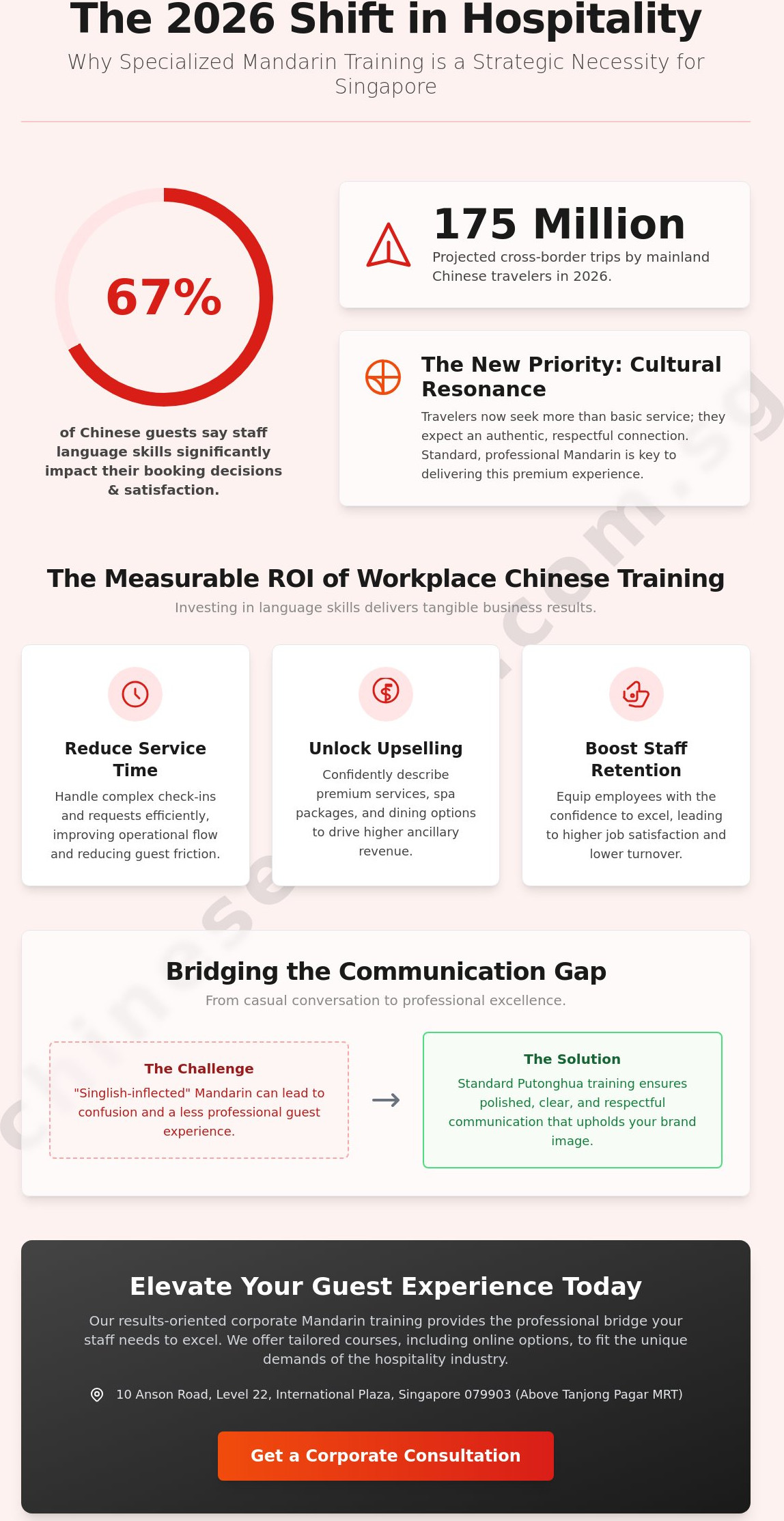
67% of Chinese guests report that the language skills of staff significantly impact their booking decisions and overall satisfaction. With mainland Chinese travelers projected to take up to 175 million cross-border trips in 2026, the ability to communicate effectively is a critical driver of revenue and reputation. You likely understand the frustration when a simple misunderstanding at check-in leads to a poor review or when language barriers prevent your team from upselling premium services. It’s a common challenge in Singapore’s competitive landscape, but it’s one that a systematic approach can solve.
This guide demonstrates how professional chinese language training for hospitality staff elevates service standards by focusing on high-impact micro-moments and cultural honorifics. You’ll learn exactly how to equip your team with the confidence to handle complex service recovery scenarios and drive long-term guest loyalty. We will preview the latest industry data and show you how our results-oriented corporate mandarin training at 10 Anson Road, level 22, International Plaza, Singapore 079903, provides the professional bridge your staff needs to excel, located right above Tanjong Pagar MRT.
Key Takeaways
- Understand why 2026 travelers prioritize cultural resonance and how specialized language skills directly influence booking decisions and guest satisfaction.
- Master high-impact service touchpoints through chinese language training for hospitality staff, ensuring professional communication from front desk check-ins to complex service recovery.
- Learn to navigate essential cultural nuances like “Mianzi” (face) and hierarchy to provide a more respectful and personalized experience for multi-generational Chinese groups.
- Assess the advantages of tailored corporate mandarin training and online Mandarin classes that accommodate the irregular shift patterns of the hospitality industry.
- Connect with expert native speakers at our training center at 10 Anson Road, International Plaza, to build a professional bridge between your staff and the Chinese-speaking world.
Why Hospitality Staff Need Specialized Mandarin Training in 2026
The 2026 evolution in global travel trends shows that mainland Chinese travelers, who are projected to take up to 175 million cross-border trips this year, now prioritize cultural resonance over basic service. For a 5-star hotel or boutique resort in Singapore, this means guests expect more than just a functional stay; they seek a connection that feels authentic and respectful. Implementing chinese language training for hospitality staff is no longer a luxury but a strategic necessity to meet these elevated expectations in a competitive market.
Hospitality Mandarin is a specialized subset of workplace chinese communication. It moves beyond basic vocabulary to focus on high-level honorifics and specific service verbs that define luxury guest relations. When your team can navigate these nuances, your Net Promoter Scores (NPS) and online reputation on platforms like Tripadvisor and Google often see a direct boost. Research shows that 67% of Chinese guests state that staff language proficiency is a deciding factor in their booking choices and overall satisfaction.
To better understand how specific hotel vocabulary works in practice, watch this helpful video:
As Singapore continues to align with its 2030 sustainability goals, the role of Mandarin becomes even more vital. Staff must be able to explain eco-friendly amenities and local heritage to a growing demographic of sophisticated travelers. This ensures that your property remains a preferred choice for the modern Chinese tourist who values both luxury and local context.
The ROI of Workplace Chinese Communication
Effective training delivers a measurable return on investment for any hospitality group. First, it significantly reduces service time. When a front desk agent can handle a complex check-in without repetitive guest inquiries, operational efficiency improves. Second, it unlocks upselling opportunities. A staff member who can confidently use a business mandarin course curriculum to describe premium wine lists or organic spa packages can drive higher ancillary revenue. Finally, it aids in staff retention. Employees who feel equipped to handle their environment experience less frustration and higher job satisfaction, which is crucial in a 24/7 service industry.
Bridging the Gap in Singaporean Guest Relations
Many local teams rely on “Singlish-inflected” Mandarin, which can inadvertently confuse international guests. In a premium setting, the use of standard Putonghua is essential for maintaining a professional image. Moving beyond a simple “Ni Hao” allows your team to build a rapport that feels genuine and polished. This level of service is often a prerequisite for obtaining the Welcome Chinese certification, a global standard for hospitality excellence. If you want to elevate your team’s skills, our group chinese courses at 10 Anson Road, level 22, International Plaza, Singapore 079903, provide the structured pedagogy needed for success right above Tanjong Pagar MRT.
Core Modules: From Front Desk Check-ins to Service Recovery
A successful guest experience is built upon a series of high-impact touchpoints. Identifying these specific moments allows a hotel to implement chinese language training for hospitality staff where it matters most. It’s not about achieving general fluency; it’s about mastering the precise vocabulary required at the concierge desk, the restaurant, and the spa. By developing a conversational chinese course curriculum that mirrors the guest journey, from the initial “Welcome” to the final “Safe travels,” your team ensures a seamless transition between departments.
Effective training in 2026 must also prioritize auditory recognition. Chinese travelers come from diverse regions, and understanding various accents is just as important as speaking clearly. Whether a guest is from Beijing or Guangzhou, your staff should feel confident interpreting their needs without hesitation. Additionally, every mandarin course we design ensures strict alignment with your brand’s Standard Operating Procedures (SOP). This ensures that the level of formality and the specific phrasing used by your team stay consistent with your 5-star identity.
Front-of-House and Concierge Essentials
The front-of-house team serves as the face of your property. Their training focuses on essential check-in and check-out vocabulary, explaining room features like high-speed Wi-Fi or smart lighting, and providing local Singapore recommendations. In F&B settings, staff learn to navigate complex dietary restrictions, ensuring that “no MSG” or “seafood allergy” is understood perfectly every time. A standard Welcome Protocol in a professional setting might be: “Huānyíng guānglín, hěn gāoxìng wèi nín fúwù,” which translates to “Welcome, it is a pleasure to serve you.”
If you want to see how these modules can be integrated into your team’s schedule, you might explore our professional syllabus at our center located at 10 Anson Road, level 22, International Plaza, Singapore 079903, right above Tanjong Pagar MRT.
Advanced Service Recovery and Problem Solving
Service recovery is where chinese language training for hospitality staff proves its highest value. When a guest is unhappy, using the right empathetic phrases can de-escalate a situation before it reaches a public review platform. Phrases that signal immediate action and sincere apology are vital. Whether your team is negotiating a late check-out or managing a specific request from a pillow menu, the goal is to provide solutions that feel proactive rather than reactive. Our group Chinese courses can be customized for specific departments, allowing your housekeeping or maintenance teams to master the specific terminology they need for guest-facing interactions. This targeted pedagogy ensures that every staff member, regardless of their role, contributes to a culture of service excellence.
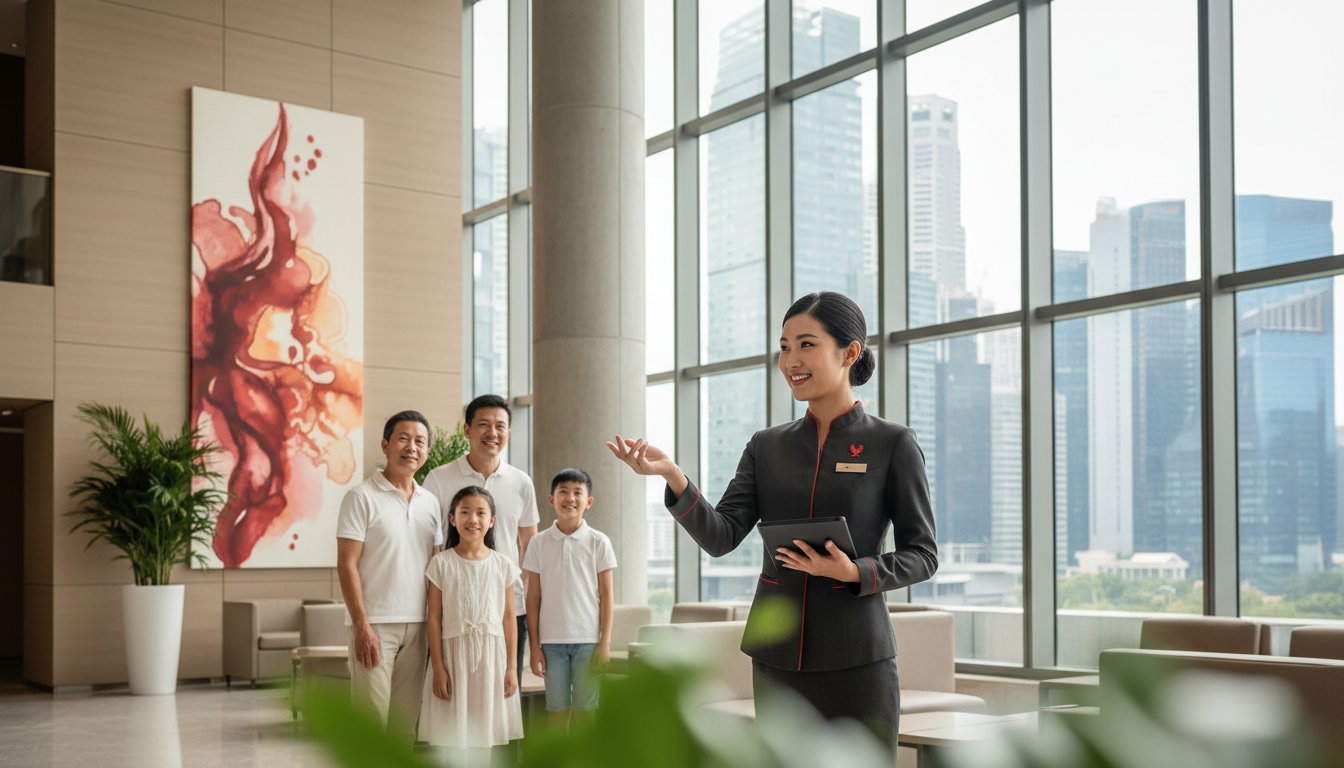
Navigating Cultural Nuances and Business Etiquette in Guest Relations
Mastering a language involves more than just memorizing a syllabus; it requires a deep understanding of the psychological drivers that influence guest behavior. In the context of chinese language training for hospitality staff, the most critical concept to grasp is “Mianzi” or Face. Giving face involves showing public respect, while saving face means avoiding any situation that might cause a guest embarrassment. For instance, if a guest makes a mistake regarding their booking, a staff member should handle the correction discreetly rather than pointing it out in a crowded lobby. This level of cultural sensitivity is what separates a standard mandarin course from a truly transformative service experience.
Understanding hierarchy is equally vital. When greeting a multi-generational travel group, staff should always address the eldest member first as a sign of respect. In a corporate setting, the lead executive or the person with the highest seniority should receive the initial greeting and the most formal register. Building “Guanxi,” or long-term relationships, is the ultimate goal in high-end hospitality. By demonstrating an understanding of these social structures, your team fosters a sense of trust that drives long-term loyalty and repeat bookings from sophisticated travelers.
Honorifics and Professional Address
In a business chinese course, students learn the importance of switching from the informal “Ni” to the respectful “Nin.” This single syllable change signals a high level of professionalism and awareness of social boundaries. Using proper titles for VIP guests, such as addressing them by their surname and position, reinforces the hotel’s commitment to excellence. From the Expert Mentor perspective, guests often forgive small grammatical errors if the underlying etiquette and respect are clearly evident. For those looking to expand these skills into a corporate setting, our guide on Business Chinese in Singapore offers a deeper look at professional etiquette.
Gift Giving and Taboos in Hospitality
Navigating traditional holidays like Chinese New Year or the Mid-Autumn Festival requires specific greetings and an awareness of symbolic gestures. Staff should be trained to avoid “unlucky” associations, such as assigning rooms with the number four, which sounds like the word for death. Conversely, the number eight is highly favored for its association with wealth. When presenting items like room keys or menus, using two hands is a non-verbal cue that signals sincerity and respect. Our corporate mandarin training programs at 10 Anson Road, level 22, International Plaza, Singapore 079903, ensure your team masters these subtle but powerful interactions right above Tanjong Pagar MRT.
Flexible Learning Modes: Online and Corporate Training for Shift Workers
Hospitality never sleeps, which makes traditional education models difficult to implement. A 24/7 operation requires a training partner that understands irregular shift patterns and the physical demands of service work. Effective chinese language training for hospitality staff must be as dynamic as the industry it serves, offering solutions that fit into the gaps of a busy roster. One hospitality group that trained 120 staff members across three properties saw a 28% year-over-year increase in bookings from Chinese tourists after implementing a structured program. This success stems from choosing the right delivery method for the right team members.
Role-play based pedagogy is the cornerstone of our approach. It allows front-line staff to practice high-stress scenarios, such as handling a double-booked room or a complex dietary request, in a controlled environment. This builds the muscle memory needed to respond with poise during actual guest interactions. For staff who prefer physical interaction during their off-hours, finding chinese classes near me that are centrally located is essential for reducing commute fatigue. Our center is at 10 Anson Road, level 22, International Plaza, Singapore 079903, situated right above Tanjong Pagar MRT. This central hub makes it easy for your team to access professional instruction before or after their shift.
On-Site vs. Virtual Training for Hotels
On-site training is excellent for building team cohesion. It allows our expert mentors to observe staff in their actual service environment, whether that is at the concierge desk or in the restaurant. In contrast, online Mandarin classes provide the ultimate flexibility for night-shift employees or decentralized teams. These interactive digital sessions ensure that even those working irregular hours don’t miss out on vital curriculum updates. Many hotels now opt for hybrid models, where foundational theory is taught online, followed by intensive in-person role-playing sessions to sharpen conversational skills.
Customizing the Syllabus for Your Brand
A boutique heritage hotel in Chinatown requires a different vocabulary than a massive convention center in the Central Business District. We don’t believe in one-size-fits-all solutions. Instead, we integrate your specific brand values and service standards into the corporate mandarin training curriculum. This ensures that the language your staff speaks reflects the unique identity of your property. If you are currently evaluating different providers, you should read The 2026 Guide to Choosing a Mandarin Course to understand the essential selection criteria for your business. To start your team’s transformation, you can contact us for a customized training proposal tailored to your specific hotel operations.
Choosing Chinese Edge: Professional Training at International Plaza
Selecting the right partner for chinese language training for hospitality staff is a strategic decision that directly impacts your brand’s long-term reputation. At Chinese Edge, we understand that luxury hotels in the Central Business District require a level of sophistication that generic language programs simply cannot provide. Our training center is strategically located at 10 Anson Road, level 22, International Plaza, Singapore 079903. Being situated right above Tanjong Pagar MRT, we offer unparalleled convenience for staff commuting from major hotel clusters in the city center, allowing for seamless integration of training into their professional schedules.
We pride ourselves on our “Expert Mentor” model. Our native speakers don’t just teach vocabulary; they bring a deep, nuanced understanding of Singapore’s unique hospitality landscape and the specific expectations of mainland Chinese travelers. This ensures that the training isn’t just about theoretical grammar, but about the practical, high-stakes application of language in 5-star service environments. Our systematic approach respects the demanding, 24/7 nature of hospitality work. We provide a clear, logical path to proficiency that avoids the fluff of academic-only programs, focusing instead on the results that drive guest satisfaction and positive reviews.
The Chinese Edge Methodology
Since 2012, we’ve been a reliable partner for Singaporean businesses looking to bridge the language gap. Our methodology is built specifically for adult learners, ensuring that every lesson uses practical hospitality tools rather than outdated primary school methods. This focus on adult pedagogy allows for faster career advancement and more immediate application on the job. Our instructors prioritize effective workplace communication, focusing on the specific terminology your team needs to excel. We provide a structured environment where your staff can master Mandarin for professionals through targeted exercises and real-world scenarios that reflect the daily operations of a premium hotel.
Next Steps for Your Hospitality Team
Elevating your team’s communication skills starts with a clear understanding of their current strengths and weaknesses. We offer comprehensive diagnostic assessments to identify proficiency levels across your various departments, from front-of-house and concierge to F&B and guest relations. This data-driven approach allows us to tailor our corporate mandarin training to the specific needs of your staff. Once the assessment is complete, we provide a customized corporate proposal that aligns perfectly with your hotel or restaurant group’s operational goals and brand values. If you’re ready to transform your guest experience and drive long-term loyalty, book a consultation for your corporate Mandarin training today. We look forward to welcoming your team to our International Plaza center.
Mastering the New Standard of Guest Excellence
The hospitality landscape in 2026 demands a shift from functional service to deep cultural resonance. By investing in chinese language training for hospitality staff, your property does more than just bridge a communication gap; it builds a sophisticated bridge to the world’s largest outbound tourism market. Our systematic approach ensures your team masters the honorifics and etiquette necessary to protect “Mianzi” and foster “Guanxi” with every interaction. Whether through interactive online sessions or on-site role-playing, we provide the practical tools required for immediate service elevation.
Our native-speaking instructors bring years of corporate expertise to a tailored hospitality curriculum already trusted by leading Singaporean brands. We invite you to visit our center at 10 Anson Road, level 22, International Plaza, Singapore 079903, conveniently located right above Tanjong Pagar MRT. This central location allows your professionals to access high-quality instruction without disrupting their demanding schedules. Your team’s journey toward multilingual proficiency is a strategic investment in your brand’s future reputation.
Empower your team with professional Mandarin skills; contact Chinese Edge today to arrange your diagnostic assessment. We are ready to help you set a new benchmark for service excellence in Singapore.
Frequently Asked Questions
Is this Mandarin course suitable for beginners with zero prior knowledge?
Yes, our adult conversational mandarin course is specifically tailored for complete beginners. We utilize a systematic pedagogy that helps professionals with no prior background build a solid foundation quickly. Students start with essential phonetics and basic greetings before moving into service-specific dialogues. This approach ensures that even staff members who have never spoken the language before can begin interacting with guests within their first few lessons.
How long does it take for hospitality staff to become proficient in basic service phrases?
Staff members typically master high-frequency service phrases within 20 training hours of targeted instruction. This duration is sufficient for front-line teams to handle routine check-ins, direct guests to amenities, and manage simple F&B orders. While full fluency takes longer, this initial phase provides the immediate communication tools needed to improve guest satisfaction scores and reduce misunderstandings during the guest’s stay.
Can the training be conducted on-site at our hotel or restaurant?
Yes, we offer flexible corporate mandarin training that can be conducted directly at your property. On-site sessions are highly effective as they allow our expert mentors to observe staff in their actual working environment. This delivery mode encourages team cohesion and allows for immediate application of vocabulary in real-world scenarios, such as at the reception desk, concierge, or dining area.
Do you provide industry-specific certificates upon completion of the course?
Yes, every staff member receives a certificate of completion that reflects their new proficiency levels. These certificates serve as a professional record of the employee’s commitment to career advancement and service excellence. While we focus on practical workplace chinese communication, these documents provide a formal recognition of the skills acquired during the training program, which can be a significant motivator for your team.
What is the difference between general Mandarin and hospitality-focused Mandarin?
General Mandarin focuses on everyday social interactions, whereas hospitality Mandarin prioritizes service-specific honorifics and technical vocabulary. Our chinese language training for hospitality staff filters out irrelevant content to focus on high-impact micro-moments. This includes mastering formal registers for VIP guests, specific service recovery phrases, and the cultural nuances of “Mianzi” that are essential for providing a luxury experience in a professional setting.
Are there online options for staff who work irregular night shifts?
Yes, we provide interactive online Mandarin classes to accommodate the 24/7 nature of the hospitality industry. These virtual sessions offer the same level of academic rigor and native-speaker interaction as our in-person classes. They are an ideal solution for night-shift workers or decentralized teams who cannot travel to our center, ensuring that all staff members have equal access to professional development regardless of their roster.
How do you ensure the training is relevant to our specific brand of service?
We align our curriculum with your hotel’s specific Standard Operating Procedures (SOP) and brand values. Before the course begins, we conduct a diagnostic assessment of your team’s needs and review your existing service protocols. This results-oriented approach ensures that the language your staff learns is a direct reflection of your brand’s unique identity, whether you operate a boutique heritage property or a large-scale convention hotel.
Where are your training centers located for staff who prefer in-person classes?
Our primary training center is located at 10 Anson Road, level 22, International Plaza, Singapore 079903. This facility is situated right above Tanjong Pagar MRT, making it exceptionally convenient for staff working within the Central Business District. The central location allows for easy access before or after shifts, providing a professional and focused environment for employees who prefer the benefits of face-to-face instruction with our expert mentors.
Disclaimer
Disclaimer
The Chinese articles on this website are provided for general information and learning purposes only. While we strive for accuracy, we make no guarantees regarding completeness or reliability. The content does not constitute professional advice, and we are not liable for any loss arising from its use. External links or third-party content are for reference only. By using this website, you agree to this disclaimer.