
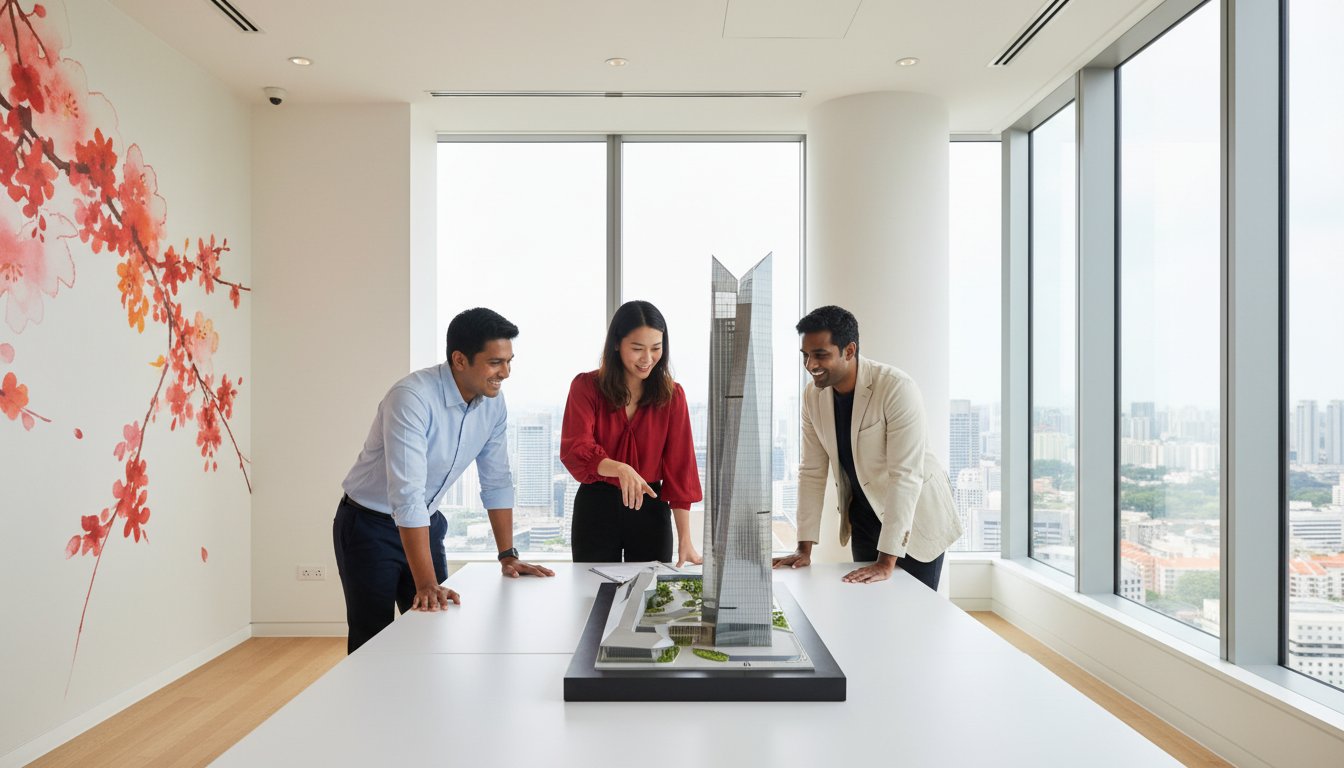
What if the most critical tool for your 2026 projects isn’t a new software update, but the ability to explain a facade detail or a load-bearing structure in fluent Mandarin? You’ve likely felt the tension when a contractor misinterprets a drawing or when a high-net-worth client’s vision seems just out of reach due to a language barrier. It’s a common hurdle in a market where the Building and Construction Authority projects up to S$53 billion in construction demand this year. While generic apps don’t teach the technical nuances of the built environment, a specialized conversational mandarin for architects program offers the precision you need.
We understand that your time is valuable and your professional needs are specific. By choosing to learn chinese through a targeted mandarin course singapore, you’ll gain the confidence to lead site meetings and pitch complex design concepts to Chinese-speaking stakeholders. This guide explores how our business chinese course at 10 Anson Road, level 22, International Plaza, Singapore 079903, located right above Tanjong Pagar MRT, provides the systematic framework to elevate your professional standing in the 2026 property market.
Key Takeaways
- Gain a competitive edge in Singapore’s 2026 property market by mastering the professional discourse required to engage with regional Chinese-speaking developers.
- Bridge the communication gap on construction sites by learning precise Mandarin terminology for building materials, structural components, and essential site safety briefings.
- Understand the limitations of gamified apps and why a specialized conversational mandarin for architects course is necessary to handle high-stakes design pitches and technical site execution.
- Follow a structured, adult-oriented curriculum that prioritizes technical clarity and pinyin mastery to ensure your architectural concepts are conveyed accurately to all stakeholders.
- Leverage the convenience of professional training at our Tanjong Pagar center to integrate language learning seamlessly into your demanding architectural practice.
The Strategic Value of Conversational Mandarin for Architects in Singapore
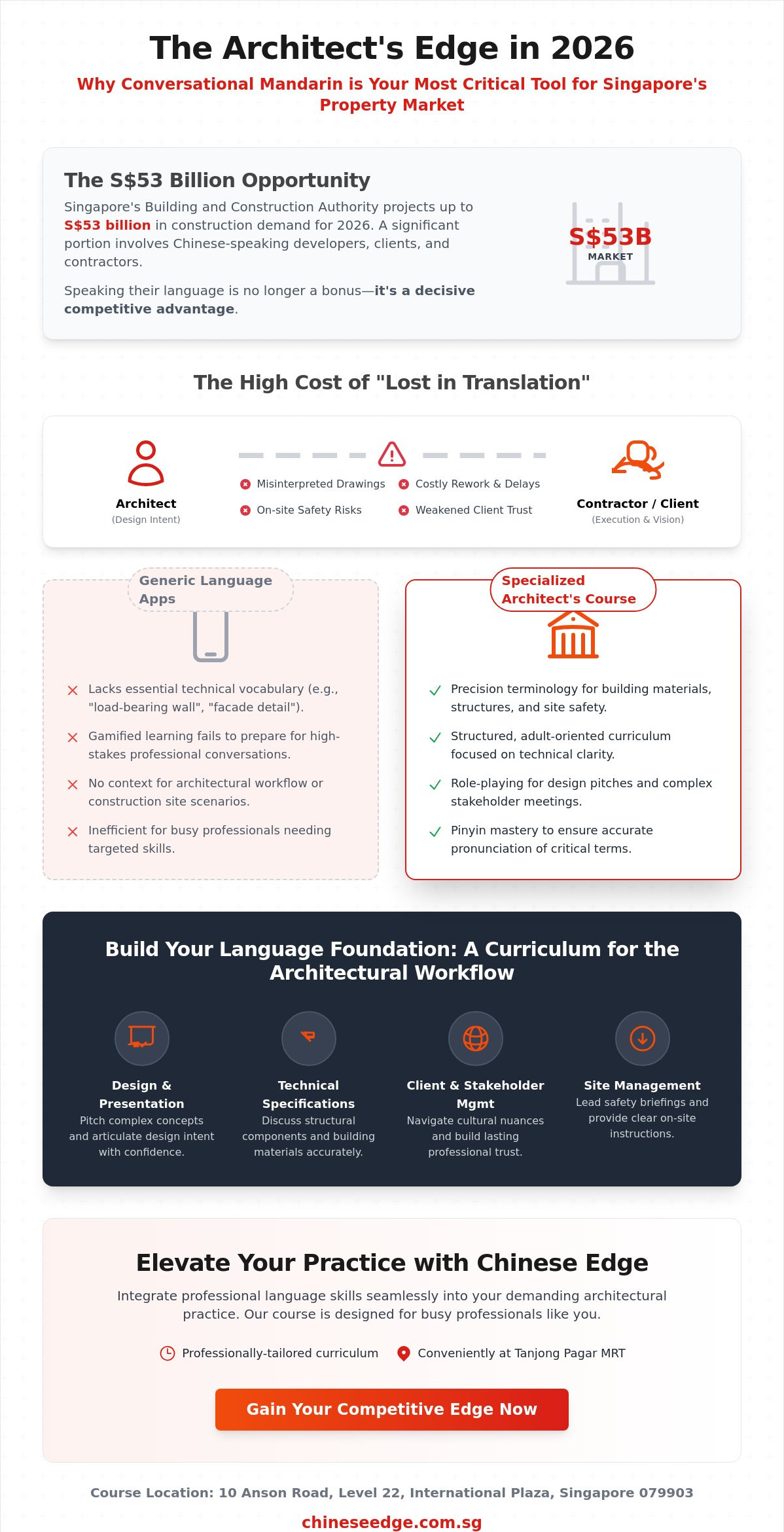
Singapore’s architectural landscape is undergoing a significant transformation in 2026. With the Building and Construction Authority projecting total construction demand between S$47 billion and S$53 billion this year, firms are increasingly competing for high-value contracts from regional Chinese-speaking developers. While English is one of the official languages in Singapore, the ability to communicate directly in Mandarin has become a decisive factor in securing these lucrative partnerships.
Professional fluency in this context goes beyond simple social interactions. It involves mastering a specialized curriculum that focuses on technical discourse, such as discussing site constraints or structural integrity. This level of conversational mandarin for architects ensures that your design intent isn’t lost in translation, allowing you to maintain the integrity of your vision throughout the project lifecycle.
To better understand how these technical terms apply on-site, watch this helpful video:
Winning Regional Bids and Client Trust
Building immediate rapport during a design pitch often depends on your ability to articulate complex concepts in the client’s preferred language. When you present a concept using precise architectural terminology, you demonstrate a level of respect and commitment that English-only presentations cannot match. Navigating cultural nuances, such as understanding local preferences for spatial flow or material symbolism, becomes significantly easier when you speak the language. Language proficiency serves as a powerful trust signal in high-value contracts, proving that you possess the cultural competence to manage a developer’s capital effectively.
Bridging the Gap Between Design and Construction
Architects act as the essential link in a bilingual project ecosystem. You often find yourself managing specialized craftsmen and contractors who may be more comfortable communicating in Mandarin. Clear, direct communication on construction sites reduces safety risks and prevents costly errors. If you can explain a complex facade detail or a specific waterproofing requirement directly to the site foreman, you eliminate the delays caused by third-party translation.
If you are ready to enhance your professional toolkit, our group chinese courses are designed for busy professionals. Our training center at 10 Anson Road, level 22, International Plaza, Singapore 079903, is located right above Tanjong Pagar MRT, making it easy to attend lessons after a day at the office. Mastering conversational mandarin for architects positions you as a versatile project lead, capable of navigating both the boardroom and the building site with equal authority.
Mastering the Site Walk: Essential Mandarin for Project Management
Walking onto a construction site in 2026 requires more than just a hard hat; it demands the linguistic precision to bridge the gap between a digital twin and physical reality. While the office environment relies on technical English, the pulse of a Singaporean building site often beats in Mandarin. This shift is deeply rooted in Singapore’s bilingualism policy, which has cultivated a workforce where professional Mandarin is a vital asset for technical coordination. Mastering conversational mandarin for architects allows you to move beyond basic greetings and engage in high-level project management with confidence.
Effective site leadership involves directing progress using specific terminology for building materials. You’ll need to discuss the curing time of concrete (hùnníngtǔ), the structural integrity of steel (gāngtiě), and the installation of high-performance glass (bōli). Safety is another critical area where language saves lives. Being able to conduct a safety briefing or identify hazards (wéixiǎn) ensures that PPE requirements (gèrén fánghù zhuāngbèi) are strictly followed. To maintain authority on-site, use “polite commands.” Phrases like “Qǐng bāng wǒ jiǎnchá” (Please help me check) allow you to direct work while respecting the expertise of the site team.
Scenario: The Weekly Site Progress Meeting
During progress meetings, you must address delays (yánqī) and variations (biàngèng) with clarity. If a structural alignment issue arises, you can ask for technical clarifications using terms for dimensions like width (kuāndù) and height (gāodù). Asking a foreman, “Nǐ kěyǐ zhěnggǎi zhège bùfèn ma?” (Can you rectify this part?) focuses on the solution rather than the error, preserving professional relationships. Using millimeters (hǎomǐ) and meters (mǐ) accurately ensures that rectification works align perfectly with your 1:100 scale drawings.
Scenario: Material Selection and Procurement
When conversing with suppliers, the focus shifts to quality standards and textures. You might specify a matte (yǎguāng) finish for floor tiles or a glossy (liànguāng) texture for a feature wall. In professional architectural discourse, the term for ‘sustainable building materials’ is kě chíxù jiànzhù cáiliào, which encompasses everything from low-carbon concrete to recycled timber composites. If you’re looking to refine these technical skills, you might explore professional mandarin classes at our training center. Located at 10 Anson Road, level 22, International Plaza, Singapore 079903, our school is right above Tanjong Pagar MRT, making it a convenient stop for CBD-based architects. Developing conversational mandarin for architects ensures you remain the central authority from the first brick to the final inspection.
Why Generic Apps Fail Architecture Professionals
Many architects start their language journey with gamified apps, but they quickly hit the ‘DuoLingo Ceiling’. These platforms are designed for casual tourists, not professionals managing a S$50 million development. While an app might teach you how to say “the house is big,” it won’t help you explain the nuances of a glass curtain wall or a sustainable facade. This gap in conversational mandarin for architects is where professional risk begins. Relying on generic tools for high-stakes site instructions is a gamble. Google Translate often fails to capture the technical context of architectural drawings, leading to site errors that can derail 2026 project timelines.
Native speakers with professional backgrounds provide something an algorithm cannot: architectural etiquette. In the AEC industry, how you say something is as important as what you say. Using the wrong honorific with a senior developer or failing to strike the right tone with a site foreman can lead to a loss of face. At our center at 10 Anson Road, level 22, International Plaza, Singapore 079903, located right above Tanjong Pagar MRT, we focus on these professional subtleties. We don’t just teach the language; we teach the workplace culture that surrounds it.
The Need for Systematic Learning
A structured syllabus is the most efficient way for busy professionals to reach fluency. Randomly acquiring vocabulary through an app lacks the logical progression needed for complex project management. For example, a slight shift in tone can change a technical instruction completely, potentially leading to structural misalignments. Immediate feedback from a mentor ensures you master the four tones of Mandarin, which is critical for technical clarity. To build this foundation, Explore our group Chinese courses for a structured professional path.
Architect-Specific Roleplay
We believe in classroom practice that mirrors the real world. Our modules move beyond “Beginner” levels into targeted AEC industry scenarios. You’ll practice leading a site walk, negotiating with suppliers, and pitching design concepts. While generic group classes focus on social chat, our 1-on-1 coaching or professional-centric group sessions allow you to roleplay with specific project data. This targeted approach is significantly more effective than broad-based learning, as it directly applies to your daily architectural workflow. By simulating a 2026 project meeting, you build the muscle memory needed for conversational mandarin for architects before you even step on site.
Building Your Language Foundation: A Curriculum for the Architectural Workflow
Mastering conversational mandarin for architects requires a disciplined approach that mirrors the precision of a technical blueprint. It isn’t about memorizing random phrases; it’s about building a functional toolkit that supports your daily professional interactions. We follow a systematic four step methodology designed to transition you from a language novice to a confident project lead. This structured progression ensures you don’t waste time on irrelevant social chatter, focusing instead on the workplace chinese communication that drives project success.
- Step 1: Strategic Assessment. We begin by evaluating your current proficiency and identifying your specific architectural goals, whether that’s leading site walks or pitching to developers.
- Step 2: Technical Phonetics. You’ll master Pinyin and the four basic tones. In architecture, a tonal error can lead to significant confusion between technical terms like “column” and “room.”
- Step 3: Vocabulary Integration. We layer industry specific terms into daily conversational structures, allowing you to discuss floor plans and material lead times naturally.
- Step 4: Professional Simulation. The final stage involves site visit simulations and mock design pitches to build real world muscle memory.
Scheduling is often the biggest hurdle for busy professionals. Our mandarin course singapore is designed with the demanding project cycles of 2026 in mind. By dedicating just two hours a week to a systematic conversational chinese course, you can achieve professional fluency without compromising your project deadlines.
Flexible Learning Modes for Busy Architects
We provide multiple learning pathways to suit your lifestyle. You can choose interactive online sessions for maximum flexibility or join us for in person classes at our center. Located at 10 Anson Road, level 22, International Plaza, Singapore 079903, our school is situated right above Tanjong Pagar MRT. This makes it an ideal stop for architects working in the CBD. For firms looking to unify communication across their teams, our Business Chinese in Singapore guide details how corporate training can transform your office’s regional capabilities.
Measuring Progress in a Professional Context
Progress in a professional setting isn’t measured by test scores but by your ability to handle a Mandarin led site meeting. You’ll know you’re ready when you can ask for a technical rectification or explain a design variation without hesitation. We provide self assessment checklists tailored for architectural professionals to track your growth. Having a mentor who understands the unique Singapore architectural landscape is invaluable for refining your delivery. If you’re ready to start your journey, you can enroll in our professional group courses today to secure your place in our next intake.
Elevate Your Practice with Chinese Edge at International Plaza
Securing your place in Singapore’s competitive 2026 architectural sector requires more than technical design skills; it demands the ability to lead and coordinate in a multilingual environment. At Chinese Edge, we specialize in bridging the gap between your professional expertise and the Chinese-speaking world. We understand that your goals are pragmatic. You don’t need a general language class; you need a conversational mandarin for architects program that focuses on the AEC industry’s specific demands. Our methodology is built on academic rigor and a systematic approach, ensuring that every hour you spend with us translates into improved professional standing.
Our commitment to excellence starts with our instructors. We exclusively employ native speakers who possess a deep understanding of business and technical Chinese. They act as expert mentors, guiding you through the nuances of professional etiquette and technical discourse. Because we focus strictly on adult education, you’ll learn alongside other professionals in an environment tailored to career advancement. We don’t offer general courses for children or school students; every resource in our center is dedicated to the needs of the working professional. If you’re looking for corporate mandarin training for your entire firm, we can customize a syllabus that unifies site communication across your team.
Convenience in the Heart of the CBD
We know that an architect’s schedule is rarely predictable. That’s why our training center is located at 10 Anson Road, level 22, International Plaza, Singapore 079903, situated right above Tanjong Pagar MRT. This prime location allows you to attend lunchtime or after-work sessions without disrupting your project workflow. Our modern training center provides a sophisticated environment designed for focused learning. Whether you’re coming from a site visit or a meeting in the CBD, our accessibility ensures that your mandarin course singapore remains a consistent part of your weekly routine.
Your Partner in Professional Growth
The Chinese Edge philosophy is defined by a practical and encouraging style. We believe that professional fluency is an attainable goal for every architect when supported by a proven, structured framework. Our conversational chinese course moves you through a logical progression, building your confidence one lesson at a time. As you master the workplace chinese communication required for 2026 projects, you’ll find that new regional opportunities become accessible. To see how this fits into your long-term career goals, read our guide on Learn Chinese in Singapore, which outlines the professional’s roadmap to success. We invite you to book a consultation to discuss your specific project needs and how our curriculum can be tailored to your firm’s unique architectural workflow.
Secure Your Professional Competitive Edge in 2026
Mastering the language of the built environment is a strategic investment in your architectural practice. By moving beyond generic phrases and embracing a systematic curriculum, you ensure that your design intent is executed perfectly on-site. Technical fluency reduces safety risks and builds the necessary trust to secure high-value regional contracts. This journey requires a partner that understands the high-stakes nature of your profession. Our adult-only learning environment focuses entirely on your career success.
At Chinese Edge, our native-speaking instructors bring professional backgrounds to the classroom, ensuring you master the specific nuances of conversational mandarin for architects. Our training center is conveniently located at 10 Anson Road, level 22, International Plaza, Singapore 079903, right above Tanjong Pagar MRT. This accessibility allows you to integrate professional development seamlessly into your busy schedule. Don’t let language barriers limit your firm’s potential in a market where construction demand reaches up to S$53 billion this year. Take the first step toward professional fluency and regional leadership.
Book Your Conversational Mandarin Consultation at Tanjong Pagar Today. We look forward to supporting your growth as a bilingual project lead.
Frequently Asked Questions
Is conversational Mandarin for architects different from general business Chinese?
Yes, it’s a highly specialized field. While a standard business course covers general office etiquette, this curriculum focuses on the specific linguistic bridge between design theory and construction reality. You’ll master the technical discourse required to manage site foremen and discuss complex structural details with regional developers. This targeted approach ensures your communication is precise and industry relevant.
How long does it take for an architect to become functional on a construction site?
Most professionals achieve functional site communication within 20 to 40 hours of systematic training. This timeframe allows you to master essential safety briefings and coordinate material deliveries with confidence. Your progress depends on consistent engagement with our structured curriculum. We focus on high frequency architectural scenarios to ensure you can apply your skills immediately in the field.
Can I take these classes online if I have a site visit in another country?
You can seamlessly transition between in person and online classes to suit your project schedule. Our hybrid model supports architects who travel regionally for inspections or client meetings. This flexibility ensures your learning momentum remains steady regardless of your physical location. You’ll receive the same high quality instruction from our native speaking mentors whether you are in the office or abroad.
Do I need to learn to write Chinese characters for architectural work?
No, our conversational mandarin for architects program prioritizes oral communication and technical pinyin. While recognizing basic labels on drawings is helpful, we focus on the speaking and listening skills needed for site coordination. This approach allows busy professionals to achieve professional fluency faster by omitting the time intensive process of mastering character calligraphy.
Are there corporate training options for my entire design firm?
We provide comprehensive corporate mandarin training tailored to the specific project portfolios of architectural firms. These sessions can be held at your office or our center at 10 Anson Road, level 22, International Plaza, Singapore 079903, located right above Tanjong Pagar MRT. Unifying your team’s communication skills ensures consistent site management and professional delivery across all regional projects.
What happens if I miss a class due to a project deadline?
We offer flexible makeup options to accommodate the unpredictable nature of the architecture industry. If a major submission or an emergency site meeting arises, you can reschedule your session with ease. This ensures your professional development stays on track without adding stress to your existing project deadlines. Our goal is to be a reliable partner in your long term career growth.
How do I choose between a group course and private 1-on-1 coaching?
Group courses offer valuable roleplay opportunities with other AEC professionals, while private coaching allows for a deep focus on your specific project data. If you are preparing for a major regional bid, 1-on-1 sessions provide the most targeted preparation. Both formats follow our systematic methodology to ensure you achieve your desired proficiency levels within your required timeframe.
Can this course help me understand technical architectural drawings in Mandarin?
Yes, the curriculum includes identifying key technical annotations and material specifications commonly found on regional drawings. This training ensures you can verify that the physical site work aligns perfectly with the documented design intent. By mastering conversational mandarin for architects, you reduce your reliance on external translators and take direct control of the quality assurance process on every project.
Disclaimer
Disclaimer
The Chinese articles on this website are provided for general information and learning purposes only. While we strive for accuracy, we make no guarantees regarding completeness or reliability. The content does not constitute professional advice, and we are not liable for any loss arising from its use. External links or third-party content are for reference only. By using this website, you agree to this disclaimer.