
The obvious choice for learning Mandarin might actually be holding you back. Many Singapore professionals assume that private tuition is always the faster route to fluency, but when it comes to the specific demands of business communication, the answer is rarely that straightforward. The real question around group vs private Mandarin lessons Singapore professionals should be asking isn’t which format is better in general; it’s which one solves your specific professional bottleneck right now.
You’re already juggling a high-pressure role in one of Asia’s most competitive business hubs. Time is your scarcest resource, and the last thing you need is a learning format that doesn’t match where you are or where you’re headed. Whether you’re preparing to negotiate with Chinese-speaking clients, build stronger workplace relationships, or simply hold your own in a boardroom conversation, the format of your Mandarin course matters as much as the content inside it.
This guide breaks down both learning formats honestly, weighing pace, flexibility, industry-specific vocabulary, and the realities of a Tanjong Pagar-based work life, so you can make a confident, informed decision about your next step toward fluency.
Key Takeaways
- The debate around group vs private Mandarin lessons Singapore professionals face isn’t about which format is universally superior — it’s about matching the right structure to your current career stage and communication goals.
- Group Mandarin classes offer a cost-effective, socially dynamic environment that builds conversational confidence through peer interaction, making them ideal for professionals building foundational fluency over time.
- Private Mandarin lessons deliver total curriculum control, allowing you to focus exclusively on industry-specific terminology — whether in finance, law, or technology — and schedule sessions around a demanding executive calendar.
- A clear decision framework comparing your available weekly hours against your target fluency timeline will help you calculate the true return on investment for each learning format before you commit.
- Chinese Edge, located at 10 Anson Road, International Plaza directly above Tanjong Pagar MRT, offers both group and private course formats designed specifically for adult professionals working in Singapore’s CBD.
Navigating Adult Mandarin Education in Singapore’s Business Landscape
Singapore’s corporate sector is shifting. Cross-border partnerships with mainland Chinese firms, regional expansion into Mandarin-speaking markets, and an increasingly bilingual executive culture have made workplace Chinese communication less of a bonus skill and more of a professional expectation. For adults entering or advancing within this environment, the pressure to speak Mandarin fluently is real, and it’s shaping how professionals approach language learning in 2026.
Two distinct paths define the modern adult learner’s journey: structured group courses that build fluency through peer interaction and a shared curriculum, and bespoke private tutoring that tailors every session to an individual’s schedule and goals. Understanding what each format actually delivers, rather than what it promises, is the starting point for any professional serious about making progress.
One trend worth acknowledging is the growing shift away from language apps toward formal instruction. Apps offer convenience, but they consistently fall short on the dimensions that matter most in professional settings: contextual accuracy, cultural nuance, and the ability to hold a real conversation under pressure. A structured Chinese language course provides a clear progression framework that self-directed app learning simply can’t replicate.
Why Format Matters for Adult Learners
Adult learners bring a different set of constraints to language acquisition than younger students do. A busy professional in the CBD isn’t choosing between formats based on preference alone; they’re weighing consistency against flexibility, social reinforcement against personal pacing. Auditory learners and those who build confidence through interaction often thrive in group settings, where live conversation with peers mirrors real-world communication. Professionals who need to master highly specific terminology quickly, or whose calendars resist fixed schedules, typically benefit from a more adaptable arrangement. Setting realistic goals for a basic Mandarin course means honestly assessing how many hours per week you can protect for study, then choosing the format that fits that reality rather than fighting it.
Mandarin for Professionals: More Than Just Vocabulary
The decision around group vs private Mandarin lessons Singapore professionals face becomes clearer once you define what fluency actually means in your context. For most working adults, the target isn’t literary proficiency; it’s functional confidence. That means navigating small talk before a client meeting, understanding the cultural weight behind a business dinner invitation, and knowing when formal language signals respect rather than distance. A well-designed business Chinese course addresses all three layers: vocabulary, etiquette, and the cultural intelligence that transforms competent speakers into credible professional communicators. These aren’t details you’ll pick up from a phrasebook. They require structured instruction, guided practice, and feedback from instructors who understand both the language and the professional environments where it’s used.
For CBD-based professionals, access matters too. Chinese Edge, located at 10 Anson Road, Level 22, International Plaza, Singapore 079903, directly above Tanjong Pagar MRT, offers group Chinese courses designed specifically for adult learners balancing demanding careers with the genuine ambition to communicate better at work.
The Dynamics of Group Mandarin Classes for Professionals
Group learning has a reputation problem in professional circles. Many adults assume it’s slower, less focused, or better suited to students than to executives with specific goals. That assumption deserves a closer look, because for a significant portion of working professionals, a structured group Mandarin class delivers something private tutoring simply can’t replicate: the pressure, rhythm, and social energy of real conversation.
The cost advantage is real and worth stating plainly. Group courses are substantially more affordable than private sessions, which matters when you’re committing to the kind of sustained study that genuine fluency requires. A professional who can maintain consistent attendance over six to twelve months will almost always outperform one who takes intensive private lessons for a few weeks and then stops. Affordability removes the friction that causes adult learners to quietly abandon their goals.
There’s also a structural benefit that busy professionals underestimate: fixed class schedules act as a commitment device. When a session is on your calendar at a set time each week, it’s far harder to deprioritize than a self-directed study block. For professionals who recognize their own tendency to defer language practice when work gets demanding, that external accountability is genuinely valuable.
Collaborative Learning in a Chinese Language Course
Hearing your peers make mistakes is one of the most efficient learning tools available. In a group setting, you absorb corrections in real time, not just when they apply to you personally. Role-playing workplace scenarios, such as opening a client call in Mandarin, navigating a formal introduction, or responding to a business dinner invitation, becomes far more dynamic when practiced with others who share similar professional contexts. The low-stakes environment of a peer group also builds the conversational confidence that many adult learners struggle to develop through solo study alone. Explore Chinese Edge’s group Mandarin courses to see how this collaborative structure is applied to adult professional learners.
Is a Group Class Right for You?
The format works best for professionals building foundational fluency who benefit from structured milestones and social accountability. Small groups are the sweet spot here. A class of six to ten adult learners strikes the right balance: enough peer interaction to make conversation practice meaningful, and enough instructor attention to ensure errors don’t go uncorrected.
When weighing the debate around group vs private Mandarin lessons Singapore professionals face, consider this: if you’re at the beginning of your Mandarin journey and your goal is to develop a reliable, broad foundation in workplace Chinese communication, a group course structured around adult learners in Singapore’s CBD is a highly efficient starting point. The networking dimension adds further value. Sharing a classroom with other professionals from Singapore’s financial, legal, and technology sectors creates connections that extend well beyond the lesson itself.
Accelerating Progress with Private Mandarin Lessons
Private Mandarin instruction operates on a fundamentally different logic than group learning. Every minute of every session is yours. There’s no shared curriculum to follow, no class pace to match, and no waiting for others to catch up before you move on. For executives and senior professionals with a specific communication target and a tight timeline, that level of control is the entire point.
The most immediate advantage is industry precision. A finance professional preparing to present a term sheet to a Chinese-speaking investment committee has almost nothing in common linguistically with a technology lead onboarding a Mandarin-speaking development team. Generic vocabulary lists serve neither of them well. Private instruction allows the curriculum to be built entirely around your sector, your role, and the specific conversations you’re about to have. That’s a fundamentally different proposition from even the best-designed group course.
Customized Business Chinese Training
The practical applications of this customization are significant. Lessons can be structured around an upcoming pitch, a regional assignment, or a specific client relationship you’re trying to deepen. An instructor working in this Expert Mentor capacity does more than teach vocabulary; they correct the subtle tonal errors that native speakers notice immediately but rarely mention, and they model the register shifts that signal cultural intelligence rather than mere competence. Tones in Mandarin aren’t decorative. A mispronounced syllable in a formal business context can shift meaning entirely, and in a high-stakes meeting, that’s a credibility risk a group class schedule may not address quickly enough. Private lessons eliminate that gap directly.
For professionals navigating the debate around group vs private Mandarin lessons Singapore executives face, the deadline factor is decisive. If you have six weeks before a client visit to Shanghai or a regional leadership meeting conducted partly in Mandarin, a private format compresses the learning curve in ways a group timetable structurally cannot.
The Intensive Path to Fluency
Beyond preparation for specific events, private coaching supports a broader goal: social integration within Mandarin-speaking professional networks. Executives who can hold a genuine conversation at a business dinner, not just exchange pleasantries, build trust at a pace that polished English simply doesn’t replicate in those contexts. That social fluency requires high volumes of speaking practice, and private sessions deliver close to 100% talk time with a native speaker, compared to the shared airtime inherent in any group setting.
Flexibility is the other structural advantage. Online and in-person sessions can be combined without disrupting continuity, which matters enormously for professionals who travel frequently across the region. A session scheduled from a hotel room in Kuala Lumpur carries the same instructional quality as one conducted at 10 Anson Road, Level 22, International Plaza, directly above Tanjong Pagar MRT. For a deeper look at how private and structured learning intersect with professional Mandarin goals, the Business Chinese in Singapore: The 2026 Professional Guide offers a thorough breakdown of what fluency actually demands in today’s corporate environment.
One dimension competitors rarely address honestly is learner fatigue in one-on-one settings. Sustained private instruction works best when sessions are purposeful and paced correctly. The most effective private learners arrive with clear objectives for each session, treat the instructor as a strategic partner rather than a passive resource, and build in deliberate review between lessons. Structure, even in a fully customized format, is what separates rapid progress from expensive stagnation.
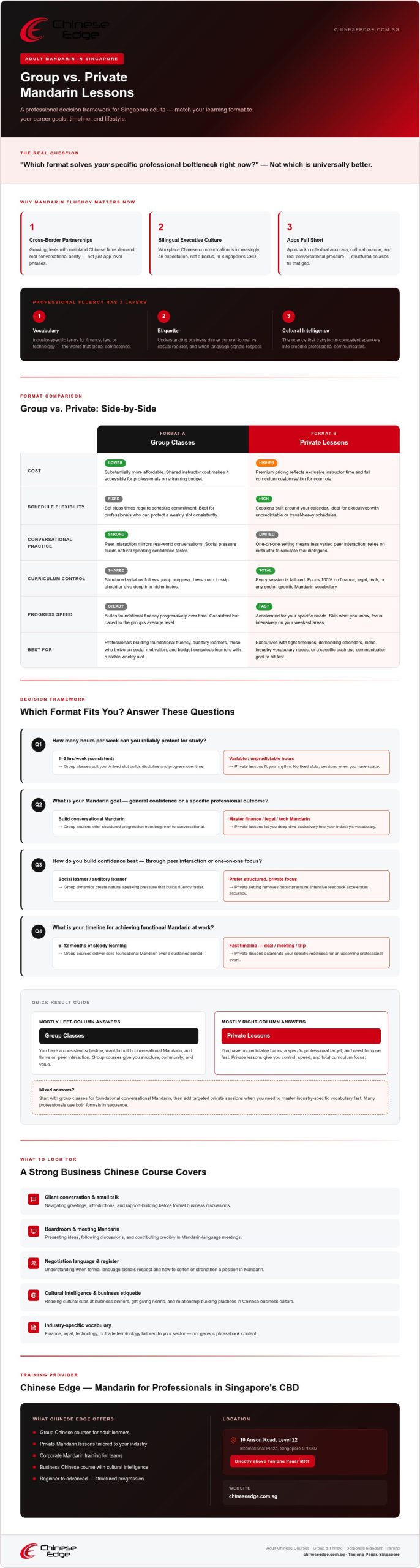
Group vs Private: A Decision Framework for Busy Adults
Choosing between formats isn’t a philosophical exercise. It’s a practical calculation, and the clearest way to make it is to map your current situation against three variables: your available weekly hours, your target timeline, and the type of learner you actually are rather than the type you’d like to be.
Start with time. Professionals who can protect two to three structured hours per week over a sustained period are strong candidates for group Mandarin classes. Those with fewer consistent hours but a hard deadline, a regional presentation, a client visit, an upcoming relocation, will extract more value from a concentrated private format. Neither answer is flattering or unflattering. It’s simply an honest read of your calendar.
To sharpen the decision further, consider which of these learner profiles most closely matches your situation:
- The Socialite: You’re building Mandarin for relationship-building, client dinners, and social fluency within a Mandarin-speaking professional network. Peer interaction accelerates your progress. Group learning fits naturally.
- The Executive: You have a specific high-stakes communication goal and a tight window to achieve it. Curriculum flexibility and maximum talk time matter more than peer dynamics. Private instruction is the logical choice.
- The Career-Changer: You’re entering a sector where workplace Chinese communication is expected at a functional level, but you’re starting from near-zero. A structured group course builds the foundation efficiently, with the option to layer in private sessions as your vocabulary demands grow more specialized.
The Cost-Value Analysis for 2026
Pricing matters, but it’s rarely the right primary lens. The more useful question is: what does a wasted month of mismatched instruction actually cost you? A professional who spends twelve weeks in a group class that moves too slowly for their timeline hasn’t saved money. They’ve deferred a professional opportunity. Equally, a learner who commits to intensive private sessions without the foundational vocabulary to absorb them will find each lesson building on sand. Quality of instruction and format alignment are what determine real return on investment, not the fee comparison alone.
This principle of investing in quality and specialized expertise applies to all facets of professional life in Singapore. Whether you are selecting a language school to advance your career or engaging Ninja Pest Control to maintain a clean and professional environment for your home or office, the focus should always be on long-term results and reliability over the lowest bid.
Which Path Fits Your Career Goals?
Consider two realistic scenarios. An expat professional building social Mandarin for community integration and client relationship management benefits immediately from the structured peer environment of a group course. The shared context of other adult learners, the role-play scenarios, and the fixed weekly rhythm all reinforce exactly the conversational confidence they need.
A regional director preparing to close a deal with a Chinese-speaking investment group needs something different entirely. Sector-specific vocabulary, tonal precision, and the cultural register that signals credibility in a formal negotiation context can’t wait for a shared curriculum to arrive at that chapter. Private instruction compresses that gap directly.
Many professionals find the most durable path runs through both formats sequentially. Group courses build breadth; private coaching sharpens depth. As your fluency matures, the questions you bring to each session become more sophisticated, and a private instructor can meet that sophistication in ways a shared classroom structure can’t always accommodate. That transition from group to private isn’t a failure of the first format; it’s a sign that it worked.
Whichever format you’re weighing right now, the decision becomes significantly clearer when you can discuss your goals with instructors who understand both options and the professional contexts where they perform best. Explore Chinese Edge’s group Mandarin courses to see how the curriculum is structured for adult professionals working in Singapore’s CBD, and consider reaching out to discuss which format aligns with where you are today.
The debate around group vs private Mandarin lessons Singapore professionals face ultimately resolves into a single practical question: which format will you actually sustain? Consistency, not intensity, is what produces fluency over time. Choose the structure that fits your life as it is, not as you’d ideally like it to be.
Mastering Mandarin at Chinese Edge: Tanjong Pagar’s Premier School
Location shapes habit. For CBD-based professionals, the single biggest predictor of whether a language course sticks isn’t the curriculum or the instructor quality; it’s whether attending feels frictionless. Chinese Edge sits at 10 Anson Road, Level 22, International Plaza, Singapore 079903, directly above Tanjong Pagar MRT. That’s not incidental. It means you can walk off the train and into a lesson without rerouting your commute, booking a cab, or losing thirty minutes to logistics. For professionals weighing group vs private Mandarin lessons Singapore-wide, proximity to your workplace removes one of the most common reasons adult learners quietly drop out.
The environment itself signals something important. Chinese Edge is designed for working adults, not students. There are no school-level exercises, no children’s syllabi repurposed for grown-up classrooms. Every element of the learning environment, from the curriculum structure to the pace of instruction, reflects the reality that the people in the room have professional stakes in what they’re learning.
Instructors are native Mandarin speakers with hands-on experience in corporate training contexts. That distinction matters. A native speaker who has taught executives how to navigate formal negotiations, manage cultural register shifts, and hold their own in a business dinner conversation brings a different depth to the classroom than a generalist language teacher. Corrections land with precision. Cultural nuance gets explained, not glossed over.
The Chinese Edge Methodology
The curriculum is built around speaking and listening for real professional situations. Lessons don’t begin with textbook grammar tables; they begin with the conversations you’re actually going to have. The proprietary adult-centric approach strips out school-level content entirely and replaces it with scenarios drawn from workplace Chinese communication: client introductions, meeting participation, cross-cultural negotiation, and the kind of informal relationship-building that happens over lunch rather than at a conference table. For a detailed breakdown of what this progression looks like from beginner to fluent professional, Learn Mandarin in Singapore: The Professional’s Roadmap maps the full journey with the specificity that most generic guides avoid.
Start Your Journey Today
Getting started is straightforward. An initial assessment helps place you accurately, so you’re not sitting through content you’ve already absorbed or struggling with material that assumes vocabulary you haven’t built yet. From there, enrollment is flexible across both conversational and business Chinese course formats, with options for in-person sessions at International Plaza or online delivery for weeks when travel or schedule pressure makes the commute impractical.
For organizations looking to develop Mandarin capability across a team or department, corporate Mandarin training programs can be structured around your sector’s specific vocabulary and communication demands. Whether that’s a finance team preparing for regional client engagement or a leadership group building credibility within Mandarin-speaking markets, the curriculum adapts to the professional context rather than asking the team to adapt to a fixed syllabus.
Fluency is a career asset that compounds. Every conversation you handle with confidence opens the next one. The decision around group vs private Mandarin lessons Singapore professionals face is ultimately about choosing the format that gets you into consistent, purposeful practice as quickly as possible. Explore Chinese Edge’s group Mandarin courses and take the first practical step toward the professional fluency you’ve been deferring.
Your Next Conversation in Mandarin Starts with One Decision
The debate around group vs private Mandarin lessons Singapore professionals face comes down to something straightforward: know your timeline, know your learning style, and choose the format that fits your actual life rather than an idealized version of it. Group courses build conversational confidence through peer interaction and structured progression. Private instruction compresses timelines and sharpens sector-specific fluency when a deadline is real and the stakes are high. Both paths work. The one you’ll sustain is the right one.
What doesn’t work is continuing to defer. Every month without consistent, purposeful practice is a professional conversation you’re not having with the confidence you could have.
Chinese Edge, located at 10 Anson Road, Level 22, International Plaza directly above Tanjong Pagar MRT, offers both formats through native speaker instructors in an adult-only professional learning environment built specifically for Singapore’s CBD workforce. The starting point is knowing where you are today. Book your Mandarin proficiency assessment at International Plaza and take the step that turns intention into progress.
Frequently Asked Questions
Is it better to learn Mandarin in a group or privately for business?
Neither format is universally better; the right choice depends on your timeline and communication goals. If you’re building broad conversational confidence for client relationships and workplace interactions over several months, a structured group course delivers excellent value. If you have a specific deadline, such as a regional presentation or a key client meeting, private instruction lets you focus entirely on the vocabulary and register that situation demands.
Many professionals find the most effective path combines both: group learning to establish a solid foundation, followed by private coaching to sharpen sector-specific fluency. The debate around group vs private Mandarin lessons Singapore professionals face rarely has a single correct answer; it has a correct answer for your current stage.
How long does it take for a beginner to speak Mandarin fluently in Singapore?
Functional professional fluency, the ability to participate confidently in meetings, handle client introductions, and navigate business dinners, typically takes between twelve and eighteen months of consistent study for adult beginners. The pace depends heavily on how many hours per week you protect for practice and whether your instruction is aligned to professional contexts from the start. A general conversational course will get you there more slowly than one designed specifically for workplace Chinese communication.
Consistency matters more than intensity. A professional attending structured sessions twice a week over a sustained period will almost always progress further than someone who completes an intensive short course and then stops. Setting realistic milestones at the outset of a basic Mandarin course helps maintain momentum through the inevitable plateaus.
Can I switch from group classes to private lessons later?
Yes, and for many adult learners it’s actually the most logical progression. Group courses build the vocabulary breadth and conversational confidence you need to absorb more advanced instruction effectively. Once you’ve established that foundation, private lessons can target the specific gaps that matter most to your career, whether that’s tonal precision, industry terminology, or the cultural register shifts that signal credibility in formal negotiations.
At Chinese Edge, both formats are available, so transitioning between them doesn’t mean starting over with a new school or a new instructor relationship. An initial proficiency assessment ensures you’re placed accurately regardless of which format you begin with.
Where is the best place for a Mandarin class near me in the CBD?
Chinese Edge is located at 10 Anson Road, Level 22, International Plaza, Singapore 079903, directly above Tanjong Pagar MRT. For professionals working in the CBD, that positioning removes the logistical friction that causes most adult learners to quietly abandon their language goals. You can attend a session between meetings or immediately after work without rerouting your commute.
The school is designed exclusively for adult learners, so the environment, curriculum, and instructor expertise all reflect the priorities of working professionals rather than students. Online sessions are also available for weeks when travel or schedule pressure makes the commute impractical, maintaining continuity without interrupting your progress.
Are online Mandarin classes as effective as in-person lessons for adults?
For adult professionals with a structured curriculum and a disciplined approach, online Mandarin classes can be highly effective, particularly for private instruction where the session is already built around one person’s goals. The key variable isn’t the delivery format; it’s the quality of the instructor and the consistency of attendance. A well-run online session with a native speaker delivers the same tonal correction and cultural nuance as an in-person one.
Group learning online requires slightly more intentional participation since the social energy of a shared physical space doesn’t transfer automatically to a video call. That said, many professionals find the flexibility of combining online and in-person sessions across a single course the most practical arrangement for a demanding calendar.
What is the typical class size for group Mandarin courses in Singapore?
Effective adult group Mandarin courses typically run with small cohorts rather than large classroom numbers. A group of six to ten adult learners strikes the right balance: enough peer interaction to make conversation practice dynamic and varied, while still allowing the instructor to give meaningful individual attention and correct errors in real time. Larger classes dilute both of those benefits significantly.
If you’re evaluating a group course, class size is one of the most practical questions to ask before enrolling. It directly affects how much speaking time you get per session and how quickly tonal and grammatical errors get addressed rather than accumulating uncorrected.
Do I need any prior knowledge to join a basic Mandarin course?
No prior knowledge is required to join a basic Mandarin course designed for adult beginners. A well-structured program starts from the foundational level, covering pronunciation, tones, and core vocabulary before progressing to conversational scenarios. What matters more than prior knowledge is a realistic commitment to consistent attendance, since Mandarin’s tonal system requires repeated exposure to build reliable recall.
Chinese Edge conducts an initial proficiency assessment for all new students. This ensures you’re placed at the right level from the first session, whether you’re starting from zero or returning to Mandarin after a gap. Starting at the wrong level in either direction wastes time that busy professionals can’t afford to lose.
How do private lessons help with industry-specific vocabulary?
Private instruction allows the entire curriculum to be built around your professional context. A finance professional preparing for client presentations needs a completely different vocabulary set than a technology lead managing a cross-border development team. In a private format, the instructor can draw directly from the documents, scenarios, and conversations relevant to your role, rather than working through a shared syllabus that approximates your needs without precisely meeting them.
Beyond vocabulary, private lessons address the register shifts that professional Mandarin demands. Knowing the right word is only part of the challenge; knowing when formal language signals respect and when it creates distance is the cultural intelligence that separates competent speakers from credible ones. A native speaker instructor working in a one-on-one corporate Mandarin training context can model and correct those distinctions with a precision that group instruction structurally can’t match.
Disclaimer
Disclaimer
The Chinese articles on this website are provided for general information and learning purposes only. While we strive for accuracy, we make no guarantees regarding completeness or reliability. The content does not constitute professional advice, and we are not liable for any loss arising from its use. External links or third-party content are for reference only. By using this website, you agree to this disclaimer.