

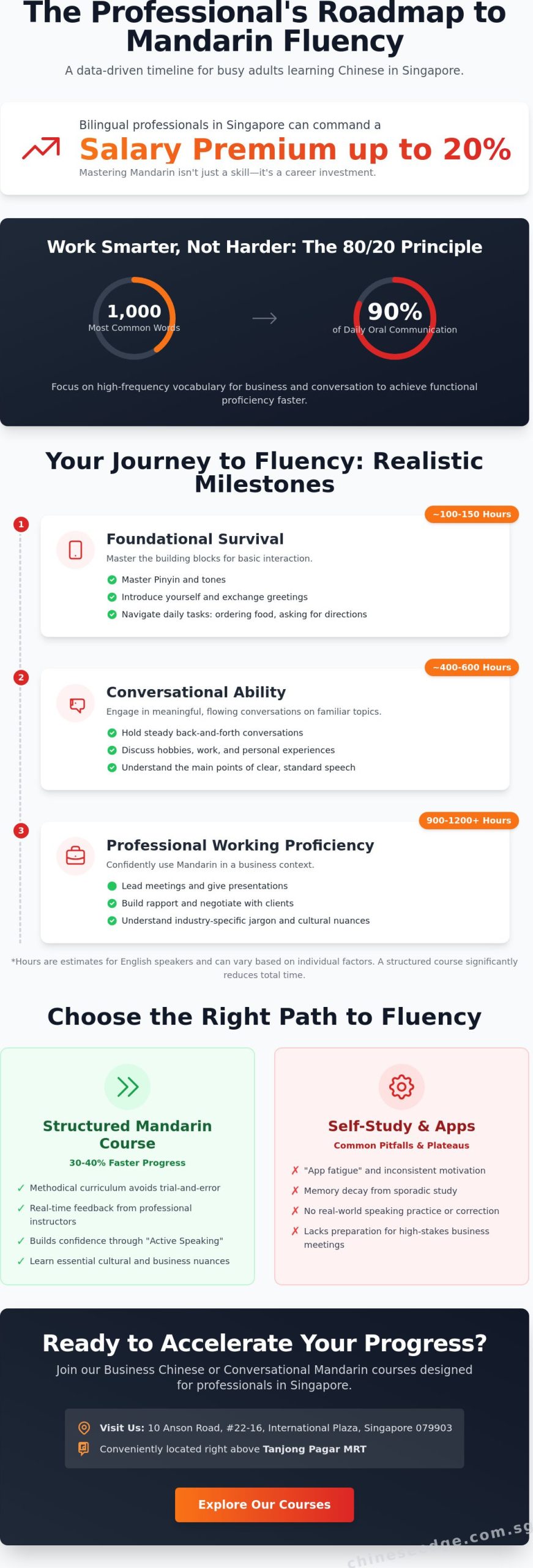
Bilingual professionals in Singapore can command a salary premium of up to 20 percent in 2026, yet many career-driven individuals still hesitate because they aren’t sure how long does it take to become fluent in mandarin. You’ve likely experienced the “app fatigue” of digital tools that promise quick results but fail to prepare you for a high-stakes boardroom meeting or a complex social dinner. It’s natural to feel intimidated by the new HSK 3.0 standards or the perceived difficulty of mastering tones while working a forty-hour week.
We understand that your time is your most valuable asset. This article provides a clear, data-driven reality check on the time investment required to reach your specific goals, from basic conversational ability to professional workplace chinese communication. You’ll discover how a structured business chinese course can streamline your path to fluency. We also examine why our mandarin class singapore at 10 Anson Road, level 22, International Plaza, Singapore 079903, right above Tanjong Pagar MRT, offers the ideal environment for professionals to transition from hesitant learners to confident speakers in a matter of months, not years.
Key Takeaways
- Define the realistic time commitment needed to reach your specific milestones and finally answer the question of how long does it take to become fluent in mandarin for a busy professional.
- Distinguish between social fluency and professional proficiency to focus your efforts on the high-impact skills that matter most in the Singapore business environment.
- Explore why a structured mandarin course offers a superior return on investment compared to self-study apps by providing real-time feedback and essential cultural nuance.
- Learn how to leverage Singapore’s unique bilingual landscape as a practical training ground to reinforce what you learn in your conversational chinese course.
- Discover the “Active Speaking” methodology used in our corporate mandarin training to maximize your confidence during workplace chinese communication.
Defining Fluency: What Does “Fluent” Mean for a Professional in 2026?
Many professionals approach language learning as a mountain to climb, but fluency in 2026 is better viewed as a series of functional milestones. When asking how long does it take to become fluent in mandarin, you must first define your specific finish line. For a career-focused expat in Singapore, native-level mastery of the Chinese language is rarely the goal. Instead, the focus should be on “professional working proficiency.” This level allows you to lead a meeting or build rapport with clients without needing a translator.
You can achieve significant results by applying the 80/20 rule. Linguistic research suggests that mastering the 1,000 most common words covers nearly 90 percent of daily oral communication. This approach prioritizes speaking and listening over the academic rigors of reading and writing thousands of complex characters. By focusing on high-frequency vocabulary used in the Singaporean business context, you reduce the time required to reach a functional level. If you aim for professional utility, you don’t need to wait years to start seeing a return on your investment.
To better understand this concept, watch this helpful video:
Conversational vs. Business Mandarin
Social fluency involves ordering food at a hawker center, giving directions, and basic small talk. While these skills are rewarding, professional fluency requires a deeper understanding of industry-specific jargon and formal etiquette. Our Adult Conversational Mandarin Course prioritizes immediate utility by teaching you the structures needed for both social and workplace settings. This ensures you can transition from a casual lunch to a formal boardroom discussion with confidence.
The Myth of the 6-Month Master
You have likely seen viral claims promising “mastery” in just a few weeks. These claims are often misleading. While you can reach basic proficiency (HSK 3) in about a year with consistent study, true professional fluency takes time. If you commit to three hours of weekly study, you can expect to hold steady conversations within six months. Consistency beats intensity every time. A structured mandarin course at our center at 10 Anson Road, level 22, International Plaza, Singapore 079903, provides the discipline needed to avoid the common plateaus of self-study apps.
The Math of Mandarin: How Many Hours Do You Really Need?
To accurately answer how long does it take to become fluent in mandarin, we must look at the data provided by linguistic experts. The U.S. Foreign Service Institute (FSI) categorizes Mandarin as a “super-hard” language for native English speakers. According to the FSI language difficulty rankings, it takes approximately 2,200 hours of intensive study to reach professional working proficiency. However, these figures assume full-time, immersive training designed for diplomats. For a busy professional in Singapore, the math changes when you focus on functional milestones rather than academic perfection.
A structured approach can significantly reduce the total hours required. When you follow a methodical curriculum, you often see a 30 to 40 percent reduction in the time spent on trial-and-error learning. If you study for one hour daily, you might reach basic conversational ability within a year. If your schedule only allows for five hours a week, reaching that same level may take 14 to 18 months. The key is consistency; sporadic study sessions often lead to “memory decay,” forcing you to spend half your time reviewing old material instead of progressing.
Milestones for Adult Learners
We break down the journey into three distinct phases based on total hours invested:
- 0-100 Hours: You master Pinyin and basic survival phrases. You can navigate daily life in Singapore, such as ordering at a local bistro or giving directions to a driver.
- 100-300 Hours: After completing a conversational chinese course, you can handle social interactions with ease and discuss familiar topics without constant hesitation.
- 300-600 Hours: This is the threshold for professional independence. You can participate in workplace chinese communication, understand the gist of news reports, and build deeper rapport with Chinese-speaking clients.
Speaking vs. Reading: The Great Time Sink
One of the biggest hurdles in Mandarin is the written script. Learning to read and write thousands of characters can double the time it takes to reach fluency. For most professionals, focusing on speaking and listening first provides a higher return on investment. In a modern business environment, most written communication happens digitally using Pinyin-based input methods. By prioritizing oral proficiency, you accelerate your ability to lead meetings and close deals. If you are ready to start your journey, you can view our available course schedules at International Plaza, located right above Tanjong Pagar MRT.
Why Learning Mandarin in Singapore Offers a Unique Advantage
While the total hours required to master a language can seem daunting, the environment in which you study serves as a powerful catalyst. Singapore functions as a unique bilingual laboratory where over 70 percent of the population is of Chinese descent. This provides immediate, daily opportunities for real-world practice that self-learners in other countries simply cannot access. When considering how long does it take to become fluent in mandarin, you must account for the “immersion dividend” that comes from living in a city where English and Mandarin coexist in every professional and social sphere.
The speed of your progress is heavily influenced by environmental factors that determine your speed to fluency, such as the availability of native speakers who understand your specific corporate culture. In Singapore, your learning isn’t confined to a textbook. You can apply a new phrase from your morning lesson during a lunch meeting in the CBD or while navigating a local wet market. This constant reinforcement helps move vocabulary from your short-term memory into functional, everyday use much faster than isolated study.
Tanjong Pagar: The Professional Learning Hub
Convenience is a primary driver of consistency for busy executives. Our training center is located at 10 Anson Road, level 22, International Plaza, Singapore 079903, situated right above Tanjong Pagar MRT. This strategic location allows you to attend a mandarin class singapore during your lunch hour or immediately after work without a lengthy commute. Learning in the heart of the financial district also connects you with a network of like-minded professionals who are also working toward workplace chinese communication goals, creating a supportive community of adult learners.
Local Context in Business Mandarin
Success in regional trade often depends on understanding local linguistic nuances, including the differences between “Singdarin” and Standard Mandarin. A specialized business chinese singapore curriculum focuses on these distinctions, ensuring your communication is both professional and culturally appropriate. By mastering the etiquette used in Singapore-China trade relations, you position yourself as a sophisticated bridge between markets. This practical application ensures that every hour you spend in a mandarin course translates directly into a competitive edge in the local and international job markets.
4 Critical Factors That Determine Your Speed to Fluency
Achieving professional proficiency is rarely a linear path. When you evaluate how long does it take to become fluent in mandarin, you must look beyond the raw number of hours and consider the quality of your learning environment. Many students find that their progress stalls after an initial burst of enthusiasm because they lack a cohesive strategy. While mobile apps are convenient for basic vocabulary drills, they cannot simulate the complexities of a real-time negotiation or a high-stakes business dinner. “Winging it” without a structured curriculum often leads to linguistic plateaus that are difficult to overcome without professional intervention.
Psychological safety is a frequently overlooked factor in adult education. In the competitive professional world of Singapore, the “fear of losing face” can prevent learners from practicing out loud, which is the very thing they need to do to improve. A supportive environment provides the safety net needed to make mistakes and learn from them. Whether you opt for online mandarin classes singapore or choose to attend in-person sessions at our center at International Plaza, having an expert mentor to guide your progress is essential for building confidence.
The Role of Native Instructors
In the first 50 hours of your journey, immediate tonal correction is vital. Mandarin is a tonal language, and developing bad habits early on can be difficult to correct later. Native instructors provide the real-time feedback necessary to move beyond “textbook Chinese” toward a natural conversational flow. By enrolling in a chinese speaking course, you receive personalized guidance that helps you master the nuances of workplace chinese communication, ensuring you sound professional and authoritative in every interaction.
Group vs. Private Learning Speed
The choice between group and private lessons depends on your learning personality and timeline. Group classes offer peer motivation and the opportunity to practice with other professionals, which is often beneficial for a conversational chinese course. Conversely, private lessons provide an intensity that can accelerate your progress if you have a looming deadline. For organizations, corporate mandarin training aligns the entire team’s goals, fostering a collaborative learning culture right in the heart of the CBD at Tanjong Pagar.
If you are ready to stop guessing and start progressing with a proven methodology, contact us today to find the right mandarin course for your professional goals.
Accelerating Your Progress: The Chinese Edge Methodology
Understanding the theoretical timeline is the first step, but the specific strategy you employ determines your actual speed of success. While general resources often leave the question of how long does it take to become fluent in mandarin unanswered, we provide a structured framework designed for the professional environment. Our methodology focuses on Adult Conversational and Business Mandarin, ensuring every lesson translates into real-world results. We prioritize practical application over academic theory, helping you move through the levels of proficiency with purpose and clarity.
A key pillar of our system is the “Active Speaking” approach. In many traditional settings, students spend the majority of their time listening to instructors. We flip this dynamic to maximize student talk time in every session. This intensive focus on oral production helps bridge the gap between understanding a concept and being able to use it during workplace chinese communication. By practicing high-stakes scenarios like client introductions or project updates, you build the muscle memory required for spontaneous conversation.
A Proven Path for Professionals
Our curriculum is a streamlined roadmap that eliminates academic fillers to focus on high-impact communication. When you learn chinese with us, you’re following a path specifically curated for the Singaporean business context. Many of our students work in the surrounding CBD and find that they can apply their new skills during lunch meetings or networking events within just a few weeks of starting. This immediate feedback loop reinforces your learning and keeps your motivation high as you work toward professional fluency.
Get Started Today
Consistency is the final piece of the puzzle. We offer flexible scheduling to accommodate the demanding lives of executives and their teams. Whether you’re looking for a mandarin course for yourself or corporate mandarin training for your entire department, we provide customized solutions that fit your operational needs. Our center is conveniently located at 10 Anson Road, level 22, International Plaza, Singapore 079903, situated right above Tanjong Pagar MRT. Visit us today or book a consultation to determine your current level and discover how quickly you can achieve your linguistic goals.
Take Command of Your Linguistic Future in 2026
Achieving professional proficiency is a strategic investment that requires a shift from passive study to active application. The definitive answer to how long does it take to become fluent in mandarin depends on your commitment to a structured, high-impact curriculum. By focusing on the high-frequency vocabulary of the business world and leveraging Singapore’s unique bilingual environment, you can reach functional workplace independence in hundreds of hours rather than thousands. True fluency is not about perfection; it’s about the confidence to lead, negotiate, and connect in a new language.
Our center provides the ideal ecosystem for this professional growth. With native-speaking instructors specializing in adult education and a tailored Business Mandarin curriculum, we ensure your progress is both rapid and relevant to your career. Our location at 10 Anson Road, level 22, International Plaza, right above Tanjong Pagar MRT, makes it simple to integrate consistent study into a busy corporate schedule. You have the professional drive, and we have the proven methodology to help you succeed.
Start your journey to Mandarin fluency with our Professional Conversational Courses today!
The doors to new global opportunities are open. We look forward to partnering with you as you master the linguistic skills necessary for the modern marketplace.
Frequently Asked Questions
Is Mandarin really the hardest language for English speakers to learn?
Mandarin is classified as a Category IV language by the Foreign Service Institute, meaning it requires more time than European languages. However, its grammar is remarkably straightforward because it lacks verb conjugations, genders, or plural forms. The challenge for most professionals lies in mastering the four tones and the writing system rather than complex sentence structures.
Can I become fluent in Mandarin without learning how to write characters?
Yes, you can achieve high levels of oral fluency by focusing primarily on Pinyin and speaking. In a modern business environment, most written communication is conducted digitally using Pinyin input methods on keyboards and smartphones. Prioritizing a conversational chinese course allows you to build professional rapport and lead meetings without the time sink of memorizing thousands of handwritten characters.
How many hours a week should I study to see progress in 3 months?
You should commit to at least three to five hours of structured study per week to see measurable progress within a quarter. This consistency allows you to move past basic phonetics and begin handling simple social interactions. If you follow a methodical mandarin course, this timeframe is sufficient to master survival phrases and basic self-introductions in a professional setting.
What is the best way to practice speaking Mandarin in Singapore outside of class?
The most effective method is to engage with native speakers in everyday social settings, such as ordering at hawker centers or interacting with staff in Tanjong Pagar. Singapore’s bilingual landscape provides a unique laboratory where you can immediately apply what you learn in class. Using the language in these low-stakes environments builds the confidence needed for more formal workplace chinese communication.
Do I need to learn Chinese tones perfectly to be understood?
You don’t need absolute tonal perfection to be understood in most situations because context provides significant clues to your meaning. While native speakers are generally patient with learners, clear tones are essential for professional authority. A quality chinese course singapore will emphasize tonal accuracy in the early stages to ensure your speech remains intelligible as you move toward complex business topics.
How long does it take to reach a level where I can conduct a business meeting?
Most adult learners reach functional business proficiency within 300 to 600 hours of focused study. The specific answer to how long does it take to become fluent in mandarin for meetings depends on your existing linguistic background and the intensity of your training. Enrolling in a specialized business chinese course can accelerate this process by focusing on industry-specific vocabulary and formal etiquette.
Are online Mandarin classes as effective as in-person lessons for adults?
Online classes are highly effective for professionals when they utilize interactive, real-time instruction rather than pre-recorded videos. These sessions offer the same linguistic rigor as our classes at International Plaza while providing the flexibility needed for a global travel schedule. Many corporate clients find that online training successfully bridges the gap for regional teams who need to learn chinese together.
What is the difference between HSK levels and actual conversational fluency?
HSK levels are standardized academic benchmarks used to measure proficiency, while conversational fluency is the practical ability to communicate in real-time. The new HSK 3.0 standards introduced in 2026 now include mandatory speaking and translation components to address this gap. This change ensures that students who pass these exams possess the functional skills required for effective workplace chinese communication.
Disclaimer
Disclaimer
The Chinese articles on this website are provided for general information and learning purposes only. While we strive for accuracy, we make no guarantees regarding completeness or reliability. The content does not constitute professional advice, and we are not liable for any loss arising from its use. External links or third-party content are for reference only. By using this website, you agree to this disclaimer.