

What if the 2,200 hours often cited by the Foreign Service Institute to reach professional proficiency in Chinese isn’t the metric you should be measuring your success by? Many professionals in Singapore feel overwhelmed by language apps or fear that Mandarin is simply too difficult to grasp as an adult. You’ve likely asked yourself exactly how long to learn conversational mandarin when you’re already balancing a demanding career. It’s a valid concern, especially when you need practical results for the boardroom rather than just rote memorization.
This article provides a transparent 2026 reality check on your learning timeline, offering a structured roadmap to move from silence to social fluency. You’ll learn about the specific milestones of the HSK 3.0 framework and how professional strategies can help you achieve functional communication in months. We’ll also preview how a targeted mandarin course at our center in International Plaza, located at 10 Anson Road, level 22, Singapore 079903, right above Tanjong Pagar MRT, can streamline your path. By the end of this guide, you’ll have the confidence to start your mandarin class singapore journey with a clear, achievable plan for success.
Key Takeaways
- Prioritize high-frequency vocabulary and functional communication to bypass information overload and achieve practical results faster.
- Understand the realistic timeline for how long to learn conversational mandarin, moving from basic tones to structured social interactions within a nine-month framework.
- Shift your learning mindset by managing your “Language Ego” and prioritizing short, daily consistency over ineffective intensive cramming.
- Apply active listening strategies and real-world practice to bridge the gap between classroom theory and professional workplace communication in Singapore.
- Access structured, native-led instruction at our professional training center located at International Plaza, level 22, right above Tanjong Pagar MRT.
Defining “Conversational”: What Level of Mandarin Do You Actually Need?
Many adult learners get trapped in the pursuit of absolute fluency without defining what that actually means for their daily lives. In academic settings, fluency often involves reading complex literature or writing formal essays. For a busy professional in Singapore, conversational competence is a much more strategic target. It’s about having the linguistic agility to handle real-time interactions without freezing. Understanding exactly how long to learn conversational mandarin starts with identifying your specific end-goal. This shift in perspective is part of the global trends in learning Chinese, where the focus has moved toward practical, task-based communication.
To optimize your time, you should follow the 80/20 rule. This principle suggests that 80% of daily speech is composed of roughly the 1,000 most common words. By mastering these high-frequency terms first, you can participate in a vast majority of conversations. You don’t need to be a walking dictionary to be effective. You just need the right foundation. This approach allows you to see immediate results in your ability to communicate.
To better understand this concept, watch this helpful video:
Social Conversational Mandarin
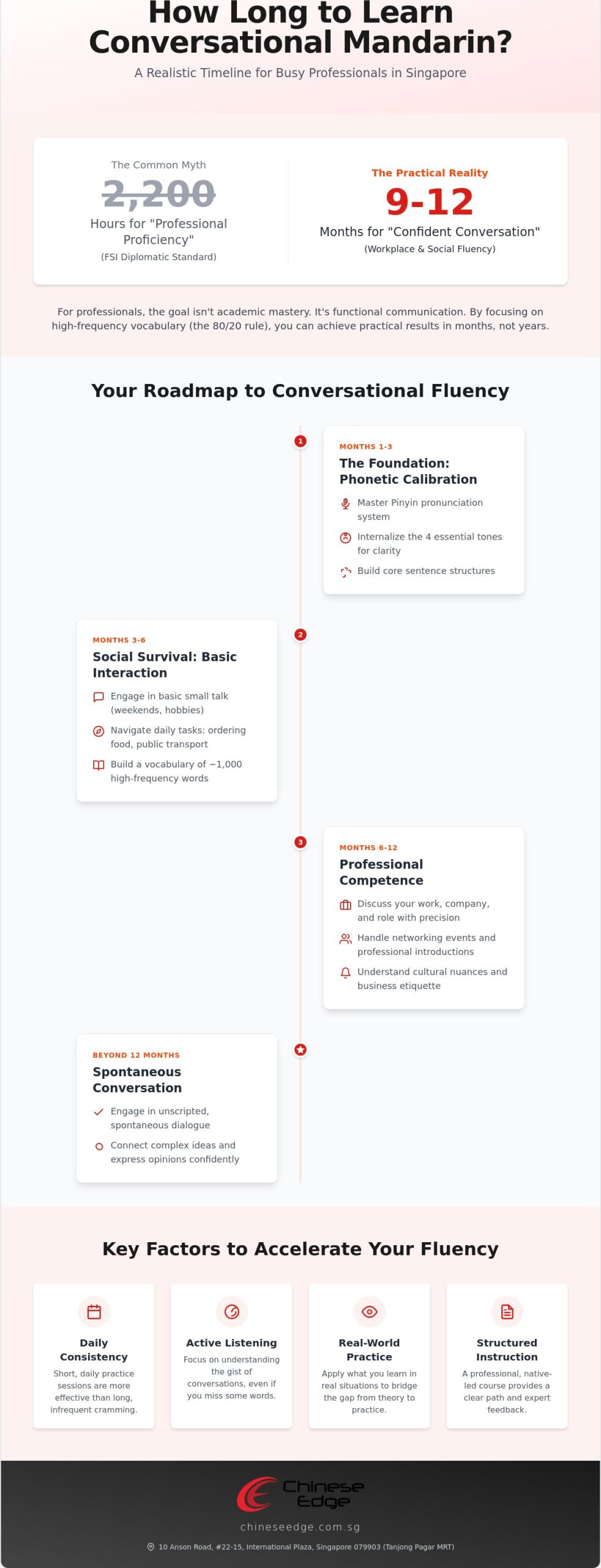
This level focuses on basic survival and social integration. You should be able to order food at a hawker center, navigate public transport, and engage in basic small talk about your weekend. A major milestone at this stage is the ability to understand the general gist of what native speakers are saying around you. Typically, if you enroll in a conversational chinese course, you can reach this social survival level within three to six months of consistent practice. It is about building the confidence to step out of your comfort zone.
Professional & Business Conversational Mandarin
For those looking to learn chinese for career growth, the requirements are more specific. Workplace communication involves navigating networking events and introducing your company or role with precision. Using the correct tones is vital here; it establishes your professionalism and respect for the culture. Business etiquette is often just as important as the vocabulary itself. When asking how long to learn conversational mandarin for the office, you should expect a timeline of six to twelve months to feel comfortable. This training is most effective when conducted at a central location, such as our center at 10 Anson Road, level 22, International Plaza, Singapore 079903, which is situated right above Tanjong Pagar MRT.
The Timeline Breakdown: From Zero to Confident Speaker
Many adult learners are initially intimidated by the Foreign Service Institute (FSI) estimates which suggest that reaching professional proficiency in Mandarin requires approximately 2,200 hours of study. While this data is grounded in intensive diplomatic training, it often misrepresents the path for a professional seeking social or workplace fluency. When asking how long to learn conversational mandarin, it’s vital to distinguish between academic mastery and the ability to hold a confident conversation. A structured approach allows you to reach functional milestones much faster than the FSI figures might imply.
The first three months of your journey focus on phonetic calibration. You’ll master Pinyin and the four tones, which serve as the essential foundation for being understood by native speakers. Between three and nine months, the focus shifts to building flexible sentence structures and expanding your functional vocabulary. By the one-year mark, students who maintain consistency can typically engage in unscripted, spontaneous conversations about their lives and work. Choosing a conversational chinese course significantly shortens this window compared to unguided self-study, as it provides the immediate tonal correction necessary for adult learners.
Comparing self-study to a structured environment reveals a clear difference in efficiency. Without a native-speaking mentor to correct your pronunciation in real-time, you risk fossilizing errors that become harder to fix later. Our methodology ensures that every hour you spend in the classroom translates directly into usable speaking skills.
The Beginner Milestone (80-120 Hours)
Reaching your first 100 hours of study is a significant achievement for any professional. At this stage, you’ve developed a “Survival Mandarin” toolkit that allows you to handle daily interactions like ordering at a restaurant or taking a taxi. The true breakthrough occurs when you stop translating every individual word in your head and begin recognizing grammatical patterns instinctively. This shift marks the transition from rote memorization to genuine language processing, giving you the confidence to use Mandarin in low-stakes social settings.
The Intermediate Breakthrough (240-400 Hours)
As you progress toward 400 hours, you move beyond “textbook” phrases into the realm of natural expression. This is where you gain the ability to express nuanced opinions and navigate professional networking events with ease. Progress can sometimes feel slower during this period, often referred to as the “Intermediate Plateau,” but regular participation in a mandarin course ensures you stay motivated. Our instructors at 10 Anson Road, level 22, International Plaza, Singapore 079903, provide the expert guidance needed to navigate these complexities right above Tanjong Pagar MRT. If you’re ready to commit to a proven methodology, exploring a mandarin course singapore professionals rely on is the most efficient next step.
Factors That Accelerate or Delay Your Mandarin Fluency
The speed at which you progress is rarely just about raw intelligence. It is often about your psychological approach to the language. Adult learners frequently grapple with “Language Ego,” which is the fear of appearing less competent because they cannot yet express complex thoughts in a new tongue. Students who are willing to make mistakes in a safe, professional environment tend to learn much faster. When you treat every mispronounced word as a necessary step toward mastery, you significantly reduce how long to learn conversational mandarin. This mindset shift allows you to engage more freely with native speakers, which is where the real growth happens.
Consistency is another critical variable that dictates your timeline. Many busy professionals try to “cram” their learning into a single four-hour session on the weekend. This is scientifically less effective than spending just 20 minutes every day. Daily exposure keeps the language active in your short-term memory, allowing it to transition into long-term storage more efficiently. While the U.S. Department of State’s language learning timelines suggest a high total hour count for proficiency, consistent daily practice makes those hours feel much more productive and less like a chore.
Prior linguistic experience can also play a role in your development. If you already speak a tonal language or have been exposed to dialects like Cantonese, your ear is already trained to hear pitch variations. However, even without this background, professional guidance is essential to prevent the “unlearning” of bad habits. It’s much easier to learn a tone correctly the first time than to fix a deeply ingrained error two years later. This is why our conversational chinese course prioritizes phonetic precision from the very first lesson.
Structured Classes vs. Self-Study Apps
While language apps are convenient for building a basic vocabulary, they have a major limitation: they cannot provide real-time, nuanced tonal correction. Interactive mandarin classes in Singapore provide a feedback loop that is significantly faster than any digital interface. Learning alongside peers at our center at 10 Anson Road, level 22, International Plaza, Singapore 079903, creates a dynamic environment where you can practice real-world scenarios. This physical presence right above Tanjong Pagar MRT allows for immediate adjustments to your speech, ensuring you don’t spend months practicing the wrong sounds in isolation.
Tones and Pronunciation: The Great Wall of Mandarin
Tones are the most common hurdle for English speakers, yet they are the foundation of all conversational clarity. Mastering the four tones early in your journey saves you hundreds of hours of frustration in the future. Many learners try to bypass this stage to reach “useful” phrases, but without tonal accuracy, those phrases often remain unintelligible to native speakers. Tonal accuracy is the make or break factor for conversational clarity; without it, even a perfect vocabulary won’t help you navigate a business meeting or a social dinner in Singapore effectively.
Practical Strategies to Reach Conversational Fluency Faster
While the initial timeline provides a roadmap, your daily habits determine your actual speed of acquisition. Passive listening, such as playing a movie in the background, is often ineffective for beginners without a foundation. Instead, you should engage in active listening by using podcasts designed for your specific level. Focus on identifying grammatical structures you’ve recently covered in class. This active engagement helps reduce how long to learn conversational mandarin by reinforcing the neural pathways required for real-time processing.
Another powerful strategy is to stop memorizing isolated words. Adult brains process language more efficiently through “chunks” or prefabricated phrases. For instance, instead of learning the word for “meeting” and “schedule” separately, learn the phrase for “Let’s schedule a meeting.” This approach is particularly effective when exploring business chinese singapore contexts, where specific professional formulas are used repeatedly. By learning these blocks of language, you bypass the mental fatigue of building every sentence from scratch.
Immersion in the Heart of Singapore
Living in Singapore provides a unique advantage for immersion that many learners overlook. You don’t need to wait for a boardroom presentation to practice. The “Language Partner” method involves finding a colleague or friend to speak with for just 10 minutes a day. Start with “small wins” at the local hawker center. Ordering your coffee or lunch in Mandarin builds immediate confidence. If you’re worried about slowing people down, keep your interactions brief and focused. Most native speakers are supportive when they see a professional making a genuine effort to learn. These daily micro-interactions are essential for testing the vocabulary you’ve acquired in your conversational chinese course.
Leveraging Professional Courses
A structured chinese speaking course provides the scaffolding necessary to handle more complex social and professional nuances. Self-study often leaves gaps in your understanding of business etiquette and tonal subtleties. Our instructors at International Plaza, 10 Anson Road, level 22, provide the native-speaker feedback required to transition from classroom exercises to real workplace communication. This expert mentorship ensures that your progress remains steady and results-oriented. If you’re ready to accelerate your growth, you can view our available course schedules at our Tanjong Pagar MRT location.
Achieve Your Language Goals at Chinese Edge Singapore
Understanding the realistic timeline for your progress is the first step toward success. While we’ve explored the various variables that influence how long to learn conversational mandarin, the most significant factor is the quality of your instruction. At Chinese Edge, we act as your Expert Mentor, providing the discipline and structured methodology required to transform a complex language into a functional professional tool. We recognize that as an adult learner, you don’t have time for academic filler. You need results that translate directly to your next business meeting or social event in Singapore’s fast-paced environment.
Our training center is strategically located at 10 Anson Road, level 22, International Plaza, Singapore 079903. Being situated right above Tanjong Pagar MRT allows us to serve the specific needs of the CBD professional community efficiently. Whether you require an Adult Conversational Mandarin Course to navigate social settings or specialized Corporate Chinese Language Training for your entire team, our programs are designed to fit into a high-performance lifestyle. We prioritize active communication and tonal precision, ensuring you build a solid foundation from your very first session.
Convenient Learning for CBD Professionals
We offer the flexibility that modern careers demand. You can choose from lunch-hour sessions or after-work classes that allow you to study without disrupting your professional obligations. Beyond the linguistic benefits, joining a group mandarin course in the heart of the business district offers significant networking opportunities. You’ll learn alongside like-minded professionals, creating a supportive environment where you can practice conversational nuances in a real-world context. Our commitment is to move you from zero to a confident speaker within a structured, predictable timeframe.
Start Your Journey Today
Taking the first step is often the most difficult part of the process. We invite you to book a consultation or a trial class at our Tanjong Pagar center to assess your current proficiency and identify the right path forward. Our instructors will help you set realistic milestones based on your specific goals, whether they are social or professional. Fluency is a journey of a thousand miles, but with the right guidance, it’s a journey you can complete with confidence. Contact us today to begin your transformation into a bilingual professional.
Begin Your Path to Mandarin Fluency Today
Achieving professional communication is a matter of strategy rather than just time. While the answer to how long to learn conversational mandarin depends on your personal commitment, a structured approach focusing on high-frequency vocabulary and tonal accuracy can yield functional results in months. By prioritizing daily consistency and leveraging the professional immersion opportunities available throughout Singapore, you can bypass the common hurdles that often stall adult learners.
Our native-speaking instructors at Chinese Edge specialize in adult education, utilizing a proven curriculum designed specifically for the needs of busy business professionals. We are conveniently located at 10 Anson Road, level 22, International Plaza, situated right above Tanjong Pagar MRT. This central location ensures your learning journey fits seamlessly into your career without added stress.
Ready to see real progress in your workplace communication? View our Adult Conversational Mandarin Course schedules at Tanjong Pagar to find a program that aligns with your professional objectives. Fluency is an attainable goal; it simply requires the right partner to guide your progress and support your growth every step of the way.
Frequently Asked Questions
Can I learn conversational Mandarin in just 3 months?
You can certainly achieve basic survival fluency within three months by focusing on high-frequency vocabulary and essential greetings. This timeframe allows you to handle simple social interactions, such as ordering food or navigating transport. However, reaching a professional or business-level conversational standard typically requires a more extended commitment to a structured curriculum.
Is it possible to learn to speak Mandarin without learning to read characters?
Yes, many professionals choose to focus exclusively on speaking and listening skills by utilizing Pinyin, the Romanized phonetic system. This approach is often the most efficient path for those who need immediate verbal communication skills for the workplace. While character recognition is beneficial for long-term literacy, it is not a prerequisite for becoming verbally conversational.
How many hours a week should I study to see real progress?
We recommend a minimum of three to five hours of structured study per week to maintain steady momentum. When considering how long to learn conversational mandarin, consistency is more impactful than intensity. Supplementing your weekly classes with 15 to 20 minutes of daily practice ensures that the language remains active in your long-term memory.
Is Mandarin really the hardest language for English speakers to learn?
Mandarin is often perceived as difficult due to its tonal nature, but the grammar is remarkably straightforward compared to many European languages. There are no verb conjugations, plurals, or gendered nouns to memorize. Once you master the initial hurdle of tones and basic sentence structures, your progress often feels much more logical and predictable.
What is the best way for a busy professional to stay consistent?
The most effective strategy is to choose a mandarin course located within a major commercial district to minimize travel time. Our training center at 10 Anson Road, level 22, International Plaza, is situated right above Tanjong Pagar MRT, making it easy to attend sessions during lunch hours or immediately after work. Integrating study into your existing routine is the key to long-term success.
Do I need to take the HSK exam to prove I am conversational?
While the HSK provides an international benchmark for proficiency, it is not strictly necessary for those seeking social or workplace fluency. Your ability to navigate a business networking event or a social dinner in Singapore is a more practical measure of your success. Many of our students use the HSK framework to track their progress without necessarily sitting for the formal exam.
How long does it take to stop translating in my head?
Most learners experience this breakthrough after approximately 100 to 150 hours of active study. This is the point where you begin to recognize linguistic patterns and respond using “chunks” of language rather than translating individual words. Achieving this milestone significantly reduces how long to learn conversational mandarin by making your speech feel more natural and fluid.
Why are tones so important in conversational Mandarin?
Tones are fundamental because they distinguish the meanings of words that otherwise sound identical. In a conversational setting, incorrect tones can lead to significant misunderstandings or make your speech unintelligible to native speakers. This is why our instructors prioritize phonetic precision early in the learning process to ensure your communication is always clear and professional.
Disclaimer
Disclaimer
The Chinese articles on this website are provided for general information and learning purposes only. While we strive for accuracy, we make no guarantees regarding completeness or reliability. The content does not constitute professional advice, and we are not liable for any loss arising from its use. External links or third-party content are for reference only. By using this website, you agree to this disclaimer.