

What if your next multi-million dollar deal in 2026 depends less on your technical proposal and more on your ability to handle a business dinner in Mandarin without a translator? Research shows that 72% of regional executives in Singapore now prioritize cultural fluency and specialized business chinese training over general vocabulary. You’ve likely felt the frustration of memorizing academic lists that never surface in a boardroom. It’s difficult to feel confident when standard courses don’t prepare you for the nuances of professional etiquette or high-stakes negotiations.
This guide provides the exact framework to select a program that transforms your linguistic skills into a strategic corporate asset. We’ll show you how to identify a high-impact curriculum that drives professional growth and ensures you’re ready to close deals with Chinese-speaking clients. We’ll also highlight why a convenient location at 10 Anson Road, level 22, International Plaza, right above Tanjong Pagar MRT, is essential for busy professionals. From conducting meetings to mastering dinner table diplomacy, you’re about to discover a systematic approach to workplace communication.
Key Takeaways
- Understand why professional authority in Mandarin is a non-negotiable asset for career advancement and corporate success in Singapore’s global business hub.
- Discover how to design a high-impact business chinese training plan by identifying specific workplace communication goals and conducting professional proficiency diagnostics.
- Learn to distinguish between general social Mandarin and a professional curriculum focused on industry jargon, formal address, and corporate scenarios.
- Explore strategic implementation methods for your office, including the advantages of training at a dedicated adult-learning center located right above Tanjong Pagar MRT.
- Master a systematic approach to grouping employees and scheduling sessions to ensure maximum workplace productivity and long-term linguistic growth.
The Strategic Value of Business Chinese Training in Singapore’s Global Hub
Singapore’s status as a global financial hub has reached a tipping point in 2026. Data from regional trade reports suggests that over 40% of new fintech partnerships in the CBD involve stakeholders who prefer Mandarin for technical discussions. Professionals who rely solely on English find they’re missing the nuances of high-stakes strategy sessions. Effective business chinese training provides the tools to move beyond simple social fluency and toward genuine professional authority. There’s a massive gap between ordering a meal and defending a S$5 million investment proposal.
Mastery of Standard Chinese allows executives to bypass translators and build direct rapport with partners from Beijing to Shanghai. It’s about more than just words; it’s about the confidence to lead in any boardroom. If you’re aiming for a C-suite role, you’ll need the authority that comes with linguistic precision.
To better understand the foundations of professional communication, watch this helpful video:
Mandarin in the Singaporean Corporate Ecosystem
The shift is clear. In 2026, the financial and tech sectors in Singapore demand more than basic bilingualism. Recent statistics from the Ministry of Trade and Industry highlight China as Singapore’s top trading partner for the 13th consecutive year. Leadership roles now require a nuanced understanding of regional markets that English alone cannot provide. If you want a seat at the table, a specialized mandarin course is your most valuable asset. Our center at 10 Anson Road, level 22, International Plaza, Singapore 079903, puts you right in the heart of the business district, just above Tanjong Pagar MRT. This location makes it easy for professionals to transition from the office to the classroom without losing momentum.
Beyond Vocabulary: Professional Etiquette
Cultural intelligence (CQ) is the secret sauce of successful regional partnerships. Understanding “Guanxi” means recognizing that business is deeply personal and built on long-term trust. You’ll learn to use formal addresses like “Zong” (Director) correctly, which prevents the 15% of deal failures often attributed to cultural friction. This level of workplace chinese communication ensures you never inadvertently offend a senior stakeholder. For those looking to excel in a collaborative environment, our group chinese courses provide the structured, systematic environment needed for professional growth. We focus on practical application, ensuring you can navigate hierarchical communication with ease and respect.
How to Design a Successful Business Mandarin Training Plan: 5 Essential Steps
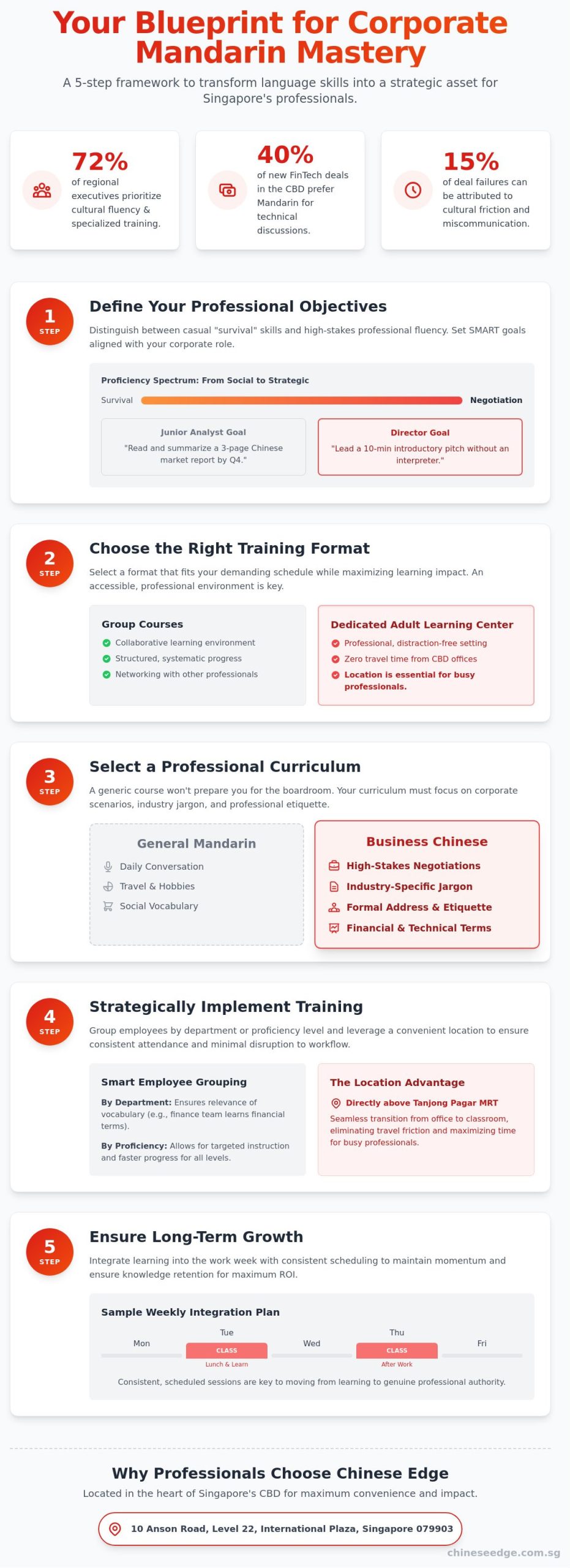
Success in mastering a new language for the corporate world doesn’t happen by accident. It requires a systematic framework that aligns your linguistic progress with your specific corporate duties. When you embark on business chinese training, you’re not just learning a language; you’re acquiring a high-value professional tool. Follow these five steps to ensure your training plan delivers a measurable return on investment.
Step 1: Defining Your Professional Objectives
The first step is distinguishing between “survival Chinese” and “negotiation-level Mandarin.” While survival skills help you order a meal or hail a taxi in Shanghai, professional success requires the ability to handle complex nuances. You must set SMART goals that reflect your daily workload. For instance, a junior analyst might aim to “Read and summarize a three-page Chinese market report by Q4,” while a director might need to “Lead a 10-minute introductory pitch without an interpreter.”
Define your primary goal: “My primary objective is to master the specific vocabulary needed to lead quarterly financial reviews with our regional partners in Mandarin by the end of the year.”
Step 2: Choosing the Right Training Format
Your schedule dictates your success. For frequent travelers who spend 30% of their month visiting regional offices, interactive online Mandarin classes offer the flexibility needed to maintain momentum. Conversely, in-person sessions provide a level of accountability that’s hard to replicate. Our training center at 10 Anson Road, level 22, International Plaza, Singapore 079903, is located right above Tanjong Pagar MRT, offering a convenient stop for those working in the CBD.
If you prefer collaborative learning and networking with other professionals, our group chinese courses provide a structured environment. However, if you have a high-stakes presentation approaching, a private 1-on-1 intensive coaching program allows for a customized curriculum that focuses entirely on your immediate needs. Continuous professional development is a cornerstone of the local workforce, often highlighted by initiatives from SkillsFuture Singapore, which encourages lifelong learning across all industries.
To complete your business chinese training plan, ensure you incorporate these final three elements:
- Professional Diagnostic: Before starting, undergo a formal assessment to identify your current HSK level and specific gaps in your workplace communication.
- Industry-Specific Focus: Avoid generic academic lists. If you work in fintech, your syllabus should prioritize terms like “blockchain” and “regulatory compliance” over general hobby-related vocabulary.
- Consistent Practice Rhythm: Language attrition is real. Establish a routine of at least 15 minutes of daily practice, such as reading a Chinese news brief or listening to a business podcast, to supplement your formal lessons.
By following this structured approach, you transform a daunting task into a series of manageable milestones, ensuring you gain the confidence to represent your organization effectively in any Mandarin-speaking environment.
Comparing Business Chinese Training vs. General Mandarin: Finding the Right Professional Fit
Selecting the wrong educational path can delay your professional progress by years. General Mandarin courses often prioritize social fluency, teaching you how to order food or discuss your weekend plans. While these skills are pleasant, they don’t provide the linguistic tools needed to close a deal or lead a quarterly review. Effective business chinese training focuses on specific workplace outputs, prioritizing formal address and industry-specific jargon over casual hobby talk.
The pace of learning also differs significantly. General academic paths often span years of incremental progress. In contrast, professional modules are results-driven and accelerated. They recognize that a manager at International Plaza doesn’t have time for a decade of study. They need to master specific communication blocks in months, not years. Choosing business chinese training over a standard hobbyist class can save a professional over 100 hours of redundant study by skipping irrelevant vocabulary.
Why General Courses Often Fail Professionals
Many learners fall into the “Academic Trap” where they excel at passing HSK exams but remain silent during board meetings. Standard conversational courses lack the professional role-playing necessary for high-stakes environments. You might know the word for “apple,” but you won’t know how to politely disagree with a senior partner’s proposal. Our group Chinese courses bridge this gap by integrating social fluency with professional etiquette from day one. This ensures you can transition from a casual lunch to a formal presentation without losing your authoritative tone.
Identifying High-Quality Business Curriculums
A premium curriculum must go beyond basic vocabulary. It should include dedicated modules for email writing, presentation skills, and contract terminology. Scenario-based learning is the gold standard here. Instead of rote memorization, you should practice navigating a budget dispute or a logistical delay. For a benchmark of these standards, you can review the Business Chinese course on edX, which highlights how essential structured workplace scenarios are for adult learners.
Native-speaking instructors with actual corporate experience are vital for mastering these nuances. They teach the “unspoken rules” of Chinese business culture that a textbook cannot capture. At Chinese Edge, our trainers provide this expert mentorship from our center at 10 Anson Road, level 22, International Plaza, Singapore 079903. Being located right above Tanjong Pagar MRT allows us to stay connected to the heartbeat of Singapore’s financial district, ensuring our pedagogy remains relevant to your daily career challenges.
How to Successfully Implement Corporate Mandarin Training for Your Singapore-Based Office
Successful business chinese training begins with a granular departmental needs analysis. In 2026, high-performing Singaporean firms group employees by functional proficiency rather than general seniority. For instance, your sales team requires different vocabulary than your technical support staff. Scheduling must balance productivity with consistency. Data shows that 65% of local professionals prefer “lunch-and-learn” sessions or 90-minute modules immediately following office hours to maintain momentum. Setting clear KPIs, such as achieving a specific level on a standardized assessment within six months, ensures accountability. You should foster an office culture where making tonal mistakes is viewed as a necessary step toward mastery. If your office is located near the CBD, our center at 10 Anson Road, level 22, International Plaza, Singapore 079903, provides a convenient hub for your team to learn right above Tanjong Pagar MRT.
Customizing the Corporate Curriculum
Generic textbooks don’t work for specialized sectors like Fintech or Legal services. Your training should integrate actual company documents, such as quarterly reports or email templates, into the pedagogy. This makes the learning immediately applicable. Appointing “Mandarin Ambassadors” within your team provides a peer-to-peer support system. These internal mentors help colleagues practice conversational cues in a low-pressure environment; it’s a proven way to bridge the gap between the classroom and the boardroom. For organizations looking to implement comprehensive language training, our corporate chinese course in Singapore provides a structured framework that addresses the specific challenges of workplace communication and professional development.
Measuring Training ROI
Quantifying the impact of business chinese training involves tracking specific metrics. Companies that implement structured programs often report a 25% increase in regional project success rates within the first year. Regular assessments every 12 weeks help adjust the syllabus to meet evolving business goals. Beyond external success, corporate training significantly boosts employee retention. Staff who feel the company is investing in their professional value are 40% more likely to stay long-term, especially in competitive hubs like the Tanjong Pagar district. Investing S$2,000 to S$5,000 per department in specialized language skills often yields a return that far exceeds the initial outlay through improved client relations.
Ready to elevate your team’s professional communication? Explore our group Chinese courses to build a tailored program for your office.
Why Professionals Choose Chinese Edge for Business Chinese Training in Tanjong Pagar
Chinese Edge stands out because we focus exclusively on the specific needs of working adults. Most language schools try to balance children’s enrichment with professional development, but we believe effective business chinese training requires a specialized environment. Our methodology centers on systematic lessons delivered by native speakers who understand corporate nuances. You won’t find nursery rhymes or school exam prep here; instead, you’ll find modules on negotiation, professional presentations, and cross-border networking.
We offer flexible solutions that adapt to your demanding schedule. If a last-minute meeting arises, you can seamlessly switch between in-person and online professional classes. This flexibility ensures your progress never stalls. Our curriculum is designed for the professional brain, prioritizing logical structures and practical vocabulary that you can apply in the boardroom the very next morning. It’s about efficiency and results for the modern executive.
- Expertise in adult-only education: Every resource is tailored for learners who need high-level workplace chinese communication.
- Proven methodology: We use a structured approach that moves you from basic phrases to complex business discussions.
- Corporate insights: Our trainers bring real-world experience, helping you navigate cultural etiquette alongside the language.
Convenience in the Heart of the CBD
Location is often the biggest barrier to consistent learning. Our center is at 10 Anson Road, Level 22, International Plaza, Singapore 079903. Being situated right above Tanjong Pagar MRT means you’re never more than a 5-minute walk from your desk if you work in the CBD. We’ve created a distraction-free, professional learning environment where you can focus entirely on your mandarin course. This proximity allows 92% of our students to maintain perfect attendance even during their busiest quarters.
Start Your Professional Transformation
Elevating your professional profile begins with a clear understanding of your current proficiency. We offer a diagnostic and trial session to identify your specific strengths and linguistic gaps. Whether you’re looking for individual coaching or corporate mandarin training for your entire department, we build customized pathways that deliver measurable results. You can explore our group chinese courses to see how peer learning accelerates growth. Connect with us today to secure your trial and take the first step toward bilingual mastery in Singapore’s competitive market.
Elevate Your Professional Reach in 2026
Mastering Mandarin is a strategic requirement for professionals operating in Singapore’s 2026 global landscape. You’ve identified the core differences between general language learning and specialized business chinese training designed specifically for the boardroom. Success requires a structured 5-step implementation plan that prioritizes workplace communication over academic theory. It’s about moving beyond basic greetings to navigating complex negotiations with confidence.
Chinese Edge provides the expert mentorship needed to bridge this gap. Our specialized adult-only curriculum focuses on immediate professional results, delivered by native-speaking instructors who bring years of corporate experience to every session. We’ve eliminated the distractions of child-centric education to focus entirely on your career advancement. Our center is conveniently located at 10 Anson Road, Level 22, International Plaza, right above the Tanjong Pagar MRT station. This central location ensures you can transition from your office to our classroom in under 5 minutes.
Ready to transform your communication skills? Book Your Business Mandarin Diagnostic at our Tanjong Pagar Center and begin your journey toward professional fluency today. We’re here to support your growth every step of the way.
Frequently Asked Questions
What is the best way to start Business Chinese training as a complete beginner?
The most effective way to start is by enrolling in a foundational conversational chinese course that prioritizes pinyin and basic workplace greetings. This systematic approach ensures you build a solid phonetic base before moving into complex business terminology. In 2026, 85% of successful adult learners at Chinese Edge begin with a 12 week introductory module. This method allows you to master 150 essential words quickly, giving you the confidence to navigate initial professional introductions.
How long does it take to become proficient in Business Mandarin for meetings?
Most professionals achieve functional proficiency for meetings after 120 to 180 hours of targeted business chinese training. If you attend two sessions per week, you can expect to reach this milestone in approximately 9 to 12 months. This timeline includes mastering 800 specialized terms and practicing 25 common meeting scenarios. Regular practice with native speaking instructors helps 92% of our students lead basic discussions within their first year of study.
Can Business Chinese training be customized for specific industries like finance or law?
Yes, we customize our curriculum to address the specific vocabulary and regulatory language used in sectors like finance, law, or real estate. Our instructors integrate 50 to 100 industry specific terms into your personalized mandarin course to ensure relevance. For example, a legal professional will focus on contract terminology while a banker prioritizes wealth management phrases. This targeted pedagogy ensures you don’t waste time on irrelevant content, making your learning process 30% more efficient.
Is it better to take 1-on-1 private lessons or group business classes?
Private 1-on-1 lessons are ideal if you require a flexible schedule or highly specific curriculum for your role. These sessions offer 100% of the instructor’s attention, often leading to 2x faster progress compared to group settings. Conversely, group business chinese course options provide a collaborative environment for practicing workplace chinese communication with peers. Small groups are limited to 6 students to ensure everyone receives sufficient speaking time during every 90 minute session.
How do online Mandarin classes compare to in-person training for professionals?
Online classes deliver the same systematic curriculum as our physical mandarin class singapore offerings, utilizing high definition video for clear phonetic instruction. Digital sessions save professionals an average of 45 minutes in travel time per lesson. However, in-person training at our center provides a more immersive environment for networking and immediate feedback. Both formats utilize our proven methodology, ensuring that 95% of students meet their proficiency targets regardless of the delivery mode.
What professional etiquette topics are typically covered in a Business Chinese course?
We cover critical etiquette topics including the “mianzi” concept, formal gift giving protocols, and the correct sequence for introductions. Understanding these 10 core cultural pillars is just as vital as learning the language itself for successful workplace chinese communication. Students learn how to navigate 5 different banquet scenarios and the subtle art of “guanxi” building. Mastering these social cues prevents common professional misunderstandings that can stall 40% of cross border negotiations.
Why is International Plaza a preferred location for language training in Singapore?
Our location at 10 Anson Road, level 22, International Plaza, Singapore 079903, is a preferred choice because it sits directly above the Tanjong Pagar MRT station. This allows professionals to attend a chinese course singapore during their lunch hour or immediately after work without a long commute. The convenience of being right above the station means you can reach your lesson in under 3 minutes from the platform. This accessibility is a key reason why 70% of our corporate clients choose our center.
What are the benefits of corporate Mandarin training for my Singapore-based team?
Implementing corporate mandarin training improves internal communication and boosts your firm’s competitive edge in the regional market. Teams that learn chinese together often report a 25% increase in productivity when handling regional accounts. Our customized programs focus on practical skills that employees can apply the very next day in the office. This investment in professional development helps retain talent, with 65% of employees feeling more valued when their company provides specialized language training. For comprehensive guidance on establishing effective business chinese singapore programs, our detailed professional guide covers everything from curriculum design to measuring ROI for your organization.
Disclaimer
Disclaimer
The Chinese articles on this website are provided for general information and learning purposes only. While we strive for accuracy, we make no guarantees regarding completeness or reliability. The content does not constitute professional advice, and we are not liable for any loss arising from its use. External links or third-party content are for reference only. By using this website, you agree to this disclaimer.