

Did you know that as of July 2026, the updated HSK 3.0 standard has nearly doubled the vocabulary requirements for top-tier proficiency? For many professionals in Singapore, this transition makes it difficult to know how to determine your mandarin level for a course without feeling misplaced. You don’t want to waste time on beginner basics you’ve already mastered, yet the fear of being lost in an advanced business chinese course is a valid concern. It’s vital to find a starting point that respects your existing knowledge while pushing you toward fluency.
We believe that language learning should be a strategic investment in your professional growth. This guide provides an expert-led framework designed to help you identify your exact standing on the Mandarin proficiency scale. By the end of this article, you’ll have a clear roadmap for your conversational chinese course and the confidence to select a mandarin course that aligns with your career goals. We will break down the new HSK 3.0 benchmarks and explain how our structured approach at International Plaza, located right above Tanjong Pagar MRT, helps you bridge the gap between your current skills and workplace mastery.
Key Takeaways
- Avoid the common “beginner’s trap” and “level inflation” by understanding how proper course placement prevents burnout and sustains long-term motivation.
- Distinguish between passive recognition and active speaking skills to gain a realistic view of your current workplace chinese communication abilities.
- Use our expert framework on how to determine your mandarin level for a course to align your existing knowledge with the updated 2026 HSK 3.0 proficiency benchmarks.
- Identify the specific milestones that separate basic survival phrases from the complex linguistic requirements of a business chinese course.
- Learn how a professional assessment by a native-speaking instructor provides a structured roadmap for your conversational chinese course and professional growth.
Why Finding the Right Mandarin Level is Critical for Adult Learners in 2026
The landscape of language learning in Singapore has shifted significantly by 2026. With the full implementation of HSK 3.0 in July 2026, the vocabulary requirements have expanded dramatically. For instance, HSK 6 now requires over 5,400 words. If you’re an adult learner, you can’t afford to get your placement wrong. The “Beginner’s Trap” is a real productivity killer. Many students find themselves repeating basic greetings they already know, which leads to immediate disengagement. Conversely, “Level Inflation” pushes you into environments where the vocabulary is too dense, causing burnout before you’ve even mastered the basics of workplace chinese communication.
Understanding how to determine your mandarin level for a course isn’t just about ticking boxes on a multiple-choice quiz. While major Mandarin proficiency exams provide a standardized framework, they often fail to measure your actual conversational readiness in a high-stakes business meeting. In the fast-paced Singapore commercial district, efficiency is everything. You need a program that matches your current ability precisely so you can see immediate returns on your time investment.
To better understand this concept, watch this helpful video:
The Cost of Incorrect Level Placement
Misjudging your starting point has tangible consequences. Wasted course fees are the most obvious impact, but the hidden cost is the “starting over” syndrome. When a student feels misplaced, their professional confidence wavers. If you’re struggling to keep up in a mandarin course that’s too advanced, you might mistakenly believe you aren’t capable of learning the language. Proper placement at our center in International Plaza, located right above Tanjong Pagar MRT at 10 Anson Road, level 22, Singapore 079903, ensures you start at a level that challenges you without overwhelming your schedule. This precision accelerates your path to fluency by keeping you in the “goldilocks zone” of learning.
Defining Functional Fluency for Professionals
True fluency for an adult learner means moving beyond memorized vocabulary lists to real-world application. You might be able to read a Chinese news article but struggle to negotiate a contract or manage a team in Mandarin. This gap between “active” and “passive” language skills is why a professional assessment is vital. Your level in social settings often differs from your ability to handle corporate mandarin training requirements. An Expert Mentor acts as a sophisticated bridge, evaluating your ability to use the language in professional applications rather than just recognizing characters on a screen. By focusing on functional fluency, you ensure your chinese for professionals training translates directly into career success.
Decoding Mandarin Proficiency: Beginner, Intermediate, and Advanced
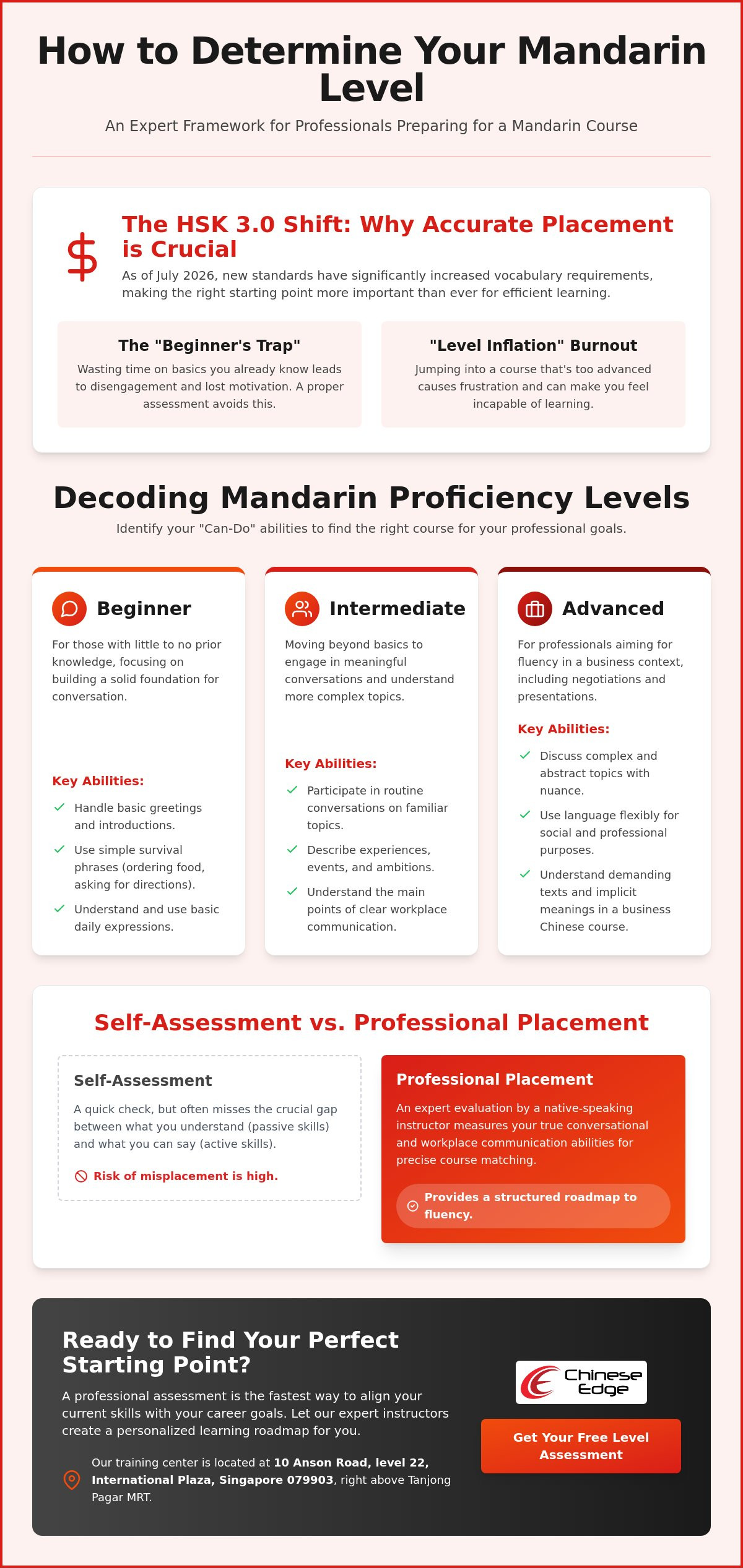
Understanding the standard tiers of language proficiency is the first step in your educational journey. Most professionals find that how to determine your mandarin level for a course depends on their specific “Can-Do” abilities rather than just the number of hours spent in a classroom. Our Adult Conversational Mandarin Course is structured to transition students through three primary stages: Beginner, Intermediate, and Advanced. Each stage represents a major shift in both vocabulary depth and functional application.
Beginners at Levels 1 and 2 often start with zero knowledge. They quickly move toward basic survival phrases. Under the July 2026 HSK 3.0 standards, this involves mastering between 300 and 500 words. This foundation allows you to navigate daily life in a Mandarin-speaking environment without feeling completely lost. It’s the essential groundwork for anyone looking to learn chinese for the first time.
Intermediate learners at Levels 3 and 4 bridge the gap between survival and professional utility. You’ll expand your vocabulary to roughly 2,000 words. At this stage, you can navigate complex social conversations and handle basic work tasks. You’re no longer just reciting phrases; you’re beginning to construct original thoughts. If you’re looking for a mandarin class singapore that moves beyond the basics, this is where the real work begins.
Advanced levels 5 and 6 represent professional-grade fluency. This requires a command of over 5,400 words and deep cultural nuance. You’ll master technical vocabulary and high-speed native speech. This level is critical for those pursuing a business chinese course to lead major projects or enter high-level negotiations. If you’re unsure where you fit, exploring our mandarin course options can help clarify your path.
Conversational Benchmarks for Each Stage
In a conversational context, beginners focus on ordering food, introducing themselves, and asking for directions. Intermediate students move into expressing opinions, debating current events, and handling travel hitches like lost luggage. Advanced learners reach a point where they can understand subtle humor, complex idioms, and rapid-fire native dialogue. This progression ensures your conversational chinese course remains practical and engaging at every step.
Business Mandarin Course Requirements
- Level 1-2 Business: Focuses on formal greetings, proper etiquette for exchanging business cards, and simple workplace introductions.
- Level 3-4 Business: Involves participating in internal meetings, writing professional emails, and giving basic project updates.
- Level 5-6 Business: Requires mastery of negotiation tactics, complex contract terminology, and delivering keynote presentations to large audiences.
Our instructors at 10 Anson Road, level 22, International Plaza, Singapore 079903, right above Tanjong Pagar MRT, specialize in helping you identify these specific benchmarks during your initial assessment.
Self-Assessment vs. Professional Placement: Which is More Accurate?
Many professionals begin their journey by taking a quick online quiz. It’s a convenient starting point, but it often leads to the “Fluency Illusion.” This phenomenon occurs when your ability to recognize characters or choose the correct grammar option on a screen far outpaces your actual ability to speak. If you’re wondering how to determine your mandarin level for a course accurately, you must look beyond automated scoring. A bot can’t hear the slight tonal shifts that change the meaning of a word entirely. Relying solely on software can result in you being placed in a class where you can read the textbook but can’t participate in the discussion.
Online multiple-choice quizzes are fundamentally limited. They test passive recognition rather than active production. For those aiming for Business Chinese in Singapore, the stakes are higher than a simple test score. You need to know if you can handle the pressure of a real-time negotiation or a rapid-fire Q&A session. Native-speaker feedback is the only way to identify tonal “blind spots” that you might have developed through self-study or app-based learning. This professional insight ensures your conversational chinese course investment actually translates into workplace performance.
When to Trust a Self-Assessment
It’s perfectly fine to trust your own judgment if you’re an absolute beginner with zero prior exposure. In this case, a mandarin course for beginners is the obvious starting point. Self-assessment is also a useful preliminary “ballpark” figure before a formal interview. You might check your familiarity with the 100 most common characters to see if you’ve retained the basics from years ago. However, treat this as a rough guide rather than a final decision. It’s the first step in understanding how to determine your mandarin level for a course before seeking expert validation.
The Benefits of an Instructor-Led Placement Interview
A formal interview at our center, located at 10 Anson Road, level 22, International Plaza, Singapore 079903, right above Tanjong Pagar MRT, offers insights no app can provide. Our instructors assess your listening comprehension under pressure. They provide immediate correction for foundational tonal mistakes that could hinder your workplace chinese communication. Most importantly, we provide personalized course recommendations based on your specific industry. Whether you work in Finance, Tech, or Law, we ensure your chinese classes near me match the linguistic demands of your daily professional life.
A 5-Step Checklist to Determine Your Level for a Course
Moving from theory to practice requires a systematic approach. If you’re wondering how to determine your mandarin level for a course, you need more than a gut feeling. This checklist serves as a diagnostic tool to help you audit your current skills and identify where your gaps lie. It’s designed specifically for the professional environment of Singapore, where time is a premium resource. Use these five points to evaluate your current standing:
- Audit your past learning: Did you learn through self-study apps or formal classes? Apps often prioritize recognition over production, while formal classes usually provide a better structural foundation.
- Test your ‘Active’ Vocabulary: Don’t just count characters you can read. How many words can you actually use in a spontaneous sentence during a conversational chinese course?
- Evaluate your listening: Can you understand a native speaker at normal speed? Listening comprehension is often the first skill to erode without regular practice.
- Check your tonal accuracy: Mandarin is a tonal language. If you can’t produce the four tones accurately, your workplace chinese communication will suffer from frequent misunderstandings.
- Identify your professional ‘Must-Haves’: List the specific tasks you need to perform, such as answering client inquiries or leading a business chinese course meeting.
Step-by-Step Level Determination
When you’re figuring out how to determine your mandarin level for a course, start by determining your primary goal. Are you looking for social integration or professional advancement? Next, review standard proficiency frameworks like the HSK 3.0 benchmarks to establish a baseline. Finally, attempt a ‘Stress Test’; try to explain your job role in Mandarin for two minutes without stopping. This reveals your true comfort level under pressure.
Identifying the ‘Intermediate Plateau’
Many professionals find themselves stuck at the same level for years. You might be comfortable with daily small talk but feel paralyzed when a conversation turns toward market trends or legal requirements. This stagnation is a clear sign that you need a more rigorous strategy. Transitioning to an Advanced Mandarin Course requires moving beyond general vocabulary into industry-specific terminology. If you can handle social settings but struggle with professional emails, it’s time to shift your focus toward corporate mandarin training. Ready to break through the plateau? Book your professional assessment today at our center located at 10 Anson Road, level 22, International Plaza, Singapore 079903, right above Tanjong Pagar MRT.
Expert Level Assessment at Chinese Edge: Your Gateway to Fluency
Choosing the right program is a decision that impacts your career trajectory. At Chinese Edge, we’ve developed a methodical approach to adult language placement that removes the guesswork from how to determine your mandarin level for a course. Our process doesn’t rely on generic software or automated quizzes. Instead, we pair you with an Expert Mentor who understands the specific linguistic demands of the Singapore business sector. This ensures your learning path is both realistic and challenging from day one.
Our native-speaking instructors possess the cultural depth and professional experience required to gauge your readiness for high-stakes environments. They don’t just test your grammar; they evaluate your ability to think and react in Mandarin. For organizations, we offer customized Corporate Mandarin Training. We audit your team’s collective proficiency to design a curriculum that addresses specific workplace gaps, ensuring everyone moves forward at an optimal pace.
Convenient Learning at International Plaza
We understand that professionals have demanding schedules. Our center is located at 10 Anson Road, level 22, International Plaza, Singapore 079903. Being situated right above Tanjong Pagar MRT makes it easy to visit us for a lunch-hour assessment or an after-work consultation. The high-floor, professional environment is designed specifically for adult learners, providing a quiet space that fosters concentration and growth. It’s a premium boutique setting that reflects the sophisticated nature of our mandarin course offerings.
Your Next Steps to Mandarin Mastery
The journey to fluency begins with an accurate starting point. You don’t have to wonder how to determine your mandarin level for a course on your own. Booking a professional placement interview with our instructors provides the clarity you need to choose between our Adult Conversational Mandarin Course or a specialized business mandarin course. We offer flexible learning modes to suit your lifestyle, including in-person group sessions and Online Mandarin Classes.
By joining our school, you become part of a community of like-minded professionals learning Chinese in Singapore. Our results-oriented methodology has supported over 10,000 students since 2005. If you’ve been searching for chinese classes near me that prioritize professional application over simple memorization, we’re here to serve as your reliable partner. Take the first step toward workplace mastery today.
Your Roadmap to Workplace Fluency Starts Here
Achieving professional proficiency in Mandarin requires a structured approach that respects your time and career goals. By moving beyond simple self-assessments and understanding the new HSK 3.0 benchmarks, you can avoid common pitfalls like the beginner’s trap. This guide has provided you with the necessary framework for how to determine your mandarin level for a course, but the most accurate results come from expert human interaction.
Our expert native-speaking instructors specialize in tailoring curriculum for adult and corporate learners, ensuring your workplace communication is sharp and effective. We invite you to visit our prime CBD location at 10 Anson Road, level 22, International Plaza, situated right above Tanjong Pagar MRT, for a comprehensive evaluation of your active speaking skills. Don’t let your progress stall on an intermediate plateau when professional mastery is within reach.
Book Your Professional Level Assessment at Chinese Edge Today. We look forward to supporting your growth as you bridge the gap between your current skills and the linguistic world. Your path to confidence begins with one decisive step.
Frequently Asked Questions
How long does it take to move from Beginner to Intermediate level?
It typically takes between 100 and 150 hours of structured instruction to transition from a total beginner to an intermediate level. This timeline aligns with the 2026 HSK 3.0 benchmarks, where students move from a 500-word vocabulary to roughly 2,000 words. Consistency is the most important factor. If you attend sessions twice a week, you’ll reach this milestone significantly faster than through sporadic self-study.
Can I take a placement test online if I cannot visit the Tanjong Pagar centre?
You can certainly complete your assessment virtually if you’re unable to visit our center at 10 Anson Road, level 22, International Plaza, Singapore 079903. While our location right above Tanjong Pagar MRT is convenient for many, our Online Mandarin Classes include the same rigorous placement interview. This ensures every student knows how to determine your mandarin level for a course with total precision before they begin.
I learned Mandarin in school but haven’t used it for years; where should I start?
Returning learners should start with a professional placement interview rather than enrolling in a basic beginner class. Your passive knowledge from school might remain high, but your active speaking skills often require a focused refresh to overcome the “Fluency Illusion.” We help you identify which specific modules will bridge the gap between your past education and your current professional requirements.
Is there a specific level required for the Business Mandarin course?
A Business Mandarin Course generally requires a solid intermediate foundation, equivalent to HSK Level 3 or 4. You must be able to handle basic social interactions comfortably before diving into the complexities of workplace chinese communication. If you haven’t reached this stage yet, we’ll recommend starting with a conversational program to build the necessary linguistic base.
What is the difference between HSK levels and the Chinese Edge course levels?
HSK levels are international academic benchmarks, while our course levels are optimized for practical, professional application. We map our curriculum to the July 2026 HSK 3.0 standards to ensure your progress is recognized globally. However, our primary focus remains on your ability to use the language effectively in real-world Singapore business scenarios rather than just passing a written test.
How do I know if my tones are correct enough for an Intermediate course?
The most reliable way to verify your tonal accuracy is through a real-time conversation with a native-speaking instructor. While mobile apps provide basic feedback, they often miss the subtle nuances of sentence-level intonation. If you can be understood by a native speaker at normal speed, as outlined in our 5-step checklist, you’re likely ready for an intermediate mandarin course.
Do I need to know how to write Chinese characters to join a conversational course?
You don’t need to master character handwriting to join our conversational programs. We prioritize Pinyin and verbal fluency to get you speaking as quickly as possible. This approach is ideal for professionals who need immediate results in workplace chinese communication without the steep learning curve associated with traditional character calligraphy.
What happens if I start a course and find the level is not right for me?
We provide a flexible adjustment period if you find your current level is unsuitable after the first few lessons. Our Expert Mentors monitor your progress closely to ensure the challenge level is appropriate for your skills. Your confidence and steady progress are our primary objectives, and we’ll move you to a different level to ensure an optimal learning experience.
Disclaimer
Disclaimer
The Chinese articles on this website are provided for general information and learning purposes only. While we strive for accuracy, we make no guarantees regarding completeness or reliability. The content does not constitute professional advice, and we are not liable for any loss arising from its use. External links or third-party content are for reference only. By using this website, you agree to this disclaimer.