

Last Tuesday, a senior analyst working at International Plaza spent 45 minutes toggling between translation tabs just to draft a three sentence reply to a Shanghai partner. Despite the effort, the machine output felt stiff and lacked the professional nuance required for a high-value contract. If you’ve experienced this frustration, you know that relying on software often takes more time than it saves. You likely agree that appearing unprofessional to Chinese clients is a risk your career can’t afford. This guide provides the exact steps on how to finally stop using a translator for business emails and start writing with authority.
Discover a systematic roadmap to transition from unreliable machine tools to confident writing tailored for the Singapore business landscape. We’ll explore the essential frameworks used in the business Chinese course at Chinese Edge, located at 133 Cecil Street, #10-01A Keck Seng Tower, Singapore 069535. These strategies help experts master Chinese for professionals to achieve career advancement through better workplace Chinese communication. You’ll learn how to draft clear emails independently and build genuine rapport with your Chinese partners without the crutch of a digital translator.
Key Takeaways
- Identify the hidden risks of relying on AI and why machine translation often fails to capture the subtle hierarchies required in professional Singaporean business environments.
- Master a systematic 5-step roadmap on how to finally stop using a translator for business emails by transitioning to a structured, formulaic writing approach.
- Build a high-impact “Phrase Bank” of professional greetings and closings to ensure your correspondence remains polished, authoritative, and linguistically accurate.
- Navigate complex cultural expectations, such as the concept of “Mianzi” (Face), to improve your workplace Chinese communication and build stronger cross-border partnerships.
- Learn how a professional business chinese course at our Tanjong Pagar MRT location provides the foundational logic and native-speaker guidance needed for long-term self-reliance.
The Hidden Risks of Relying on Translation Software for Business
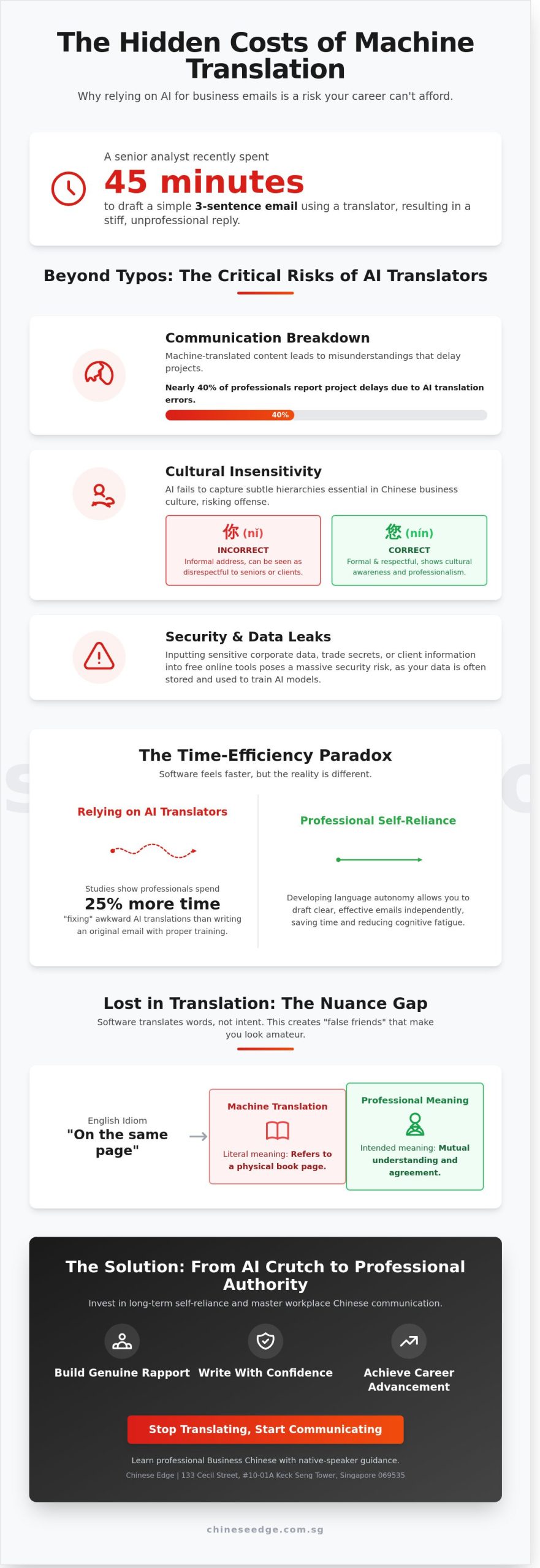
Many professionals working near Tanjong Pagar MRT rely on digital tools for cross-border communication. While these tools seem convenient, The Hidden Risks of Relying on Translation Software often outweigh the benefits. In a 2023 industry report, nearly 40% of business professionals admitted that machine-translated content led to misunderstandings that delayed project timelines. When you’re managing a high-stakes deal with a partner in Shanghai or Beijing, a single mistranslated technical term can erode years of built-up trust. Learning how to finally stop using a translator for business emails is a critical step for any professional seeking genuine career advancement in Singapore’s competitive landscape.
To better understand why your brain struggles to let go of these tools, watch this helpful video:
Machine translation often produces a “robotic tone” that misses the subtle business hierarchies essential in Chinese corporate culture. AI tools frequently default to the informal “nǐ” (你) instead of the respectful “nín” (您). This small error can appear disrespectful to a senior executive, signaling a lack of cultural awareness. Beyond tone, security is a major concern. Inputting sensitive corporate data or proprietary trade secrets into free online tools poses a massive risk to your firm. Most free platforms retain your input data to train their models, which could lead to accidental leaks of sensitive corporate strategy.
The Nuance Gap in Machine Translation
Software struggles with the difference between literal meaning and professional intent. For example, translating a common English idiom like “on the same page” often results in a Chinese sentence that refers to physical books rather than mutual understanding. These “false friends” make your writing look amateur. A structured business chinese course teaches you the specific vocabulary needed for workplace chinese communication, ensuring your emails reflect the sophistication of your professional role.
The Time-Efficiency Paradox
It’s a common misconception that software saves time. A 2022 study found that professionals spend 25% more time “fixing” awkward AI translations than they would spend writing a clear, original email if they had the proper training. The mental fatigue of switching between translation tabs drains your cognitive energy. By enrolling in a mandarin course at our center located at 10 Anson Road, level 22, International Plaza, you invest in long-term productivity. Developing language autonomy allows you to respond to clients instantly, positioning you as a reliable partner in any negotiation.
Essential Business Mandarin Skills to Replace Your Translator
Learning how to finally stop using a translator for business emails starts with understanding that Chinese professional correspondence is highly structured. Relying on digital tools often leads to awkward phrasing or culturally insensitive tone shifts. Research from 2023 indicates that automated tools often fail to capture the hierarchical nuances required in Asian corporate settings. Using these tools also introduces the Hidden Risks of Translation Software, such as data privacy leaks and accuracy errors that can damage your professional reputation. By mastering a few core skills, you can draft clear, effective messages that build trust with your partners without the crutch of a translation app.
The Anatomy of a Professional Chinese Email
A standard business email follows a predictable pattern: subject line, salutation, the “reason for writing” sentence, the core request, and the closing. For the subject line, clarity is vital. Instead of vague titles, use a format like “Project Name + Action Required + Date.” Salutations should reflect your relationship. Use “Respected [Surname] [Title]” for formal first contacts, or “[Surname] [Title], Hello” for established colleagues. The “reason for writing” usually follows a pattern like “I am writing to inquire about…” or “Regarding our meeting on Tuesday…” which sets a professional tone immediately. This systematic approach is a cornerstone of any effective business chinese course.
Vocabulary for Workplace Chinese Communication
To move beyond basic workplace chinese communication, you need a toolkit of high-frequency verbs and softening techniques. Focus on mastering these five essential project management verbs: coordinate, implement, approve, finalize, and negotiate. Using these correctly demonstrates a high level of chinese for professionals. Additionally, professional Mandarin often uses specific particles at the end of sentences to “soften” a request, making it sound like a suggestion rather than a command. This is crucial for maintaining harmony in business relationships. Understanding industry-specific jargon also boosts your credibility, as 85% of professionals surveyed in 2024 agree that using correct terminology is the fastest way to build rapport in a new market.
Developing these skills doesn’t have to be an isolating process. If you want to refine your skills in a collaborative environment, consider joining a mandarin course at our training center. We’re located at 10 Anson Road, level 22, International Plaza, Singapore 079903, which is conveniently situated right above Tanjong Pagar MRT. Our mandarin class singapore focuses on practical application, helping you build a personal phrase bank that makes translators obsolete. You’ll learn to self-correct common errors, ensuring your emails are always polished and professional. This hands-on approach is the most efficient way to learn how to finally stop using a translator for business emails while advancing your career.
A 5-Step Plan to Transition from AI to Professional Self-Reliance
Breaking the cycle of dependency requires a systematic framework. You don’t need to quit software cold turkey. Instead, shift your role from a passive user to an active editor. This is how to finally stop using a translator for business emails while maintaining the high standards expected in Singapore’s competitive corporate environment.
- Step 1: Audit your patterns. Review your sent folder from the last 30 days. You’ll likely find that 70% of your communication uses the same 50 to 100 phrases. Identifying these recurring blocks is the first step toward ownership.
- Step 2: Build a foundation. Enroll in a structured business chinese course to understand the logic of sentence construction. Learning the “why” behind the grammar prevents the awkward “word salad” often produced by automated tools.
- Step 3: Adopt the hybrid method. Draft greetings and simple logistical requests yourself. Use tools only for complex data or legal disclaimers.
- Step 4: Implement a “Native Check” system. Write your draft in Mandarin first. Use AI only to verify specific technical terms rather than generating the entire message from English prompts.
- Step 5: Increase complexity incrementally. Move from one-sentence updates to three-paragraph proposals over a six-month period. Consistent practice at our center at 10 Anson Road, level 22, International Plaza, ensures you have the support needed for this progression.
Starting Small: The Hybrid Email Approach
The hybrid approach focuses on reclaiming the “low-stakes” sections of your correspondence. Start by writing your own greetings, introductions, and scheduling requests. These segments follow predictable patterns that are easy to master. Instead of using AI as a ghostwriter, treat it as a specialized dictionary for industry-specific nouns. Set a weekly goal to reduce your software reliance by 15%. By the end of the first month, you’ll find that how to finally stop using a translator for business emails becomes a matter of confidence rather than just vocabulary.
Leveraging Professional Feedback
Self-study has limits. Real growth happens through interaction with native-speaking instructors who understand the Singaporean business context. At our location right above Tanjong Pagar MRT, students practice “back-translation.” This involves writing a draft in Mandarin and then translating it back to English to see if the original intent remains intact. Incorporating feedback from a conversational chinese course into your written work ensures your emails sound natural and culturally appropriate. This professional oversight identifies subtle nuances that software consistently misses, such as the correct level of formality for a senior director versus a peer.
Beyond Vocabulary: Navigating Chinese Business Etiquette in Singapore
Success in regional trade requires more than just a dictionary. It demands a deep understanding of “Mianzi” or Face. This cultural pillar dictates how you structure every sentence. If you want to learn how to finally stop using a translator for business emails, you must learn to give face to your counterparts. Direct criticism often causes a loss of face, which can stall a S$100,000 deal instantly. Instead of pointing out an error directly, frame it as a request for clarification. This subtle shift preserves the relationship while achieving your business goal.
Timing is another critical factor in the Singapore-China corridor. Responsiveness signals respect and commitment. While email remains the legal anchor for contracts, WeChat often drives the pace of daily operations. A 2023 industry report indicated that 74 percent of professionals in mainland China prefer immediate mobile communication for project updates. While you should reply to emails within 24 hours, WeChat messages often require a response within two hours. If you must say “No,” do it indirectly. Use phrases like “It might be difficult at this moment” rather than a flat refusal. This keeps the door open for future collaboration without offending your partner.
Understanding Hierarchy and Respect
Hierarchy remains central to professional Mandarin communication. Use “Nin” (您) instead of “Ni” (你) when addressing senior management, elders, or new clients. This distinction is a quick way to show you understand professional boundaries. Address your recipient by their specific title and surname, such as “Manager Lim” or “Director Chen.” Always conclude your message with a formal “Closing Wish” like “祝工作顺利” (Wishing you success in your work). These small details demonstrate that you are a culturally competent professional, not just someone copying and pasting from a digital tool.
The Singapore Advantage: Bridging East and West
Singaporean professionals have a unique strategic edge. You can combine Western clarity with Eastern etiquette to create a powerful hybrid communication style. By studying business chinese singapore, you learn to strip away “Chinglish” and replace it with high-level, industry-specific vocabulary. This makes your communication more persuasive and authoritative. Our systematic curriculum at 10 Anson Road, level 22, International Plaza, focuses on these real-world applications. Located right above Tanjong Pagar MRT, we help you master the nuances that automated tools miss. You’ll move from being a functional speaker to a sophisticated communicator who can lead negotiations without a linguistic crutch.
Master Workplace Chinese Communication with Chinese Edge
Relying on software to bridge the communication gap often leads to missed nuances and professional friction. At Chinese Edge, we provide a systematic business chinese course specifically designed for adults who need to function at a high level in a Mandarin-speaking environment. Our curriculum moves beyond basic vocabulary, focusing instead on the complex linguistic structures used in Singaporean boardrooms and regional trade. By learning from native speakers, you gain insights into cultural etiquette and tone that a machine simply cannot replicate. This structured approach is the most effective way for you to learn how to finally stop using a translator for business emails and start communicating with genuine authority.
Our pedagogy prioritizes practical application over rote memorization. We use real-world scenarios, such as pitch presentations and contract negotiations, to ensure that every lesson translates directly to your career advancement. Whether you are looking for a conversational chinese course to improve team bonding or a rigorous mandarin course to handle technical documentation, our flexible learning options accommodate your schedule. You can choose to join us for intensive sessions at our center or participate in live online training from your office.
Convenient Learning at Tanjong Pagar
Our training center is located at 10 Anson Road, level 22, International Plaza, Singapore 079903. We are situated right above Tanjong Pagar MRT, providing unparalleled access for professionals working in the Central Business District. We have designed a professional boutique environment that stands in stark contrast to traditional academic settings. It is a space tailored for adult learners who value privacy, comfort, and efficiency. Many of our students find it convenient to visit for a consultation at 5:30 PM or 6:00 PM immediately after their workday ends. This central location makes it easy to integrate a mandarin class singapore into a busy corporate lifestyle without the stress of a long commute.
Results-Oriented Corporate Training
We specialize in corporate mandarin training that solves specific organizational challenges. We help teams understand how to finally stop using a translator for business emails by developing customized syllabi for the finance, tech, and legal sectors. Our trainers analyze your industry’s specific terminology to ensure the workplace chinese communication skills we teach are 100 percent relevant to your daily operations. We have successfully assisted legal firms in drafting correspondence and tech teams in coordinating with regional developers. Our results-oriented framework ensures that your staff can move from hesitant translation to direct, confident dialogue. If your team is ready to enhance its professional proficiency, book a consultation for your corporate mandarin training to discuss a syllabus that fits your industry needs.
Take Control of Your Professional Communication Today
Relying on software for your daily correspondence limits your career growth and risks costly misunderstandings. By mastering workplace Chinese communication, you move beyond basic vocabulary to understand the cultural nuances that build real trust with partners. Learning how to finally stop using a translator for business emails isn’t just about efficiency; it’s about projecting the authority you already possess in English. Our team at Chinese Edge provides a systematic curriculum designed specifically for the Singaporean corporate landscape. We’ve helped professionals across the Central Business District transition from AI dependence to confident, self-reliant communication. Our native-speaking instructors bring years of corporate experience to ensure every lesson has immediate practical value. You’ll find us conveniently located at 10 Anson Road, level 22, International Plaza, situated right above Tanjong Pagar MRT. It’s time to invest in a skill that pays dividends for the rest of your career. We’re ready to help you bridge the gap between being a functional speaker and a persuasive leader.
Master Professional Communication: Join Our Business Mandarin Course
Frequently Asked Questions
How long does it take to stop using a translator for business emails?
It typically takes between 6 to 12 months of consistent study to reach a level where you can draft professional correspondence independently. By following a structured syllabus for 2 hours every week, you’ll learn how to finally stop using a translator for business emails for standard inquiries and follow-ups. Most professionals at our center in International Plaza see a 40% reduction in their reliance on translation software within the first 12 weeks of their business chinese course.
Can I learn Business Mandarin if I only know basic greetings?
Yes, you can start learning chinese for professionals even if you only know “Ni Hao” right now. Our curriculum bridges the gap between basic greetings and workplace chinese communication by focusing on high-frequency vocabulary used in Singaporean offices. Starting early helps you build correct habits, ensuring your professional tone is established before you tackle complex negotiations or legal terminology.
Is it better to learn conversational or business Chinese first?
Choosing between a conversational chinese course and a business-focused one depends on your immediate goals, but many adults benefit from a hybrid approach. While conversational skills provide the foundation for social rapport, a specialized mandarin course teaches the specific honorifics and formal structures required for email etiquette. In Singapore’s competitive market, mastering formal register often yields faster career advancement results than casual fluency alone.
What are the most common mistakes when translating emails into Mandarin?
The most frequent error is direct literal translation, which often results in phrasing that sounds unprofessional or even rude. For example, using the informal “you” (ni) instead of the polite “nin” or failing to use standard opening phrases can damage client relationships. Our corporate mandarin training focuses on these nuances, helping students avoid 90% of common syntax errors that automated tools consistently miss.
Are online Mandarin classes as effective as in-person for business writing?
Online classes are exceptionally effective for business writing because they mirror the digital environment where you actually work. When you join a mandarin class singapore online, you practice typing and screen-sharing in real-time with native instructors. However, many students prefer our physical location at 10 Anson Road, level 22, International Plaza, located right above Tanjong Pagar MRT, for the focused environment and immediate feedback.
How do I explain to my boss that I need a business Chinese course?
Focus your proposal on the time saved and the reduction in communication errors. Explain that a business chinese course allows you to respond to regional clients 50% faster without waiting for external translations. Mention that corporate mandarin training is a strategic investment in the company’s regional expansion goals, specifically for markets where professional etiquette is a prerequisite for closing deals.
What is the best way to remember professional Chinese characters for typing?
The most efficient method is to master Pinyin input systems rather than rote memorization of every stroke. When you learn chinese for the modern office, you focus on recognizing characters and selecting the correct one from a list. Our chinese course singapore teaches you to identify 500 core business characters, which covers about 80% of daily email needs, making the typing process intuitive and fast.
Disclaimer
Disclaimer
The Chinese articles on this website are provided for general information and learning purposes only. While we strive for accuracy, we make no guarantees regarding completeness or reliability. The content does not constitute professional advice, and we are not liable for any loss arising from its use. External links or third-party content are for reference only. By using this website, you agree to this disclaimer.