

The biggest barrier to fluency isn’t a lack of vocabulary; it’s the paralyzing fear of losing face over a misplaced tone. You might find yourself sitting in a boardroom near Tanjong Pagar, knowing exactly what you want to say in English but feeling mentally exhausted as you try to translate it into Chinese in your head. It’s frustrating to feel stuck at a beginner level when your professional expertise is so much higher. We understand that for many, the struggle with how to improve mandarin speaking confidence is more psychological than academic.
In this 2026 guide, you’ll discover how to master the psychological shifts and practical habits needed to speak Mandarin fluently in both professional and social environments. We’ll show you how to move past the “translation trap” and embrace a structured approach to communication. We will preview the essential strategies for workplace chinese communication and explain how a specialized mandarin course can transform your career. Whether you’re looking for chinese for professionals or a conversational chinese course, our methodology at 10 Anson Road, level 22, International Plaza, right above Tanjong Pagar MRT, ensures you gain the results-oriented skills required for success in Singapore’s global landscape.
Key Takeaways
- Overcome the “face” barrier by prioritizing functional communication over perfect pronunciation in professional environments.
- Distinguish between practice zones and performance zones to prevent mental exhaustion and maintain flow during business discussions.
- Learn how to leverage your daily routine in Singapore to create immersion opportunities that support long-term retention.
- Discover how to improve mandarin speaking confidence by moving beyond self-study into a structured, mentor-led conversational chinese course.
- Understand why context often overrides minor tonal errors, allowing you to speak more naturally without the fear of being misunderstood.
Understanding the Psychology of Mandarin Speaking Confidence
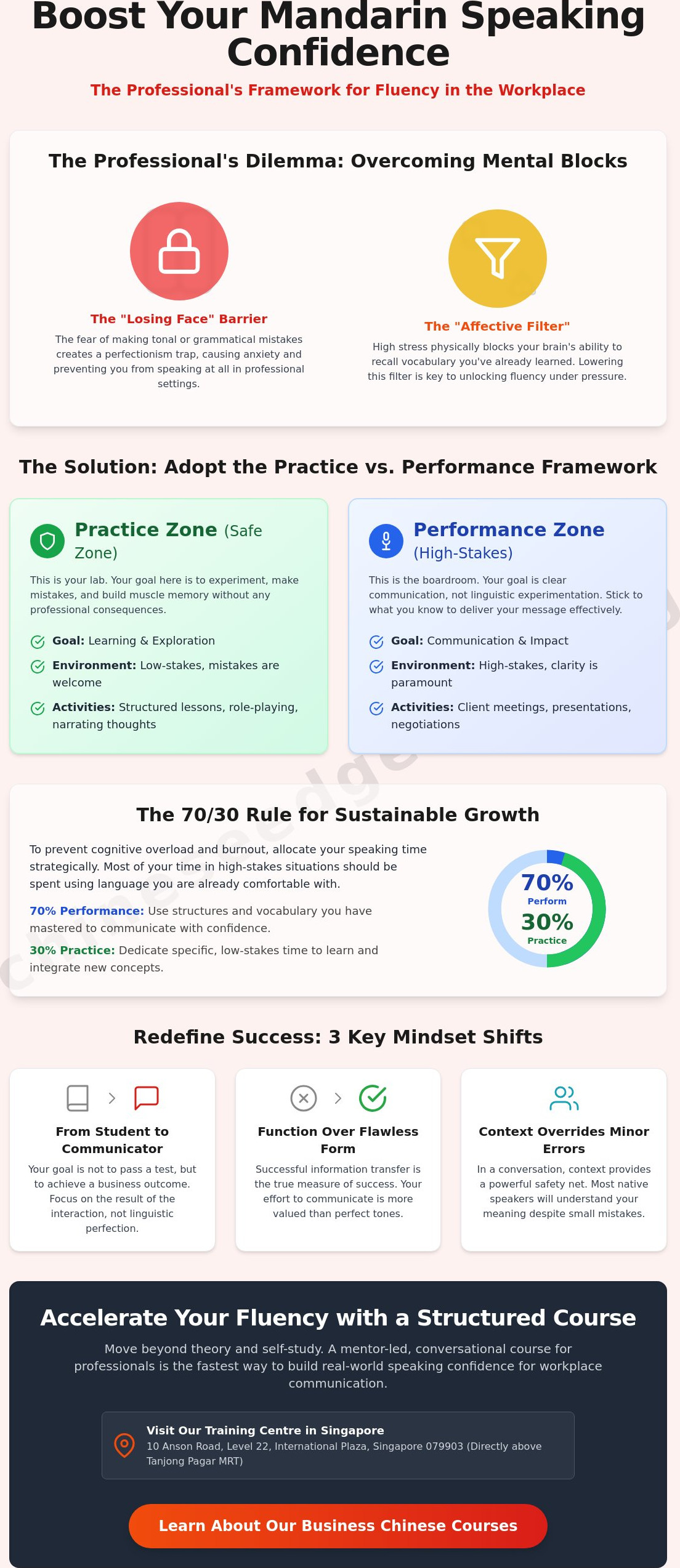
True confidence in a linguistic sense isn’t about having a perfect accent or an exhaustive vocabulary. Instead, it’s the ability to express your thoughts freely without the weight of debilitating anxiety. For many professionals in Singapore, the struggle of how to improve mandarin speaking confidence is rooted in the “Face” or Mianzi barrier. In a corporate environment, there’s a perceived risk that a simple tonal error or a grammatical slip might make you appear less competent in your field. This perfectionism trap creates a mental block that prevents you from even trying to speak.
To better understand this concept, watch this helpful video:
Transitioning from a student mindset to a communicator mindset is essential for professional growth. A student often focuses on passing a test or getting a specific grade. A communicator, however, focuses on the result of the interaction. When you are in a meeting, your goal is to convey data, build rapport, or close a deal. If you can achieve that goal despite a few clumsy sentences, you have succeeded. This shift in perspective reduces the pressure to be perfect and allows you to focus on the actual objective of your conversation.
The Science of Language Anxiety in Adults
Adults often experience what linguists call the “Affective Filter.” This is a psychological barrier where high stress levels physically block your brain’s ability to recall vocabulary you’ve already learned. When your filter is high, your brain shifts into a stress response rather than a communicative one. Building linguistic self-confidence requires lowering this filter through consistent, low-pressure practice. Unlike children, adults have established professional identities to protect, which makes the stakes feel higher. Developing muscle memory for tones under pressure is a physical process that requires you to move past the fear of being wrong.
Redefining Success in Conversational Mandarin
If you wait until your grammar is flawless, you’ll never speak. In a professional setting, successful information transfer is far more valuable than linguistic perfection. Most native speakers actually appreciate the effort you put into learning their language and will prioritize the meaning of your words over the precision of your tones. Shifting your focus to the message rather than the mechanics is a core component of a mandarin course designed for busy professionals. Confidence is a skill that is built through repeated, imperfect exposure rather than silent study. By accepting that mistakes are a functional part of the learning process, you can begin to unlock the fluency needed for effective workplace chinese communication.
The Practice vs. Performance Framework for Fluency
Mastering how to improve mandarin speaking confidence requires a clear distinction between “practice” environments and “performance” environments. Most professionals struggle because they try to learn new vocabulary in the middle of a high-stakes meeting. This creates cognitive overload and leads to mid-sentence stalling. Instead, adopt a framework that separates your development into Safe Zones, where mistakes are encouraged, and Performance Zones, where you focus entirely on the delivery of your message.
The 70/30 Rule is a vital component of this strategy. You should spend 70% of your time using the structures you already know and only 30% learning new concepts. This ratio ensures you aren’t constantly operating at the edge of your abilities, which is a major factor when exploring foreign language anxiety in professional settings. Your daily commute to our center at 10 Anson Road, level 22, International Plaza, right above Tanjong Pagar MRT, is a perfect time for low-stakes “Play.” Use this time to narrate your thoughts in Mandarin or listen to a podcast, lowering your inhibitions before you step into a boardroom.
Creating Your ‘Safe Zone’ for Practice
In a Safe Zone, your goal is repetition and vocal conditioning. Use the shadowing technique by listening to native speakers and mimicking their rhythm immediately after they speak. This builds the muscle memory needed for fluent speech without the pressure of a real audience. Recording your own voice is also a necessary step for objective self-correction. Utilizing Online Mandarin Classes provides a controlled, risk-free environment where you can fail and receive immediate feedback from expert mentors.
Executing During Performance
When you are in a Performance Zone, such as a client presentation, stop acting like a student. Focus entirely on the listener’s reaction rather than your internal monologue. If you forget a word, use survival phrases like “Let me put it another way” (换句话说) to maintain the flow. Remember that shorter sentences are safer. Using simplified structures allows you to maintain a steady rhythm, which projects more confidence than complex, broken sentences. If you want to sharpen these skills in a professional setting, exploring a business chinese course can provide the specific performance drills you need to excel.
Overcoming the #1 Barrier: The Fear of Tonal Mistakes
For native English speakers, Mandarin tones often represent the “final boss” of language acquisition. It is the one element that can make a seasoned executive feel like a novice. However, the reality of Business Chinese in Singapore is that context is king. In a boardroom, your colleagues and clients are listening for your insights, not just your intonation. If you are discussing quarterly projections, a minor slip in the second tone won’t lead to a total breakdown in communication. Understanding this truth is the first step in how to improve mandarin speaking confidence.
One common pain point is the fear of sounding childish. When learners over-enunciate every single character to ensure tonal accuracy, they lose the natural flow of speech. This can undermine your professional authority. Instead of aiming for 100% tonal precision across an entire speech, focus on maintaining a professional cadence. Use subtle hand gestures under the table to “anchor” your tones. This physical cue helps your brain associate the movement with the sound, making the process more automatic over time. It’s about projecting confidence through steady delivery rather than perfect pitch.
Tonal Anchor Points for Professionals
Rather than attempting to master thousands of characters, identify the 50 most common business words relevant to your specific industry. Master these perfectly. When your audience hears you use terms like “strategic partnership” or “operational efficiency” with perfect tones, they will perceive your overall proficiency as higher. Mastering the rhythm of a sentence often masks the imperfection of a single tone. Focus on the phrase-level rhythm rather than individual characters to sound more like a native speaker and less like a student reading from a textbook.
Workplace Chinese Communication Strategies
In a Singaporean office, “code-switching” is a standard practice. You don’t need to speak 100% Mandarin if you hit a wall; it’s perfectly acceptable to use an English technical term to keep the conversation moving. This maintains your momentum and prevents the mental fatigue of translation. Be aware that you will encounter various accents, from mainland standard to local Singaporean Mandarin. Exposure to these variations during a mandarin course at our center at 10 Anson Road, level 22, International Plaza, right above Tanjong Pagar MRT, will prepare you for real-world workplace chinese communication. By focusing on these practical strategies, you can maintain your professional identity while expanding your linguistic reach.
A Daily Routine for Singapore-Based Professionals
Transforming your linguistic ability requires more than occasional study; it demands a structured integration of the language into your professional life. While the psychological shifts discussed earlier provide the foundation, a consistent daily routine serves as the catalyst for growth. Singapore offers a unique advantage for this immersion. Because our training center is located at 10 Anson Road, level 22, International Plaza, right above Tanjong Pagar MRT, you are positioned in the heart of a bilingual commercial hub. Understanding how to improve mandarin speaking confidence involves turning your environment into a living laboratory where you can test your skills in low-stakes scenarios before entering a high-pressure boardroom.
The 15-Minute Morning Immersion
Your morning commute is the ideal time to prime your brain for the day ahead. Instead of scrolling through social media, dedicate 15 minutes to listening to business-focused Mandarin podcasts. This passive immersion helps your ears adjust to the natural cadence and rhythm of the language. Pair this with a quick review of a “Phrase of the Day” specifically tailored for workplace chinese communication. Before you reach the office, perform a mental rehearsal by narrating your daily schedule in Mandarin. This internal monologue builds the neural pathways needed for faster recall when you actually need to speak.
Social Integration in the CBD
The Central Business District provides endless opportunities for the “Tanjong Pagar Challenge.” This involves using Mandarin in social interactions where the pressure is minimal. Try ordering your morning coffee or lunch at Maxwell Food Centre entirely in Mandarin. These micro-conversations are essential for building the muscle memory required for more complex interactions. During pantry breaks, engage colleagues in brief exchanges about the weekend or the weather. If you aren’t sure of a word, ask for feedback politely. Most people in a professional setting appreciate the effort and will be happy to assist without derailing the conversation flow.
Confidence is built through measurable gains rather than vague goals. By setting micro-objectives, such as using one new business term in a meeting or completing a week of social challenges, you create a sense of momentum. If you are ready to accelerate this process through structured practice, consider joining our adult conversational mandarin course to refine your skills alongside fellow professionals. Integrating these habits into your digital life, such as switching your news apps or podcasts to Mandarin, ensures that the language remains a constant, non-threatening presence in your day.
Accelerating Fluency with a Conversational Chinese Course
While daily habits and psychological shifts provide a strong foundation, many adult learners eventually hit a “fluency plateau” through self-study alone. You might find that you understand the grammar rules but still hesitate during live interactions. This stagnation often occurs because self-study lacks the real-time feedback and corrective pressure that only a structured environment can provide. If you want to know how to improve mandarin speaking confidence effectively, you must move beyond passive learning and into active, mentor-led practice.
A structured curriculum led by native-speaking expert mentors ensures that you aren’t just memorizing characters, but mastering the nuances of professional communication. Joining a group chinese course also provides a unique community of like-minded professionals. Learning alongside peers who face similar workplace challenges creates a supportive network where you can practice without the fear of judgment. At Chinese Edge, we position ourselves as the premium solution for those working in Singapore’s commercial heart, offering a bridge between academic knowledge and professional authority.
The Chinese Edge Methodology
Our methodology focuses on practical, real-world application rather than abstract grammar drills. We believe that your time is valuable, so we prioritize the vocabulary and structures you will actually use in a boardroom or at a business lunch. By maintaining small class sizes, we maximize the “talk time” for every student, ensuring you get the vocal practice necessary to build muscle memory. Our center is located at 10 Anson Road, level 22, International Plaza, Singapore 079903, which is conveniently situated right above Tanjong Pagar MRT for easy access after work.
Tailored Solutions for Professionals
We understand that every organization has different linguistic needs. That is why we offer customized corporate mandarin training designed to help teams communicate more effectively with regional partners. For those with demanding schedules, our flexible learning modes include interactive online Mandarin classes that deliver the same high-quality instruction as our physical sessions. Whether you prefer in-person collaboration or the convenience of digital learning, we provide the tools to elevate your professional presence. Join a trial lesson at Chinese Edge today and start speaking with the authority your career demands.
Master Your Professional Voice in 2026
Achieving fluency in a business environment requires more than just a large vocabulary; it demands a strategic shift in how you approach mistakes and daily practice. By prioritizing functional communication over perfection and utilizing the practice versus performance framework, you can overcome the psychological barriers that often lead to a fluency plateau. Understanding how to improve mandarin speaking confidence is ultimately about building consistent habits that integrate the language into your professional identity right here in Singapore’s CBD.
At Chinese Edge, we provide a proven curriculum delivered by expert native instructors with years of experience teaching adult learners. Our boutique school at 10 Anson Road, level 22, International Plaza, is located right above Tanjong Pagar MRT, making it easy to fit high-impact lessons into a busy corporate schedule. Whether you require corporate mandarin training or a conversational mandarin course, our results-oriented approach ensures you speak with authority in every professional interaction.
Book Your Adult Conversational Mandarin Trial Class at Tanjong Pagar and take the first step toward linguistic mastery today. Your journey to professional fluency is well within reach with the right mentor by your side.
Frequently Asked Questions
How long does it take to feel confident speaking Mandarin?
Most professionals experience a significant shift in their abilities within three to six months of consistent, structured practice. While total fluency takes longer, the initial hurdle of how to improve mandarin speaking confidence is often cleared once you master basic survival phrases and common workplace terminology. By committing to a daily routine and attending a weekly mandarin course, you’ll find that your anxiety decreases as your muscle memory for tones begins to solidify.
Can I learn Mandarin if I don’t have a ‘musical ear’ for tones?
You can certainly learn Mandarin without being musically inclined because tones are a result of vocal muscle memory rather than musical talent. While tones are essential, native speakers rely heavily on the context of your conversation to understand your meaning. In a professional setting, mastering the rhythm of a full sentence is often more effective than obsessing over the pitch of a single character. Practical drills and physical cues can help you anchor these sounds without needing a perfect ear.
Is it better to learn Mandarin online or in a physical classroom in Singapore?
The best format depends on your schedule, but a physical classroom at our center in International Plaza offers the advantage of immediate, nuanced feedback from expert mentors. Being in a professional environment right above Tanjong Pagar MRT allows for better focus and peer interaction. However, our online Mandarin classes provide a high level of interactivity for those who need to balance their studies with frequent travel or demanding office hours in the CBD.
How do I stop translating from English to Chinese in my head?
To stop internal translation, you must shift from learning individual words to mastering “language chunks” or full phrases. When you memorize a complete sentence used in workplace chinese communication, your brain retrieves it as a single unit rather than a puzzle of translated parts. This reduces the cognitive load during high-stakes meetings. Over time, these rehearsed patterns become automatic, allowing you to respond instinctively without the mental exhaustion of translating back and forth.
What is the best way to practice Mandarin if I don’t have Chinese-speaking friends?
The most effective solo practice involves the shadowing technique and recording your own voice for objective review. You can also leverage the Singaporean environment by participating in the “Tanjong Pagar Challenge” during your lunch break at nearby hawker centers. Ordering food or engaging in brief social exchanges provides low-stakes practice that builds your comfort level. These small, daily interactions are vital for testing your skills in a real-world setting without the pressure of a formal meeting.
How can I improve my Mandarin pronunciation for business meetings?
Focus your efforts on mastering the specific terminology used in your industry rather than trying to perfect the entire language at once. By perfecting the tones of your 50 most frequently used business terms, you project an image of professional authority and competence. Use phrase-level rhythm to mask minor tonal slips, as a steady and confident cadence is more important for successful information transfer than absolute linguistic perfection during a presentation.
Are there specific Mandarin courses for adults in Singapore?
Yes, we offer a specialized conversational chinese course and business mandarin course designed specifically for adult learners and corporate teams. Our programs at 10 Anson Road, level 22, International Plaza, focus on practical application and professional results. If you are looking for how to improve mandarin speaking confidence in a supportive, high-level environment, our curriculum is tailored to help you navigate Singapore’s unique bilingual business landscape with ease and authority.
What should I do if a native speaker doesn’t understand my tones?
If a native speaker is confused, the best strategy is to rephrase your sentence using different words or provide more context rather than repeating the same word louder. Communication is about the successful transfer of information, so using a synonym or a descriptive phrase can quickly clear up any tonal misunderstandings. Don’t let a single slip-up discourage you; even native speakers occasionally mishear one another, and your ability to pivot shows true linguistic confidence.
Disclaimer
Disclaimer
The Chinese articles on this website are provided for general information and learning purposes only. While we strive for accuracy, we make no guarantees regarding completeness or reliability. The content does not constitute professional advice, and we are not liable for any loss arising from its use. External links or third-party content are for reference only. By using this website, you agree to this disclaimer.