

Tonal mastery isn’t a gift of musical talent; it’s a mechanical skill that any professional can learn through a systematic, logic-based approach. Most adult learners fear that one wrong inflection in a boardroom will change a professional greeting into an embarrassing mistake. You’ve likely felt that hesitation before speaking, wondering how to master the four mandarin tones so your listener can actually distinguish your rising inflections from your falling ones. It’s frustrating to know the vocabulary but still struggle with being understood during a business chinese course or while trying to learn chinese for your career.
If you’ve ever worried about sounding unprofessional, you’re not alone. We understand the unique challenges adults face when trying to communicate in high-stakes environments. This 2026 guide provides an expert-led roadmap to unlock flawless pronunciation, ensuring you communicate with authority. By following our structured methodology, you’ll gain the secrets to clear workplace chinese communication. We’ll preview the essential mechanics of each tone and explain how a professional mandarin class singapore at our center, located at 10 Anson Road, level 22, International Plaza, Singapore 079903, right above Tanjong Pagar MRT, can help you navigate your professional life with absolute confidence.
Key Takeaways
- Discover why tonal accuracy serves as the foundation of professional credibility and learn to view tones as a mechanical skill rather than a musical talent.
- Gain a clear understanding of how to master the four mandarin tones through a structured roadmap that simplifies the distinctions between rising, falling, and level pitches.
- Identify common linguistic pitfalls in business settings to ensure your message is never misinterpreted during critical presentations or negotiations.
- Implement five physical and auditory strategies, such as the “shadowing” technique, to integrate language practice seamlessly into your busy professional schedule.
- Explore how personalized mentorship at our training center right above Tanjong Pagar MRT provides the disciplined environment needed to achieve conversational fluency.
Why Mastering Mandarin Tones is Essential for Professional Fluency
Mandarin tones aren’t merely accents or regional flair; they represent the very DNA of the language. While an English speaker might change their pitch to convey excitement or ask a question, a Mandarin speaker changes their pitch to change the dictionary definition of the word itself. For a professional, this distinction is the difference between a successful negotiation and a confusing encounter. Understanding how to master the four mandarin tones is the first step toward building genuine credibility with Chinese-speaking partners and clients.
To better understand this concept, watch this helpful video:
When you speak with tonal precision, you signal respect for the culture and a high level of attention to detail. This builds immediate trust. Many adult learners worry they’ll sound “silly” when practicing these sounds, but this psychological barrier is often the only thing standing between them and fluency. Children learn through mimicry, but as an adult, you can use your analytical skills to treat tones as a mechanical system. Mastering these sounds isn’t about having a musical ear. It’s about disciplined practice and professional coaching that translates “being understood” into “sounding professional.”
The Role of Pitch in Meaning
In most Western languages, pitch is used for intonation. If you raise your voice at the end of a sentence in English, you’re usually asking a question. However, in Standard Chinese phonology, pitch is a tool for lexical differentiation. This means every syllable has a specific pitch shape that defines its meaning. If you apply English stress patterns to Mandarin, your sentence flow becomes erratic and difficult for native speakers to follow. Learning how to master the four mandarin tones requires you to decouple your emotions from your pitch, ensuring that your professional message remains clear and consistent.
Tones in the Singaporean Business Context
Singapore’s multilingual environment is a unique asset, but it also presents specific challenges for those in a business chinese course. Local “Singdarin” often flattens tones or blends them with other dialects. This works in a casual hawker center but can hinder formal workplace chinese communication. When you’re in a high-stakes meeting at International Plaza, sounding professional requires a transition from colloquial habits to standard pronunciation. By focusing on precise tonal delivery, you project an image of sophistication and global competence. This is why our chinese for professionals training emphasizes the systematic nature of tones, helping you navigate the commercial landscape right here at 10 Anson Road, level 22, International Plaza, Singapore 079903, located right above Tanjong Pagar MRT, with complete confidence.
A Deep Dive into the Four Mandarin Tones (and the Neutral Tone)
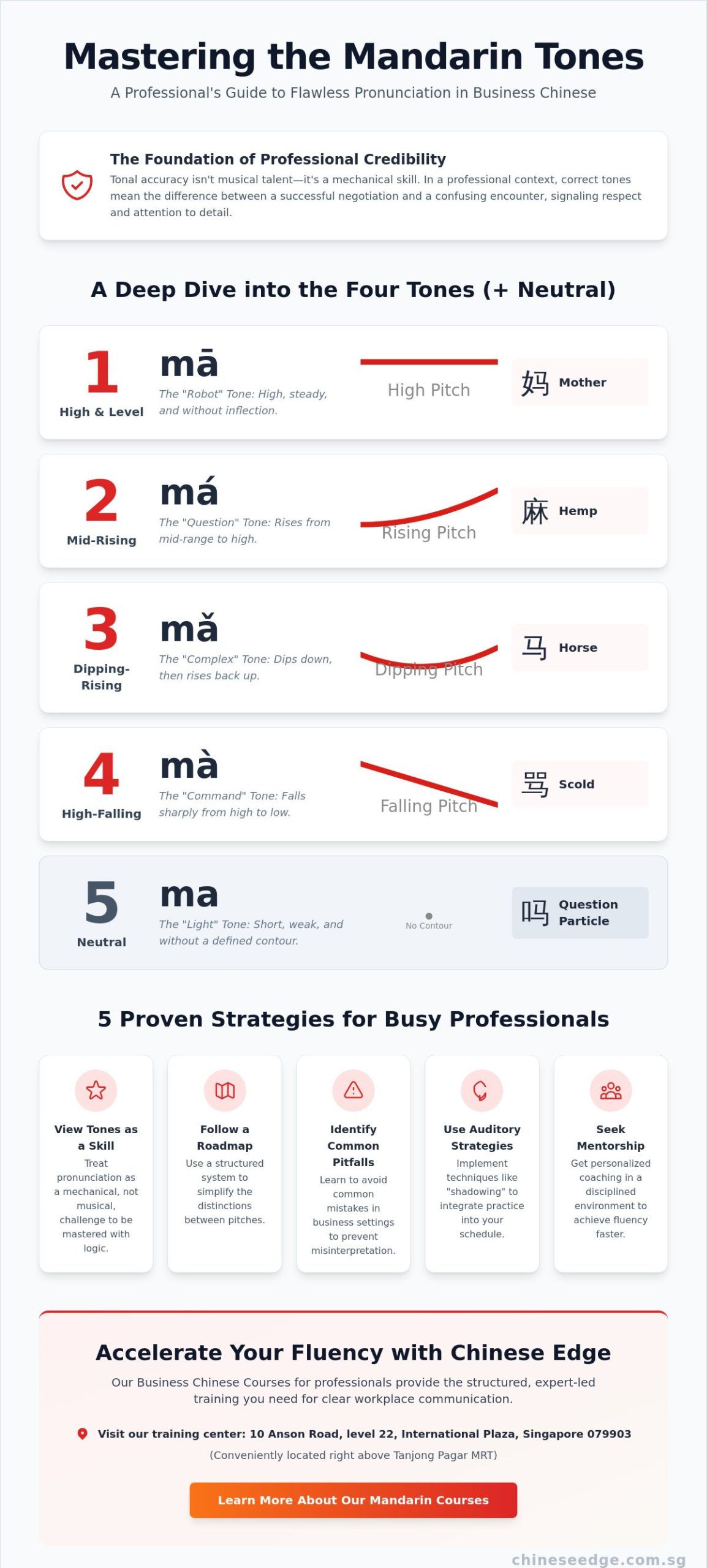
Mastering the mechanics of pronunciation requires a shift from intuitive listening to logical analysis. In Standard Mandarin, each syllable is assigned a specific pitch value that dictates its meaning. While many beginners feel overwhelmed by these variations, understanding how to master the four mandarin tones becomes significantly easier when you categorize them by their pitch “shape.” Rather than guessing, you can treat these sounds as a series of physical targets for your vocal cords.
- Tone 1 (High and Level): Often called the “Robot” tone, this requires you to maintain a high, steady pitch without any dipping or rising. It stays at the top of your natural range.
- Tone 2 (Rising): This mimics the inflection used in English when asking a surprised question, such as “What?” It starts at a middle pitch and moves quickly upward.
- Tone 3 (Falling-Rising): This is the “Dipping” tone. It starts mid-low, drops to your lowest possible register, and then rises. In natural conversation, the rise is often subtle, but the low dip is essential.
- Tone 4 (Falling): The “Assertive” tone starts at the top of your vocal range and drops sharply to the bottom. It sounds like a firm, brief command.
- The Neutral Tone: This is a light, de-emphasized sound. It doesn’t have a fixed pitch shape; instead, it takes its cue from the tone that precedes it, acting as a short “unstressed” syllable.
Visualizing Tone Marks and Pitch Contours
Logical learners often benefit from the 5-level pitch scale. This system maps the human voice from 1 (lowest) to 5 (highest). For example, Tone 1 stays at a consistent 5-5, while Tone 4 drops from 5 all the way to 1. Recognizing these contours in pinyin marks is a core component of any professional conversational chinese course. These visual aids help you internalize the physical effort required to produce each sound correctly, moving beyond guesswork toward consistent accuracy in every sentence.
Understanding Tone Sandhi: When Tones Change
One of the biggest hurdles for professionals is realizing that tones aren’t always static. “Tone Sandhi” refers to the specific rules where tones change based on the words surrounding them. The most famous example is the “Two Third Tones” rule. If two third-tone words appear together, the first one automatically changes to a second tone. Similarly, common words like “Yi” (one) and “Bu” (not) change their pitch depending on the tone of the following syllable. Understanding these shifts is vital for fluid workplace chinese communication. If you’re looking for a structured environment to practice these nuances, joining a mandarin course singapore at our center in International Plaza provides the expert feedback needed to master these transitions. Our mentors ensure you don’t just learn sounds in isolation but apply them correctly in real business contexts.
Tonal Pitfalls: Why “Ma” Can Mean “Mother” or “Horse” in a Business Pitch
In a professional environment, precision is your most valuable asset. While mispronouncing a vowel in English might result in a slight accent, a misplaced pitch in Mandarin can fundamentally alter your message. This is the primary reason why understanding how to master the four mandarin tones is a non-negotiable requirement for anyone serious about a business chinese course. Tones act as semantic filters; without them, the language loses its structural integrity.
The classic “Ma” example illustrates this risk perfectly. Depending on your pitch, the syllable “ma” can mean mother (mā), hemp (má), horse (mǎ), or scold (mà). While native speakers often use context to bridge small gaps, relying on their intuition during a high-stakes pitch is a risky strategy. If you’re presenting a strategy and accidentally use the fourth tone (mà) instead of the first, you might sound like you’re scolding your audience rather than discussing a concept. These nuances are exactly what we focus on during our chinese for professionals sessions at International Plaza.
Business-specific blunders can be even more consequential. A common mistake involves the words for “buy” (mǎi) and “sell” (mài). The only difference is that “buy” uses the dipping third tone, while “sell” uses the sharp, falling fourth tone. If you confuse these during a trade discussion, you’re not just making a pronunciation error; you’re miscommunicating the entire nature of the transaction. Similarly, mistaking “wèn” (to ask) for “wěn” (to kiss) can lead to significant social awkwardness in a corporate setting. If you do make a mistake, don’t panic. Simply pause, offer the correct pronunciation with a confident smile, and continue your point. Professionalism is often found in how you handle the recovery.
High-Stakes Vocabulary Mistakes
Financial terminology and corporate titles require absolute tonal accuracy to maintain authority. Mistaking a “Zhǔrèn” (Director) for “Zhūrén” (Pig Man) because of a flat tone is an avoidable error that can damage rapport. One misplaced tone can pivot a discussion from a mutual agreement to a state of total confusion or unintended conflict. When you learn chinese with a focus on business, you’re learning to protect your professional reputation through vocal discipline.
Listening Mastery: Hearing the Difference
You can’t produce a sound correctly if your ear hasn’t been trained to recognize it first. This is where minimal pair drills become essential. These exercises involve listening to two words that are identical except for their tone, forcing your brain to distinguish between the rising and falling contours. Utilizing consistent native speaker feedback in a structured mandarin course is the fastest way to calibrate your hearing. At our center at 10 Anson Road, level 22, International Plaza, Singapore 079903, located right above Tanjong Pagar MRT, we emphasize these auditory drills to ensure your workplace chinese communication is both accurate and authoritative.
5 Proven Strategies for Busy Professionals to Master Tones
Mastering a language while managing a demanding career requires a focus on efficiency over volume. You don’t need hours of repetitive drilling; you need high-impact methods that respect your schedule. If you want to know how to master the four mandarin tones, you must treat the process as physical training for your vocal cords. By applying these five strategies, you can integrate tonal practice into your daily routine without sacrificing productivity.
- The Physical Movement Technique: Use your hand or head to trace the pitch contour as you speak. Moving your hand upward for the second tone or downward for the fourth creates a “muscle memory” link between your body and your voice.
- Focus on Tone Pairs: In real conversation, words don’t exist in isolation. Practicing “tone pairs” (two-syllable combinations) helps you master the transitions between different pitches, which is the secret to a natural flow in workplace chinese communication.
- Exaggerate to Calibrate: During practice, make your tones 20% more dramatic than necessary. This theatrical approach ensures that when you’re in a relaxed business meeting, your tones remain distinct rather than flattening out.
- Record and Compare: Use your phone to record yourself during your commute. Comparing your recording to a native speaker’s audio allows you to identify subtle pitch gaps that you might miss while speaking in real-time.
- Enroll in a Structured Program: Self-study often leads to plateauing. A structured business chinese singapore program provides the logical progression and expert oversight needed to reach professional fluency.
The Shadowing Technique
Shadowing involves listening to a native speaker and repeating what they say with as little delay as possible. This isn’t just about repeating words; it’s about mimicking the rhythm, volume, and pitch of the entire sentence. For the busy Tanjong Pagar professional, short 10-minute bursts of shadowing during a commute or a lunch break can lead to significant improvements. It trains your brain to process how to master the four mandarin tones as part of a melodic sentence structure rather than a series of disconnected rules.
Leveraging Professional Coaching
While mobile apps are useful for vocabulary, they frequently fail to detect subtle tonal errors or “Tone Sandhi” shifts. There is no substitute for the immediate, nuanced feedback provided by a native-speaking instructor. Professional mandarin classes singapore bridge the gap between academic theory and real-world application. At our center at 10 Anson Road, level 22, International Plaza, Singapore 079903, located right above Tanjong Pagar MRT, we provide the disciplined environment required to refine your pronunciation for the boardroom.
If you’re ready to move beyond basic phrases and achieve true tonal precision, consider exploring our Adult Conversational Mandarin Course to accelerate your professional growth.
Accelerate Your Fluency at Chinese Edge Singapore
While the strategies discussed in this guide provide a solid foundation, achieving professional-grade accuracy requires a partner who understands the nuances of executive communication. At Chinese Edge, we specialize in helping individuals discover exactly how to master the four mandarin tones through a results-oriented methodology. We recognize that for a professional, time is the most limited resource. Our programs are designed to move you from hesitation to confidence with systematic efficiency.
Our “Expert Mentor” approach sets us apart from generic language apps or casual learning groups. We work with native instructors who are specifically trained to teach adult learners within a corporate framework. This ensures that your business chinese course focuses on the vocabulary and tonal precision required for high-stakes meetings and international trade. By learning in an environment that mirrors your professional reality, you internalize the language faster and more effectively.
We maintain small group sizes to ensure every student receives maximum speaking time. This allows for immediate, real-time tonal correction, which is essential for preventing bad habits from becoming permanent. For organizations looking to upskill their staff, our corporate mandarin training offers customized solutions that align with your specific industry goals, ensuring your team can navigate the Chinese market with absolute authority.
Our Training Center at International Plaza
Our physical presence is strategically located at 10 Anson Road, level 22, International Plaza, Singapore 079903. This puts our center right above Tanjong Pagar MRT, making it an ideal location for professionals working in the Central Business District. Whether you prefer to attend a session during your lunch hour or immediately after work, our facility provides a sophisticated, professional environment designed for focused adult education. The convenience of our location ensures that your mandarin class singapore fits seamlessly into your workday.
Join a Community of Professional Learners
Learning a language is more effective when you’re surrounded by like-minded peers. By participating in our learn chinese programs, you’ll join a community of executives and entrepreneurs who are also navigating the complexities of the global market. We understand that your schedule can be unpredictable. That’s why we offer flexible online and in-person hybrid options, ensuring that your progress in understanding how to master the four mandarin tones never stalls due to business travel or late meetings.
If you’re ready to transform your workplace chinese communication and speak with the authority that tonal mastery provides, it’s time to take the next step. Book your trial lesson at Chinese Edge today and experience our systematic, professional approach to fluency firsthand.
Elevate Your Global Career with Tonal Precision
Mastering the nuances of pitch is a commitment to professional excellence. You’ve learned that tones are the structural foundation of the language, and with a logic-based approach, they become a manageable skill rather than a source of anxiety. By replacing guesswork with the systematic techniques used by experts, you ensure your message is received with the respect it deserves in the boardroom. Understanding how to master the four mandarin tones provides you with a distinct competitive advantage in the 2026 business landscape. It’s not just about learning words; it’s about commanding the language with authority.
At Chinese Edge, we’re dedicated to your success. Our native-speaking instructors provide the immediate feedback necessary to refine your pronunciation within our specialized curriculum for adult professionals. Located right above Tanjong Pagar MRT at International Plaza, our center offers the disciplined environment you need to reach your goals. We provide the tools and support to turn your linguistic objectives into tangible professional results.
Master Mandarin Tones with Our Professional Courses at Tanjong Pagar
Start your journey toward fluency today and begin communicating in every business meeting with absolute confidence.
Frequently Asked Questions
Is it possible for an adult to master Mandarin tones?
Yes, adults can absolutely achieve tonal mastery by utilizing their analytical skills to treat pitch as a mechanical system. While children learn through passive immersion, professionals benefit from structured methodologies that break down the physical production of sound. By focusing on the logic of how to master the four mandarin tones, you can overcome the psychological barriers that often hinder older learners and achieve professional clarity.
How long does it take to get the four tones right?
Most dedicated learners can accurately recognize and produce individual tones within three to six months of consistent study. However, achieving automaticity in complex sentences typically requires longer, disciplined practice through a structured mandarin course. The timeline depends heavily on the frequency of your feedback from native-speaking instructors who can correct subtle deviations before they become ingrained habits.
Can I learn Mandarin without learning the tones?
It’s impossible to achieve functional fluency without learning tones because they’re fundamental to word meaning. In Standard Chinese, the pitch of a syllable is as important as the consonants and vowels. If you ignore tones, you risk significant miscommunication in workplace chinese communication, as your listeners will struggle to distinguish between unrelated concepts that share the same pinyin spelling.
What is the hardest Mandarin tone for English speakers to learn?
English speakers often find the second rising tone and third dipping tone the most challenging to distinguish and produce. The second tone requires a rapid upward shift that feels counterintuitive, while the third tone requires a deep vocal dip that many beginners cut short. Mastering these requires specific auditory drills and physical cues to ensure your pitch reaches the necessary targets for clear communication.
Are tones different in Business Mandarin compared to Conversational Mandarin?
The tones themselves don’t change between business and conversational contexts, but the stakes for accuracy are much higher in professional settings. While a casual listener might use context to guess your meaning, a business partner expects the precision that comes from a business chinese course. Tonal accuracy in the boardroom projects an image of discipline, attention to detail, and cultural respect.
How can I practice my tones while working in Singapore?
You can integrate practice into your daily routine by shadowing audio recordings during your commute to Tanjong Pagar. Many of our students also practice by ordering food in Mandarin or engaging in brief exchanges with colleagues. For those working in the CBD, attending a mandarin class singapore at our International Plaza center allows you to refine your skills during lunch hours or immediately after work.
Why do I keep forgetting the tones of words I already know?
Forgetting tones often happens when you learn vocabulary in isolation rather than in tone pairs. Your brain finds it easier to remember the melodic relationship between two syllables than the individual pitch of a single word. Transitioning your study to focus on common two-syllable combinations will significantly improve your long-term retention and help you understand how to master the four mandarin tones in real-world sentences.
What is the neutral tone and when should I use it?
The neutral tone is a short, light, and unstressed syllable that doesn’t have a fixed pitch contour. It’s used in specific grammatical markers and the second syllable of many common word pairs. You should use it when the dictionary indicates no tone mark, ensuring you don’t over-emphasize the syllable, which helps maintain a natural and professional speech rhythm.
Disclaimer
Disclaimer
The Chinese articles on this website are provided for general information and learning purposes only. While we strive for accuracy, we make no guarantees regarding completeness or reliability. The content does not constitute professional advice, and we are not liable for any loss arising from its use. External links or third-party content are for reference only. By using this website, you agree to this disclaimer.