

What if the 2,200 hours of study often cited by linguistic experts isn’t the barrier you think it is for professional growth? You likely wonder, is learning mandarin hard for adults who are already balancing tight corporate schedules and international travel? It’s natural to feel intimidated by the four tones or the rigorous HSK 3.0 standards arriving in July 2026. We recognize the fear of sounding “off” during a high-stakes negotiation or feeling overwhelmed by the sheer volume of characters.
The reality is that adults have a distinct advantage in mastering the logical, conjugation-free structure of the Chinese language. This guide will demonstrate how you can achieve conversational fluency for business meetings and social settings without spending years in a classroom. We’ll explore a results-oriented approach through our adult conversational mandarin course and business mandarin course at 10 Anson Road, level 22, International Plaza, Singapore 079903, conveniently located right above Tanjong Pagar MRT. Discover how workplace chinese communication can become your next competitive edge.
Key Takeaways
- Understand the distinction between linguistic distance and actual complexity to see why Mandarin grammar is often simpler than European languages.
- Discover why the answer to is learning mandarin hard for adults depends more on using a structured methodology than on natural talent or age.
- Learn how to leverage your professional background and cognitive maturity to master logical patterns and business vocabulary more efficiently.
- Explore practical micro-learning strategies that allow busy professionals to integrate language acquisition into a demanding corporate schedule.
- Identify the critical role of native-speaker feedback in navigating the HSK 3.0 standards and preventing the development of fossilized speaking errors.
The Myth of the ‘Hardest Language’: Mandarin vs. Reality
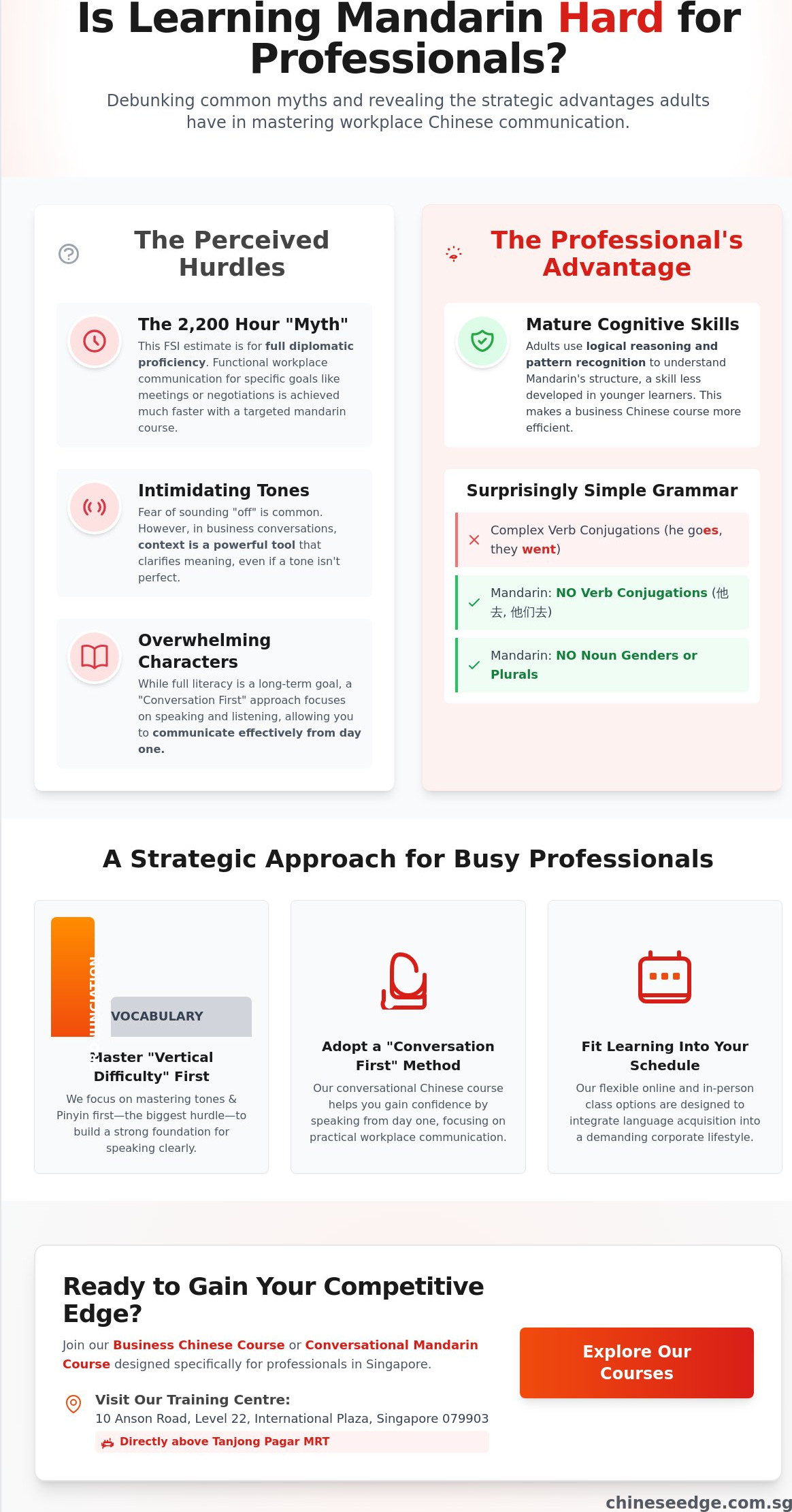
Professionals often hesitate to begin their linguistic journey due to the daunting reputation of Chinese. The U.S. Foreign Service Institute (FSI) classifies Mandarin as a Category IV language, suggesting it takes native English speakers roughly 2,200 hours to reach professional working proficiency. However, these statistics can be misleading for those seeking functional workplace chinese communication. When asking is learning mandarin hard for adults, you must distinguish between linguistic distance and functional difficulty. The “distance” refers to how different the language is from your native tongue, but it doesn’t mean the logic behind it is impossible to grasp.
To better understand this concept, watch this helpful video:
While Mandarin is linguistically distant from English, it’s not inherently more complex. In fact, the process of second-language acquisition is often faster for adults who use their logical reasoning to master Mandarin’s predictable structures. The perceived “hardness” usually stems from outdated rote-learning techniques that prioritize character writing over verbal fluency. By adopting a “Conversation First” methodology, you can bypass these academic bottlenecks and start speaking in weeks. If you choose a structured mandarin course, you’ll find that the language is built on a highly logical framework that rewards consistent, strategic practice.
Vertical vs. Horizontal Difficulty in Mandarin
Vertical difficulty describes the initial phonetic hurdle of mastering the four tones and Pinyin. This stage requires precision but is limited in scope; once you master the sounds, you’ve cleared the biggest barrier to entry. Horizontal difficulty refers to the massive volume of characters and vocabulary required for full academic literacy. If you are a professional, you should prioritize vertical mastery first. Our conversational chinese course focuses on these high-impact speaking skills, allowing you to navigate business meetings without getting bogged down by the 5,400 words required for the new HSK 3.0 Level 6 standards arriving in July 2026.
Why Your Native Language Influences Your Perspective
English speakers often find Mandarin grammar surprisingly intuitive. There are no noun genders, no articles, and no complex pluralizations to track. Living and working in Singapore provides a distinct advantage, as you can practice your skills immediately at our center at 10 Anson Road, level 22, International Plaza, Singapore 079903, located right above Tanjong Pagar MRT. Mandarin’s total lack of verb conjugations serves as a major time-saver for busy adults. If you enroll in a business chinese course that leverages these grammatical shortcuts, you’ll find that is learning mandarin hard for adults becomes a question of methodology rather than difficulty.
Tones and Characters: Breaking Down the Hurdles
Many professionals ask, is learning mandarin hard for adults when they first encounter the four tones. It’s a valid concern, as the melodic nature of the language is entirely different from the stress-timed rhythm of English. However, tones shouldn’t be a source of paralysis. In a professional setting, context often bridges the gap if a tone is slightly off. If you are discussing “market share” (shìchǎng fèn’é), your listener won’t mistake your meaning even if your pitch isn’t perfect. For a deeper dive into the nuances of linguistic difficulty, you might explore the analysis on whether Is Chinese difficult to learn? by industry experts.
Mastering the Four Tones Without the Stress
The secret to tonal accuracy isn’t found in a textbook; it’s found in your ears. We advocate for “shadowing,” a technique where you mimic the rhythm and pitch of native speakers in real time. This builds muscle memory quickly. Most conversational chinese courses now prioritize ear training because it reflects how we naturally acquire speech. By focusing on the melody of full sentences rather than isolated syllables, you’ll find your pronunciation becomes more fluid and less forced during workplace chinese communication.
The Reality of Learning Characters in 2026
In 2026, the definition of “writing” has fundamentally changed. While traditional schools might insist on hours of handwriting practice, modern professionals only need character recognition. If you can recognize a character, you can type it using Pinyin on your smartphone or laptop. This digital bridge removes the need to memorize every stroke of a complex radical, making the language far more accessible than it was a decade ago.
The “Rule of 500” is a game-changer for adult learners. Research suggests that recognizing the 500 most common characters allows for roughly 80% comprehension of daily written Chinese. This is a far more attainable goal than the 11,000 words required for the highest tiers of the HSK 3.0 framework. By understanding the logic of radicals, which act as semantic clues, you can decode new characters without constant dictionary lookups. For example, characters related to liquid often share the “water” radical, providing an instant hint about the word’s meaning.
Our mandarin course at 10 Anson Road, level 22, International Plaza, Singapore 079903, right above Tanjong Pagar MRT, is designed to help you master these high-frequency characters while maintaining a focus on immediate verbal application. If you want to see how these characters apply to your specific industry, consider exploring our corporate mandarin training options.
Why Adults Have an Advantage in Learning Mandarin
While many assume that the window for language acquisition closes after childhood, the reality is that the answer to is learning mandarin hard for adults is often a resounding ‘no’ when approached with a professional mindset. Adults possess a cognitive maturity that allows for superior pattern recognition and logical analysis compared to younger learners. You don’t just absorb sounds; you decode systems. This analytical capability is exactly what’s needed to master a language that functions more like a logical puzzle than a chaotic set of rules. Our students find that their disciplined approach to career growth translates perfectly into the structured environment of a mandarin course.
The motivation behind your study also plays a critical role. Unlike students in a general classroom, professionals have a clear “why.” Whether it’s closing a deal in Shanghai or managing a local team in Singapore, this goal-oriented focus drives faster results. You aren’t just learning a language; you’re acquiring a high-value business tool. This clarity of purpose allows adults to filter out irrelevant information and focus on the high-impact vocabulary that actually moves the needle in their careers.
The Logical Simplicity of Mandarin Grammar
Mandarin grammar is often the most pleasant surprise for adult learners. It functions like Lego blocks; it’s modular and highly predictable. You won’t find gendered nouns, complex plurals, or the endless verb conjugations that plague European languages. There’s no need to memorize past, present, or future tense variations for every verb. This math-like structure appeals directly to the professional brain. Once you understand the basic word order, you can swap in new vocabulary without worrying about grammatical “agreement” errors that often make is learning mandarin hard for adults feel like an uphill battle in other languages.
Leveraging Your Professional Background
Professionals don’t start from zero. You already understand the nuances of corporate culture, negotiation, and social etiquette. By enrolling in specialized business chinese courses, you can map new Mandarin terms directly onto your existing expertise. Instead of learning “The apple is red,” you’ll start with “The market is expanding.” This contextual learning ensures immediate workplace utility.
In the Singaporean corporate landscape, the social ROI of Mandarin is immense. Being able to exchange pleasantries or navigate a business dinner in Mandarin builds trust and rapport that English alone cannot achieve. If you’re ready to gain this competitive edge, visit us at 10 Anson Road, level 22, International Plaza, Singapore 079903. We’re located right above Tanjong Pagar MRT, making it easy to transition from your office to your next breakthrough in workplace chinese communication.
Strategies for Learning Mandarin While Working Full-Time
For most professionals in Singapore, the primary concern isn’t cognitive ability but time management. When you ask, is learning mandarin hard for adults, you’re often really asking if it’s possible to fit a complex language into a sixty-hour work week. The answer lies in a “Micro-Learning” strategy. Instead of waiting for a massive block of free time that never arrives, successful learners integrate Mandarin into existing gaps. A fifteen-minute commute on the East-West Line is the perfect window to review Pinyin or listen to business-centric podcasts. By breaking the language down into modular segments, you maintain steady progress without burning out.
Setting realistic milestones is vital for long-term retention. Rather than aiming for immediate total literacy, focus on functional wins, such as introducing yourself confidently in a boardroom or navigating a social dinner. This goal-oriented approach ensures that every hour you spend studying provides a direct return on investment in your professional life.
Maximizing Your Time in Singapore
Logistics can make or break your commitment to a new language. Attending a mandarin course that fits seamlessly into your workday is a game-changer. Our training center is strategically located at 10 Anson Road, level 22, International Plaza, Singapore 079903, which is situated right above Tanjong Pagar MRT. This central location allows you to transition from your office to the classroom in minutes. Many of our students find that a post-work session helps them decompress from the corporate day while gaining a high-value skill in a professional, focused environment.
The Role of Online Mandarin Classes
If your role requires frequent regional travel or has an unpredictable schedule, online mandarin classes in Singapore offer the necessary flexibility. Modern virtual platforms have evolved far beyond simple video calls; they now feature interactive whiteboards and real-time feedback loops that mirror the in-person experience. A hybrid approach is often the most effective for retention, combining the convenience of virtual lessons during busy weeks with the deep immersion of physical meetups when your schedule allows. This adaptability ensures that your progress never stalls, regardless of your professional commitments.
If you’re ready to see how a structured path can simplify your journey, you can explore our adult chinese courses designed specifically for the Singaporean corporate landscape.
The Path to Fluency: Why a Structured Course Matters
Many professionals ask, is learning mandarin hard for adults when they are trying to teach themselves via mobile apps. While tools like HelloChinese or Duolingo are excellent for building basic vocabulary, they often fall short in a professional context. These platforms lack the real-time feedback necessary to correct subtle tonal shifts or explain the cultural nuances required for high-stakes business negotiations. If you rely solely on automated tools, you risk developing “fossilized errors.” These are incorrect linguistic habits that become deeply ingrained and difficult to correct later in your journey. A structured mandarin course provides the expert oversight needed to ensure your foundation is accurate from day one.
A curated curriculum saves you hundreds of hours of trial and error. Instead of guessing which characters are relevant, you follow a path designed for immediate workplace utility. This methodical approach is especially important as we move toward the full implementation of HSK 3.0 in July 2026. Transitioning from learning chinese as a hobby to speaking it in a boardroom requires a disciplined framework that only a professional institution can provide. Our instructors, all with extensive linguistic backgrounds, act as mentors who bridge the gap between academic theory and practical application.
The Chinese Edge Methodology
Our approach is built specifically for the adult brain. We move away from the rote memorization used in schools; instead, we focus on logical pattern recognition and practical conversational skills. By keeping our classes in small group settings, we ensure that every student receives individual attention and ample time to practice speaking. This environment builds the confidence you need to use Mandarin during corporate presentations or social networking events. For organizations, we also provide customized corporate mandarin training solutions that align with specific industry goals and team requirements.
Taking the First Step at International Plaza
Success in language learning is often a result of the environment you choose. We invite you to visit our training center at 10 Anson Road, level 22, International Plaza, Singapore 079903. Located right above Tanjong Pagar MRT, our center offers a professional and sophisticated atmosphere designed for executive learners. Here, you can consult with our experts to map out your 2026 linguistic goals. Whether you are starting from zero or looking to refine your business communication, we provide the structured path to move from a beginner to a confident speaker in months, not years. Is learning mandarin hard for adults? Not when you have a dedicated partner and a proven methodology to guide you through every step of the process.
Master Your Next Professional Milestone
We’ve explored how Mandarin’s logical structure and the shift toward digital literacy in 2026 have redefined the acquisition process. Adults don’t need to fear the “hardest language” label when they leverage their cognitive maturity and existing professional context. By focusing on high-frequency characters and verbal fluency, the path to workplace communication becomes clear and manageable. Many professionals realize that the question is learning mandarin hard for adults is less about inherent difficulty and more about choosing a structured methodology that prioritizes practical application over rote memorization.
Our training center at 10 Anson Road, level 22, International Plaza, Singapore 079903, offers a premium environment located right above Tanjong Pagar MRT. With native-speaking instructors and a curriculum tailored for corporate success, we provide the steady support you need to achieve measurable results. Don’t let outdated myths stall your career growth. Enroll in our Adult Conversational Mandarin Course and start your journey today! We look forward to being your partner in achieving conversational fluency and professional excellence.
Frequently Asked Questions
Is it harder to learn Mandarin after age 40?
It is not necessarily harder to learn Mandarin after age 40 because adults possess superior analytical skills compared to younger learners. While children excel at mimicry, adults are better at understanding the logical framework of Mandarin grammar. When people ask is learning mandarin hard for adults in their 40s, they are often surprised to find that their professional discipline helps them master the language faster than students who lack a clear career objective.
How many hours a week should an adult study Mandarin to see progress?
Aim for three to five hours of engagement per week to see consistent progress. This total should include your formal lessons and short “micro-learning” sessions during your daily commute. Because adult learners have significant corporate commitments, focusing on high-impact vocabulary that you can use immediately in your next business meeting is the most efficient way to maintain momentum.
Can I learn to speak Mandarin without learning to write characters?
Yes, you can achieve high levels of verbal fluency by prioritizing Pinyin and character recognition over manual handwriting. In a modern professional environment, most workplace chinese communication happens via digital typing. By focusing on recognizing the 500 most frequent characters, you can navigate roughly 80% of daily written Chinese without ever needing to memorize complex stroke orders for handwriting.
What is the most difficult part of Mandarin for English speakers?
The four tones and the character system are typically the most challenging aspects for native English speakers. Tones represent a “vertical” hurdle that requires precision during the early stages of a conversational chinese course. However, many find that is learning mandarin hard for adults only if they use outdated rote-learning methods rather than a modern approach that emphasizes ear training and contextual usage.
Is it better to learn Mandarin online or in a classroom setting?
The best choice depends on your professional schedule and preferred learning style. Classroom settings at our center at 10 Anson Road, level 22, International Plaza, provide deep immersion and the benefit of immediate social interaction right above Tanjong Pagar MRT. Online mandarin classes offer the flexibility required for regional travelers who must maintain their study rhythm while working outside of Singapore.
How long does it take to become conversationally fluent in Business Mandarin?
Achieving basic conversational fluency for business usually takes several months of structured, consistent study. While the FSI estimates 2,200 hours for full professional proficiency, a targeted business mandarin course allows you to bypass general vocabulary. You can master essential meeting etiquette and industry-specific terminology in a fraction of the time required for academic literacy.
Do I need a musical ear to master Mandarin tones?
You do not need a musical ear or any musical talent to master Mandarin tones. These tones are linguistic pitch markers relative to your own natural speaking range, not absolute musical notes. With consistent practice and feedback from native speakers, any professional can learn to distinguish and produce the four tones accurately in social and business settings.
What are the career benefits of learning Mandarin in Singapore?
Learning Mandarin in Singapore provides a significant competitive advantage in regional networking and trust-building. Our students often apply their skills immediately in the Tanjong Pagar commercial district to build rapport with clients. Proficiency in Mandarin opens doors to leadership roles that require managing cross-border teams or navigating complex negotiations in Chinese-speaking markets.
Disclaimer
Disclaimer
The Chinese articles on this website are provided for general information and learning purposes only. While we strive for accuracy, we make no guarantees regarding completeness or reliability. The content does not constitute professional advice, and we are not liable for any loss arising from its use. External links or third-party content are for reference only. By using this website, you agree to this disclaimer.