

What if the biggest barrier to your next high-stakes negotiation isn’t the contract terms, but the linguistic bridge you haven’t yet crossed? Mastering mandarin for business meetings is no longer just a competitive edge; it’s a strategic necessity in a global economy where China’s output is projected to reach $20 trillion in 2026. You’ve likely felt that sudden wave of anxiety when a room of native speakers switches to fast-paced jargon, leaving you nodding along while feeling completely lost.
It’s frustrating to have brilliant professional ideas but lack the specific workplace Chinese communication tools to express them clearly. This guide will empower you to lead discussions with authority and master the cultural etiquette needed to build genuine rapport with international partners. We’ll explore the core phrases and professional protocols that turn awkward silences into successful deals, ensuring you navigate every corporate interaction with total confidence.
Key Takeaways
- Learn the critical distinctions between social conversation and the formal register required to establish professional authority in corporate settings.
- Master the structured phrases and industry-specific terminology needed to lead mandarin for business meetings with precision and clarity.
- Understand the nuanced role of hierarchy and the concept of “Saving Face” to navigate high-stakes negotiations and build lasting partner rapport.
- Implement the “Scripting” method and targeted pre-meeting research to prepare for complex professional discussions with confidence.
- Discover how a structured learning approach led by native instructors provides a faster, more reliable path to fluency for busy professionals.
Mastering Mandarin for Business Meetings: Why Conversational Skills Aren’t Enough
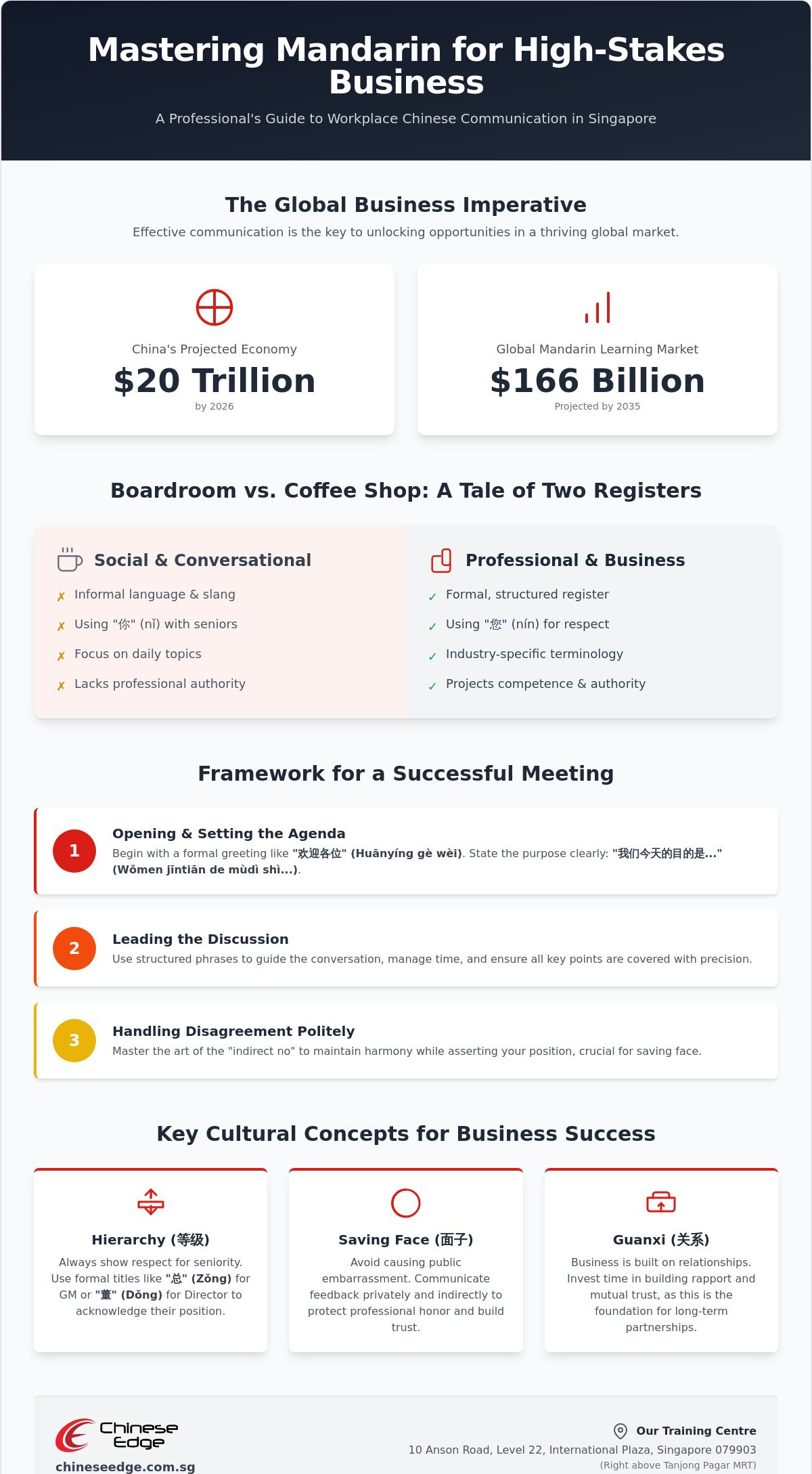
Ordering a meal at a local hawker center or chatting with a neighbor requires a functional level of language, but these social interactions don’t prepare you for the boardroom. In Singapore’s fast-paced trade environment, your ability to handle mandarin for business meetings serves as a direct indicator of your professional status and competence. While a basic conversational course provides a foundation, it lacks the formal register and specialized vocabulary necessary to influence stakeholders or navigate complex negotiations. Professional fluency in 2026 is about more than just being understood; it’s about projecting authority through precise linguistic choices.
To better understand how these professional phrases differ in a digital or face-to-face setting, watch this helpful video:
The Stakes of Workplace Chinese Communication
The global Mandarin learning market is projected to reach over $166 billion by 2035, reflecting the language’s critical role in international commerce. When you engage with partners from a $20 trillion economy, the stakes extend beyond simple data exchange. Effective communication is the bedrock of Guanxi, or relationship building. Using the correct honorifics and observing Chinese etiquette demonstrates a profound respect for your client’s culture, which often dictates the success of a long-term partnership. Conversely, a linguistic slip in a financial or legal context isn’t just embarrassing; it can lead to costly misunderstandings that jeopardize entire projects. Professionals who master this nuance find that doors open faster and trust is established earlier in the procurement process.
Identifying the Gap in Your Current Skills
Many adult learners realize too late that their casual language habits are undermining their professional image. A common mistake is using the informal “Ni” when addressing a senior executive instead of the respectful “Nin”. Casual particles and slang that work in a coffee shop can make you appear unprepared or disrespectful in a high-stakes environment. The transition from surviving a conversation to leading a meeting requires a systematic approach to learning. If you find yourself struggling to articulate complex strategies, a structured business chinese course can bridge that gap. Learning within the CBD at 10 Anson Road, level 22, International Plaza, ensures you are studying right above Tanjong Pagar MRT, making it convenient to move from your office to a professional training environment where you can practice the specific honorifics and industry terms that define a leader.
Essential Vocabulary and Phrases for Every Stage of a Meeting
Success in mandarin for business meetings depends on a structured linguistic framework. It isn’t enough to simply speak; you must direct the flow of information with precision. Using formal titles like “Zong” for General Manager or “Dong” for Director immediately acknowledges hierarchy and establishes your professionalism. This linguistic discipline ensures that everyone in the room understands their role and yours. Mastery of these power phrases allows you to move beyond passive listening and take an active role in shaping the outcome of professional discussions.
Opening and Setting the Agenda
The first few minutes of a meeting set the tone for the entire session. Begin with a formal greeting such as “Huanying ge wei” (Welcome everyone) to signal the start of the proceedings. Clarity is essential when stating the purpose of the gathering. Use the phrase “Women jintian de mu de shi…” (Our purpose today is…) to align all participants with the agenda. Establishing a clear roadmap prevents the discussion from drifting and demonstrates your capability as a leader. If you feel your opening remarks need more polish, a targeted business chinese course can help you practice these introductions until they become second nature.
Discussion, Redirection, and Polite Disagreement
Managing the middle section of a meeting requires tact, especially when you need to pivot the conversation. If you need to interrupt, do so respectfully by saying “Bu haoyisi, wo xiang bu chong yi xia” (Excuse me, I’d like to add…). This allows you to contribute without appearing aggressive. When expressing a different view, avoid direct “No” responses. Instead, use phrases that seek consensus, such as “Dajia dui ci you shenme yi jian?” (What are everyone’s views on this?). This approach maintains harmony while ensuring your professional perspective is heard. It’s a vital skill for anyone navigating workplace chinese communication in high-stakes environments.
Closing and Follow-Up Actions
A meeting only provides value if it results in clear action items. As the session concludes, summarize the key points by stating “Women lai zong jie yi xia…” (Let’s summarize…). This ensures there are no lingering misunderstandings about what was agreed upon. Be specific when assigning tasks; use the structure “Zhe jian shi jiao gei…” (This matter is assigned to…) to establish accountability. Finally, end on a high note with a formal closing like “Ganxie dajia de baogui yijian” (Thank you for your valuable opinions). This reinforces the relationship and leaves a lasting impression of your competence. For professionals working in the CBD, practicing these closing strategies at our center at 10 Anson Road, level 22, International Plaza, ensures you are ready for your next session right above Tanjong Pagar MRT.
Navigating Business Etiquette: Hierarchy, ‘Saving Face,’ and the Indirect No
Etiquette often speaks louder than words in high-stakes environments. While mastering the specialized vocabulary for mandarin for business meetings is vital, understanding the cultural undercurrents is what truly builds trust. In Chinese corporate culture, the meeting room is a stage where hierarchy and respect are performative. Seating arrangements, for instance, are rarely accidental. The most senior representative typically sits in the center of the table or directly opposite the host. Observing these nuances prevents you from inadvertently causing offense before the first word is even spoken. Speaking order also follows this hierarchical structure; it’s standard practice to let the highest-ranking individuals open the discussion before subordinates contribute.
The Concept of ‘Mianzi’ in the Meeting Room
“Mianzi,” or Face, is the currency of professional relationships. Giving face involves publicly acknowledging a partner’s contribution or expertise. You can build significant rapport by praising a counterparty’s recent project success during the opening remarks. Conversely, taking face away by correcting a superior’s mistake in front of others can permanently damage a deal. It’s better to discuss discrepancies privately during a break. To foster a sense of partnership, lean into collective language. Using “Women” (We) instead of “Wo” (I) aligns your objectives with their interests, signaling that you value the partnership over individual gain. This shift in register is a subtle but powerful tool in workplace chinese communication.
Decoding Non-Verbal Cues and Indirect Communication
Western business culture often prizes directness, but professional Mandarin is frequently nuanced and indirect. You’ll often hear the phrase “Wo men zai yan jiu yi xia” (We will study it further). While this sounds like a positive next step, it’s frequently a “Soft No” or a sign that the proposal lacks internal support. Recognizing this allows you to pivot the conversation and find middle ground without forcing your partner into an uncomfortable direct refusal. This ability to read between the lines is what separates a novice from a seasoned professional.
Silence also plays a strategic role. In many negotiations, a long pause isn’t an invitation to keep talking; it’s a sign of deliberate consideration. Rushing to fill that silence can make you look anxious or ill-prepared. Similarly, don’t overlook the importance of informal chatter before and after the official session. These moments are where the real “Guanxi” is built. If you’re looking to refine these social nuances, our training center at 10 Anson Road, level 22, International Plaza, offers a convenient location right above Tanjong Pagar MRT to practice these cultural strategies. Mastering these subtle cues ensures you aren’t just participating in mandarin for business meetings, but actively steering them toward your desired outcome.
How to Prepare for High-Stakes Workplace Chinese Communication
Preparation is the difference between a productive session and a missed opportunity. In 2026, many professionals operate in a hybrid environment where virtual mandarin for business meetings are the standard. These digital interactions require even greater clarity because non-verbal cues like body language are often obscured by a screen. To succeed, you must move beyond general vocabulary and focus on the specific terminology relevant to your industry, whether you’re in fintech, logistics, or legal services. Mastery of these niche terms demonstrates that you haven’t just learned the language; you’ve mastered the professional context.
One highly effective technique is the ‘Scripting’ method. Instead of relying on spontaneous translation, write out your opening statement and your concluding summary in advance. This ensures you start with authority and end with a clear call to action, even if the middle of the discussion becomes fast-paced. If you want to refine these scripts with a native speaker before your next big presentation, you can enroll in a business chinese course to gain immediate feedback on your tone and phrasing.
The Face-Saving Clarification Framework
Don’t fear asking for clarification; it’s a sign of professional diligence, not a lack of skill. You can use a humble opening like “My Mandarin is still improving” as a strategic tool to encourage the speaker to slow down. It’s always better to pause and confirm understanding than to proceed based on an incorrect assumption. Use the phrase “Nin de yisi shi…ma?” (Do you mean…?) to restate their point in your own words. If a sentence was too fast, a polite “Qing nin zai shuo yi bian?” (Could you please say that again?) is perfectly acceptable and shows you’re genuinely engaged in the conversation.
Preparation Checklist for Singapore Professionals
Before entering the boardroom at International Plaza or joining a high-stakes video call, follow this checklist to ensure you’re ready for workplace chinese communication:
- Review the participant list: Memorize formal titles and surnames to ensure you address everyone with the correct level of respect.
- Prepare bilingual slides: Having key data points and executive summaries in both English and Mandarin provides a visual safety net for all participants.
- Define your core objective: Write a single Mandarin sentence that defines your goal for the meeting. Keeping this objective front-of-mind helps you stay focused during complex negotiations.
This level of preparation turns a daunting task into a strategic advantage. Our instructors at 10 Anson Road, level 22, International Plaza, specialize in helping CBD professionals prepare for these specific scenarios. Since our center is located right above Tanjong Pagar MRT, you can easily drop in for a session to dry-run your meeting remarks before the actual event, ensuring you lead your next mandarin for business meetings with absolute poise.
Elevate Your Career with a Targeted Business Chinese Course in Singapore
Self-study often lacks the situational pressure and linguistic nuance required for high-stakes professional environments. While digital apps can help with basic vocabulary, they don’t simulate the dynamic and unpredictable flow of mandarin for business meetings. A structured business chinese course provides the disciplined environment needed to bridge the gap between basic comprehension and professional leadership. You’ll benefit from real-time feedback that corrects subtle tonal errors and etiquette missteps before they become ingrained habits. This methodical approach ensures you’re prepared to handle the complexities of 2026’s global trade landscape with absolute poise.
For organizations aiming to strengthen their regional presence, corporate mandarin training serves as a strategic investment. These customized programs focus on the specific linguistic needs of your industry, ensuring your team can navigate workplace chinese communication without relying on external translators. Learning from native-speaking instructors who understand the nuances of corporate culture gives you a distinct advantage in building long-term partner rapport. This tailored training transforms language skills into a functional business tool that drives results.
Why Choose Chinese Edge for Your Professional Growth?
Our school functions as an expert mentor for CBD professionals. We specialize exclusively in adult Chinese education, focusing on conversational and business applications. Our curriculum is designed to move beyond academic theory, providing a practical bridge between international proficiency benchmarks and real-world boardroom scenarios. By maintaining small group settings, we maximize your speaking time and ensure you receive personalized attention from our experienced linguistic team. This results-oriented approach helps you achieve fluency faster than traditional classroom methods.
Start Your Journey at International Plaza
Convenience is critical for busy professionals working in the city. Our training center is located at 10 Anson Road, Level 22, International Plaza, Singapore 079903. Since we’re situated right above Tanjong Pagar MRT, you can easily transition from your office to your lesson without a long commute. We offer flexible evening and weekend classes to accommodate demanding work schedules, ensuring that your professional development doesn’t come at the expense of your daily responsibilities.
If you’re ready to master mandarin for business meetings and advance your career, contact us today. We provide individual consultations to help you select the program that best fits your professional objectives and current proficiency level. Let us be your partner in achieving the fluency needed to lead and succeed in the modern business world.
Secure Your Professional Future in the Global Market
Managing the complexities of international trade requires more than just a passing knowledge of vocabulary. You now understand that success in mandarin for business meetings is built on a foundation of formal register, cultural intelligence, and meticulous preparation. By mastering the art of “Saving Face” and utilizing structured clarification frameworks, you transform from a passive participant into a respected leader. These skills don’t just facilitate communication; they build the trust necessary for high-stakes negotiations and long-term partnerships.
At Chinese Edge, we specialize in helping professionals bridge the gap between classroom learning and boardroom excellence. Our expert native teachers provide the academic rigor and practical insights needed to excel in Singapore’s competitive commercial landscape. Whether you require customized corporate mandarin training or individual coaching, our center at 10 Anson Road, level 22, International Plaza, Singapore 079903, offers the perfect environment right above Tanjong Pagar MRT.
Don’t let a language barrier limit your professional growth. Book Your Business Mandarin Consultation at Chinese Edge today and take the first step toward linguistic authority. We’re here to support your journey every step of the way, ensuring you lead every interaction with total confidence.
Frequently Asked Questions
What is the most important Mandarin phrase to know in a business meeting?
The most critical phrase to master is “Qing duo zhi jiao,” which translates to “Please guide me” or “I look forward to your advice.” Using this expression during an introduction signals humility and respect for your partner’s expertise. It immediately builds rapport by acknowledging their seniority and experience. This small linguistic gesture can significantly influence the atmosphere of mandarin for business meetings, paving the way for a more collaborative and productive discussion.
How do I politely disagree with a senior Chinese partner?
Direct disagreement should be avoided to prevent “loss of face” for your partner. Instead, use a softening phrase like “Wo li jie nin de yi jian, dan shi…” (I understand your opinion, but…). This acknowledges their perspective before you present an alternative view. By framing your disagreement as a request for further study or a different angle, you maintain professional harmony while ensuring your strategic concerns are heard without appearing confrontational.
Is it better to use a translator or speak basic business Mandarin?
Speaking basic business Mandarin is often superior for building trust and personal connections. While a translator is necessary for complex legal or technical details, making the effort to speak the language directly shows commitment and respect. Partners appreciate the initiative, which can lead to more favorable negotiation outcomes. Many professionals find that a structured course provides the foundational skills needed to handle these essential social and opening segments of a meeting.
How long does it take to learn Mandarin for business meetings?
Achieving functional proficiency for professional settings typically takes three to six months of consistent, structured study. While total fluency takes longer, focusing on high-frequency workplace chinese communication allows you to participate in meetings much sooner. Your progress depends on the intensity of your training and your opportunity to practice. Our methodical programs are designed to help busy adults reach these milestones efficiently through targeted, results-oriented lessons that focus on real-world application.
What should I do if I don’t understand what is being said in a meeting?
If you lose the thread of a conversation, use a polite request for repetition like “Qing nin zai shuo yi bian?” (Could you please say that again?). It is better to clarify immediately than to proceed with incorrect information. You can also summarize what you did understand to confirm accuracy. This demonstrates your professional diligence and ensures that all parties remain aligned on the meeting’s core objectives and subsequent action items.
Are there specific business etiquette rules for virtual Mandarin meetings?
Virtual meetings require the same hierarchical respect as in-person sessions, starting with logging in early to show punctuality. Always use formal titles when addressing participants on camera to acknowledge their professional standing. Since digital platforms can obscure non-verbal cues, your verbal clarity becomes even more important. Ensure your background is professional and your audio is clear. These technical details reflect your overall competence and respect for the digital communication environment.
How can I improve my industry-specific Mandarin vocabulary quickly?
Rapid improvement comes from creating a bilingual glossary of the 50 most common terms used in your specific field. Reviewing industry-specific news in Mandarin and practicing the “Scripting” method for your upcoming presentations also accelerates progress. For the fastest results, targeted corporate mandarin training can provide you with a customized curriculum that focuses exclusively on the vocabulary and scenarios you encounter daily in your professional role.
Where can I find a business Chinese course in Singapore’s CBD?
You can find our specialized training center at 10 Anson Road, level 22, International Plaza, Singapore 079903. We are located right above Tanjong Pagar MRT, making it incredibly convenient for professionals working in the Central Business District to attend classes before or after work. Our facility provides a sophisticated learning environment where you can master mandarin for business meetings under the guidance of expert native instructors in the heart of the city.
Disclaimer
Disclaimer
The Chinese articles on this website are provided for general information and learning purposes only. While we strive for accuracy, we make no guarantees regarding completeness or reliability. The content does not constitute professional advice, and we are not liable for any loss arising from its use. External links or third-party content are for reference only. By using this website, you agree to this disclaimer.