

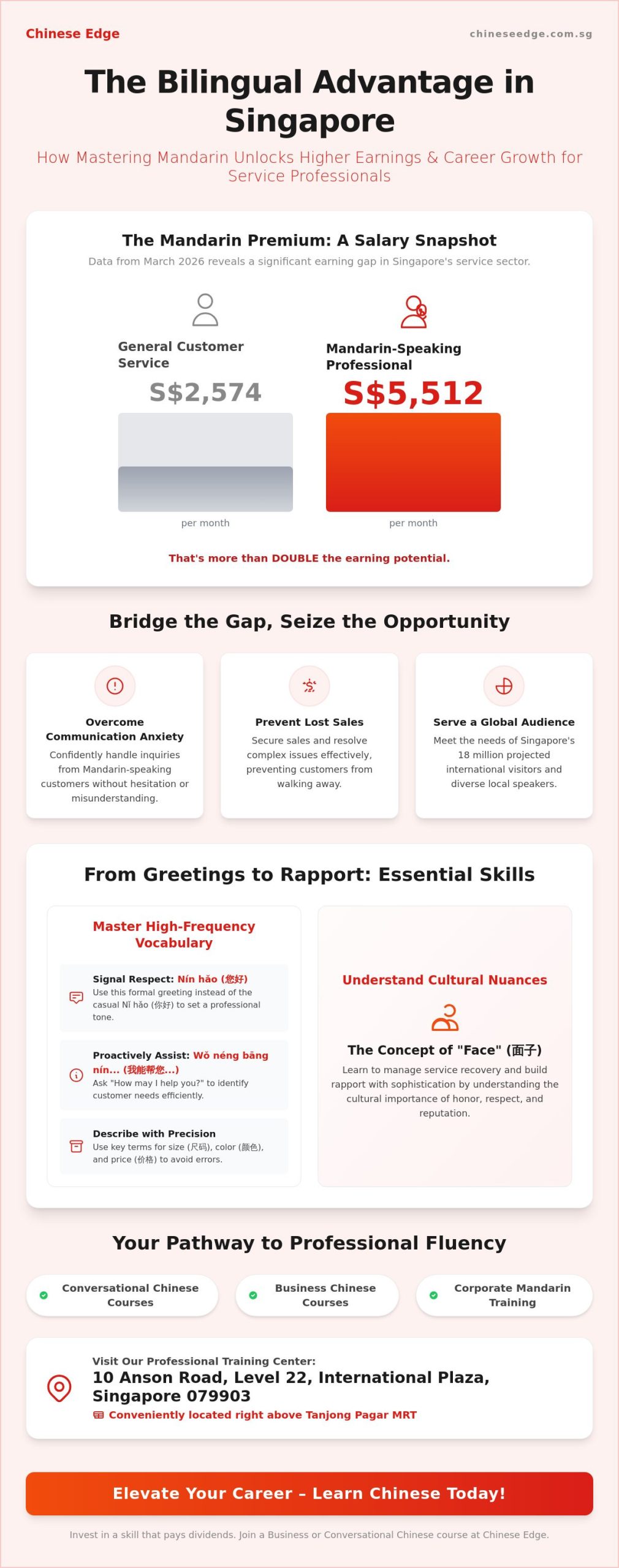
Did you know that as of March 2026, the average salary for a Mandarin-speaking employee in Singapore has reached S$5,512 per month, which is more than double the S$2,574 average for general customer service roles? This data underscores a clear reality: bilingualism isn’t just a skill; it’s a significant financial asset. You’ve likely felt a wave of anxiety when a Mandarin-speaking customer approaches your desk, or perhaps you’ve watched a sale slip away because you couldn’t resolve a complex issue in their native tongue.
It’s a common frustration, but it doesn’t have to define your career. Our goal is to help you master the specific mandarin for customer service professionals Singapore requires to thrive in a competitive landscape. By joining a targeted mandarin course or business chinese course at our professional training center at 10 Anson Road, level 22, International Plaza, you’ll gain the practical phrases and cultural nuances needed to handle any enquiry with confidence. This guide will preview the essential service etiquette and recovery strategies that lead to higher satisfaction scores and qualify you for premium, bilingual-required positions right here above Tanjong Pagar MRT.
Key Takeaways
- Understand how bilingualism serves as a critical tool for career advancement and higher salary brackets in Singapore’s 2026 service landscape.
- Learn high-frequency greetings and professional phrases that help you identify customer needs without sounding intrusive.
- Master the cultural nuances of “Face” and formal addresses to build rapport and manage service recovery with sophistication.
- Discover why practical mandarin for customer service professionals Singapore training is superior to academic learning for achieving front-line excellence.
- Explore how industry-specific corporate training solutions can be customized to meet the unique communication demands of retail, F&B, and finance.
The Strategic Value of Mandarin for Customer Service Professionals in Singapore
In 2026, Singapore remains a global nexus for commerce and tourism, with the Singapore Tourism Board projecting international visitor arrivals to reach up to 18 million. For those on the front lines, the ability to communicate effectively in Mandarin has shifted from a “bonus skill” to a core requirement for professional survival. Mastering mandarin for customer service professionals Singapore isn’t just about politeness; it’s about operational efficiency. When you can resolve a query in a customer’s native tongue, you reduce friction, save time, and prevent minor misunderstandings from escalating into negative reviews.
Data from March 2026 reveals a stark contrast in earning potential within the local market. While general customer service representatives earn an average of S$2,574 per month, those with Mandarin proficiency command an average of S$5,512. This significant gap reflects the high demand for professionals who can navigate complex transactions and emotional service recovery in a second language. In sectors like retail and banking, being bilingual is the most direct path to higher salary brackets and job security.
To better understand this concept, watch this helpful video:
The industry has moved past the era where a simple greeting suffices. Today’s customers in banking and high-end retail expect you to explain policy changes, troubleshoot digital payment errors, and provide nuanced advice. This level of linguistic precision is what separates a standard employee from a leader in the field. As Singapore continues to serve as a regional hub, the expectation for high-quality workplace chinese communication has never been higher.
Meeting the Needs of Mainland Chinese and Local Speakers
Differentiation is key to providing excellent service. A tourist from Shanghai might require help with specific tax refund procedures, while a local resident might prefer using Singaporean Mandarin for daily banking needs. Establishing first-contact confidence is essential. Even if you’re a beginner, showing linguistic effort builds an immediate bridge of trust. It signals that you value the customer’s comfort and are dedicated to finding a solution.
Career Progression and the Bilingual Advantage
If you want to pivot into high-end luxury retail or private banking, your language skills are your strongest leverage. These sectors prioritize staff who can offer a seamless experience to high-net-worth individuals. Excellence in Service awards often go to those who bridge communication gaps during high-stress situations. By enrolling in a targeted mandarin course at our center at 10 Anson Road, level 22, International Plaza, you position yourself for internal promotions that others simply can’t access. Being located right above Tanjong Pagar MRT, our classes fit the busy schedules of professionals aiming for the top.
Essential Mandarin Vocabulary for Front-Line Service Excellence
Professional service begins with the right words. While a general language class might teach you how to order tea, specialized mandarin for customer service professionals Singapore focuses on the high-stakes interactions that define your brand. Start with “Nin hao” instead of the casual “Ni hao” to signal immediate respect. This small shift in honorifics sets a professional tone from the very first second. Once the connection is made, use “Wo neng bang nin shenme ma?” (How may I help you?) to identify needs. This proactive approach prevents customers from feeling neglected during busy peak hours at the storefront.
Describing products requires precision to avoid costly errors. You need to master terms for “chi ma” (size), “yan se” (color), and “jia ge” (price). If an item isn’t in stock, saying “mu qian mei you xian huo” (we don’t have stock currently) is more professional than a blunt refusal. To ensure you’re using these terms correctly in a live environment, many find that a targeted conversational chinese course provides the necessary role-playing practice to build muscle memory and linguistic precision.
Industry leaders emphasize that language proficiency is a core competency for modern service. This includes the ability to close interactions with “Xie xie guang lin” (thank you for visiting). This phrase leaves a lasting positive impression and encourages repeat business, which is a key metric for service excellence. Mastering these closing cues ensures the customer leaves feeling valued and respected, reinforcing the premium standards of your organization.
The “Service Recovery” Toolkit: Handling Complaints
If a customer is unhappy, your vocabulary can de-escalate the situation before it turns into a negative review. Use “Wo men fei chang bao qian” (We are very sorry) to show deep sincerity. If you need to verify information with a manager, ask them to “Qing shao deng” (Please wait a moment) rather than just walking away. Using empathetic phrases like “Wo li jie nin de gan jue” (I understand how you feel) validates their frustration. This is an essential skill for anyone looking to learn chinese for high-pressure environments.
Professional Phone and Digital Etiquette
Answering a corporate line requires a standard opening: “Nin hao, [Company Name], wo shi [Your Name], qing wen you shenme ke yi bang nin?” This structure is clear and authoritative. When taking messages, always confirm contact details by saying “Wo neng chong fu yi xia nin de dian hua ma?” (May I repeat your phone number?). This ensures accuracy and demonstrates the high level of workplace chinese communication expected in top-tier firms. Mastering these digital touchpoints at our center at 10 Anson Road, level 22, International Plaza, ensures you remain consistent across all channels. Being located right above Tanjong Pagar MRT, we make it easy for busy staff to refine their professional presence.
Mastering Cultural Nuance and Etiquette in Singaporean Business
Language proficiency alone is insufficient without cultural literacy. In the context of mandarin for customer service professionals Singapore, the concept of “Face” (Mianzi) is the invisible currency that governs every interaction. When a service failure occurs, your ability to resolve the issue without making the customer feel embarrassed or publicly corrected is vital. Protecting a client’s dignity through indirect language and soft tones isn’t just polite; it’s a strategic move to preserve the long-term relationship. If you handle a complaint with aggression or bluntness, you risk losing that customer forever, regardless of how accurate your grammar might be.
The distinction between “Nin” (formal) and “Ni” (casual) remains a critical marker of professionalism. While Singaporean culture often leans toward efficiency, the formal “Nin” should always be your default for elder customers or high-ranking corporate clients. Using the casual “Ni” prematurely can signal a lack of training or a disregard for traditional respect. This balance of directness and politeness is a core component of our business mandarin course, where we teach students how to be clear about technical details while remaining culturally sensitive.
Honorifics and Addressing Customers Correctly
In a luxury service setting, addressing a customer as “Xian sheng” (Sir) or “Nu shi” (Madam) is non-negotiable. Overly casual language can instantly devalue a premium brand experience. It’s a common mistake to use family-based titles like “Auntie” or “Uncle” in a corporate environment. While these are acceptable in a hawker center, they are inappropriate in banking or high-end retail. Our instructors at 10 Anson Road, level 22, International Plaza, focus on these professional distinctions to ensure you never accidentally cause offense in the workplace.
Etiquette for Gift Giving and Document Handling
Physical gestures often speak louder than words. When you present a business card, a receipt, or a credit card, you must use both hands. Using only one hand can be perceived as dismissive or lazy. Presenting items with both hands is a non-negotiable trust signal in Singapore because it demonstrates full attention and respect for the recipient’s resources and status. During festive periods like Lunar New Year, avoid cultural taboos such as using white or black packaging, which are associated with mourning. Instead, lean into the symbolism of red and gold to reflect prosperity. If you’re looking for a mandarin course that covers these practicalities, our center right above Tanjong Pagar MRT offers the contextual training you need to excel.
Choosing the Right Mandarin Course for Working Professionals
Selecting a program requires looking beyond generic syllabus descriptions. While many institutions focus on “Academic Chinese” which prioritizes rote memorization and character writing, these methods often fail those on the front line. For mandarin for customer service professionals Singapore, success depends on verbal fluidity and auditory comprehension. You don’t need to write an essay; you need to respond to a customer’s frustration in real-time. This is why a specialized mandarin course must prioritize role-playing exercises that mimic actual service floor interactions.
Native-speaking instructors are vital, provided they understand the specific local business context. They guide you through the subtle differences in tone that change a sentence from a blunt command into a polite request. If you work irregular shifts, check for flexibility. We provide both in-person and online Mandarin classes to ensure you never miss a lesson due to a changing roster. This hybrid approach allows you to maintain progress even during peak retail seasons or busy financial quarters.
The Benefits of Small Group Learning
Shared learning environments are superior for service training. In our group chinese courses, you’ll practice with peers who face similar workplace challenges. This environment builds confidence by allowing you to make and correct mistakes in a supportive setting. Instructor feedback is focused on correcting professional tones and ensuring your “Service Mandarin” sounds polished and authoritative rather than just grammatically correct.
Location Matters: Accessibility in the CBD
Consistency is the hardest part of adult education. Choosing a center located at 10 Anson Road, level 22, International Plaza, removes the friction of travel. Being right above Tanjong Pagar MRT means you can attend a session immediately after your shift ends in the Central Business District. Proximity to your workplace makes it significantly easier to maintain a regular learning rhythm. When your training center is integrated into your daily commute, you’re more likely to achieve your fluency goals.
Ready to elevate your professional standing? Explore our conversational chinese course options and start your journey toward bilingual excellence today.
Chinese Edge: Tailored Mandarin Solutions for Singapore’s Service Leaders
Chinese Edge stands as a dedicated partner for those seeking to master mandarin for customer service professionals Singapore. We recognize that adult learners require more than just vocabulary lists. They need the agility to handle real-world pressure. Our programs in business chinese singapore are built on a methodology that prioritizes practical application over theoretical study. We use native-speaking instructors who bring years of professional experience to the classroom, ensuring that every lesson translates directly to the service floor.
Our Expert Mentor approach bridges the gap between simply knowing a language and delivering world-class service. We don’t just teach you how to speak; we teach you how to represent your brand with sophistication. By focusing on a structured curriculum that targets specific professional pain points, we help you achieve measurable results in your workplace chinese communication. Our goal is to ensure you feel as comfortable speaking Mandarin as you do English, whether you’re handling a phone enquiry or a face-to-face interaction.
Corporate Training for Service Teams
For organizations looking to upskill their entire front-line staff, we offer comprehensive corporate mandarin training solutions. These on-site training options are ideal for large retail, F&B, or hospitality teams that need a unified approach to mandarin for customer service professionals Singapore. We develop custom glossaries tailored to your company’s specific products and services, ensuring your team uses the exact terminology required for your niche. Industry professionals report that staff who undergo targeted language upskilling see a noticeable rise in customer satisfaction scores and a reduction in service recovery times. Whether you’re in private banking or luxury retail, our customized modules ensure your team is ready for the high expectations of the 2026 market.
Start Your Professional Journey Today
The path to bilingual confidence begins with a single step toward structured learning. We invite you to visit our training center located at 10 Anson Road, level 22, International Plaza, Singapore 079903. Our facility is situated right above Tanjong Pagar MRT, making it an ideal choice for those searching for a mandarin class singapore within the heart of the business district. This central location ensures that your professional development fits seamlessly into your workday without the stress of a long commute.
Don’t let language barriers limit your career potential or your company’s growth. Take the decisive step toward professional fluency and higher service standards. Explore our Adult Conversational Mandarin Course today and discover how our structured approach can transform your career trajectory.
Elevate Your Service Career in 2026
The ability to handle complex enquiries with linguistic precision is no longer optional in Singapore’s premium service industry. You’ve seen how specialized vocabulary and cultural nuances like “Face” can transform a standard interaction into a loyal customer relationship. By choosing a mandarin course that prioritizes role-playing and practical application, you ensure your skills are ready for immediate use on the service floor. Our native-speaking instructors at 10 Anson Road, level 22, International Plaza, provide the steady support needed to turn fluency into a reality.
Mastering mandarin for customer service professionals Singapore creates a clear path toward the higher salary brackets found in luxury retail and private banking. We invite you to experience our tailored curriculum designed specifically for adult learners and corporate teams. Our center is located right above Tanjong Pagar MRT, making it easy to attend lessons after your shift concludes. Master Mandarin for your career—Join our Professional Conversational Course today! We are ready to partner with you in your professional growth and look forward to seeing your confidence soar.
Frequently Asked Questions
How long does it take for a beginner to use Mandarin in customer service?
Beginners can typically start using basic service phrases within 8 to 12 weeks of a structured conversational chinese course. While full fluency takes longer, focusing on specific greetings and identification of needs allows for immediate application on the job. Our methodical approach ensures that students gain the confidence to handle simple interactions early in their training journey.
Can I learn Mandarin online if I have a busy service industry schedule?
Yes, our online Mandarin classes are designed specifically for professionals with irregular shift patterns. These sessions provide the same quality of instruction as our in-person classes while offering the convenience of learning from any location. This flexibility is essential for those in the F&B or retail sectors who find it difficult to attend a fixed physical schedule every week.
What are the most important Mandarin phrases for retail staff in Singapore?
Retail staff should prioritize phrases related to inventory, sizing, and payment methods. While “Nin hao” is a standard greeting, phrases like “Zhe shi wo men de xin kuan” (This is our new arrival) or “Ke yi shi chuan” (You can try it on) are invaluable. Mastering these allows you to guide customers through the purchasing process with ease and professionalism.
Do I need to learn how to write Chinese characters for customer service?
You don’t need to master complex character writing for most front-line customer service roles. Most professionals focus on Pinyin and verbal communication to ensure they can speak and understand customers effectively. While recognizing basic characters for signage is helpful, your primary goal in a conversational chinese course is to build the auditory and oral skills needed for face-to-face interactions.
How does Mandarin proficiency impact salary for service roles in Singapore?
Proficiency in mandarin for customer service professionals Singapore significantly increases your marketability for high-end roles. Bilingual staff are often prioritized for positions in luxury boutiques and private banking where clear communication with international clients is a requirement. This skill set leads to greater job security and faster career progression into management or specialized service categories within the competitive local market.
Are there specific Mandarin courses for the hospitality industry?
We offer specialized corporate Chinese language training that can be customized for the hospitality sector. These modules focus on hotel-specific scenarios such as check-in procedures, room service requests, and concierge advice. By training in these specific contexts, staff can provide a more personalized and professional experience for Mandarin-speaking guests, which directly improves service scores.
What is the difference between General Mandarin and Business Mandarin?
General Mandarin focuses on everyday social interactions and basic grammar, whereas a business chinese course targets professional terminology and workplace etiquette. In a business context, you’ll learn how to handle formal negotiations, explain company policies, and use honorifics correctly. This specialized training is what allows you to move from basic conversation to professional service recovery in a corporate environment.
Where is Chinese Edge located for in-person classes?
Our training center is located at 10 Anson Road, level 22, International Plaza, Singapore 079903. This central location is situated right above Tanjong Pagar MRT, providing easy access for those working in the Central Business District. Our physical presence in this commercial hub reflects our commitment to serving the professional community and ensuring that learning fits into your daily commute.
Disclaimer
Disclaimer
The Chinese articles on this website are provided for general information and learning purposes only. While we strive for accuracy, we make no guarantees regarding completeness or reliability. The content does not constitute professional advice, and we are not liable for any loss arising from its use. External links or third-party content are for reference only. By using this website, you agree to this disclaimer.