
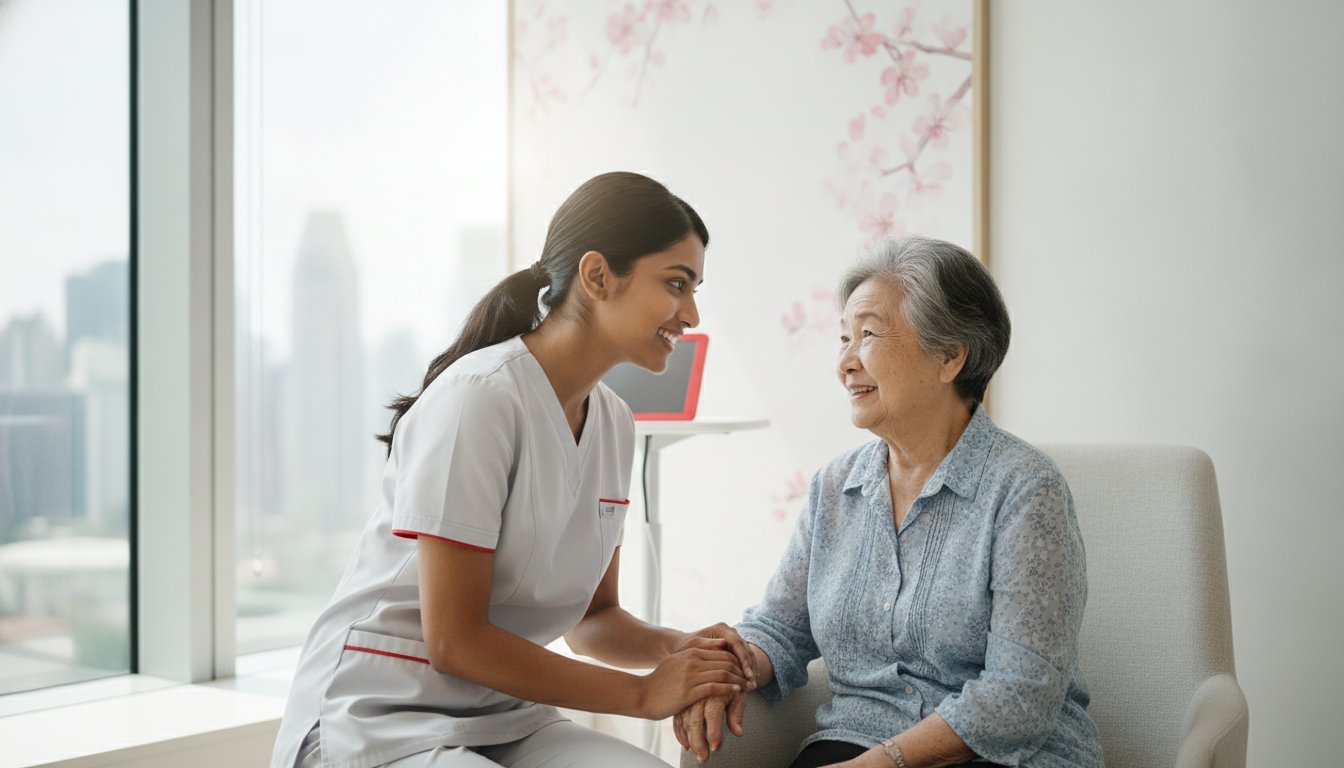
Did you know that 68% of local healthcare workers reported that language barriers were a primary source of workplace stress in a 2024 survey? It is a familiar, high-pressure scenario: you are standing at a bedside trying to decode a patient’s symptoms while the clock is ticking. You likely feel a surge of anxiety when an elderly patient speaks only Mandarin and you worry about misinterpreting a critical clinical detail. Mastering mandarin for healthcare professionals Singapore is no longer just an optional skill; it is a vital tool for patient safety and your own professional confidence in our aging society.
We understand that your schedule is incredibly demanding, often making traditional learning feel impossible to manage. However, you can master essential clinical Mandarin to enhance patient trust, reduce diagnostic errors, and excel in your medical career. This 2026 guide shows you how to transition from basic greetings to conducting a full consultation with total confidence. Whether you visit our professional training center at 10 Anson Road, International Plaza, located right above Tanjong Pagar MRT, or choose an online mandarin course, we will help you build immediate rapport and unlock new advancement opportunities in Singapore’s leading hospitals.
Key Takeaways
- Understand why precise communication is vital for reducing clinical risks and ensuring patient safety within Singapore’s aging demographic.
- Learn to navigate cultural nuances when treating elderly patients; including the use of respectful titles and recognizing dialect influences.
- Master the essential clinical vocabulary for mandarin for healthcare professionals Singapore to conduct efficient patient intakes and pain assessments.
- Discover why choosing a conversational chinese course provides more practical value for your daily clinical duties than traditional academic programs.
- Access flexible learning solutions through online mandarin classes or our specialized training center located at International Plaza in the heart of the CBD.
Why Mandarin Proficiency is Critical for Singapore Healthcare in 2026
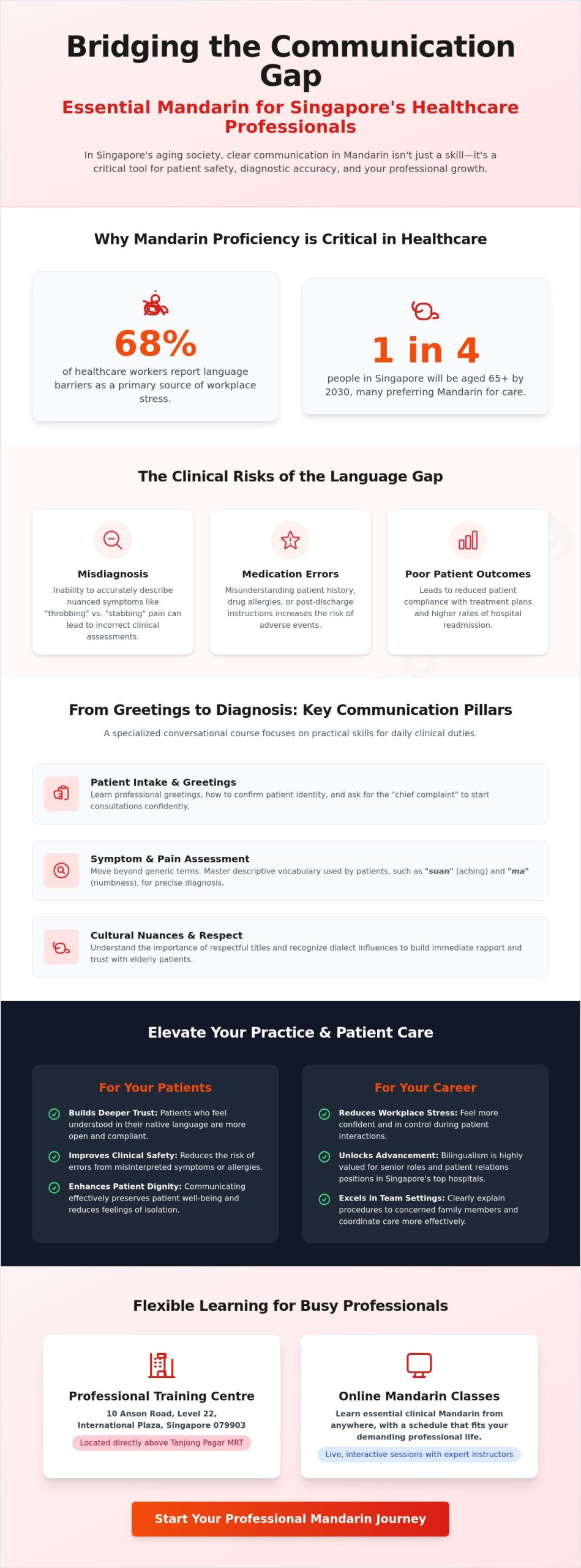
Singapore’s demographic landscape is undergoing a rapid transformation. By 2030, nearly one quarter of the population will be aged 65 and above. For this significant portion of the community, Mandarin remains a primary medium for daily interaction, often preferred over English in high-stress environments like hospitals. While English is one of the four official languages in Singapore, the emotional and cognitive comfort provided by a patient’s native tongue cannot be overstated. When patients feel heard in their own language, they’re more likely to share sensitive health information that they might otherwise struggle to articulate.
Mastering mandarin for healthcare professionals Singapore is about more than just social etiquette; it’s a fundamental component of clinical risk management. When a patient can’t accurately describe the nuance of their symptoms or their history of drug allergies, the risk of misdiagnosis or medication errors increases. Clear communication ensures that instructions for post-discharge care, such as complex insulin dosages or anticoagulation schedules, are fully understood. This directly reduces readmission rates and improves the patient’s willingness to follow long-term treatment plans, which is essential for the success of national health initiatives.
To better understand how the local healthcare system is evolving to meet these communication needs, watch this helpful video:
Bridging the Communication Gap in Local Wards
Imagine the anxiety of an elderly patient who is in pain but lacks the English vocabulary to describe it as “throbbing” or “stabbing.” They often feel isolated in a busy ward, which can lead to non-compliance or increased distress. As a healthcare professional, you serve as the essential bridge between the complex hospital system and the patient’s personal experience. Clinical Mandarin is a safety-critical professional tool that ensures diagnostic accuracy while maintaining the patient’s dignity and emotional well-being during their recovery journey.
Career Advancement for Professionals
Healthcare clusters in Singapore increasingly value bilingualism for senior roles and specialized patient relations positions. Proficiency in Chinese for professionals allows you to navigate multidisciplinary team settings where you might need to explain medical procedures to concerned family members or coordinate with various departments. It also opens doors in the growing private healthcare sector, where high-touch communication is a key differentiator. You can learn more about structured learning paths by reviewing a professional mandarin course designed specifically for adult learners in a workplace context.
Mastering Clinical Mandarin: From Patient Intake to Symptom Assessment
Effective clinical communication starts with more than just a list of vocabulary; it requires a structured approach to the entire patient encounter. Mastering mandarin for healthcare professionals Singapore involves learning how to guide a patient through the intake process while managing their expectations and anxieties. This begins with a professional greeting, confirming the patient’s identity, and clearly asking about their “chief complaint,” which is the primary reason for their visit. Unlike general language studies, clinical training focuses on the “connective tissue” of the conversation, allowing you to move seamlessly from one assessment stage to the next.
A significant part of this process involves pain assessment. While standard textbooks might focus on the generic word for pain, patients in local wards often use more descriptive terms. For instance, an elderly patient might describe their discomfort as “suan” (aching), “ma” (numbness), or “zhang” (a sensation of pressure or bloating). Distinguishing between these descriptors is critical for accurate diagnosis and triage. Highlighting the importance of these skills, the Ministry of Health on language competency emphasizes that effective communication is a cornerstone of patient safety. When you can describe cardiovascular or respiratory checks in simple, non-intimidating terms, you significantly reduce the patient’s fear of procedures like blood tests or X-rays.
Essential Phrasing for Daily Consultations
In a fast-paced hospital environment, clarity and brevity are your best allies. Instead of using complex medical jargon, use direct questions like “Where does it hurt?” or “How long has this been happening?” During physical examinations, simple commands such as “Please breathe deeply” or “Does this feel tender?” help the patient cooperate without confusion. If you want to build these specific skills in a structured environment, enrolling in a specialized mandarin course can provide the targeted practice you need for the ward.
Medication Instructions and Compliance
Ensuring patients follow their treatment plans after they leave your care is a major hurdle in healthcare. You must be able to explain dosages clearly, such as “Take two tablets after meals” or “Apply this cream twice daily.” It’s equally important to warn them about potential side effects like drowsiness or nausea in terms they understand. Always use the “teach-back” method by asking the patient to repeat the instructions to you. This verification step confirms that the linguistic gap hasn’t compromised their safety or recovery process.
Bridging the Cultural and Linguistic Gap with Elderly Patients
In the wards of Singapore, the Mandarin spoken by seniors is rarely the “standard” version found in textbooks. It’s a rich, localized blend frequently influenced by dialects like Hokkien, Teochew, and Cantonese. For those seeking to master mandarin for healthcare professionals Singapore, success depends on recognizing these linguistic nuances. A patient might use dialect-inspired terms for body parts or sensations that don’t align with formal vocabulary. By acknowledging these variations, you demonstrate a deeper level of respect and understanding that goes beyond simple translation.
Building trust with elderly patients often requires adopting the “Expert Mentor” persona. This involves using culturally appropriate forms of address, such as “Uncle” or “Auntie,” rather than strictly formal titles. This small shift in tone can immediately lower a patient’s guard and reduce the power imbalance often felt in clinical settings. Research regarding Singapore General Hospital’s medical interpreter program underscores how vital specialized communication is in achieving better health outcomes for our non-English speaking population. When words aren’t enough, your non-verbal cues, such as a gentle tone and open body language, complement your spoken Mandarin to provide a sense of security.
Understanding Localized Medical Terms
Many seniors describe their ailments through the lens of traditional concepts like being “heaty” (shang huo) or having “wind” (feng) in their body. It’s essential to validate these cultural beliefs rather than dismissing them, as this validation forms the foundation of clinical rapport. Before starting any physical examination, always use a rapport-building phrase like “I’m going to check your breathing now to make sure you’re comfortable” to ensure the patient feels involved in their care. If you want to refine your professional vocabulary further, consider exploring a specialized mandarin course that focuses on these practical, real-world interactions.
Empathetic Communication in High-Stress Settings
Delivering difficult news requires a delicate balance of clarity and compassion. In Mandarin, it’s often more effective to use indirect but clear phrasing to discuss a serious diagnosis, allowing the patient and their family time to process the information. Use reassurance phrases like “We are doing our best to help you” or “Don’t worry, we are monitoring your condition closely” to de-escalate anxiety during high-stress moments. For those looking to master more formal communication strategies, our guide to business Chinese in Singapore offers valuable tips on maintaining professional decorum in complex workplace environments.
How to Choose the Right Mandarin Course for Busy Medical Professionals
Choosing a mandarin course when you’re working irregular hospital shifts requires a strategy beyond just finding “chinese classes near me.” You need a program that understands the unique pressures of the healthcare sector. Traditional academic courses often focus on passing standardized exams, which might not help you when a patient is in acute distress. Instead, prioritize a conversational chinese course that emphasizes high-frequency clinical dialogue. This approach ensures you’re learning workplace chinese communication that you can apply immediately in the ward, rather than memorizing obscure vocabulary that doesn’t serve your patients.
Native speaker instructors are another non-negotiable factor for success. They provide the necessary guidance on clinical nuances and pronunciation that prevent embarrassing or dangerous misunderstandings. Learning from an expert mentor ensures you’re capturing the right tone, which is vital when dealing with sensitive medical topics. It’s about building a bridge of trust, and that starts with authentic linguistic training tailored to the medical landscape.
Online vs. In-Person Training for Shift Workers
For many doctors and nurses, fixed weekly schedules are a luxury they don’t have. This is where online mandarin classes become essential. Live interactive sessions allow you to join a lesson from home between shifts, providing the consistency needed for progress without the stress of a commute. If you prefer face-to-face interaction and work near the Central Area, our training center at 10 Anson Road, level 22, International Plaza, Singapore 079903, is located right above Tanjong Pagar MRT. This prime location makes it easy to attend a session before or after your shift. You can explore more options in our 2026 Professional’s Buying Guide for online Mandarin classes.
Corporate Training for Healthcare Institutions
Hospitals looking to improve patient safety across entire departments should consider corporate mandarin training. These programs can be tailored to specific specialties, such as geriatrics, where dialect-influenced Mandarin is common, or emergency medicine, where speed and clarity are paramount. By training as a team, departments can establish a standardized linguistic protocol for patient handovers and consultations. If your medical team is ready to elevate its communication standards, check out our group Chinese courses for customized institutional solutions.
Finding the right fit is the first step toward clinical excellence. If you’re ready to start your journey, explore our specialized mandarin for healthcare professionals Singapore programs today.
Elevate Your Clinical Practice with Chinese Edge’s Professional Mandarin Courses
Your clinical expertise is only as effective as your ability to communicate it to those under your care. At Chinese Edge, we recognize that mastering mandarin for healthcare professionals Singapore requires a curriculum that goes beyond standard greetings. We have specifically adapted our Business Mandarin Course to meet the high-stakes demands of the medical field. Our program ensures you aren’t just memorizing vocabulary; you are developing the practical fluency needed to manage complex patient interactions and emergency scenarios with precision.
The Chinese Edge methodology is built on the principle of real-world application. We move away from dry, academic exercises to focus on the specific linguistic challenges you face in the ward. Whether you are explaining a surgical procedure or de-escalating a patient’s anxiety, our lessons provide the “connective tissue” of conversation that traditional courses often overlook. This specialized focus is why our chinese course singapore has become a preferred choice for adult learners who prioritize professional growth and patient safety.
Convenience is a critical factor for any busy medical professional. Our training center is located at 10 Anson Road, level 22, International Plaza, Singapore 079903, situated right above Tanjong Pagar MRT. This central location allows you to attend classes easily before or after your hospital shifts. For those with even more restrictive schedules, our online mandarin classes offer the same rigorous training from the comfort of your home, ensuring your progress never stalls due to workplace demands.
Proven Results for Healthcare Professionals
Our students include local nurses and doctors who have successfully transformed their patient rapport through our targeted training. By working with native-speaking trainers, you gain exposure to authentic clinical dialogue and the subtle nuances of pronunciation that build immediate trust. These instructors act as expert mentors, guiding you through the cultural and linguistic complexities of Singapore’s healthcare landscape. Many of our students find that the ability to speak the patient’s language reduces their own workplace stress while significantly improving the quality of care they provide.
Get Started with Your Professional Mandarin Journey
Taking the next step in your career is a matter of choosing a partner that understands your professional objectives. If you are ready to enhance your clinical practice and unlock new advancement opportunities, it is time to enroll in our next intake. Whether you choose a comprehensive mandarin course or a targeted chinese speaking course, we provide the structured support you need to reach fluency. Contact Chinese Edge today to master Mandarin for your medical career and bridge the communication gap in your workplace.
Master Clinical Communication for a Safer Future
Bridging the linguistic gap is a fundamental step toward ensuring patient safety and building lasting trust in the ward. By mastering specialized clinical terms and understanding the cultural nuances of our aging population, you can significantly reduce diagnostic errors and improve treatment compliance. Investing in mandarin for healthcare professionals Singapore is a strategic move for any practitioner looking to excel in local healthcare clusters.
Our training center at International Plaza, 10 Anson Road, level 22, is located right above Tanjong Pagar MRT, making it easily accessible for busy medical staff. With a customized clinical curriculum and native-speaking instructors who offer professional expertise, we provide the steady support you need to reach your goals. You have the medical expertise; now empower yourself with the language skills to provide the best possible care for every patient. Enhance Your Patient Care: Enroll in Our Professional Mandarin Course Today. We look forward to being your partner in professional growth.
Frequently Asked Questions
Is it difficult for healthcare professionals to learn Mandarin if they have no prior background?
Learning Mandarin is entirely achievable for beginners when you use a structured, phonetic approach. We focus on Pinyin and high-frequency clinical phrases to help you build confidence quickly. This methodical style ensures you can start communicating basic patient needs without needing years of academic study first. Our instructors provide steady support to help you overcome initial hurdles in pronunciation and tone.
How long does it take to become proficient in medical Mandarin for consultations?
Most students can conduct basic patient consultations after 30 to 40 hours of targeted training. While full fluency is a long-term journey, our mandarin for healthcare professionals Singapore program prioritizes “survival” phrases for intake and symptom assessment. This specific focus allows you to apply your new skills in the ward almost immediately, accelerating your professional development and patient rapport.
Are there specific Mandarin courses for healthcare professionals in Singapore?
Yes, we provide specialized Adult Conversational Mandarin and Business Mandarin courses tailored for the medical sector. These programs move beyond general social topics to focus on anatomy, pain scales, and medication instructions. Every lesson is designed to provide practical value for your next hospital shift, ensuring you’re prepared for the unique linguistic challenges of a clinical environment.
Can I take these Mandarin classes online to fit my hospital shift schedule?
Our Online Mandarin Classes are designed specifically to accommodate the irregular schedules of doctors and nurses. You can join live, interactive sessions from any location, which provides the flexibility needed to maintain progress despite changing rosters. It’s an ideal solution if you can’t commit to a fixed weekly in-person time but still want the benefits of expert instruction.
Do these courses cover traditional Chinese medicine (TCM) terminology?
While our primary focus is on Western clinical settings, our curriculum includes common localized terms like “heaty” or “wind.” We help you understand these traditional concepts because many elderly patients use them to describe their symptoms. Validating these cultural beliefs is essential for accurate symptom assessment and building a strong bridge of trust with your patients.
What is the difference between a general Mandarin course and a professional medical Mandarin course?
General courses focus on daily life and social interaction, whereas a professional medical course targets workplace chinese communication. You’ll learn specific anatomy and procedural explanations rather than travel or hobby-related vocabulary. This specialized focus saves you time and ensures you are prepared for the high-stakes environment of a hospital where clarity is a safety requirement.
Is there corporate training available for entire hospital departments or clinics?
We provide comprehensive Corporate Chinese Language Training for hospital departments and private clinics seeking to standardize their communication protocols. These sessions can be customized to your team’s specific medical specialty, such as geriatrics, pediatrics, or emergency care. Training as a group improves overall patient safety and ensures that your entire staff can provide a consistent level of care.
Where is the Chinese Edge training center located for in-person classes?
The Chinese Edge training center is located at 10 Anson Road, level 22, International Plaza, Singapore 079903. Our facility is situated right above Tanjong Pagar MRT, providing a convenient hub for professionals working in the CBD or nearby medical clusters. The central location makes it easy to attend a session before or after your hospital duties without a long commute.
Disclaimer
Disclaimer
The Chinese articles on this website are provided for general information and learning purposes only. While we strive for accuracy, we make no guarantees regarding completeness or reliability. The content does not constitute professional advice, and we are not liable for any loss arising from its use. External links or third-party content are for reference only. By using this website, you agree to this disclaimer.