
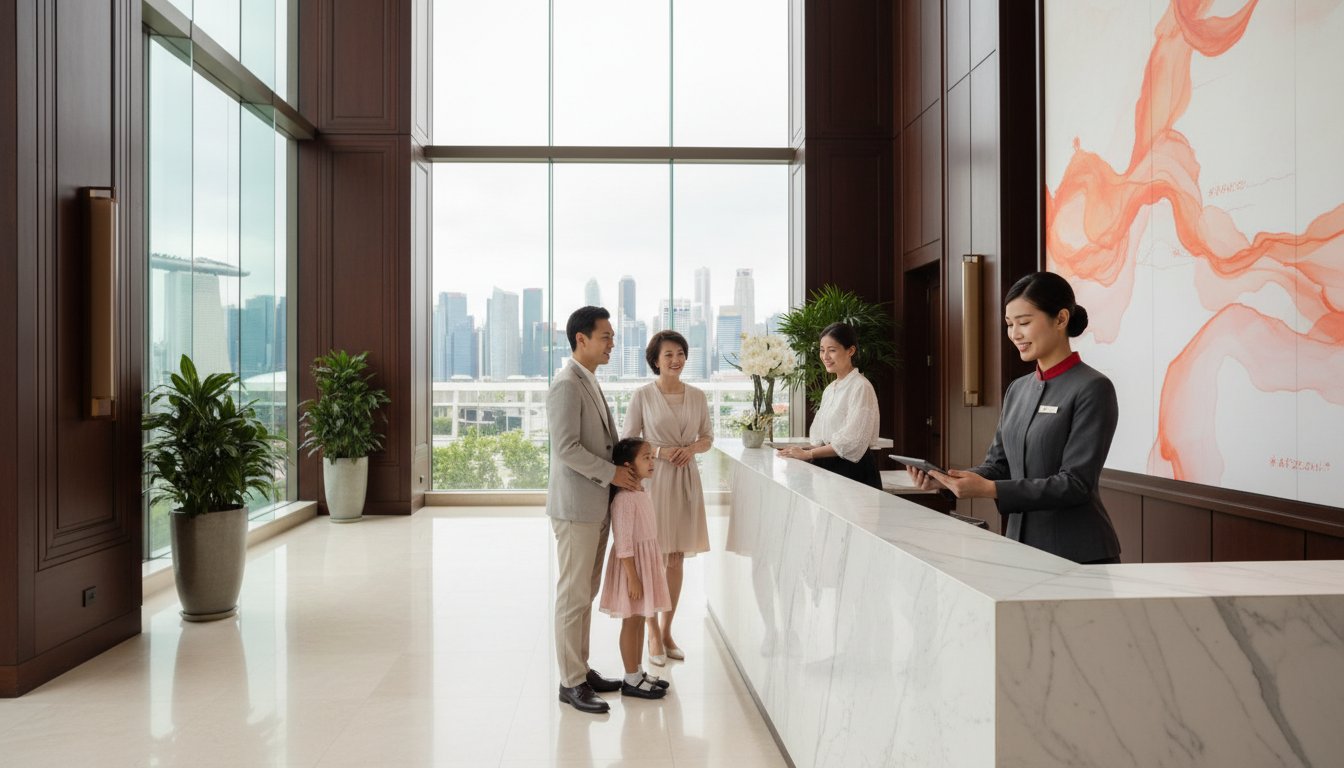
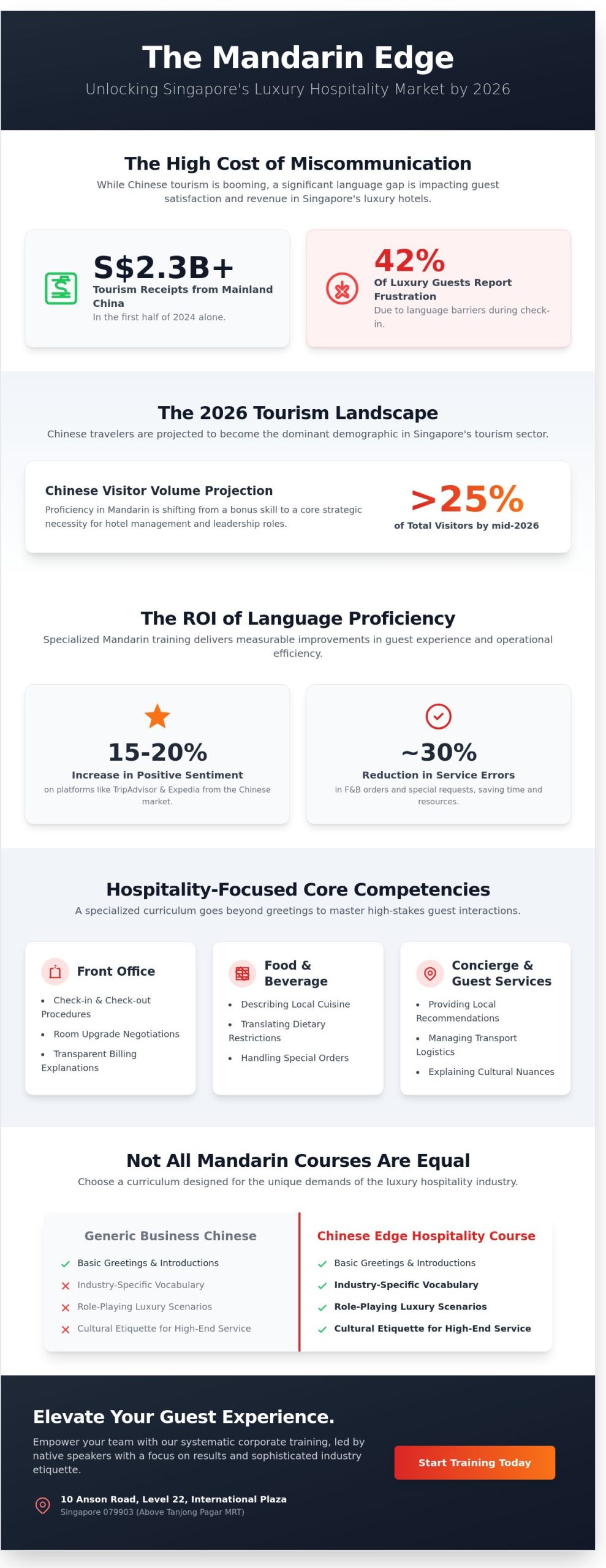
In 2024, visitors from Mainland China contributed over S$2.3 billion to Singapore’s tourism receipts in the first half of the year alone, yet 42 percent of luxury hotel guests still report frustration with language barriers during check-in. Mastering the chinese language for hotel management Singapore is no longer optional for brands aiming to lead the 2026 hospitality market. You understand that providing a premium experience goes beyond just a comfortable room; it’s about making every guest feel understood from the moment they step into the lobby. When communication breaks down, service recovery scores drop and potential revenue is lost to competitors who speak the guest’s language fluently.
This guide will show you how to implement a specialized curriculum to help your team master the specific vocabulary needed to turn potential complaints into glowing reviews. You’ll learn how to streamline guest check-ins and handle complex requests with professional ease. We will examine the essential phrases for luxury service, flexible training structures for 24/7 shifts, and how our systematic mandarin course at 10 Anson Road, level 22, International Plaza, Singapore 079903, right above Tanjong Pagar MRT, empowers your staff to deliver excellence.
Key Takeaways
- Understand why professional Mandarin is essential for navigating Singapore’s 2026 tourism landscape and providing the high-touch service that translation apps cannot replicate.
- Identify critical hospitality competencies, from managing luxury room upgrades at the front desk to explaining local Singaporean cuisine in high-end dining environments.
- Learn to distinguish between a generic business chinese course and a specialized curriculum designed specifically for chinese language for hotel management Singapore.
- Explore how to implement effective workplace chinese communication training that balances 24-hour hotel operations with flexible, hybrid learning models.
- Discover the benefits of professional corporate training led by native speakers who focus on systematic results and sophisticated industry etiquette.
The Strategic Importance of Chinese Language for Hotel Management in Singapore
By 2026, the landscape of Tourism in Singapore will be defined by a sophisticated demographic of Chinese travelers. Projections from industry analysts suggest that Chinese arrivals will account for over 25% of total visitor volume by mid-2026. For professionals in the sector, mastering the chinese language for hotel management Singapore is no longer an optional skill; it’s a strategic necessity for those seeking leadership roles. While technology advances, basic translation apps consistently fail in high-end hospitality environments because they lack the cultural nuance and professional register required for luxury service.
To better understand the practical application of these skills, watch this helpful video:
There’s a direct correlation between language proficiency and guest reviews. Hotels with Mandarin-speaking staff often see a 15% to 20% increase in positive sentiment on TripAdvisor and Expedia from the Chinese market. For a manager, this translates to better KPIs and faster career advancement. Proficiency allows you to handle complex guest issues with poise, positioning you as an indispensable asset in the competitive Singaporean market. Using the chinese language for hotel management Singapore contextually allows for a more systematic approach to guest requests and conflict resolution.
Meeting Luxury Expectations in the Heart of the City
Guests at premium properties in the Tanjong Pagar and Marina Bay districts expect a “home-away-from-home” experience. A personalized concierge service delivered in Mandarin provides a level of comfort that digital tools cannot replicate. When you can recommend a local dining spot or explain a cultural nuance in their native tongue, you build immediate trust. Our group Chinese courses at International Plaza are designed to help professionals master these high-stakes interactions. Being located at 10 Anson Road, level 22, International Plaza, Singapore 079903, right above Tanjong Pagar MRT, we are perfectly positioned to serve the city’s hospitality hub.
Mandarin as a Tool for Operational Efficiency
Beyond guest satisfaction, Mandarin is vital for operational excellence. Clear communication reduces errors in F&B orders and special requests by roughly 30%, saving the property both time and money. It also streamlines the check-in and check-out process for large tour groups, preventing bottlenecks in the lobby. In hotels with diverse, multilingual teams, a manager who speaks Mandarin can bridge communication gaps, ensuring that instructions are understood across all departments. This systematic approach to language leads to a more disciplined and results-oriented work environment.
Key Competencies in a Hospitality-Focused Mandarin Course
A robust curriculum for chinese language for hotel management Singapore focuses on four operational pillars. Front office staff must master the precision of check-in procedures, room upgrade negotiations, and transparent billing explanations. According to 2024 tourism data, Chinese travelers represent a significant portion of Singapore’s luxury market, and clear communication regarding S$500+ room rates is essential for building trust. For Food & Beverage teams, training involves describing complex local dishes like Hainanese Chicken Rice or Chili Crab while accurately translating dietary restrictions to ensure guest safety.
Concierge teams require linguistic agility to provide local recommendations and manage transport logistics seamlessly. This includes explaining the proximity of our training center at 10 Anson Road, International Plaza, located right above Tanjong Pagar MRT, to nearby business hubs. Service recovery remains the most challenging aspect. It requires a deep understanding of the art of the apology. Resolving complaints with cultural sensitivity ensures that a minor room issue doesn’t escalate into a permanent loss of a high-net-worth client.
The Vocabulary of High-End Service
Professionalism starts with essential honorifics like “Nín” instead of “Nǐ” to show respect to VIP guests. Staff learn specific phrases to explain hotel policies, such as non-smoking rules or deposit requirements, without causing the guest to feel embarrassed. In Chinese hospitality culture, “face” (mianzi) represents a person’s social standing and reputation, and preserving it is vital for maintaining a harmonious guest relationship. Using the correct chinese language for hotel management Singapore helps staff navigate these social nuances effectively.
Scenario-Based Training for Real-World Results
Our systematic approach utilizes role-playing for common friction points. This includes managing late check-out requests during high occupancy or handling overbookings with grace. Training also covers high-stakes situations like medical emergencies or security concerns in Mandarin. Professionals who want to refine these skills often join a group Mandarin course to practice in a collaborative environment. We customize curriculum levels for different hotel tiers, ensuring a five-star property uses different linguistic registers than a boutique lifestyle hotel. This ensures every employee communicates with confidence and authority.
Choosing the Right Mandarin Class Near Me: Hospitality vs. General Business
Selecting the correct educational path determines how quickly your team can provide seamless service. Industry data from 2025 suggests that over 65% of luxury hotel guests in Singapore’s downtown core prefer interacting in their native Mandarin. A generic business chinese course typically emphasizes trade negotiations or legal terminology. While these skills are valuable, they don’t cover the specific vocabulary required for chinese language for hotel management Singapore. Your front-of-house staff must master terms for “valet parking,” “pillow menus,” and “late checkout” rather than “mergers” or “acquisitions.”
Effective training requires trainers who are native speakers with a deep awareness of professional service standards. They don’t just teach grammar; they teach the cultural nuances of hospitality. When you evaluate a curriculum, check if it includes workplace chinese communication designed specifically for service staff. This ensures your team can handle guest complaints or special requests with confidence. For senior leaders, private 1-on-1 coaching offers the flexibility needed for a hectic schedule. Conversely, group dynamics work best for frontline staff. These sessions allow them to role-play real-world guest interactions and build collective confidence.
The Advantage of Systematic Adult Learning
Adult learners thrive on a structured, results-oriented roadmap. Casual learning isn’t enough when guest satisfaction scores are at stake. By using international HSK standards to benchmark staff proficiency, hotels can track measurable progress across different departments. You should integrate mandarin classes in Singapore into your long-term HR development plan. This systematic approach ensures that by the end of 2026, your guest-facing team can converse fluently with Mandarin-speaking patrons, directly impacting your property’s online ratings.
Location and Accessibility for Busy Professionals
Logistics shouldn’t be a barrier to professional growth. Our training center is located at 10 Anson Road, Level 22, International Plaza, Singapore 079903. It’s positioned right above Tanjong Pagar MRT; this makes it incredibly convenient for staff commuting from various hotel properties across the city. A central CBD location simplifies the organization of corporate mandarin training. It allows your executives to attend sessions during lunch breaks or immediately after their shifts without wasting time in transit. Accessibility ensures high attendance rates and better long-term retention of the language.
Implementing Workplace Chinese Communication Training for Hotel Staff
Managing training schedules in a 24-hour hotel environment is a logistical puzzle. Front-of-house teams often work rotating shifts, making it difficult to gather everyone for a single session. Successful HR managers in 2026 are moving away from rigid classroom settings in favor of a hybrid model. This approach combines high-impact in-person workshops with online mandarin classes singapore. By providing digital access, night shift staff and concierge teams can learn at their own pace without disrupting the guest experience.
Measuring the ROI of your language program is essential for long-term buy-in. Data from regional hospitality reports suggests that hotels investing in chinese language for hotel management Singapore see a 14% average increase in positive guest reviews within the first year. Beyond reviews, you can track staff confidence through internal surveys. When employees stop feeling anxious about answering the phone or greeting guests in Mandarin, service speed improves. Creating a “Mandarin-friendly” culture helps too. You can implement “Mandarin Mondays” in the staff canteen or place phrase cards in back-of-house areas to encourage daily practice.
Flexible Training Modes for the Hospitality Sector
Hotels have two primary options for delivery: on-site corporate training or sending staff to a professional center. Our facility at 10 Anson Road, level 22, International Plaza, is located right above Tanjong Pagar MRT, offering a central location for teams based in the CBD. For staff who are constantly on the move, bite-sized interactive modules are the most effective. These 10 to 15-minute digital lessons allow employees to practice specific vocabulary during their breaks. Using digital tools ensures that the chinese language for hotel management Singapore stays top-of-mind between formal sessions.
Customizing the Syllabus for Your Property
A generic curriculum won’t suffice in a luxury setting. Your training should be tailored to your property’s specific USPs, whether that is a heritage spa or a high-tech business center. It is also critical to align training with the Singapore event calendar. Staff need specific phrases for the Formula 1 Singapore Grand Prix, Chinese New Year peak periods, and major MICE conferences. We recommend developing a “Hospitality Mandarin Handbook” that acts as a quick-reference guide for common guest requests. This ensures that even during high-pressure events, your team maintains a consistent standard of professional communication.
Ready to elevate your team’s service standards? Explore our customized professional group Mandarin courses today.
Elevate Your Guest Experience with Chinese Edge’s Corporate Training
Chinese Edge serves as the premier partner for chinese for professionals in the Singaporean hospitality sector. We understand that effective communication is the cornerstone of luxury service. Our curriculum focuses specifically on the nuances of chinese language for hotel management Singapore, ensuring your staff can handle complex guest interactions with confidence. We adopt an Expert Mentor approach, where native speakers guide your team through the subtleties of corporate etiquette and professional address. These trainers bring real-world experience, helping learners move beyond simple translations to achieve cultural fluency that resonates with high-net-worth travelers.
By 2026, the demand for personalized, linguistically competent service in Singapore’s 400 plus hotels will reach new heights. Our corporate mandarin training is designed to meet this demand head-on. We don’t just teach words; we provide a bridge to better guest relations. Whether it’s a concierge explaining local attractions or a front office manager resolving a booking nuance, our training provides the linguistic tools necessary for precision. This systematic approach ensures that every interaction reflects the high standards of your brand.
Our Proven Methodology for Adult Learners
Our systematic conversational chinese course prioritizes immediate workplace application. We focus on listening and speaking skills that staff can use from day one. Since our founding in 2012, The Language Edge Group has built a heritage of excellence in Singaporean language education. We maintain small group sizes, often limited to 8 or 10 students, to ensure maximum interaction and real-time pronunciation correction. This focus on adult pedagogy allows learners to grasp workplace chinese communication without the fluff of traditional academic settings.
Our curriculum is structured into logical modules. These modules cover everything from greeting VIP guests to handling specialized requests in the food and beverage department. We use a problem-solution framework in our lessons. If a guest has a specific dietary requirement, your staff will have the exact phrases ready. This practical focus is why over 60 corporate entities in Singapore trust our methodology to upskill their workforce.
Visit Our Tanjong Pagar Training Center
Our state-of-the-art training center is located at 10 Anson Road, level 22, International Plaza, Singapore 079903. It’s situated right above Tanjong Pagar MRT, making it a convenient hub for professionals working across the city. The facilities are designed specifically for adult education, providing a sophisticated environment that mirrors the professional world. If you’re looking for flexible options, we also offer group chinese courses that can be adapted for corporate teams.
Getting started is a straightforward process. We invite hotel management teams to contact us for a bespoke corporate assessment. We evaluate the current proficiency levels of your staff and design a program tailored to your hotel’s specific operational goals. This ensures your investment in chinese language for hotel management Singapore yields measurable results in guest satisfaction scores. Reach out today to design a curriculum that sets your property apart in the competitive Singaporean market.
Master Your Service Delivery for the Future
The landscape of Singapore’s hospitality sector continues to evolve. With the Singapore Tourism Board reporting that visitor arrivals reached 13.6 million in 2023, the demand for specialized service is higher than ever. Mastering the chinese language for hotel management Singapore ensures your team can handle complex guest requests with precision and cultural nuance. Effective communication reduces service friction and directly impacts your hotel’s guest satisfaction scores.
Chinese Edge provides a systematic approach to language mastery through our expert instructors. As part of the Language Edge Group, we deliver training led by native speakers with extensive corporate backgrounds. Our center is conveniently located at 10 Anson Road, Level 22, International Plaza, right above Tanjong Pagar MRT. We focus on practical, workplace-ready skills that empower your staff to represent your brand with confidence. Whether it’s front-of-house interactions or luxury concierge services, our curriculum is designed for professional results.
Book a Corporate Mandarin Consultation for Your Hotel Team
We’re excited to support your team’s professional growth and help you achieve new standards of excellence.
Frequently Asked Questions
Is a general Mandarin course sufficient for hotel staff?
No, a general course doesn’t cover the technical vocabulary required for professional guest interactions. Hotel staff need to master specific terms related to reservations, concierge services, and facility management to provide seamless service. Our chinese language for hotel management Singapore programs focus on these high-stakes scenarios, ensuring your team can handle 100% of standard guest inquiries with professional confidence.
How long does it take for hotel staff to reach basic conversational fluency?
Most employees achieve functional conversational fluency within 40 to 50 hours of structured, systematic instruction. This timeframe allows staff to manage greetings, provide directions, and handle basic room service requests comfortably. If your team attends a conversational chinese course twice a week, they’ll likely start using their new skills on the hotel floor within 12 weeks.
Can Chinese language training be customized for specific hotel departments like F&B or Housekeeping?
Yes, we tailor every module to meet the unique operational needs of different hotel departments. F&B teams focus on menu descriptions and dietary requirements, while housekeeping staff learn phrases related to room amenities and maintenance schedules. This department-specific mandarin course ensures that employees only spend time learning vocabulary they’ll actually use during their shifts.
What are the benefits of online Mandarin classes for hotel employees on shift work?
Online classes provide the essential flexibility required to accommodate 24/7 rotating rosters in the hospitality industry. Employees can join live, interactive sessions from any location, which prevents them from falling behind when their shift patterns change. This digital approach maintains learning momentum and allows for consistent progress without the need for travel time to a physical classroom.
Why is it important for hotel managers to learn Mandarin even if they have translation tools?
Translation apps often fail to capture the subtle nuances of tone and etiquette that are vital for high-level guest relations. When a manager speaks the language, it demonstrates a level of respect and commitment that a digital device simply can’t replicate. Investing in chinese for professionals allows leadership to de-escalate complaints and build genuine rapport with VIP guests more effectively.
How does Chinese Edge ensure the curriculum is relevant to the Singaporean hospitality context?
Our curriculum uses real-world examples from the local tourism landscape, including references to Singaporean landmarks and regional dining customs. We conduct our training from our center at 10 Anson Road, level 22, International Plaza, Singapore 079903, located right above Tanjong Pagar MRT. This central location keeps our mandarin class singapore grounded in the heart of the city’s business and hospitality hub.
What is the best way to encourage staff to use Mandarin with guests after the course ends?
The most effective method is to integrate Mandarin practice into daily operations, such as during morning shift briefings or “toolbox” talks. Managers should create a supportive environment where staff feel encouraged to use their corporate mandarin training without fear of making mistakes. Providing small recognition awards for employees who successfully assist a guest in Mandarin can also boost long-term retention.
Are there specific cultural etiquette modules included in the hospitality Mandarin program?
Yes, every hospitality-focused syllabus includes dedicated modules on Chinese cultural norms, body language, and gift-giving traditions. Understanding these “unwritten rules” is just as important as the vocabulary itself because it prevents unintentional offense during guest interactions. We teach students how to navigate these cultural complexities to ensure their service is perceived as both professional and deeply respectful.
Disclaimer
Disclaimer
The Chinese articles on this website are provided for general information and learning purposes only. While we strive for accuracy, we make no guarantees regarding completeness or reliability. The content does not constitute professional advice, and we are not liable for any loss arising from its use. External links or third-party content are for reference only. By using this website, you agree to this disclaimer.