
You have just finished a productive day at our training center at 10 Anson Road, International Plaza, and you’re ready to head home from Tanjong Pagar MRT. As you settle into the taxi, you realize you can’t quite explain your preferred route to avoid the latest ERP 2.0 surcharges or the morning peak hour rates. That silent moment of hesitation often leads to wrong turns or missed opportunities for a friendly chat. It’s a common challenge for professionals who want to feel truly at home in the city but struggle with localized communication. Learning specific mandarin phrases for taxi drivers in Singapore is the first step toward reclaiming your confidence on the road.
Mastering these expressions allows you to take control of your commute with professional ease. Whether you want to learn chinese for daily life or join a conversational chinese course to sharpen your workplace communication, practical application starts with these everyday interactions. This guide promises to equip you with the vocabulary needed to navigate Singapore’s streets, handle 2026’s updated fare structures, and build rapport through polite small talk. We will break down essential directions, payment instructions for card surcharges, and the cultural nuances that turn a standard ride into a meaningful connection.
Key Takeaways
- Understand how using localized Mandarin builds immediate rapport with local drivers, transforming a routine commute into a pleasant social interaction.
- Learn precise navigation instructions to ensure you reach your destination efficiently while avoiding specific routes or ERP gantries.
- Master essential mandarin phrases for taxi drivers in Singapore to clearly state your destination and manage fare payments with professional confidence.
- Discover how to engage in polite small talk that bridges cultural gaps and enhances your daily experience living and working in the city.
- Identify how transitioning from basic phrases to a structured conversational chinese course can elevate your overall workplace communication and fluency.
Why Learning Mandarin Phrases for Singapore Taxis is a Game-Changer
For many professionals arriving in the Lion City, the commute is more than just transit. It’s a prime opportunity to immerse yourself in the local environment. While English is widely spoken, mastering specific mandarin phrases for taxi drivers in Singapore provides a unique bridge to the heart of the community. It demonstrates a level of respect for the local culture that goes beyond the typical expat experience. It signals that you’re here to stay and grow.
Engaging with drivers allows you to practice Singaporean Mandarin in a functional, real-world setting. This localized version of the language often incorporates unique loanwords and rhythmic patterns that you won’t find in a standard textbook. By learning these nuances, you transition from being a passenger to a participant in the city’s daily life. You’ll improve your listening skills through authentic practice with native speakers from diverse backgrounds.
To better understand how these interactions work in practice, watch this helpful video showing real-life taxi conversations:
Beyond Basic Directions: The Cultural Connection
In Singapore, the “Uncle” and “Aunty” culture is the backbone of social interaction. While the formal term for driver is “Sī jī”, using the local preference of “Uncle” immediately softens the tone of the conversation. It builds instant rapport. If you use these mandarin phrases for taxi drivers in Singapore, you’ll often find that drivers become your best source for local food recommendations or hidden gems. These rides serve as the perfect low-stakes environment to test your skills from a conversational chinese course before applying them in more formal settings.
Practical Benefits for Expats and Professionals
Efficiency is paramount for any professional. If you have a meeting at our training center located at 10 Anson Road, level 22, International Plaza, you need to ensure you arrive on time. Clear communication helps you navigate specific traffic preferences, especially with the 2026 satellite-based ERP 2.0 system now fully operational. Being able to specify your route or ask about current surcharges reduces the stress of daily commutes. It shifts your perspective from a tourist mindset to a local resident mindset. This allows you to navigate the city with the same confidence you bring to your business meetings above Tanjong Pagar MRT.
Essential Phrases for Hailing and Stating Your Destination
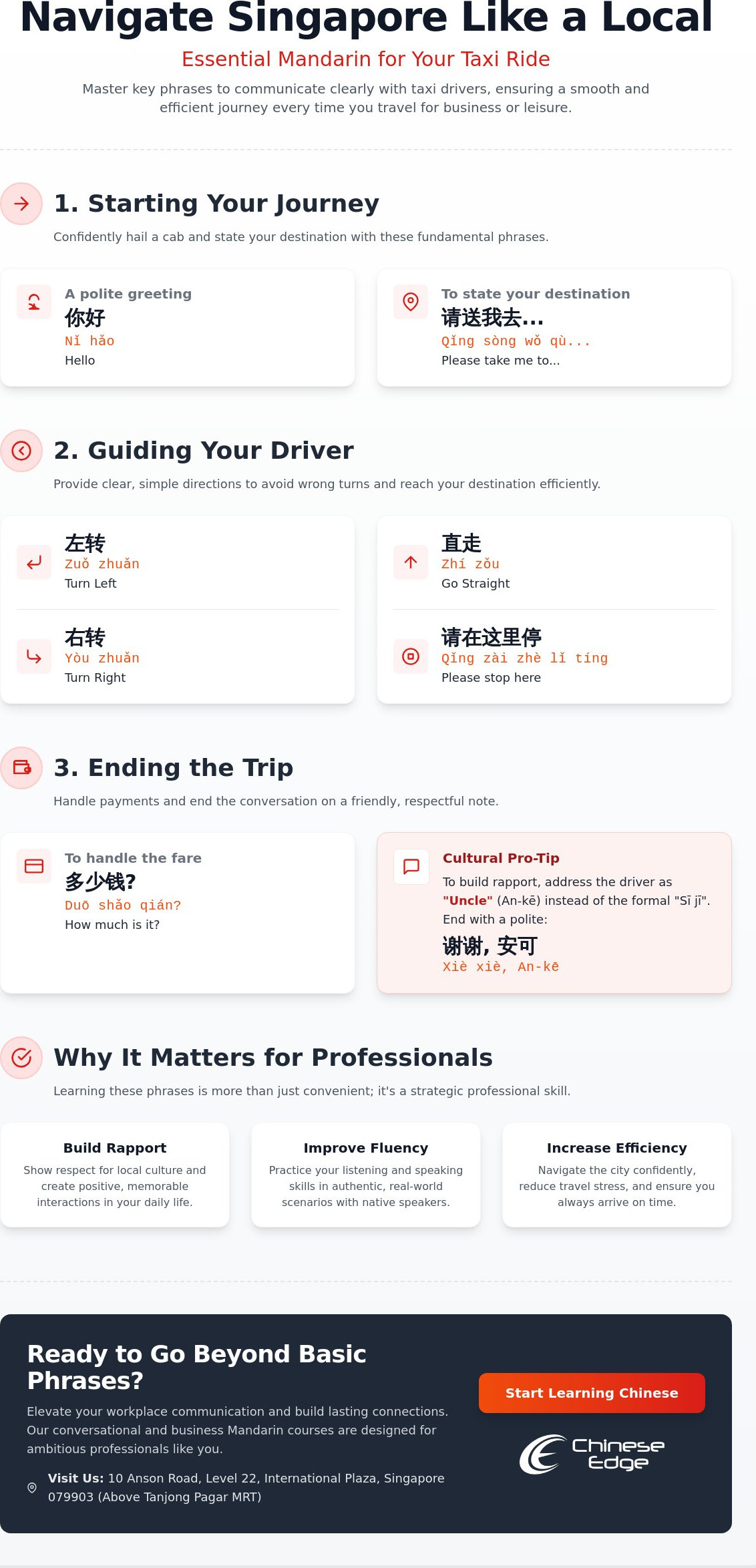
Street-hailing remains a vital part of getting around Singapore, especially within the bustling Central Business District. When you spot a taxi with a glowing green sign, a confident wave is the standard signal. Once the door opens, using specific mandarin phrases for taxi drivers in Singapore immediately establishes a professional yet local tone. You can start with a polite “Nǐ hǎo” (Hello) followed by “Wǒ yào dā chē” (I want to take a car) to confirm your intent. This clarity is especially helpful during peak hours when drivers are managing multiple bookings across different platforms.
Stating your destination with precision is the most critical step for a smooth journey. Use the standard construction “Qǐng sòng wǒ qù…” (Please take me to…) followed by your target landmark. For instance, “Qǐng sòng wǒ qù Zhāng yí jī chǎng” (Please take me to Changi Airport) is an essential phrase for any international professional. If you’re heading to the heart of the financial district, you might simply say “Qǐng sòng wǒ qù CBD.” If the destination is a smaller building or a newer development, it’s wise to ask, “Nǐ zhī dào zěn me qù ma?” (Do you know how to get there?). This ensures the driver is comfortable with the route before the journey begins.
If you are heading to a newly completed property, it is also essential to ensure your new home is in perfect condition; you can visit Prime Defectors to discover how their inspection services help identify defects in BTOs and condominiums.
Navigating to Major Singapore Hubs
For professionals heading to our training center at 10 Anson Road, level 22, International Plaza, knowing the local name is a significant advantage. You should ask for “Guó jì guǎng chǎng” (International Plaza) and mention it’s located right above Tanjong Pagar MRT. While most drivers use modern navigation systems, providing the six-digit postal code remains the gold standard for accuracy in Singapore. Simply saying “Yóu zhèng biān mǎ shì…” (The postal code is…) followed by the numbers helps avoid any confusion with nearby towers. Mastering these specifics is a key component of any conversational chinese course aimed at practical city living.
Clarifying Your Pickup
Modern ride-hailing apps have changed the landscape, but verbal confirmation is still necessary for safety and efficiency. When your car arrives, you can verify the details by asking, “Chē pái hào mǎ shì duō shǎo?” (What is the license plate number?). This confirms you’ve found the right vehicle among the tens of thousands of private hire vehicles currently operating in the city. If you’re waiting at a crowded pick-up point, you might describe your location as being “near the lobby” (zài dà tāng fù jìn). If a taxi passes with a red sign, they’re likely “on call” (yǒu rén le), so you’ll know to wait for the next available green light. Refining these interactions through a professional mandarin course can help you navigate these daily scenarios with ease.
Navigating the Ride: Giving Directions and Traffic Preferences
After stating your destination, the next step is managing the specific route to ensure you arrive efficiently. Using mandarin phrases for taxi drivers in Singapore helps you avoid costly errors or missed turns. Foundational commands like “Zuǒ zhuǎn” (Left), “Yòu zhuǎn” (Right), and “Zhí zǒu” (Straight) are essential for any passenger. If you’re nearing your office at International Plaza, you might say “Qián miàn tíng” (Stop ahead) or “Zhè lǐ tíng” (Stop here) to disembark right at the entrance above Tanjong Pagar MRT. For more precision, you can say “Qǐng zài zhè lǐ ràng wǒ xià chē” (Please let me off here).
Traffic management in 2026 involves navigating the satellite-based ERP 2.0 system. Since gantry charges can range from S$0.50 to S$6.00 depending on the time and location, clear communication is vital for your budget. You can tell your driver, “Wǒ bù xiǎng gòu guò ERP” (I don’t want to go through ERP) if you prefer a longer, toll-free route. Conversely, if you’re in a rush for a high-stakes meeting, use “Qǐng kāi kuài yī diǎn” (Please go faster) or “Màn yī diǎn” (Slower) to adjust the pace according to your comfort and schedule.
The “Shortest Way” vs. The “Fastest Way”
Professionals often face a choice between the lowest fare and the quickest arrival. To request the highway, say “Zǒu gāo sù gōng lù.” This is usually the fastest option during off-peak times. However, during the 5:00 PM to 11:59 PM peak window, a 25% surcharge applies to the metered fare. If you’re looking to minimize costs, you can request the shortest distance by asking the driver to avoid major expressways and stay on local roads. Clear navigation and route planning are core skills taught in any high-quality conversational chinese course designed for city residents.
Local Traffic Nuances
Singapore’s road network has its own rhythm and specific vocabulary. The term “jam” is locally referred to as “dǔ chē” (traffic jam). If you find yourself stuck on the AYE or PIE during the morning rush, it’s helpful to discuss alternatives with the “Uncle” at the wheel. This is particularly relevant given the ERP rate increases effective June 29, 2026, which added S$1.00 to certain gantries on the AYE after Jurong Town Hall and the PIE at Kallang Bahru. You can ask for professional advice by saying, “Nǐ jiàn yì zǒu nǎ tiáo lù?” (Which road do you suggest?). This invites the driver to use their expertise, often leading to a more efficient trip. Understanding these acronyms and nuances is essential for effective workplace chinese communication and overall professional growth in the region.
Handling Fare, Payment, and Common Uncle Small Talk
As the taxi pulls up to the drop-off point at International Plaza, the final exchange begins. Using practical mandarin phrases for taxi drivers in Singapore transforms the end of your trip from a simple transaction into a professional interaction. You can start by asking for the total fare with “Duō shǎo qián?” (How much?). If you’re traveling during peak hours or within the city area, don’t be surprised by surcharges. A S$3.00 city area surcharge applies from 5:00 PM to 11:59 PM daily. If you’ve just arrived from the airport, remember that Changi Airport surcharges are now S$8.00 during evening peak hours and S$6.00 at other times. Understanding these costs beforehand helps you verify the meter with confidence.
Mastering the Payment Process
Singapore’s payment ecosystem is diverse, but each method carries specific fees that professionals should track. If you prefer using plastic, ask “Wǒ kě yǐ yòng kǎ ma?” (Can I use card?). Be aware that credit card payments incur a 10% administrative charge plus GST. For a more economical choice, many professionals use NETS, NETS QR, or Flash Pay, which only add a S$0.30 service charge. You can ask “Yǒu é wài shòu fèi ma?” to clarify any additional tolls from the ERP 2.0 system or late-night surcharges, which remain at 50% of the metered fare from midnight to 5:59 AM. For business reimbursements, always request a receipt by saying “Qǐng gěi wǒ fā piào.” If the service was exceptional, you might tell the driver “Bù yòng zhǎo le” (Keep the change) before a polite exit with “Xiè xiè, zài jiàn.”
Answering Common Questions from Drivers
Taxi rides are a unique cultural touchpoint where “Uncles” often initiate friendly conversation. These interactions are excellent for practicing your skills from a conversational chinese course in a low-pressure environment. You’ll likely hear “Nǐ shì nǎ lǐ rén?” (Where are you from?) or “Nǐ zài xīn jiā pō zhù le duō jiǔ?” (How long have you lived in Singapore?). Drivers might also ask about your professional life with “Nǐ gōng zuò máng ma?” (Is your work busy?). Responding naturally to these questions builds rapport and shows your commitment to the local community. It’s a small but significant way to integrate into the city’s social fabric.
If you want to move beyond these basics and master professional dialogue, consider enrolling in a conversational chinese course at our Tanjong Pagar center. Our curriculum focuses on real-world application, ensuring you can handle everything from taxi rides to boardroom presentations with ease. Visit us at 10 Anson Road, level 22, International Plaza, right above Tanjong Pagar MRT to start your journey. Our instructors specialize in adult education, helping you achieve fluency through a structured and proven methodology.
From Basic Phrases to Fluency with Chinese Edge
Mastering specific mandarin phrases for taxi drivers in Singapore is an excellent way to begin your linguistic journey. It provides immediate practical value and builds your confidence on the road. However, for professionals looking to truly excel in the local market, these phrases are just the foundation. Moving from basic directions to sophisticated dialogue requires a structured approach. Enrolling in a conversational chinese course is the next logical step to ensure you can navigate both the streets and the boardroom with equal ease.
Our curriculum is designed specifically for the modern professional. We understand that your time is valuable. That’s why our native-speaking instructors focus on the nuances of the Singaporean linguistic landscape. We bridge the gap between textbook Mandarin and the practical reality of living and working in the city. Whether you’re looking for a comprehensive mandarin course or tailored business chinese singapore training, we provide the tools for corporate success.
Our Adult-Focused Learning Methodology
We pride ourselves on a results-oriented methodology that respects the busy schedules of adult learners. Our lessons emphasize workplace chinese communication, ensuring that every hour spent in class translates directly to your professional life. We offer a variety of learning formats to suit your needs:
- Small Group Sessions: We keep class sizes limited to maximize your speaking time and ensure personalized feedback from instructors.
- Online Mandarin Classes: Perfect for frequent travelers or those with unpredictable schedules, allowing you to learn from anywhere.
- Corporate Mandarin Training: Customized solutions for teams looking to improve their collective communication skills within a specific industry.
Visit Us at International Plaza
Convenience is key to maintaining a consistent learning schedule. Our professional training center is located at 10 Anson Road, level 22, International Plaza, Singapore 079903. It’s situated right above Tanjong Pagar MRT, making it an ideal stop before or after your workday in the CBD. This central location reinforces our identity as a partner in your professional growth.
If you’re searching for a mandarin class singapore that understands the needs of expats and executives, look no further. We invite you to experience our supportive environment firsthand. Sign up for a trial session today and see how our methodical approach can transform your command of the language. Don’t let communication barriers hold you back. Let us help you build the cultural depth and practical application needed to thrive in Singapore’s dynamic business environment.
Master the Streets and Your Professional Future
You now possess the essential tools to navigate Singapore’s roads with precision and confidence. By mastering these mandarin phrases for taxi drivers in Singapore, you can build immediate rapport with local drivers and manage complex routes like a seasoned resident. Whether you are avoiding ERP 2.0 surcharges or directing a driver to International Plaza, clear communication ensures your journey is efficient and stress-free. These small daily victories serve as a powerful foundation for your broader linguistic goals.
To move from basic phrases to complete fluency, you need a structured methodology that respects your time. Our training center at 10 Anson Road, level 22, International Plaza, is located right above Tanjong Pagar MRT for your convenience. We specialize in adult and corporate training, featuring native-speaking instructors who understand the specific needs of busy professionals. Start your journey to fluency with our Adult Conversational Mandarin Course today! We are committed to your success and look forward to helping you bridge the gap between basic communication and professional mastery.
Frequently Asked Questions
What is the most polite way to address a taxi driver in Singapore?
The most polite and culturally appropriate way to address a taxi driver in Singapore is by using the terms “Uncle” or “Aunty.” While “Sī jī” is the formal word for driver, the local preference for these familial titles builds immediate rapport and respect. This small linguistic shift often leads to a more pleasant journey and better local insights during your commute through the city.
How do I tell a driver to avoid the ERP in Mandarin?
To instruct a driver to avoid Electronic Road Pricing gantries, you should say “Wǒ bù xiǎng gòu guò ERP.” This is particularly important with the 2026 transition to the satellite-based ERP 2.0 system, where charges can vary significantly by time and location. Mastering these mandarin phrases for taxi drivers in Singapore helps you manage your travel costs effectively while navigating the city’s expressways.
Is it better to use an app or hail a taxi on the street in Singapore?
Both options are viable, but your choice depends on your current location and the time of day. With over 62,000 private hire vehicles available via ride-hailing apps, booking is often faster during peak hours. However, street-hailing remains essential in areas like the CBD or near Tanjong Pagar MRT, where traditional taxis with green lights are frequently available for immediate boarding.
What should I say if I want the driver to use the meter?
You should say “Qǐng dǎ biǎo” if you want the driver to use the meter for your trip. In Singapore, licensed taxi drivers are legally required to use the meter for all street-hail journeys. Using this phrase ensures transparency and prevents any confusion regarding the fare, especially when surcharges for city areas or late-night travel apply to the final total on the display.
How do I ask for a receipt in Mandarin for my company expenses?
To request a receipt for your corporate expenses, use the phrase “Qǐng gěi wǒ fā piào.” This is a standard request for professionals who need to document their travel for reimbursement. Drivers can provide a printed receipt directly from the taxi meter or a digital version if you paid via a ride-hailing platform or a linked digital wallet for your business travel.
Do Singaporean taxi drivers prefer English or Mandarin?
Most drivers in Singapore are bilingual and can communicate effectively in both languages. However, many drivers from the older demographic, with an average age of 60, appreciate the effort when you use Mandarin. Speaking the language helps you bridge cultural gaps and often results in more helpful navigation advice or local recommendations that you might miss when communicating strictly in English.
What are the peak hour surcharges called in Mandarin?
Peak hour surcharges are referred to as “Gāo fēng shí duàn fù jiā fèi.” On weekdays, a 25% surcharge applies to the metered fare from 6:00 AM to 9:29 AM and from 5:00 PM to 11:59 PM. Knowing this terminology helps you understand the fare breakdown on your receipt and plan your travel budget for your daily commute to the office or training center.
Can I learn enough Mandarin for taxi rides in a short conversational course?
You can certainly learn the necessary mandarin phrases for taxi drivers in Singapore through a focused conversational chinese course. At our center at 10 Anson Road, level 22, International Plaza, we specialize in adult-oriented training that prioritizes practical, real-world application. A few targeted sessions right above Tanjong Pagar MRT can provide the confidence you need to navigate the city’s transportation network with professional ease.
Disclaimer
Disclaimer
The Chinese articles on this website are provided for general information and learning purposes only. While we strive for accuracy, we make no guarantees regarding completeness or reliability. The content does not constitute professional advice, and we are not liable for any loss arising from its use. External links or third-party content are for reference only. By using this website, you agree to this disclaimer.