

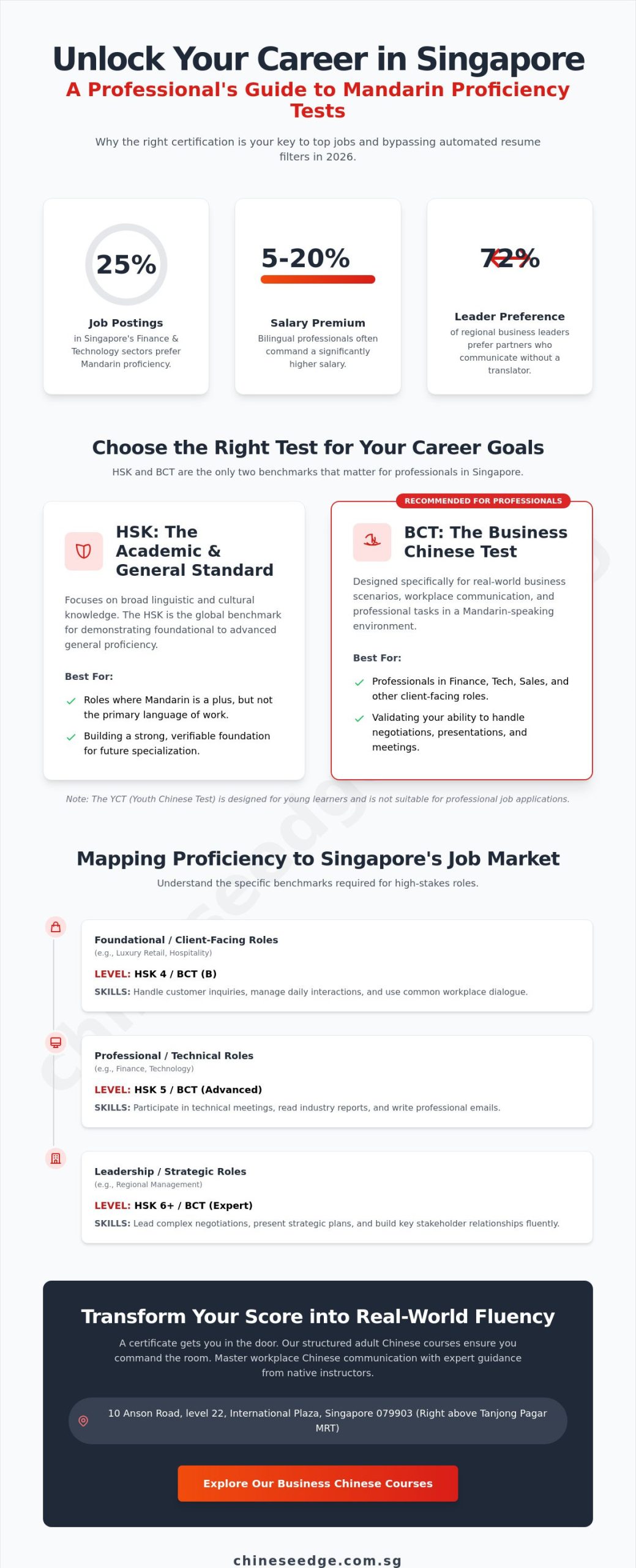
Did you know that 25% of job postings in Singapore’s finance and technology sectors now list Mandarin proficiency as a preferred skill? Despite this clear demand, many professionals face significant uncertainty when choosing the right mandarin proficiency test for job applications Singapore recruiters actually respect. You might worry that an academic HSK score won’t prepare you for a high-pressure technical interview or the nuances of regional business communication. It’s a valid concern, especially as 72% of regional business leaders now prefer partners who can communicate fluently without a translator.
We recognize that your goal isn’t just to pass a test; it’s to advance your career and handle business interactions with total confidence. This 2026 guide will help you select the most relevant certification to improve your resume visibility and command the 5% to 20% salary premium often awarded to bilingual professionals. We’ll examine the latest HSK 3.0 requirements, compare them to actual workplace needs, and provide a clear roadmap for leveraging your linguistic skills in a professional setting. From our training center at 10 Anson Road, level 22, International Plaza, located right above Tanjong Pagar MRT, we see how the right framework turns a certificate into a strategic career asset.
Key Takeaways
- Learn why a standardized score is now a prerequisite for bypassing automated resume filters in Singapore’s top MNCs.
- Compare the HSK and BCT frameworks to select the specific mandarin proficiency test for job applications Singapore recruiters value most in your industry.
- Discover the specific proficiency benchmarks required for high-stakes roles in finance, technology, and creative media.
- Prepare for technical interviews by mastering professional self-introductions and common workplace dialogue patterns.
- Explore how structured adult Chinese courses can transform test scores into functional workplace fluency.
Why a Mandarin Proficiency Test is Critical for Singapore Job Applications in 2026
In 2026, Singapore’s role as a global business hub has deepened through its High-Quality Comprehensive Contemporary Partnership with China. With over 8,500 Chinese enterprises now registered in the city-state, the demand for a valid mandarin proficiency test for job applications Singapore professionals can present has reached an all-time high. It’s no longer enough to claim you’re “good at Chinese” on a resume. Employers need objective, standardized proof that you can function in a high-stakes professional environment without the need for a translator.
Most multinational corporations (MNCs) now utilize sophisticated Applicant Tracking Systems (ATS) to filter thousands of applications. If you list your skills as “fluent” without a recognized score like the Hanyu Shuiping Kaoshi (HSK), your resume might be filtered out before a human recruiter even sees it. A standardized score acts as a digital handshake. It provides immediate credibility and signals your competence to HR departments across the region.
To better understand the technical requirements and preparation strategies for proficiency exams, watch this helpful video:
Mandarin as a Career Multiplier in Singapore
Current data shows that 25% of job postings in Singapore’s finance and technology sectors now prioritize Mandarin skills. In industries like Fintech, Private Banking, and Luxury Retail, being bilingual is a significant strategic asset. Research indicates that professionals with these skills can earn between 5% and 20% more than their monolingual counterparts. While a conversational chinese course provides a strong foundation for social interaction, senior roles require a formal credential to validate that you can handle complex negotiations. Proving your level through a test shows that you possess the discipline required for leadership roles in regional headquarters.
Meeting Recruiter Expectations
Recruiters at major firms look for more than just basic vocabulary. They need to know you can master workplace chinese communication standards, which include specific industry terminology and cultural nuances. Successfully passing a proficiency test proves you’ve moved beyond social fluency into the realm of professional application. It also builds immediate trust with Chinese-speaking stakeholders and clients who value the effort taken to master their language formally. If you’ve been investing time in a mandarin course, taking the official exam is the best way to validate your progress. At our training center at 10 Anson Road, level 22, International Plaza, located right above Tanjong Pagar MRT, we help professionals bridge the gap between classroom learning and the rigorous demands of the modern Singaporean job market.
The Most Recognized Mandarin Proficiency Tests for Adults
Selecting the right mandarin proficiency test for job applications Singapore employers trust is the first step toward professional validation. While several certifications exist, two primary frameworks dominate the professional landscape: the Hanyu Shuiping Kaoshi (HSK) and the Business Chinese Test (BCT). For adult professionals, these are the only two benchmarks that carry significant weight in a corporate setting. You should steer clear of the YCT (Youth Chinese Test); it is tailored for non-adult learners and won’t meet the rigorous standards of a modern HR department.
Preparing for these exams in 2026 often involves digital formats. Many candidates now opt for online mandarin classes to familiarize themselves with the computer-based testing environment. This approach allows you to practice Chinese character input and listening comprehension using the same digital tools you’ll encounter on exam day. It’s a practical way to ensure your technical skills match your linguistic ability.
HSK: The Foundation for Professionals
The HSK remains the global standard for general language ability. Although the new HSK 3.0 system has expanded to nine levels, levels 1 through 6 remain the core focus for most job seekers in the current market. HSK Level 4 is widely regarded by recruiters as the minimum “professional” threshold. At this stage, you’re expected to converse fluently on a wide range of topics and read business-related materials. If you’re aiming for the HSK iBT (internet-based test) in Singapore, focus on your typing speed and reading stamina. You can refine these specific skills through a structured mandarin course designed for adult learners.
BCT: Tailored for the Corporate World
The BCT is a specialized mandarin proficiency test for job applications Singapore candidates use when targeting roles in trade, finance, or international cooperation. It comes in two main versions. BCT (A) is a beginner-oriented test focusing on daily office communication and basic social interactions. BCT (B) is an advanced exam that tests your ability to handle complex business negotiations, formal report writing, and professional etiquette. If you want to excel in workplace chinese communication, a dedicated business chinese course is the most direct path. It moves beyond general vocabulary to teach the specific linguistic nuances required for BCT success. Our team at 10 Anson Road, level 22, International Plaza, located right above Tanjong Pagar MRT, provides the expert mentorship needed to navigate these technical requirements with confidence.
Mapping Proficiency Levels to Singapore’s Job Market
Understanding how your score on a mandarin proficiency test for job applications Singapore translates to daily tasks is essential for your career strategy. Recruiters often use broad terms like “Basic” or “Advanced,” but these labels carry specific expectations in a professional environment. A “Basic” level usually aligns with HSK 1 to 3, where you can handle routine social exchanges and follow simple instructions. “Intermediate” proficiency, typically HSK 4, is the standard for most office-based roles, enabling you to participate in meetings and read standard business correspondence. “Advanced” proficiency, encompassing HSK 5, HSK 6, or BCT (B), is reserved for roles requiring complex negotiation and high-level abstract reasoning.
When you update your LinkedIn profile, accuracy is your best tool for building trust. Instead of stating “Conversational Mandarin,” list your specific test score, such as “HSK Level 5 Certified.” This clarity helps you stand out to headhunters looking for chinese for professionals. It removes the guesswork for the recruiter and positions you as a candidate who understands the importance of standardized benchmarks in the Singaporean corporate landscape.
Proficiency Requirements by Job Category
Different sectors in Singapore demand different linguistic priorities. If you’re targeting Customer Service or Operations, the focus is on high-frequency conversational fluency. You need to resolve issues quickly and politely, which requires a strong conversational chinese course foundation. In contrast, Sales and Account Management roles demand a higher level of social etiquette and the ability to navigate subtle power dynamics during a business chinese course simulation or real-world pitch.
For those in Technical, Legal, or Financial sectors, precision is the priority. A minor misunderstanding in industry-specific terminology can lead to significant errors. Professionals in these fields must aim for advanced certification to prove they can produce formal writing and handle technical workplace chinese communication without ambiguity. If you’re unsure where you stand, searching for a mandarin class singapore that offers professional diagnostic testing is a wise first step.
Evaluating Your Current Level
There’s a significant difference between “knowing” Mandarin and “working” in Mandarin. You might feel comfortable ordering food or chatting with friends, but conducting a performance review or analyzing a market report requires a different vocabulary set. A dedicated chinese speaking course helps bridge this gap by placing you in simulated professional scenarios. It moves you beyond theory and into practical application.
At Chinese Edge, we provide internal assessments to help you gauge your readiness for an official mandarin proficiency test for job applications Singapore. These evaluations identify your specific strengths and weaknesses, ensuring you don’t waste time on levels that don’t match your career goals. Whether you prefer online mandarin classes or face-to-face sessions at our center at 10 Anson Road, level 22, International Plaza, located right above Tanjong Pagar MRT, our goal is to ensure your proficiency level matches the reality of your target job market.
How to Prepare for a Mandarin Job Interview in Singapore
Securing a high score on a mandarin proficiency test for job applications Singapore recruiters respect is a major milestone. However, the interview is where you must demonstrate that your test results translate into real-world performance. In a professional setting, your self-introduction (自我介绍) serves as more than just a summary of your resume. It’s a strategic opportunity to showcase your command of workplace chinese communication and your understanding of local business etiquette. You should focus on your professional achievements rather than personal hobbies, using precise terminology that aligns with the role’s requirements.
Preparation goes beyond memorizing vocabulary. You need to be ready for technical questions that test your ability to explain complex concepts in Mandarin. For instance, if you’re applying for a fintech role, you might be asked to describe market trends or regulatory challenges. Demonstrating this level of chinese for professionals requires a blend of linguistic accuracy and cultural awareness. Addressing your interviewers with the respectful “Nin” (您) and using appropriate professional titles can set a positive tone from the very first minute.
The Anatomy of a Mandarin Interview
A typical professional interview in Singapore often follows a three-phase structure. The first phase involves social opening and rapport building, often referred to as “small talk” or hanxuan (寒暄). This stage is crucial for building trust, a key element in the 72% of regional business leaders who prefer partners who can communicate fluently without a translator. The second phase moves into your professional background, where you must articulate your career progression and key wins with clarity. Finally, the third phase involves behavioral questions. You’ll need to handle hypothetical scenarios, such as resolving a conflict with a client, using the STAR (Situation, Task, Action, Result) method adapted for a Mandarin-speaking context.
Practical Preparation Tips
To succeed under pressure, you must refine your delivery. Recording yourself is a highly effective way to check for tonal accuracy and professional phrasing. Many candidates find that their tones slip when they’re nervous, which can change the meaning of technical terms. Additionally, you should build a specific vocabulary list of industry terms relevant to your target sector. While self-study is helpful, a structured mandarin class singapore provides the mock interview environments necessary to build genuine confidence. At Chinese Edge, we simulate these high-pressure scenarios to ensure you’re ready for any question an interviewer might throw at you. If you’re ready to take the next step in your career, explore our business chinese course options to sharpen your interview skills. Our training center at 10 Anson Road, level 22, International Plaza, is located right above Tanjong Pagar MRT, making it a convenient hub for busy professionals.
Achieve Workplace Fluency with Chinese Edge
Mastering a mandarin proficiency test for job applications Singapore requires more than just memorizing character lists. It demands a structured approach that bridges the gap between academic knowledge and the fast-paced reality of the corporate world. At Chinese Edge, we specialize exclusively in adult Chinese education, focusing on the specific linguistic needs of professionals. Our curriculum is methodically designed to align with HSK and BCT benchmarks, ensuring that every lesson contributes directly to your exam success and your career advancement.
Our native-speaking instructors bring deep experience in professional communication to every session. They don’t just teach the language; they mentor you on the nuances of workplace chinese communication. Whether you choose our online mandarin classes for maximum flexibility or prefer the immersive environment of our physical classrooms, you’ll receive the same high standard of results-oriented training. We believe that fluency is an attainable goal when supported by a proven methodology and expert guidance.
Why Professionals Choose Chinese Edge
We’ve positioned our training center at 10 Anson Road, level 22, International Plaza, specifically to serve the business community. Being located right above Tanjong Pagar MRT makes it easy for busy executives to attend a mandarin course during lunch breaks or after office hours. This physical presence in the heart of the commercial district reflects our identity as a partner in your professional growth.
To ensure you receive the attention you deserve, we maintain small group sizes. This maximizes your speaking time and allows our instructors to provide personalized feedback on your tonal accuracy and professional phrasing. Many of our students have achieved proven results, successfully navigating career pivots into regional roles or securing promotions within MNCs that require corporate mandarin training. By focusing on the practical application of the language, we help you become a candidate who doesn’t just hold a certificate but can actually execute a job in Mandarin.
Take the Next Step in Your Career
Your journey toward becoming a preferred candidate in Singapore’s bilingual market starts with a clear plan. If you’re ready to move beyond basic social fluency, explore our group chinese courses for a structured learning experience that targets your specific professional goals. These programs are designed to take you through the levels of the mandarin proficiency test for job applications Singapore with confidence and clarity.
We invite you to contact our consultants at International Plaza for a comprehensive level assessment. We’ll help you identify your current standing and map out a path to reach the benchmarks required by your target industry. Don’t let a lack of formal certification hold you back from the 5% to 20% salary premium often available to bilingual professionals. Start your training today and transform your Mandarin skills into a strategic career asset.
Secure Your Competitive Edge in Singapore’s Global Market
Mastering the right mandarin proficiency test for job applications Singapore requires a strategic blend of academic discipline and practical application. We’ve explored how a recognized score serves as a critical bridge between your current abilities and the rigorous expectations of top-tier recruiters. By moving beyond general fluency and focusing on industry-specific benchmarks, you ensure your resume stands out in high-growth sectors like finance and technology. Proving your competence through standardized frameworks like the HSK or BCT is the most effective way to validate your skills to regional employers.
At Chinese Edge, our expert native-speaking instructors provide a specialized adult conversational and business curriculum designed to produce tangible results. Whether you prefer online sessions or face-to-face learning at our prime location at 10 Anson Road, level 22, International Plaza, right above Tanjong Pagar MRT, we offer the steady support you need to succeed. Enroll in our Business Mandarin Course at International Plaza today! and take the final step toward professional bilingualism. Your career goals are attainable through our structured and proven approach. We look forward to partnering with you on your journey to success.
Frequently Asked Questions
What is the best Mandarin proficiency test for job applications in Singapore?
The HSK (Hanyu Shuiping Kaoshi) is the most widely recognized mandarin proficiency test for job applications Singapore employers look for across diverse industries. While the HSK measures general ability, the Business Chinese Test (BCT) is highly valued for roles specifically in trade and finance. Choosing between them depends on whether you need a broad credential or one specifically tailored to corporate environments and technical negotiations.
Is HSK level 4 enough for a professional job in Singapore?
HSK Level 4 is generally considered the minimum threshold for professional roles where Mandarin is a core requirement. At this level, you can read standard business documents and participate in most office meetings with reasonable fluency. For senior management positions or roles involving high-stakes negotiations, aiming for HSK Level 5 or 6 is a strategic move to ensure you remain competitive against bilingual counterparts.
Can I take a Mandarin proficiency test online in Singapore?
You can take the HSK as an internet-based test (iBT) at authorized centers in Singapore. This format is identical in content to the paper-based version but allows for digital character input, which many professionals find more practical. Enrolling in online mandarin classes is an excellent way to get comfortable with the digital interface and typing requirements before your actual exam date.
How long does it take to prepare for the Business Chinese Test (BCT)?
Preparation time for the BCT varies based on your starting level, but most professionals require three to six months of consistent study to see significant results. A structured business chinese course can accelerate this process by focusing specifically on high-frequency workplace vocabulary. This targeted approach ensures you spend your time mastering the formal etiquette and negotiation language required for the exam rather than general social phrases.
Do Singaporean employers prefer HSK or a local Mandarin course certificate?
Most MNCs and large enterprises prefer the HSK because it is an internationally standardized benchmark that is easy to verify. However, a certificate from a reputable mandarin course singapore provider demonstrates your ongoing commitment to professional development. Combining an official HSK score with a specialized course certificate provides the strongest evidence of both your linguistic competence and your dedication to continuous learning.
What happens if I fail the Mandarin portion of a job interview?
Failing the Mandarin portion of an interview usually means you haven’t yet reached the required level of workplace chinese communication for that specific role. It’s a signal to refine your skills through a more targeted program rather than a permanent career setback. Many professionals use this feedback to enroll in a conversational chinese course to build the specific verbal confidence needed for their next opportunity.
How do I list my Mandarin proficiency on my resume if I haven’t taken a test yet?
If you haven’t taken an official test, describe your level using terms like “Professional Working Proficiency” or “Full Professional Proficiency.” You should also mention if you are currently enrolled in a mandarin course to show you are actively working toward a formal credential. This transparency builds trust with recruiters while you prepare for your formal mandarin proficiency test for job applications Singapore.
Are there specific Mandarin courses for professionals in Singapore?
Yes, specialized training is available for those who need chinese for professionals to advance their careers. At Chinese Edge, we offer corporate mandarin training and business-focused modules at our center at 10 Anson Road, level 22, International Plaza. Our location right above Tanjong Pagar MRT makes it convenient for adults to balance their career goals with effective, results-oriented language learning.
Disclaimer
Disclaimer
The Chinese articles on this website are provided for general information and learning purposes only. While we strive for accuracy, we make no guarantees regarding completeness or reliability. The content does not constitute professional advice, and we are not liable for any loss arising from its use. External links or third-party content are for reference only. By using this website, you agree to this disclaimer.