

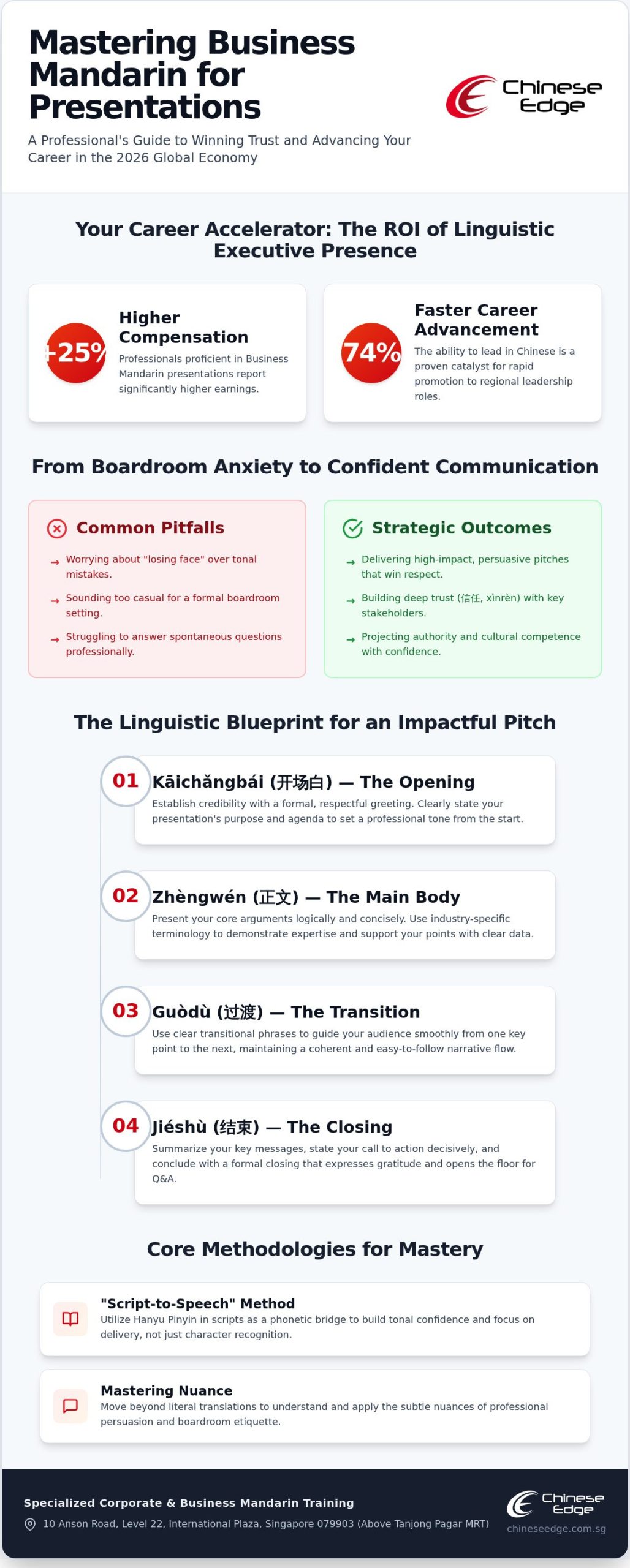
Did you know that professionals with the skills to handle business mandarin for presentations report up to 25% higher compensation and a 74% faster career advancement rate? In the global economy of 2026, the ability to command a room in Chinese isn’t just a skill; it’s a significant career accelerator. We understand that standing before a board of directors is daunting, especially when you’re worried about losing face over a tonal mistake or sounding too casual for a formal setting. It’s natural to feel pressure when you need to answer spontaneous questions without losing your professional edge.
This guide teaches you how to deliver high-impact, persuasive pitches that win trust and respect. You’ll learn essential formal opening and closing phrases, strategies for spontaneous Q&A, and the subtle nuances of Chinese boardroom etiquette. Whether you’re looking for a business chinese course at our center at 10 Anson Road, level 22, International Plaza, located right above Tanjong Pagar MRT, or prefer corporate mandarin training online, our methodical approach ensures you gain the confidence to lead. We’ll provide the structured path you need to turn workplace chinese communication into your strongest professional asset.
Key Takeaways
- Learn why mastering business mandarin for presentations is a vital career asset for professionals navigating the evolving 2026 economic landscape.
- Gain a clear four-part framework to structure your pitch, ensuring a logical flow from your formal opening to a decisive closing.
- Explore the nuances of professional adaptation to avoid the pitfalls of literal translation and maintain executive presence.
- Apply the “Script-to-Speech” methodology to build tonal confidence and eliminate anxiety when speaking in a high-stakes boardroom.
- Understand how to leverage specialized training at our center above Tanjong Pagar MRT to refine your workplace communication skills.
The Strategic Importance of Business Mandarin for Presentations in 2026
Mastering business mandarin for presentations involves much more than memorizing a few technical terms. It requires a command of formal registers, industry-specific terminology, and the specific rhetorical structures needed to influence high-level stakeholders. As we move through 2026, the economic shift toward North Asian trade hubs has made this skill indispensable for Singaporean professionals. Those who can articulate complex strategies in Mandarin are no longer just employees; they are strategic assets who can bridge the gap between global headquarters and regional markets.
In a high-stakes boardroom, linguistic precision is the foundation of credibility. While basic conversational skills might help during a casual coffee break, simple phrases like “Hao ma” won’t suffice when you’re defending a multi-million dollar budget. Using the correct professional terminology demonstrates respect for the culture and the complexity of the business. It protects your “face” and the “face” of your organization, ensuring that your message isn’t lost in translation or dismissed due to an overly casual tone. When you speak the language of the boardroom, you’re seen as an equal partner rather than a visitor.
To see how specific phrases can transform your professional interactions, watch this helpful video:
The ROI of Linguistic Executive Presence
Establishing trust, or xinren, is the primary goal of any executive communication. When you present using Standard Chinese (Putonghua), you align yourself with the professional standards of the Greater China region. This alignment reduces your reliance on third-party translators, allowing you to maintain direct, uninterrupted rapport with key decision-makers. In a Mandarin context, “Executive Presence” is defined as the ability to project authority and cultural competence through precise language and disciplined delivery. This direct connection often speeds up the decision-making process and solidifies long-term partnerships.
Mandarin as a Competitive Edge in the Singapore CBD
For those working in the Singapore CBD, being a bilingual bridge is a massive career advantage. Professionals who master business mandarin for presentations often find themselves fast-tracked for regional leadership roles within MNCs. Our training center at 10 Anson Road, level 22, International Plaza, is located right above Tanjong Pagar MRT, making it convenient for executives to refine their skills during lunch or after work. Investing in a business chinese course ensures you’re prepared to lead in an increasingly Mandarin-centric corporate world where clarity and cultural nuance are the keys to success.
Structuring Your Pitch: The Linguistic Blueprint for Impactful Chinese Presentations
A successful pitch relies on a logical architecture that guides your audience from the initial greeting to the final call to action. When mastering business mandarin for presentations, you must adopt a specific four-part framework: the kaichangbai (opening), the zhengwen (main body), the guodu (transition), and the jieshu (closing). Following this blueprint ensures your delivery remains professional and your message stays coherent, even under the pressure of a high-stakes boardroom environment.
For many professionals, relying entirely on Chinese characters during a speech can lead to hesitation. We recommend using Hanyu Pinyin for your script preparation. It acts as a reliable phonetic bridge, allowing you to focus on tonal accuracy and emotional delivery rather than struggling to recall complex strokes. This method is particularly effective for those who want to learn chinese with a focus on immediate workplace application.
Your visual aids should complement your speech, not compete with it. Avoid cluttering your slides with dense blocks of Chinese text. Instead, use high-impact keywords and clean data visualizations. If your audience is reading your slides, they aren’t listening to your pitch. During the Q&A session, practice active listening and use professional clarification phrases. This demonstrates respect and ensures you address the stakeholder’s specific concerns with precision.
The Power Opening: Setting the Tone
Your first thirty seconds determine your executive presence. Begin with a formal greeting such as “Zunwei de各位 laoban/tongshi” (Respected leaders and colleagues). Clearly state your objective using “Wo jintian de mu biao shi…” (My goal today is…). Briefly establishing your professional background in Mandarin at the start builds immediate authority and reassures your audience of your competence. Refining these structural elements is a core focus of our business chinese course at International Plaza.
Seamless Transitions and Logical Flow
Signposting is essential for keeping your audience engaged. Use “Di yi” (First), “Qi ci” (Second), and “Zui hou” (Finally) to provide a clear roadmap of your presentation. When connecting data to insights, phrases like “Zhe xie shuju shuo ming le…” (This data explains that…) help bridge the gap between numbers and strategy. Here are five essential transition phrases for 2026 business pitches:
- Ling yi fang mian: On the other hand (useful for showing balanced perspectives).
- Ji yu zhe dian: Based on this point (linking a fact to a conclusion).
- Zheng ru ni suo jian: As you can see (directing attention to visual data).
- Wo men lai kan kan: Let us take a look at (moving to a new slide or topic).
- Zong de lai shuo: Generally speaking (summarizing a complex section).
By mastering these transitions, you transform a series of isolated points into a persuasive narrative. If you’re looking for chinese classes near me in the CBD, our center at 10 Anson Road, level 22, International Plaza, right above Tanjong Pagar MRT, provides the disciplined environment needed to perfect these linguistic blueprints.
Beyond Vocabulary: Mastering the Nuances of Professional Persuasion in Mandarin
Persuasion in a Chinese boardroom isn’t about volume; it’s about nuance. While Section 2 outlined the structural blueprint for your speech, true mastery of business mandarin for presentations requires moving from literal translation to professional adaptation. When you translate English thoughts word-for-word, you risk sounding blunt or culturally detached. Professional adaptation allows you to adjust your register to match the seniority of your audience, ensuring your message lands with the intended impact.
Tonal accuracy remains your most vital tool for building credibility. A misplaced tone can literally change the meaning of your words, turning a strategic “pitch” into a confusing “mistake.” Beyond the mechanics of sounds, you must learn to soften your delivery to maintain harmony. Using “jianyi” (suggest) instead of “yaoqiub” (demand) signals a collaborative mindset that is highly valued in 2026. Understanding when to be direct and when to employ indirect professional phrasing is what separates a proficient speaker from a truly influential executive.
Power Phrases for Negotiation and Agreement
Achieving consensus is an art form in Mandarin. To signal agreement and move a meeting forward, use “Wo men dacheng le gongshi” (We have reached a consensus). If you must handle disagreement, do so with surgical politeness: “Wo lijie nin de guandian, danshi…” (I understand your perspective, but…). This acknowledges the other party’s “face” before presenting your counter-argument. Practicing these high-pressure scenarios in a controlled environment like our Group Chinese Courses helps build the muscle memory needed for real-world boardrooms.
Avoiding Common “Chinglish” Pitfalls
Many professionals fall into the trap of using “Chinglish,” where English idioms are translated directly into Mandarin. Phrases like “the ball is in your court” have no literal equivalent and will only confuse your audience. Sophisticated speakers use “Chengyu,” or four-character idioms, to demonstrate deep cultural literacy and education. Using the right idiom at the right time instantly elevates your status in the room. Consider the difference in impact between a basic and a professional invitation to collaborate:
- Basic: “Women yiqi gongzuo ba” (Let’s work together).
- Professional: “Women qidai yu guigongsi xieshou hezuo, gongchuang shuangying” (We look forward to joining hands with your company to create a win-win situation).
At our center in International Plaza, right above Tanjong Pagar MRT, we train you to identify these nuances. Our instructors help you move beyond basic vocabulary so your workplace chinese communication reflects your true professional standing and executive potential.
Practical Preparation: Overcoming Public Speaking Anxiety in a Second Language
Psychological barriers often prove more challenging than linguistic ones. Even if you have mastered the structural blueprint and professional nuances discussed in earlier sections, the physical pressure of a high-stakes boardroom can lead to hesitation. Success in business mandarin for presentations requires a disciplined preparation phase designed to build internal confidence. We recommend the “Script-to-Speech” method, which involves a gradual transition from full pinyin notes to keyword-only prompts. This systematic approach ensures you aren’t merely reading a script but are actively engaging with your audience.
Recording your practice sessions is a vital audit tool for any professional. Digital recording tools allow you to review your delivery and identify where your tones might flatten under stress. To handle the inevitable moments when a specific word escapes you, prepare a “safety net” of professional filler phrases. Using a phrase like “Rang wo xiang yi xia” (Let me think for a moment) or “Wo men lai kan kan zhe yi dian” (Let’s look at this point) buys you time without breaking your executive presence. This is far more effective than a long, silent pause that might signal a lack of preparation.
Mental Preparation and Confidence Building
Shift your focus from linguistic perfection to effective communication. In a 2026 business environment, stakeholders value clarity and cultural effort over flawless grammar. Before stepping on stage, use breathing techniques to ground your tones. If a linguistic slip-up occurs, recover gracefully by saying “Bu hao yise, wo xiang shuo de shi…” (Apologies, what I meant to say was…). This transparency builds trust and demonstrates your ability to remain composed under pressure. Our instructors at International Plaza often act as expert mentors, providing the mock presentation feedback you need to refine these recovery skills.
Leveraging Technology for Fluency
Modern professionals should use AI tools for initial pronunciation checks, but remember that these lack the nuanced feedback of a human mentor. Digital flashcards are excellent for drilling industry-specific terminology during your commute. To combine the convenience of technology with professional guidance, consider enrolling in our Online Mandarin Classes Singapore. This allows you to practice your delivery in a supportive, virtual environment before presenting in person. If you prefer a physical setting, our center at 10 Anson Road, level 22, International Plaza, is located right above Tanjong Pagar MRT, offering the perfect space for corporate mandarin training. For those who want to refine their skills alongside peers, our Group Chinese Courses provide excellent collaborative practice.
Elevate Your Executive Presence with Chinese Edge’s Business Mandarin Training
Mastering the structural blueprints and psychological strategies discussed in previous sections is a significant achievement, yet true fluency requires a structured environment to flourish. Our Business Mandarin Course is engineered specifically for business mandarin for presentations, moving beyond textbook theory into the high-pressure reality of the boardroom. At Chinese Edge, we serve as your expert mentor, bridging the gap between basic language skills and the executive presence required in 2026.
Our training center is located at 10 Anson Road, level 22, International Plaza, right above Tanjong Pagar MRT. This central location allows professionals in the CBD to refine their skills without disrupting their busy schedules. Whether you’re delivering a technical pitch or a financial report, our native instructors with corporate backgrounds provide the industry-specific feedback you need to succeed. We provide customized corporate mandarin training tailored to the unique linguistic demands of Finance, Tech, and Law. This ensures your workplace chinese communication is not only accurate but also strategically aligned with your professional goals. By focusing on practical application, we help you deliver business mandarin for presentations that wins trust and closes deals.
Methodical Learning for Busy Professionals
Our school prioritizes efficiency through flexible scheduling, offering lunchtime, evening, and weekend sessions. We maintain small group sizes to ensure every student receives maximum speaking time and personalized feedback on their tones. This methodical approach is a cornerstone of our success, making fluency an attainable goal for even the most time-pressed executives. For a broader look at your options, explore our Mandarin Classes in Singapore guide. We don’t just teach vocabulary; we teach you how to command a room.
Join the Community at International Plaza
Studying at our Tanjong Pagar center places you within a vibrant community of like-minded professionals. Networking with peers in the heart of the CBD provides a supportive environment that balances academic rigor with the practical application of your new skills. We invite you to experience our premium boutique school firsthand. Take the next step in your professional growth by booking a consultation at our International Plaza center today. Let us help you transform your mandarin class singapore experience into a powerful tool for regional leadership and career advancement.
Command the Boardroom with Confidence
Mastering business mandarin for presentations involves more than just linguistic accuracy; it requires a deep understanding of corporate etiquette and structural flow. By adopting a clear linguistic blueprint and moving beyond literal translations, you can project the executive presence necessary for regional leadership. We’ve explored how a disciplined approach to preparation, combined with professional adaptation, turns public speaking anxiety into a competitive advantage in the 2026 market.
Our school at International Plaza provides the methodical training needed to bridge the gap between basic fluency and professional mastery. With native-speaking instructors who possess real-world corporate expertise, we offer a customized Business Mandarin curriculum designed for your specific industry. Our center is conveniently located at 10 Anson Road, level 22, International Plaza, Singapore 079903, right above Tanjong Pagar MRT, making it highly accessible for busy CBD professionals.
Master your next presentation; book a consultation at Chinese Edge today!
Your journey toward becoming a persuasive bilingual leader starts with a single structured lesson. We are here to support your professional growth every step of the way.
Frequently Asked Questions
How can I start a business presentation in Mandarin professionally?
Begin with a formal greeting such as “Zunwei de各位 laoban” to establish immediate authority and respect. You should then state your objective clearly using “Wo jintian de mu biao shi” (My goal today is). This structured opening ensures your audience understands your purpose from the first thirty seconds of your speech.
What are the most common mistakes in Mandarin business presentations?
Misplaced tones and the literal translation of English idioms are the most frequent errors among professionals. These mistakes can lead to confusion or a loss of executive presence in the boardroom. Mastering business mandarin for presentations requires moving beyond basic vocabulary to adopt professional adaptation and cultural nuance.
Is it necessary to learn Chinese characters for business presentations?
You don’t need to master thousands of characters to deliver a high-impact speech. Hanyu Pinyin serves as an excellent phonetic bridge for your script preparation, allowing you to focus on tonal accuracy. However, recognizing key industry terms on your slides helps you stay aligned with your visual aids during the pitch.
How do I handle difficult questions in Mandarin during a Q&A session?
Prepare a list of professional filler phrases to buy time while you formulate your response. Using a phrase like “Rang wo xiang yi xia” (Let me think for a moment) demonstrates composure rather than hesitation. If a query is complex, use a clarification phrase to show you’re listening actively and to ensure you address the stakeholder’s concern accurately.
How long does it take to master Business Mandarin for presentations?
Achieving presentation readiness typically takes 10 to 20 focused sessions for those with an intermediate foundation. Our business chinese course is designed for rapid progression by focusing on the specific rhetorical structures needed for corporate environments. Your individual timeline will depend on your starting level and the complexity of your industry terminology.
Can I take Business Mandarin classes online with Chinese Edge?
Yes, we provide Online Mandarin Classes for professionals who require flexibility due to travel or busy schedules. These virtual sessions follow the same methodical approach as our in-person training at International Plaza. You’ll receive real-time feedback from native instructors to help you refine your delivery and tonal confidence.
What is the best way to practice Mandarin tones for public speaking?
Recording your delivery and reviewing it with an Expert Mentor is the most effective practice method. This allows you to audit your tones and identify where they might flatten or become inaccurate under the pressure of public speaking. Consistent feedback ensures your speech remains natural, authoritative, and persuasive.
Does Chinese Edge offer corporate training for entire teams in Singapore?
We provide customized corporate mandarin training for teams at our center located at 10 Anson Road, level 22, International Plaza. Our center is situated right above Tanjong Pagar MRT, making it highly accessible for CBD professionals. We tailor our syllabus to your specific sector, such as Finance or Tech, to ensure practical workplace application.
Disclaimer
Disclaimer
The Chinese articles on this website are provided for general information and learning purposes only. While we strive for accuracy, we make no guarantees regarding completeness or reliability. The content does not constitute professional advice, and we are not liable for any loss arising from its use. External links or third-party content are for reference only. By using this website, you agree to this disclaimer.