

With Singapore’s exports to China surging by 21.6% in the year leading up to May 2026, the financial stakes for local professionals have never been higher. Yet, many executives still feel a sense of dread when a meeting shifts from casual pleasantries to the actual terms of a contract. Mastering mandarin for business negotiation is the critical bridge between a polite introduction and a signed deal. You likely understand that a single misunderstood cue or a poorly phrased counter-offer can lead to a “loss of face” that jeopardizes months of rapport building.
We recognize these challenges. Whether you are looking for a business chinese course to sharpen your technical vocabulary or corporate mandarin training for your entire team, the goal is the same: confidence. This 2026 professional guide shares the specific linguistic strategies and cultural nuances required to close high-stakes deals in the Chinese business world. You’ll learn how to move beyond basic conversation to lead meetings with authority. From our training center at 10 Anson Road, level 22, International Plaza, Singapore 079903, located right above Tanjong Pagar MRT, we help you transform workplace chinese communication into a strategic advantage for long-term partnership success.
Key Takeaways
- Understand why linguistic precision is a non-negotiable requirement for regional leadership and how to avoid costly phrasing errors that stall deals.
- Master the concept of ‘Guanxi’ to build essential social capital and trust before moving to the formal contract phase of any meeting.
- Learn how to navigate circular communication styles and identify subtle linguistic markers when using mandarin for business negotiation.
- Gain a step-by-step framework for professional interactions, from the ritual of business card exchange to presenting proposals with authoritative industry terminology.
- Discover how specialized corporate training at our Tanjong Pagar center provides the linguistic tools and cultural depth needed to lead high-stakes meetings with confidence.
Beyond Translation: Why Mandarin for Business Negotiation Matters in 2026
In 2026, the ability to communicate in Mandarin has transitioned from a competitive advantage to a fundamental requirement for regional leadership. As Singapore’s exports to China reached S$7.74 billion in May 2026, the volume of cross-border interaction has intensified. Relying on English or basic translation apps is no longer sufficient when high-stakes decisions are on the line. Effective mandarin for business negotiation requires more than just translating words from one language to another. It involves understanding the intent and the strategic weight behind every phrase.
Small linguistic errors often carry a high price tag. In a boardroom setting, a slight misuse of a verb or a tone can inadvertently signal aggression or a lack of respect. These simple phrasing errors can stall million-dollar deals by creating unnecessary friction. Professionals who invest in a specialized business chinese course understand that language serves as a bridge. It moves the conversation away from a cold, transactional mindset and toward a partnership-driven approach that Chinese counterparts value deeply.
Standard conversational courses focus on daily life, such as ordering food or asking for directions. While these skills are helpful for tourists, they don’t prepare you for the complexities of a counter-offer or a strategic pivot during a high-level meeting. You need the specific vocabulary of your industry to maintain authority and ensure your message isn’t diluted by vague terminology.
The Professional Stakes of Language Proficiency
Trust is the currency of international trade. By demonstrating proficiency, you show respect for the culture and a commitment to the relationship. This is essential for Understanding ‘Guanxi’ and Rapport, which remains the bedrock of successful ventures in China. In the 2026 job market, having a background in corporate mandarin training differentiates you from peers who only possess technical skills. As business becomes more decentralized and digital-first, clear workplace chinese communication ensures that no nuance is lost in a video call or a messaging thread.
Meeting the Needs of the Singapore Professional
For those working in the CBD, the Singapore-China business corridor is a primary source of growth. Our training center at 10 Anson Road, level 22, International Plaza, Singapore 079903, sits right above Tanjong Pagar MRT, making it convenient for busy executives to attend a mandarin course after office hours. Professionals here are prioritizing chinese for professionals to navigate these corridors with confidence. If you want to lead effectively in this region, mastering the linguistic nuances of your field is the most logical step forward.
The Linguistic Pillar of Trust: Understanding ‘Guanxi’ and Rapport
Negotiation in Mandarin isn’t just about the numbers on a contract; it’s about the social capital you build before the ink even dries. This social capital is known as Guanxi (关系). Guanxi is the essential lubricant of Chinese business deals that facilitates trust and cooperation before any formal agreement is signed. If you don’t establish this rapport early, your technical arguments may fall on deaf ears. Successful mandarin for business negotiation requires you to view the relationship as the foundation upon which the deal sits.
The first 15 minutes of any meeting are often the most critical. Research on Chinese negotiating behavior suggests that counterparts prioritize relationship-building over immediate task-switching. This “niceties” phase isn’t just small talk; it’s a strategic assessment of your character and reliability. Using the right linguistic cues allows you to participate in this ritual without a filter, showing that you value the partnership as much as the profit. Professionals who have completed a business chinese course are better equipped to handle these high-stakes opening moments.
Essential Phrases for Building Foundation
Establishing respect begins with the correct pronoun. Always use ‘Nín’ (您) instead of the casual ‘Nǐ’ (你) when addressing senior leaders or new contacts. It creates an immediate atmosphere of professional deference. Another powerful tool is referring to their organization as ‘Guì gōngsī’ (贵公司), or “your honorable company.” This small linguistic choice signals that you understand traditional etiquette. If you’re looking to refine these nuances, joining a mandarin course can help you practice these in a simulated boardroom environment.
Equally important is the concept of ‘Mianzi’ (Face). Causing a counterpart to lose face during a counter-offer is a common mistake for those who haven’t undergone corporate mandarin training. Instead of a direct “no,” successful negotiators use indirect language. Phrasing a disagreement as “we might need to discuss this further” or “that is a unique perspective” preserves the other party’s dignity while keeping the negotiation alive. This mastery of workplace chinese communication prevents unnecessary conflict.
The Art of Professional Compliments
Rapport is strengthened by demonstrating that you’ve done your homework. Complimenting their ‘Fāzhǎn qiánjǐng’ (发展前景), or development prospects, shows you see the long-term value in their business. Frame your proposal around ‘Gòngtóng fāzhǎn’ (共同发展), which means mutual development. This shifts the focus from what you want to what you can achieve together. For professionals at International Plaza, mastering these cues is about more than just vocabulary; it’s about gaining the confidence to lead. If you’re ready to elevate your skills, consider exploring a tailored mandarin class singapore right here in the heart of the CBD at Tanjong Pagar.
Direct vs. Indirect: Navigating Communication Styles
Western negotiation often follows a linear trajectory where parties move from point A to point B in a logical, time-bound sequence. In contrast, Chinese negotiation logic is frequently circular. This means counterparts may revisit previously settled points to ensure the overall context of the relationship remains sound. Understanding these differences is a core component of effective mandarin for business negotiation. A classic study by the RAND Corporation on Chinese Commercial Negotiating Style highlights that patience and the ability to manage these non-linear progressions are vital for success.
In many complex Singaporean-Chinese deals, the ‘Zhongjianren’ (中间人) or middleman plays a pivotal role. This individual acts as a buffer, smoothing over direct confrontations and facilitating communication when negotiations reach an impasse. Professionals who have mastered workplace chinese communication know how to work with a middleman to relay sensitive information without causing friction. This indirect approach allows both parties to explore difficult terms without the risk of a public stalemate.
One of the most challenging aspects for professionals is learning how to express “No” without ever using the word. In a high-stakes environment, a flat “No” can be perceived as aggressive or dismissive. Instead, linguistic gymnastics like “Bù tài fāngbiàn” (It’s not very convenient) or “Wǒmen zài yánjiū yánjiū” (We will study it further) serve as polite ways to signal a decline or a need for major changes. Mastering these subtleties is what separates a basic learner from a true expert in chinese for professionals.
Decoding ‘Maybe’ and ‘Let’s See’
When a counterpart says “Wǒmen zài kǎolǜ kǎolǜ” (We will think it over), it is often a strategic pause rather than a simple delay. You must learn to identify the subtle linguistic markers that follow. If the delay is accompanied by specific questions about technical implementation, the deal is likely progressing. If the language remains vague and non-committal, the deal may be stalling. Asking for clarification requires a soft touch; use phrases that invite more detail rather than those that demand a deadline.
The Singaporean Advantage in Communication
Singaporean professionals have a unique advantage. By balancing bilingualism, they act as a cultural and linguistic bridge between Western corporate structures and Chinese business traditions. Leveraging a specialized mandarin course helps you move beyond basic grammar to master high-context communication. At our center located at 10 Anson Road, level 22, International Plaza, Singapore 079903, right above Tanjong Pagar MRT, we train you to maintain authority while remaining humble. This balance is the hallmark of the ‘Expert Mentor’ persona, allowing you to lead negotiations with a steady, results-oriented hand.
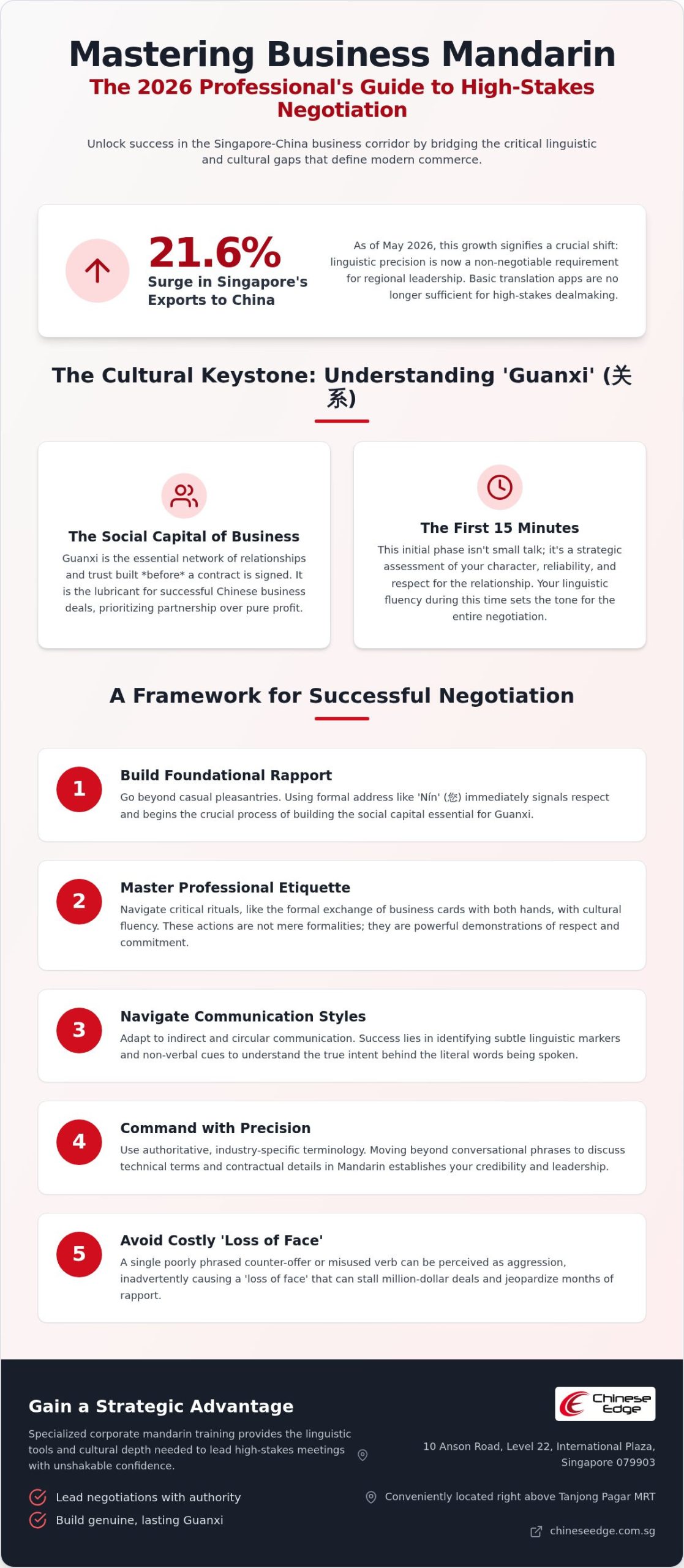
A Step-by-Step Guide to Successful Mandarin Negotiations
Mastering mandarin for business negotiation requires a disciplined approach to the physical and verbal rituals of the boardroom. Unlike Western meetings that may dive quickly into data, a Chinese negotiation is a choreographed performance where each phase serves a specific purpose. By following a structured sequence, you demonstrate that you’re a serious partner who respects the local professional landscape. This process begins the moment you enter the room and continues long after the contract is signed.
In the initial phase, your goal is to establish a clear hierarchy. This is followed by presenting your proposal using authoritative industry terminology that reflects your expertise. Professionals who have undergone corporate mandarin training know that using precise technical terms prevents the “diluted message” that often occurs when relying on general conversational skills. When you reach the counter-offer stage, the focus shifts to win-win language, ensuring that neither party feels backed into a corner.
The Rituals of the Negotiation Room
Success starts with the physical environment. Seating arrangements are strictly hierarchical; the most senior person usually sits in the center or facing the door. When you begin the business card exchange, use both hands to present your card and say ‘Zhè shì wǒ de míngpiàn’ (This is my business card). Take a moment to read their card before placing it on the table. This etiquette is a vital trust signal. Remember that the negotiation often continues away from the table during a ‘Guanxi’ dinner. These social settings are where the most difficult barriers are often lowered through informal workplace chinese communication.
Mastering the Counter-Offer
When terms are being debated, your choice of verbs can signal either flexibility or firm resolve. Use ‘Rènwéi’ (Believe/Think) when you want to state a definitive professional position, as it carries more weight than the subjective ‘Juéde’ (Feel). If you need to explore a middle ground, use ‘Wǒmen kěyǐ zài shāngliáng’ (We can discuss further) to keep the dialogue open. You can effectively pivot during a stalemate by stating ‘Wèile gòngtóng de lìyì’, which refocuses the discussion on mutual benefits rather than individual demands. This “Golden Bridge” allows both sides to move toward a compromise without losing face.
Once the deal is sealed, post-negotiation rapport maintenance is essential to ensure the partnership remains healthy. If you want to gain the specific linguistic tools needed for these high-stakes interactions, our business chinese course offers the practical training you need. Visit us at 10 Anson Road, level 22, International Plaza, Singapore 079903, located right above Tanjong Pagar MRT, or book a consultation with our expert mentors to start your journey toward professional fluency.
Elevate Your Career with Business Mandarin Courses in Singapore
Mastering the intricacies of mandarin for business negotiation isn’t a skill you can acquire in a single afternoon. While some providers offer one-day crash courses, these often fail to provide the long-term conversational fluency and cultural depth required to manage million-dollar deals. At Chinese Edge, we understand that true professional proficiency comes from a structured, methodical approach that mirrors the discipline of the corporate world itself. Our programs are designed to transform you into a confident communicator who can lead meetings with authority and precision.
We provide a sophisticated bridge between your current linguistic level and the high-stakes environment of the boardroom. Whether you’re an executive looking to sharpen your individual skills or a manager seeking corporate mandarin training for your entire team, our curriculum focuses on the practical application of the language. You won’t just learn vocabulary; you’ll learn how to deploy it strategically to build rapport and close deals. This results-oriented focus makes us the preferred choice for professionals working within Singapore’s competitive commercial districts.
Tailored Learning for Professionals
Our methodology centers on live interactive sessions with native-speaking instructors who possess significant corporate experience. This ensures that you aren’t just learning a language, but also the professional etiquette that accompanies it. For those who thrive in collaborative environments, our Chinese Edge Group Courses offer small group settings that maximize individual speaking time. If your schedule requires more flexibility, our online Mandarin classes allow busy executives to maintain their learning momentum from any location. Every business chinese course we offer is built on a problem-solution framework, linking your specific career objectives to proven linguistic strategies.
Your Training Center in the Heart of the CBD
Convenience is a critical factor for the modern professional. Our training center is located at 10 Anson Road, level 22, International Plaza, Singapore 079903, situated right above Tanjong Pagar MRT. This prime location allows you to attend a mandarin class singapore during your lunch hour or immediately after work without the stress of a long commute. By choosing a chinese course singapore in the heart of the CBD, you join a community of like-minded leaders who are all committed to mastering mandarin for business. We invite you to step into our modern learning center and experience a systematic path to fluency that respects your time and supports your professional growth. Your journey toward leading a successful mandarin for business negotiation starts with a single, disciplined step at International Plaza.
Master the Art of the Deal in 2026
Mastering mandarin for business negotiation is the final step in transitioning from a regional observer to a decisive leader. You now understand that a successful deal relies as much on the ‘Guanxi’ you build as it does on the technical terms you propose. By navigating indirect communication and mastering boardroom rituals, you ensure that your professional intent is never lost in translation. It’s about moving beyond basic conversation to lead with authority and cultural precision.
Our native-speaking instructors specialize in adult education and provide a proven curriculum tailored for professional training. We invite you to join our community of learners at 10 Anson Road, level 22, International Plaza, located right above Tanjong Pagar MRT. This methodical approach ensures that fluency is a predictable outcome of your dedication rather than a distant hope. We’re here to support your professional growth every step of the way.
Enroll in our Business Mandarin Course at Tanjong Pagar today!
Frequently Asked Questions
Do I need to be fully fluent in Mandarin to negotiate effectively?
You don’t need native-level fluency to succeed; you need strategic competence in specific professional scenarios. Focusing on high-impact vocabulary and cultural cues allows you to maintain authority and build rapport. Our business chinese course targets these essential professional needs so you can lead high-level discussions without requiring years of general academic study first.
What are the most important phrases to use during a counter-offer?
Effective counter-offers rely on non-confrontational language that keeps the dialogue open. Instead of a direct rejection, use ‘Wǒmen kěyǐ zài shāngliáng’ (We can discuss further) to signal flexibility. Phrases that emphasize mutual interest, such as ‘Wèile gòngtóng de lìyì’, are essential tools for mandarin for business negotiation when you need to pivot during a stalemate.
How does the concept of ‘Face’ (Mianzi) impact a business deal?
‘Face’ represents a person’s social standing and professional reputation. If you cause a counterpart to lose face by being too blunt or correcting them publicly, the deal may collapse regardless of the financial terms. Successful workplace chinese communication requires using indirect language to preserve dignity while still moving toward your commercial objectives.
Are your Business Mandarin courses suitable for complete beginners?
We offer structured paths for all levels, including professionals who want to learn chinese from the ground up. While business-specific modules are technical, we integrate foundational elements for beginners to ensure a logical progression. Starting with a conversational chinese course provides the phonetic and grammatical base necessary for eventual professional success.
Where are your Mandarin classes in Singapore located?
Our training center is conveniently located at 10 Anson Road, level 22, International Plaza, Singapore 079903. This central location is situated right above Tanjong Pagar MRT. It’s the ideal mandarin class singapore for CBD professionals who want to attend sessions during their lunch hour or immediately after the work day ends.
How long does it take to see improvement in my workplace Chinese communication?
Most professionals notice a significant improvement in their workplace chinese communication within 8 to 12 weeks of consistent study. Our methodical approach focuses on high-frequency business scenarios. This ensures that you can apply what you learn in our mandarin course to your real-world meetings and emails almost immediately.
Can Chinese Edge provide corporate training at our office location?
Yes, we provide customized corporate mandarin training specifically designed for Singapore-based teams. Our instructors can conduct sessions at your office location or via our interactive online platform. This flexibility allows your staff to master chinese for professionals without disrupting their daily operational responsibilities or travel schedules.
What is the difference between conversational Mandarin and business Mandarin?
Conversational Mandarin focuses on daily social interactions like ordering food or simple travel logistics. In contrast, a business chinese course emphasizes technical vocabulary, formal hierarchy, and specific negotiation tactics. While a conversational chinese course is a great starting point, professional success in the boardroom requires specialized linguistic strategies.
Disclaimer
Disclaimer
The Chinese articles on this website are provided for general information and learning purposes only. While we strive for accuracy, we make no guarantees regarding completeness or reliability. The content does not constitute professional advice, and we are not liable for any loss arising from its use. External links or third-party content are for reference only. By using this website, you agree to this disclaimer.