

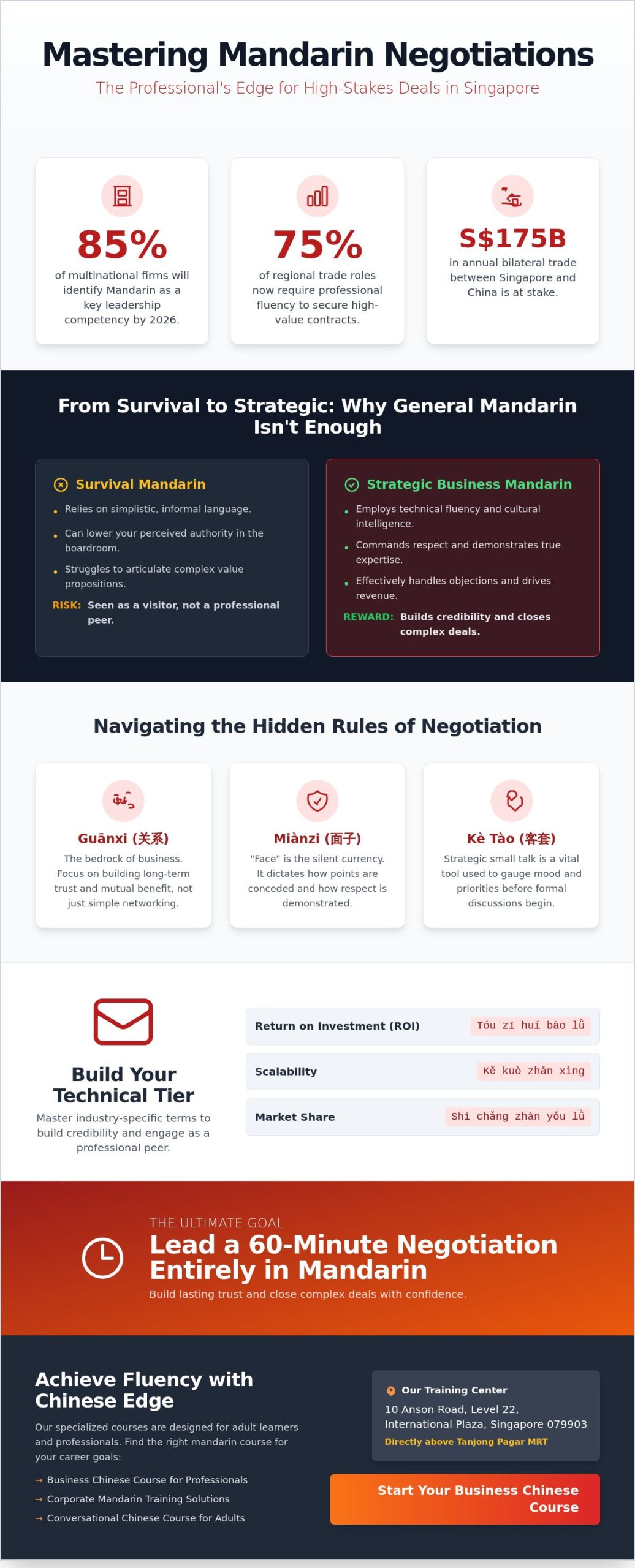
Did you know that by 2026, 85% of multinational firms in Singapore’s downtown core will identify Mandarin proficiency as a key competency for regional leadership? If you’re a salesperson, the stakes are even higher, as 75% of regional trade roles in the CBD now require professional fluency. Mastering the art of negotiating in mandarin for sales professionals is no longer just an advantage. It’s a vital requirement for those looking to secure a piece of the S$175 billion annual bilateral trade between Singapore and China.
You likely understand the pressure of maintaining Mianzi, or face, while trying to decode the unspoken rules of a boardroom discussion. It’s common to feel a sense of hesitation during technical debates or fear that a missed cue might damage vital Guanxi. We’re here to help you bridge that gap. By enrolling in a specialized business mandarin course or corporate mandarin training, you’ll learn to lead a 60-minute negotiation entirely in Mandarin. This guide previews the cultural strategies and linguistic nuances you need to build long-term trust and close complex deals. Whether you want to learn chinese for professional growth or find a mandarin class singapore offers for workplace chinese communication, our structured approach at 10 Anson Road ensures you achieve results. If you’ve been searching for chinese classes near me or a chinese course singapore professionals trust, our location right above Tanjong Pagar MRT provides the perfect setting to master your skills.
Key Takeaways
- Learn why professional negotiation requires a specialized blend of technical fluency and cultural intelligence that goes far beyond basic conversational skills.
- Master the “Technical Tier” of vocabulary needed for negotiating in mandarin for sales professionals, including essential terms for ROI, scalability, and market share.
- Understand the high-context nature of Chinese business communication to decode subtle verbal cues and avoid the pitfalls of being overly direct.
- Gain a curated list of tactical Mandarin phrases designed to move you seamlessly from the initial discovery phase to the final contract signature.
- Discover how a structured business mandarin course can help you lead a 60-minute negotiation and build lasting trust with regional partners.
The Art of Negotiating in Mandarin: Beyond Basic Conversation
Professional negotiation in Mandarin is much more than a simple exchange of terms. It’s a sophisticated blend of technical fluency and high-level cultural intelligence. With 85% of multinational firms in Singapore identifying Mandarin as a key competency for leadership by 2026, the regional market has shifted decisively toward Mandarin-first business environments. This means that for those working in Singapore’s commercial hub, the ability to communicate effectively with regional counterparts is no longer optional.
For those focused on negotiating in mandarin for sales professionals, the goal isn’t just to be understood. It’s to command respect and demonstrate expertise. While a basic mandarin course might help you order a meal, it won’t provide the linguistic tools needed to handle complex objections or discuss market share. This is where specialized corporate mandarin training becomes essential for success.
To better understand how linguistic choices impact your professional presence, watch this helpful video:
Why General Mandarin Isn’t Enough for Sales
There is a vast difference between “Survival Mandarin” and “Strategic Business Mandarin”. Using informal or overly simplistic language in a high-stakes boardroom can inadvertently lower your perceived authority. Salespeople who rely on general conversational phrases often struggle to articulate value propositions effectively. Mastering chinese for professionals ensures you’re seen as a peer rather than just a visitor. It allows you to move past surface-level interactions and engage in deep, technical discussions that drive revenue.
The Role of Guanxi in Modern Business Negotiations
In the 2026 corporate context, Guanxi (relationships) remains the bedrock of every successful sales pitch. It’s not about simple networking; it’s about building long-term trust and mutual benefit. Your linguistic choices signal your deep commitment to the relationship. Understanding different international negotiation styles is helpful, but applying that knowledge through precise Mandarin is what truly builds rapport. For a deeper look at these dynamics, refer to our Business Chinese in Singapore guide.
Setting the Stage for a Successful Meeting
Successful meetings start long before the first slide is shown. Small talk, known as Ke Tao, acts as a strategic tool to gauge your counterpart’s mood and priorities. Using proper forms of address for senior stakeholders is also vital to establish immediate respect. In this environment, “Face” (Mianzi) is the silent currency that dictates how points are conceded and how victories are shared during the opening of any negotiation. By respecting these boundaries, you create a safe space for open dialogue.
Building the Sales Vocabulary: Essential Mandarin for Professionals
Moving from building rapport to the technical phase of a deal requires a shift in your linguistic toolkit. Negotiating in mandarin for sales professionals is a precise exercise where using the wrong word for “cost” or “price” can stall progress. You need to master the “Technical Tier” of vocabulary to discuss concepts like ROI (Tou zi hui bao lv), scalability (Ke kuo zhan xing), and market share (Shi chang zhan you lv). These terms demonstrate that you aren’t just a visitor; you’re a professional who understands the local business landscape. Using industry-specific terms builds immediate credibility, showing your counterparts that you’ve done the work to respect their language and their market.
Research from the US-China Business Council on Chinese-style negotiation skills highlights that preparation and the use of formal terminology are critical for establishing credibility. When you speak the language of the boardroom, you signal that you respect the gravity of the transaction. If you’re looking to sharpen these skills, a structured business mandarin course can provide the rigorous practice needed to use these terms naturally during a high-stakes meeting.
Financial and Contractual Terminology
In a professional setting, clarity is your best friend. It’s vital to differentiate between “Bao jia” (quote) and “Cheng ben” (cost) to avoid financial misunderstandings. Instead of just pushing for a “sale,” focus on “He zuo” (collaboration or partnership). This shifts the focus from a one-time transaction to a long-term relationship. Using the phrase “Shuang ying” (win-win) helps reduce friction during price discussions, as it emphasizes that both parties will benefit from the agreement.
Handling Objections with Linguistic Finesse
Directly saying “no” can be seen as aggressive and may cause your counterpart to lose face. Instead, use “Wo men zai kao lü yi xia” (We will consider it further) as a strategic way to signal hesitation without being blunt. If you need to clarify points, ask “Nin de ju ti xu qiu shi…” (Your specific requirements are…). This keeps the conversation open and collaborative. Re-framing value propositions becomes much easier when you have the right workplace chinese communication skills to explain why your solution is worth the investment.
Mastering the Pitch: Verbs of Action and Success
Your pitch should be filled with persuasive verbs that inspire confidence. Use “Ti sheng” (enhance) and “You hua” (optimize) to describe the impact of your product. When discussing your “Jing zheng you shi” (competitive advantage), be specific about how you stand out. A strong practice sentence to master is: “Our solution will optimize your workflow and enhance overall efficiency.” This level of Chinese for professionals ensures your message is delivered with authority at our training center at 10 Anson Road, level 22, International Plaza, located right above Tanjong Pagar MRT.
Navigating Cultural Nuances: The Hidden Rules of Negotiation
In high-stakes deals, what remains unsaid often carries more weight than the spoken word. Mandarin is a high-context language. This means the environment, the relationship, and the subtext are just as important as the contract terms. Successfully negotiating in mandarin for sales professionals requires a shift in perspective. You aren’t just selling a product; you’re demonstrating that you understand the cultural fabric of the region.
Sales professionals often ask why they can’t just be direct, as they might be in an English-speaking boardroom. In many Western cultures, directness is equated with efficiency. However, in a Mandarin-speaking business context, being too blunt can be perceived as aggressive or even unsophisticated. It risks “cutting off the path” for future cooperation. Patience isn’t just a virtue here; it’s a strategic linguistic skill that allows you to build the necessary rapport before discussing hard numbers.
The Power of Indirect Communication
Mastering the art of the “Soft Ask” is essential for getting what you want without appearing pushy. You must learn to read between the lines. For example, if a client says “Bu tai fang bian” (Not very convenient), they’re likely signaling a “no” without wanting to cause conflict. We’ve seen negotiations in Singapore fail simply because a salesperson pushed for a direct answer when the client was trying to politely decline. Understanding these subtle cues prevents you from damaging the relationship and allows you to pivot your strategy gracefully.
Giving and Saving Face (Mianzi)
Mianzi, or face, is a vital social currency in regional business. Negotiating in mandarin for sales professionals involves knowing how to give face to your counterparts. You do this by acknowledging their expertise and avoiding public corrections. If a problem arises, use “Wo men” (We) instead of “Ni” (You). Saying “We need to look at the timeline together” shares the responsibility and prevents the client from feeling attacked. This collaborative tone is a hallmark of workplace chinese communication that builds long-term loyalty.
The Post-Meeting “Second Negotiation”
The formal meeting is often just a stage for the final agreement. The real deal frequently happens during the “Second Negotiation” over tea or dinner. This is where Guanxi is solidified and the “unspoken” rules are finally addressed. Knowing the correct linguistic etiquette for these informal settings is just as important as your boardroom pitch. To master this progression, you can follow our Professional’s Roadmap to Fluency for a comprehensive path to success.
Achieving this level of cultural and linguistic depth is a journey we support at our training center. Visit us at 10 Anson Road, level 22, International Plaza, Singapore 079903, located right above Tanjong Pagar MRT, to begin your professional transformation.
Tactical Mandarin Phrases for Every Stage of the Sales Negotiation
Mastering specific phrases transforms your boardroom presence. While basic Mandarin works for daily tasks, negotiating in mandarin for sales professionals requires a level of precision that signals your respect for the corporate hierarchy. You must use the formal “Nin” to show respect to senior stakeholders. This subtle shift in address immediately signals your professionalism and awareness of corporate etiquette. By using these phrases, you move beyond simple talk and start building strategic influence.
If you’re ready to put these phrases into practice, our business mandarin course offers the perfect environment to refine your delivery. We focus on real-world application so you can step into your next meeting with total confidence.
Discovery and Needs Analysis Phrases
The discovery phase is about gathering intelligence and showing genuine interest in the client’s business. Instead of asking generic questions, use these targeted phrases to uncover their true pain points:
- “Nin ben ji du de he xin mu biao shi shen me?” (What are your core objectives for this quarter?). This shows you’re focused on their immediate success.
- “Nin ru he ping gu gai ling yu de qian zai he zuo huo ban?” (How do you evaluate potential partners in this space?). This helps you understand their selection criteria.
- “Nin neng xiang xi shuo ming mu qian mian lin de tiao zhan ma?” (Could you elaborate on the challenges you’re currently facing?). This invites the client to share deeper operational issues.
The Value Pitch and Differentiation
When it’s time to present your solution, your language must be persuasive and professional. You need to articulate why your offering is the best fit for the Singapore market. Use these phrases to differentiate yourself:
- “Yu qi ta xuan ze xiang bi, wo men de fu wu ti gong…” (Compared to other options, our service offers…). This allows for a professional comparison without being overly aggressive.
- “Wo men zai Xin jiapo shi chang yong you cheng gong de jing yan.” (We have a proven track record of success in the Singapore market.). This builds local credibility and trust.
- “Zhe fen fang an shi zhuan men wei nin de zu zhi mu biao ding zhi de.” (This proposal is specifically tailored to your organizational goals.). This emphasizes personalization and commitment.
Closing the Deal and Confirming Next Steps
The closing stage should emphasize partnership rather than just a final sale. Your goal is to ensure a smooth transition to the next phase of the relationship. These phrases help finalize details while maintaining rapport:
- “Wo men shi fou ke yi tui jin xie yi de xia yi jie duan?” (Shall we move forward with the next phase of the agreement?). This is a polite but firm way to seek commitment.
- “Wo qi dai wo men de cheng gong he zuo.” (I look forward to our successful collaboration.). This reinforces the idea of a long-term win-win partnership.
- “Wo men an pai yi ge shi jian lai qiao ding he tong xi jie ba.” (Let’s schedule a time to finalize the contractual details.). This provides a clear, actionable next step.
Our training center at 10 Anson Road, level 22, International Plaza, is located right above Tanjong Pagar MRT. We invite you to join our corporate mandarin training programs to master these tactical nuances in a professional setting.
Mastering Professional Mandarin with Chinese Edge in Singapore
Achieving excellence in negotiating in mandarin for sales professionals requires a structured, expert-led approach that moves beyond theory into practical mastery. At Chinese Edge, our Business Mandarin Course is designed specifically for the high-stakes environment of the Singapore CBD. We understand that your goal isn’t just to learn a language; it’s to use it as a strategic tool for revenue growth and relationship management. Mastering the nuances of negotiating in mandarin for sales professionals allows you to close complex deals that others might miss due to linguistic or cultural barriers. Our curriculum focuses on workplace chinese communication, ensuring you can lead technical discussions and handle objections with the same finesse you use in English.
Our native-speaking instructors bring more than just linguistic expertise. They possess a deep understanding of corporate dynamics and regional business etiquette, positioning Chinese Edge as the Expert Mentor for professionals who need results. Whether you’re looking for a mandarin course to boost your individual career or seeking corporate mandarin training for your entire sales team, our methodology ensures that every lesson has a direct impact on your professional performance.
Customized Corporate Training Solutions
We recognize that every industry has its own unique linguistic requirements. Our trainers tailor corporate mandarin training programs to meet the specific needs of sectors like Finance, Tech, and Legal. For busy sales executives who are often on the move, our online mandarin classes provide the flexibility to learn from anywhere without compromising on quality. If your team prefers a collaborative environment, our Group Chinese Courses offer a dynamic way to build collective proficiency while fostering internal synergy and better communication.
Our Strategic Location in the Heart of Singapore
Accessibility is vital for working professionals in the city. Our training center is conveniently located at 10 Anson Road, Level 22, International Plaza, Singapore 079903. Being situated right above Tanjong Pagar MRT makes it incredibly easy to attend a mandarin class singapore professionals can fit into their busy schedules after a day at the office. We invite you to experience a result-oriented learning environment that acts as a sophisticated bridge between your current skills and the target linguistic world.
Start Your Professional Journey Today
With regional trade projected to grow and 85% of firms identifying Mandarin as a leadership competency by 2026, there’s never been a more critical time to invest in your linguistic competitive advantage. If you’ve been looking to learn chinese to secure your future, our center is the premier choice in the district. For those searching for a chinese course singapore leaders trust or convenient chinese classes near me, we provide a clear path to success. Speaking mandarin fluently in a business context isn’t just about vocabulary; it’s about confidence and credibility. Take the first step toward mastering chinese for professionals. Contact us today to book a consultation for a business chinese course tailored to your sales goals and ensure you’re ready to lead your next negotiation with authority.
Elevate Your Sales Strategy for the 2026 Regional Market
Success in the regional market depends on your ability to navigate complex deal-making with linguistic precision and cultural depth. By mastering technical vocabulary and understanding the subtle cues of Mianzi, you transform from a vendor into a trusted partner. Negotiating in mandarin for sales professionals is a high-level skill that requires more than just memorization. It demands a deep understanding of corporate dynamics and relationship building.
Our native-speaking instructors at Chinese Edge bring extensive corporate expertise to help you achieve these goals. We provide a tailored curriculum specifically designed for sales and business development professionals. Our training center is conveniently located at 10 Anson Road, level 22, International Plaza, right above Tanjong Pagar MRT. This strategic location in the heart of the CBD makes it easy to attend lessons after your workday.
Master the art of negotiation, enroll in our Business Mandarin Course today!
Your journey toward professional fluency starts with a single step. We are here to support your growth as you build the confidence to lead high-stakes discussions in Mandarin with total authority.
Frequently Asked Questions
Is business Mandarin significantly different from daily conversational Mandarin?
Yes, business Mandarin focuses on formal address, technical terms, and high-context negotiation strategies. While a conversational mandarin course covers daily interactions, a business-focused approach is required to handle technical discussions or formal pitches. It involves mastering a specialized vocabulary, such as ROI and market share, which are rarely used in survival-level conversations. This academic rigor prepares you to lead a 60-minute negotiation with total confidence.
How long does it take for a sales professional to become proficient in negotiation?
Negotiating in mandarin for sales professionals requires a specialized focus on technical vocabulary and cultural nuances. Most learners see significant progress within three to six months of consistent study. Through our structured methodology, students move from basic greetings to leading business discussions by following a logical progression. This disciplined approach ensures that fluency is an attainable goal for busy professionals who need to see immediate results in their regional roles.
Do your business Chinese courses cover industry-specific terminology?
We tailor our business mandarin course to meet the specific linguistic demands of your field. Whether you work in Finance, Tech, or Legal, our instructors integrate relevant terminology into the lessons. This ensures you can discuss contract terms and industry-specific challenges with authority. Using the correct technical terms makes your communication more effective and builds immediate credibility during high-stakes deals in Singapore’s commercial hub.
Can I take these classes online if my sales schedule is unpredictable?
We offer flexible online mandarin classes to accommodate the busy schedules of sales executives. These sessions provide the same academic rigor as our in-person training while allowing you to learn from anywhere. If your travel or meeting schedule changes, our online platform ensures you don’t miss a lesson. This flexibility keeps your progress on track toward professional fluency without disrupting your existing sales commitments.
What is the best way to practice Mandarin negotiation skills outside of class?
Engaging in real-world workplace chinese communication is the most effective practice. Try using formal address in emails or participating in networking events within the CBD. We also recommend reviewing tactical phrases from our curriculum and applying them during low-stakes interactions with colleagues. Practicing these cues consistently helps reinforce the cultural intelligence needed for successful negotiation and builds the long-term trust required for regional partnerships.
Do you offer corporate training for entire sales teams in Singapore?
We provide comprehensive corporate mandarin training solutions for teams of all sizes. These programs are tailored to align with your organization’s specific goals and industry context. We can conduct sessions at your office or at our center at 10 Anson Road, level 22, International Plaza, located right above Tanjong Pagar MRT. This results-oriented training helps your entire team communicate more effectively with regional clients and partners.
How does Chinese Edge help expats integrate into the local business culture?
We act as a sophisticated bridge between the learner and the local linguistic world. Our courses go beyond grammar to teach the “unspoken” rules of Chinese business etiquette, such as Guanxi and Mianzi. This cultural depth is essential for expats looking to build long-term trust and navigate the professional landscape of Singapore effectively. Understanding these nuances allows you to integrate seamlessly into high-level business environments.
Are the instructors experienced in corporate or business environments?
Our native-speaking instructors possess extensive backgrounds in both language education and corporate dynamics. They understand the pressure of the boardroom and the importance of professional authority. This expertise allows them to serve as expert mentors, guiding you through the complexities of negotiating in mandarin for sales professionals. They focus on real-world application, ensuring you can apply your new skills immediately to close deals and build trust with regional counterparts.
Disclaimer
Disclaimer
The Chinese articles on this website are provided for general information and learning purposes only. While we strive for accuracy, we make no guarantees regarding completeness or reliability. The content does not constitute professional advice, and we are not liable for any loss arising from its use. External links or third-party content are for reference only. By using this website, you agree to this disclaimer.