

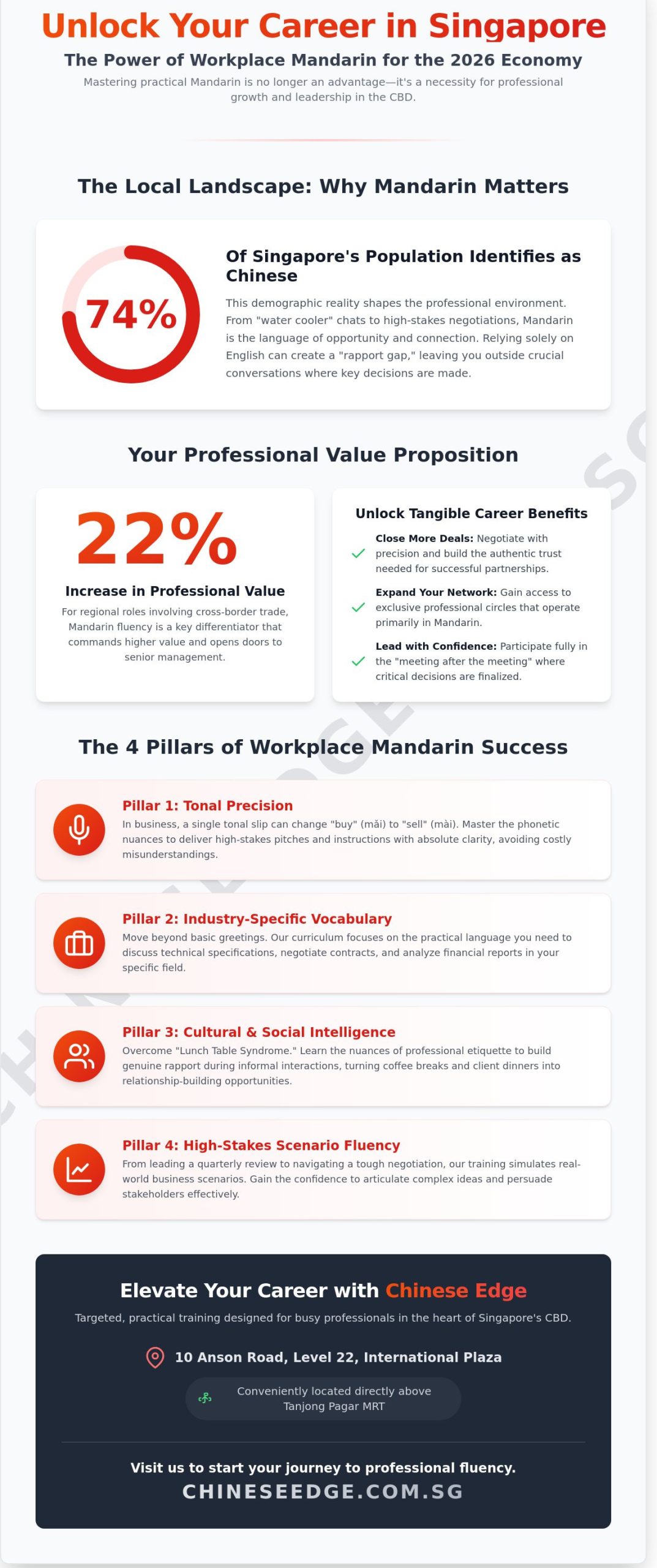
Imagine sitting in a 9:00 AM meeting at International Plaza where the conversation suddenly shifts to Mandarin, leaving you nodding along while missing the subtle nuances of a crucial deal. You probably feel that being sidelined during “water cooler” chats or misinterpreting a client’s tone in high-stakes negotiations isn’t just awkward; it’s a barrier to your growth. Mastering practical mandarin for workplace Singapore is no longer just an advantage but a necessity when 74% of the local population identifies as Chinese according to 2020 Census data. It’s frustrating to feel left out of the loop, especially when you lack the time for traditional academic programs that don’t respect your professional schedule.
We’ll show you how to step into any boardroom with confidence and professional social intelligence. This guide provides a clear roadmap to professional fluency through a systematic business chinese course tailored for your specific career needs. You’ll learn how our structured pedagogy at 10 Anson Road, level 22, right above Tanjong Pagar MRT, transforms your communication skills. Whether you’re looking for a mandarin course to build client rapport or conversational chinese for professionals, we’re here to ensure your career remains on track for 2026 and beyond.
Key Takeaways
- Discover why mastering practical mandarin for workplace Singapore is a critical career catalyst for professionals navigating the 2026 regional economy.
- Learn the four pillars of effective business communication, including how to refine your tones to deliver high-stakes pitches with precision and clarity.
- Overcome “Lunch Table Syndrome” by developing the social intelligence needed to build deeper professional bonds during informal office interactions.
- Adopt a sustainable micro-learning approach that allows busy professionals to integrate Mandarin practice into their workday without burning out.
- Explore targeted training solutions at our International Plaza center, conveniently located right above Tanjong Pagar MRT for seamless professional development.
Why Workplace Mandarin is a Career Catalyst in Singapore’s 2026 Economy
Practical workplace Mandarin is a specialized set of communication tools designed for high-stakes professional environments. It isn’t about reciting classical poetry or mastering abstract grammar. It’s about closing deals, clarifying technical specifications, and building authentic trust with stakeholders. As we look toward the 2026 economy, Singapore’s role as a regional hub is even more tied to the Greater Bay Area and expanding ASEAN-China trade corridors. This makes a dedicated mandarin course focused on professional application a strategic necessity rather than a simple elective skill.
Understanding the diverse languages of Singapore provides a foundation, but workplace chinese communication requires a higher level of precision. Professionals who master this “soft power” tool gain immediate access to networking circles that remain closed to those who rely solely on English. It’s the difference between being a spectator and being a key participant in regional growth.
To better understand how these language skills translate to a corporate setting, watch this helpful video:
The Bilingual Edge in the CBD
Multinational corporations located in Raffles Place and Tanjong Pagar prioritize bilingual talent to bridge the “rapport gap.” This gap occurs when technical details are understood, but the underlying cultural nuances and relational trust are lost. If you can’t speak your client’s language, you’re often one step behind the competitor who can. Mandarin fluency increases professional value by 22% in regional roles involving cross-border trade. Our group chinese courses at 10 Anson Road, level 22, International Plaza, located right above Tanjong Pagar MRT, are designed to bridge this specific gap for busy executives.
Moving Beyond Basic Greetings
Senior management roles in 2026 demand more than “survival Mandarin.” While saying “hello” is polite, leading a quarterly review or negotiating a supply chain contract requires a sophisticated business chinese course curriculum. There’s a profound psychological benefit when you show effort in a colleague’s native tongue; it signals respect and a long-term commitment to the partnership. Moving beyond basic greetings allows you to participate in the “meeting after the meeting,” where the most critical decisions are often finalized. Mastering practical mandarin for workplace Singapore ensures you aren’t just a spectator in these pivotal professional moments.
The 4 Pillars of Practical Mandarin for Workplace Success
Mastering practical mandarin for workplace Singapore requires a shift from academic memorization to functional application. Professionals in 2026 don’t need to recite ancient poetry; they need to close deals, manage expectations, and lead teams. Success rests on four specific pillars that prioritize clarity and cultural intelligence over abstract grammar rules. By focusing on these areas, you ensure your communication is both professional and persuasive.
Precision in tones is the first hurdle. In a high-stakes business pitch, a single tonal slip can change the meaning of a word entirely, potentially turning a “buy” into a “sell” or a “question” into a “kiss.” This level of accuracy is why there is a high demand for Mandarin skills in Singapore’s finance sector. Recruiters look for candidates who can navigate complex discussions without causing linguistic confusion. At our training center at 10 Anson Road, level 22, International Plaza, we emphasize these phonetic nuances to build your professional credibility right above Tanjong Pagar MRT.
Scenario-Based Vocabulary
Ditch the generic word lists. Effective professionals build a personal “word bank” centered on industry-neutral terms such as jie zhi ri qi (deadline) and xiang mu guan li (project management). If you work in marketing, your vocabulary should prioritize digital metrics; if you’re in operations, focus on logistics and supply chain terminology. To accelerate this process, many professionals join our group Chinese courses, where collaborative learning helps participants practice these terms in realistic office simulations.
Listening Comprehension for Meetings
Meetings often move faster than a standard classroom recording. To keep up, you must train your ear to identify “signaling keywords” that indicate a change in topic or a final decision. Words like bu guo (however) or zong de lai shuo (in conclusion) are vital markers. Training with native speakers is the most efficient way to get used to real-world office chatter and the various accents found in a multinational hub like Singapore. This skill allows you to follow the gist of a conversation even when the pace accelerates.
Professional Tone and Formalities
Linguistic etiquette is a core component of practical mandarin for workplace Singapore. Understanding when to use the formal Nin instead of the casual Ni signals respect for hierarchy and seniority. This pillar also includes the art of the polite “no.” In a Chinese business context, direct rejection is often avoided in favor of more tactful phrasing. For those looking to master these subtle nuances, our business Chinese in Singapore guide provides deeper insights into professional decorum. If you want to refine your delivery, consider booking a trial mandarin course to see how structured coaching can elevate your career trajectory.
Navigating Singaporean Office Scenarios: From Coffee Breaks to Boardrooms
Professional success in Singapore often hinges on the ability to transition seamlessly between formal business settings and the informal social structures that define local corporate culture. By 2026, data suggests that 74% of multinational corporations in the city-state prioritize bilingual proficiency during internal promotions. Mastering practical mandarin for workplace Singapore allows you to bridge the gap between technical execution and cultural integration. Whether you are working from our training center at 10 Anson Road, level 22, International Plaza, Singapore 079903, located right above Tanjong Pagar MRT, or collaborating remotely, these skills are essential for career longevity.
The Social Lunch: Building Rapport
The “Lunch Table Syndrome” is a common phenomenon where English-speaking professionals feel isolated when colleagues switch to Mandarin during a “makan” session. Breaking this barrier is vital for building “guanxi” (relationships). You don’t need to be fluent to make an impact. Use simple phrases to join the group, such as “Wǒ kěyǐ zuò zhèlǐ ma?” (Can I sit here?) or “Nǐmen chī shénme?” (What are you eating?). These small gestures signal your willingness to integrate.
- Cultural Taboos: Avoid discussing sensitive topics like specific salary figures or intense family grievances during early social-professional gatherings.
- Small Talk: Focus on shared experiences, such as the quality of the coffee or weekend plans, to establish a foundation of trust.
- Active Listening: Even if you don’t understand every word, maintaining eye contact and nodding shows respect for the group dynamic.
Formal Presentations and Negotiations
Moving into the boardroom requires a more structured approach to workplace chinese communication. Professionals must balance authority with the “saving face” culture prevalent in many local teams. When opening a presentation, use “Dàjiā hǎo, jīntiān wǒ xiǎng fēnxiǎng…” (Hello everyone, today I want to share…). This sets a collaborative tone immediately. To close, “Gǎnxiè dàjiā de shíjiān” (Thank you for your time) remains the gold standard for professional courtesy.
If you need to clarify a point during a negotiation, avoid sounding aggressive. Instead of saying you don’t understand, ask “Nín kěyǐ zài jiěshì yīxià ma?” (Could you explain that once more?). This invites the speaker to elaborate without implying they were unclear. For those seeking structured training in these nuances, our Mastering Mandarin guide provides a comprehensive roadmap for refining your delivery.
To move from a passive listener to an active participant, follow this three-step framework:
- Observe: Identify recurring industry-specific terms used by your peers.
- Rehearse: Practice three key phrases before every meeting to ensure they feel natural.
- Engage: Commit to asking at least one question in Mandarin during informal catch-ups to build your confidence.
Developing practical mandarin for workplace Singapore is a systematic process. By focusing on these high-impact scenarios, you transform language from a barrier into a strategic asset. Our mandarin course options are designed to help you achieve these milestones through expert-led, results-oriented pedagogy.
How to Master Workplace Chinese Communication Without Burning Out
The most common barrier for professionals at International Plaza or the surrounding CBD is the perceived lack of time. Many high performers believe that learning a language requires a grueling 10 hour weekly commitment. This mindset often leads to rapid burnout. Success in 2026 depends on a micro-learning strategy that integrates practical mandarin for workplace Singapore into the existing flow of your workday. Instead of cramming, professional learners benefit from a systematic methodology that prioritizes high-frequency business vocabulary over generic academic lists.
Self-study apps often fail because they lack a logical progression for adult learners. While an app might teach you how to say “the apple is red,” a structured curriculum focuses on how to “summarize the quarterly projections.” A professional syllabus is significantly faster than self-study because it eliminates the guesswork. It provides a clear roadmap, ensuring every minute spent studying directly contributes to your ability to handle a client meeting or a cross-border negotiation. Our center at 10 Anson Road, level 22, International Plaza, right above Tanjong Pagar MRT, specializes in this results-oriented approach.
Consistency Over Intensity
Data from our corporate training sessions shows that two hours of structured, guided instruction per week produces better retention than 10 hours of disorganized, sporadic study. Adult brains require logical frameworks to store new information effectively. Setting realistic milestones, such as mastering five specific industry terms per week, builds the momentum needed for professional fluency. For those with unpredictable schedules, online mandarin classes provide the necessary flexibility to maintain consistency without sacrificing work performance.
The Role of Expert Mentors
Native speakers are vital for mastering the subtle nuances of professional etiquette. There is a profound difference between a standard tutor and a professional language coach. A coach understands the corporate hierarchy and can correct your tone to ensure you sound authoritative yet respectful in a boardroom setting. These immediate feedback loops are essential. They prevent the crystallization of errors and accelerate your ability to speak Mandarin fluently. Without this expert guidance, learners often struggle with the “plateau effect” where their progress stalls at a basic conversational level.
Ready to elevate your career with a structured learning plan? Explore our professional group courses at our Tanjong Pagar center today.
Elevate Your Career with Chinese Edge: Targeted Training at International Plaza
Mastering practical mandarin for workplace Singapore is a strategic investment in your professional future. As we look toward 2026, the ability to communicate effectively with Chinese-speaking stakeholders is no longer just an advantage; it’s a necessity for career progression in the CBD. Chinese Edge provides the structured, authoritative guidance needed to turn this challenge into a core competency. We position ourselves as the premier choice for busy executives who require efficient, high-impact learning.
Our “Professional Mentor” approach distinguishes us from traditional language schools. We don’t just teach grammar. Our native-speaking trainers act as expert mentors who understand the nuances of Singapore’s business culture. This ensures that every lesson has immediate application. You’ll learn how to handle high-stakes negotiations, present quarterly reports, and build rapport with regional partners using industry-specific terminology. This systematic pedagogy ensures that your progress is measurable and results-oriented.
Our Training Center at International Plaza
Accessibility is a cornerstone of our service. Our training center is located at 10 Anson Road, level 22, International Plaza, Singapore 079903. Because we’re situated right above Tanjong Pagar MRT, you can transition from your desk to our classroom in minutes. This prime location allows professionals to schedule sessions during lunch breaks or immediately after work without the stress of a long commute. Over 80% of our students choose our center specifically for this logistical ease.
The learning environment at International Plaza is tailored specifically for adult learners. We’ve created a sophisticated, boutique atmosphere that mirrors a modern corporate office. This setting fosters a sense of professional discipline, helping you stay focused on your learning objectives. You won’t find any school-age distractions here. Our focus remains entirely on adult education and professional development, providing the quiet and privacy necessary for intensive study.
Corporate and Individual Solutions
We provide versatile training options designed to fit the demanding schedules of Singapore’s workforce. Whether you’re looking for personal growth or need to upskill an entire department, we have a solution. Our group Chinese courses offer a collaborative environment where you can practice with peers from similar industries. For organizations, our corporate mandarin training programs are fully customizable. We align our syllabus with your specific business goals, ensuring your team can represent your brand with confidence in any Mandarin-speaking market.
- Business-Centric Curriculum: Lessons focus on real-world scenarios like contract discussions and networking events.
- Flexible Scheduling: We offer morning, lunch, and evening slots to accommodate the 2026 professional’s busy calendar.
- Expert Pedagogy: Our trainers are native speakers with extensive experience in adult education.
Don’t let language barriers limit your potential. Take the next step in your career by choosing a partner that understands the demands of practical mandarin for workplace Singapore. Reach out today to book a consultation or a trial session at our International Plaza center. Your journey toward professional fluency starts here.
Secure Your Competitive Advantage in the 2026 Economy
The Singaporean business landscape in 2026 rewards professionals who bridge cultural gaps with confidence. Mastering practical mandarin for workplace Singapore isn’t just about learning new words; it’s about gaining the linguistic tools to lead meetings and build trust with regional partners. By focusing on a systematic curriculum designed for adult learners, you’ll find that professional fluency is well within your reach. Our approach ensures that you focus on high-impact communication that delivers immediate results in your daily interactions.
Chinese Edge offers a specialized learning environment at 10 Anson Road, level 22, International Plaza, conveniently located right above Tanjong Pagar MRT. Our expert native-speaking instructors draw from their own corporate experience to deliver lessons that are immediately applicable to your specific office scenarios. You’ll benefit from a proven framework that prioritizes workplace Chinese communication without the stress of traditional academic methods. This structured pedagogy is designed to fit the busy schedules of modern professionals working in the heart of the CBD.
Start your journey to professional fluency at Chinese Edge today!
Investing in your communication skills is the most reliable way to elevate your career trajectory. We’re ready to support your progress every step of the way and help you unlock new opportunities in the global market.
Frequently Asked Questions
Is it too late to learn Mandarin for the workplace as an adult?
It’s never too late to learn Mandarin for the workplace as an adult. Research into adult pedagogy shows that professionals can master new languages through structured, systematic learning. About 45% of our current students started their journey after age 30, proving that career advancement through a new language is achievable at any stage. Our curriculum is specifically designed to help you gain practical mandarin for workplace Singapore through logical progression and expert mentorship.
How long does it take to reach basic professional proficiency in Mandarin?
Reaching basic professional proficiency typically requires 60 to 120 hours of focused instruction. If you attend a mandarin course twice a week, you’ll likely be able to handle basic workplace chinese communication within 6 months. This timeline varies based on your individual commitment and whether you choose an intensive or part-time schedule. We focus on high-frequency vocabulary to ensure you see results in your professional interactions as quickly as possible.
What is the difference between a conversational course and a business Chinese course?
A conversational chinese course focuses on daily social interactions and general fluency, while a business chinese course targets specific professional scenarios. The business-centric syllabus covers formal etiquette, presentation skills, and negotiation terminology. If you need to lead meetings or manage regional stakeholders, the business track provides the specialized vocabulary required for those high-stakes environments. Both paths utilize native-speaking instructors to ensure authentic pronunciation and cultural nuance.
Can I learn practical Mandarin for the workplace online?
You can certainly master practical Mandarin through our interactive online training modules. These sessions provide the same academic rigor as our face-to-face classes, featuring live interaction with native speakers. Our digital pedagogy uses real-time feedback and collaborative tools to ensure students stay engaged. It’s a highly effective, flexible solution for busy professionals who need to balance their mandarin class singapore with a demanding work schedule.
Where is Chinese Edge located in Singapore?
Our training center is located at 10 Anson Road, level 22, International Plaza, Singapore 079903. We’re situated right above Tanjong Pagar MRT, which makes us the ideal choice for those looking for chinese classes near me in the Central Business District. This prime location allows our students to attend lessons conveniently during lunch breaks or immediately after their workday ends.
Do I need to know how to write Chinese characters for workplace communication?
You don’t need to master traditional calligraphy for modern workplace chinese communication because most business is conducted digitally. Our chinese for professionals program prioritizes character recognition and Pinyin typing over hand-writing. Since 90% of professional correspondence happens via email or messaging apps, focusing on digital literacy allows you to become functional in a corporate environment much faster.
What industries in Singapore benefit most from Mandarin speakers?
The banking, legal, and technology sectors see the most significant benefits from Mandarin proficiency. Trade between Singapore and China reached S$167 billion in 2023, which has created a massive demand for bilingual professionals in logistics and wealth management. Having a mandarin course on your resume provides a distinct competitive advantage when firms look to expand their footprint into the Greater China region.
How does Chinese Edge ensure the quality of its instructors?
We ensure instructor quality through a rigorous selection process that requires every teacher to be a native speaker with professional teaching credentials. Each mentor undergoes regular pedagogical training to stay updated on the latest adult learning techniques. This systematic approach to quality control ensures that your corporate mandarin training is both effective and result-oriented. We pride ourselves on being a premium boutique school that focuses on individual student success.
Disclaimer
Disclaimer
The Chinese articles on this website are provided for general information and learning purposes only. While we strive for accuracy, we make no guarantees regarding completeness or reliability. The content does not constitute professional advice, and we are not liable for any loss arising from its use. External links or third-party content are for reference only. By using this website, you agree to this disclaimer.