

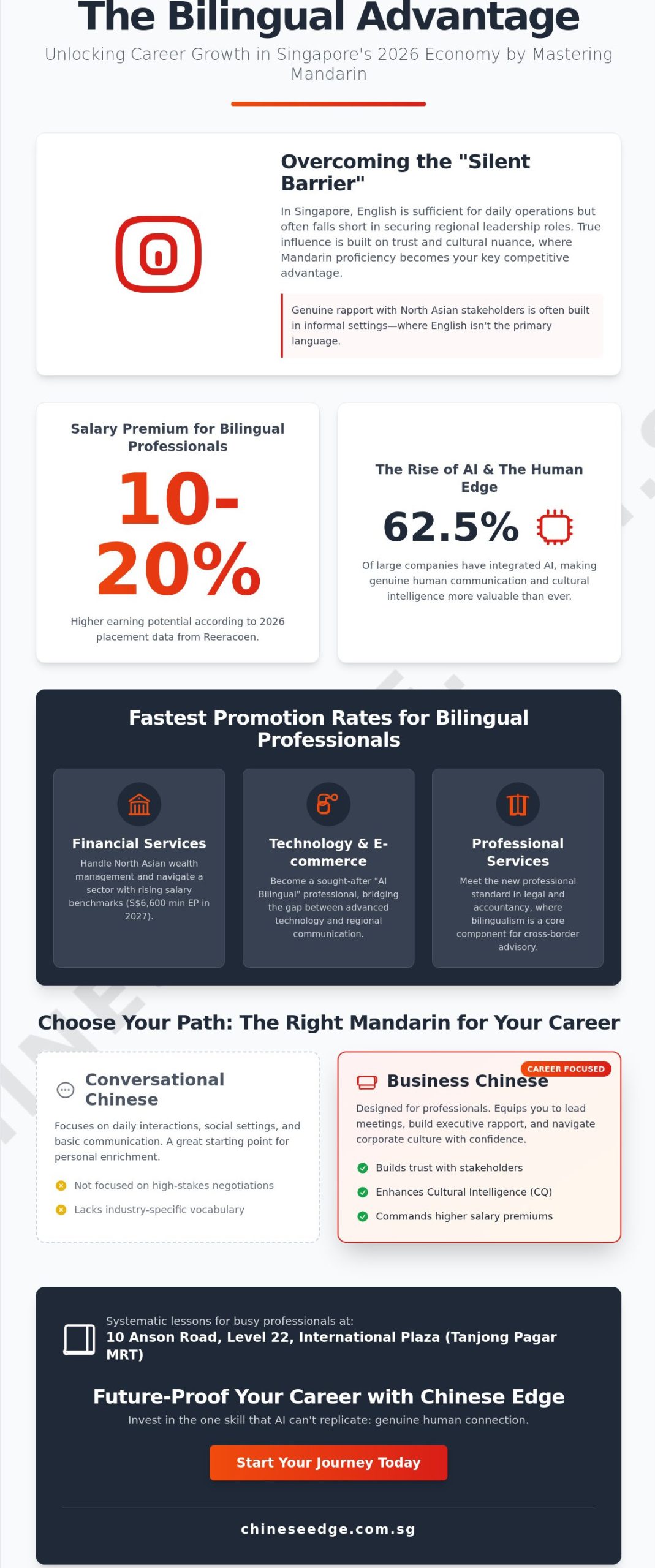
Did you know that as of April 2026, bilingual professionals in Singapore command an estimated 10% to 20% salary premium according to placement data from Reeracoen? Understanding the benefits of being bilingual for career advancement in Singapore is essential if you’ve ever felt sidelined during high-level stakeholder meetings or struggled to build rapport with Chinese-speaking clients. It’s a valid concern in a corporate landscape where 62.5% of large companies have integrated AI, making genuine human communication and cultural nuance even more valuable for regional leadership.
This guide demonstrates how mastering Mandarin as a second language unlocks high-level regional opportunities and accelerates your professional growth. You’ll discover why linguistic versatility is the key to job security and higher compensation in the 2026 economy. We’ll also preview how a systematic business chinese course at our center at 10 Anson Road, level 22, International Plaza, right above Tanjong Pagar MRT, provides the professional training you need to lead with confidence and bridge the gap between your expertise and the Chinese-speaking world.
Key Takeaways
- Understand why English is sufficient for daily operations but insufficient for securing regional leadership roles in Singapore’s 2026 gateway economy.
- Explore how Mandarin proficiency bridges the trust deficit with North Asian stakeholders and enhances your Cultural Intelligence (CQ) for executive-level hiring.
- Gain clarity on the strategic benefits of being bilingual for career advancement in Singapore, including how to command salary premiums of up to 20%.
- Determine the right educational path for your goals by comparing the professional outcomes of a conversational chinese course versus a business-focused curriculum.
- Access a practical roadmap and timeline for mastering Mandarin through systematic lessons designed specifically for busy professionals.
The Shift in Singapore’s 2026 Workforce: Why Bilingualism is a Career Prerequisite
Singapore serves as the primary gateway to the ASEAN and Greater China markets. In 2026, the city-state remains the preferred location for regional headquarters, hosting over 40% of Asia-Pacific regional hubs. While English remains the official working language, it’s often insufficient for high-level leadership. One of the primary benefits of being bilingual for career advancement in Singapore is the ability to move beyond mere operational tasks and into strategic decision-making. Relying solely on English limits your influence to surface-level interactions. Understanding Singapore’s bilingual language education policy provides the historical context for our multilingual society, but professional success in 2026 requires a more targeted, business-centric approach to language mastery.
To better understand the personal and professional impact of these skills, watch this helpful video:
Singapore as a Regional Hub: The Gateway Dynamics
Regional headquarters (RHQs) located in the Tanjong Pagar business district manage diverse teams across Asia. If you’re managing cross-border projects, you’ll find that technical expertise is only half the battle. Leaders who can communicate directly with stakeholders in Shanghai or Beijing without a translator possess a significant competitive edge. Enrolling in a systematic mandarin course at our center at 10 Anson Road, level 22, International Plaza, allows you to master these regional management needs. This professional training ensures you can lead regional strategy with confidence and clarity.
The “Silent Barrier” in Professional Advancement
Many professionals encounter a “silent barrier” when they’re excluded from informal stakeholder bonding. These moments, often occurring during dinners or casual coffee breaks, are where deep rapport is built and high-stakes decisions are often pre-negotiated. Speaking a client’s native language provides a psychological advantage that builds trust faster than any slide deck. This is why “functional fluency” has become the new benchmark for career-driven adults. A specialized business chinese course focuses on these high-pressure scenarios, ensuring you aren’t just speaking the language, but navigating the culture effectively.
In 2026, three specific industries show the fastest promotion rates for bilingual professionals:
- Financial Services: With the minimum Employment Pass salary for this sector rising to S$6,600 in 2027, companies prioritize versatile talent who can handle North Asian wealth management.
- Technology and E-commerce: As 62.5% of large companies adopt AI, the demand for “AI Bilingual” professionals who can bridge tech and regional communication is at an all-time high.
- Professional Services: Legal and accountancy firms are the first to benefit from the National AI Impact Programme, where bilingualism is a core component of the new professional standard.
Choosing to learn chinese is no longer just a personal hobby. It’s a calculated move to future-proof your career against a backdrop of hyper-localization where companies prefer leaders who can bridge cultural gaps seamlessly.
Strategic Advantages of Mandarin Fluency in Singapore’s Corporate Landscape
While many professionals rely on English for technical accuracy, real leadership in 2026 requires bridging the “Trust Deficit” with North Asian partners. One of the core benefits of being bilingual for career advancement in Singapore is the shift from transactional interactions to relational influence. English is often used for the “what” of a business deal, but Mandarin is used for the “why” and the “how”. This distinction is a cornerstone of Singapore’s language policy, positioning the city as a cultural and economic bridge between East and West. By mastering the language, you signal a long-term commitment to the relationship that transcends a single contract.
Building Trust with High-Value Stakeholders
In Singapore’s regional hub, trust is the currency of advancement, and language is the key to the vault. When you use effective workplace chinese communication, you demonstrate respect for a client’s heritage and business philosophy. This creates a level of psychological safety that English alone cannot provide. For example, during high-stakes negotiations in 2026, a lead who can interpret subtle cues and read between the lines often secures approval faster than a more technical but monolingual peer. Being the “designated lead” for China-facing projects doesn’t just protect your job; it makes you an essential asset for regional expansion, directly contributing to the 10% to 20% salary premium observed in recent placement data.
Mandarin for Professionals: Beyond Basic Vocabulary
Executive hiring in 2026 places heavy weight on Cultural Intelligence (CQ). It isn’t enough to order coffee; you must navigate the boardroom with precision. This involves understanding “Mianzi” (Face) and the specific hierarchy of formal address during executive presentations. Professionals who lack this awareness risk offending key stakeholders, regardless of their technical brilliance. If you want to master these complexities, our Business Chinese in Singapore guide provides a deep dive into the specific vocabulary required for contract negotiations and high-level pitches.
Mastering these skills allows you to unlock the full benefits of being bilingual for career advancement in Singapore. You’ll find that promotions to regional roles happen more frequently when you can lead a team in their native tongue. Our systematic mandarin course at 10 Anson Road, level 22, International Plaza, is designed to move you from basic proficiency to boardroom readiness. Located right above Tanjong Pagar MRT, our center provides the professional environment necessary for adult learners to thrive. If you’re looking to elevate your corporate profile, a structured approach to language is the most reliable path to success.
Navigating Your Career Path: Conversational vs. Business Mandarin
Choosing between a conversational chinese course and a business chinese course depends on your current career stage and specific professional objectives. While both paths contribute to the benefits of being bilingual for career advancement in Singapore, they serve different strategic purposes. You don’t need to master 3,000 characters to see a return on your investment. In fact, most professionals find that achieving “functional fluency” in specific contexts yields immediate results. By early 2026, data indicates that bilingual candidates are 35% more likely to be shortlisted for regional director roles, proving that targeted learning is more effective than broad academic study.
The Conversational Edge for Networking
If you’re looking to break the ice during lunch meetings or social corporate events, a focus on conversational skills is the most effective starting point. Practical fluency allows you to navigate the social nuances that define Singapore’s business culture. Instead of academic perfection, these lessons prioritize the ability to sustain a 20-minute dialogue with a client. This social bridge often leads to the informal stakeholder bonding mentioned in earlier sections. For those who prefer a collaborative environment, our Group Chinese Courses offer a structured way to build these social assets alongside other professionals in the heart of the CBD.
The Business Mandarin Power-Up
As you move into senior leadership or regional roles, the requirements shift toward industry-specific terminology and formal presentation skills. High-stakes negotiations require a different vocabulary set than a casual dinner. Specialized corporate mandarin training equips teams to handle regional expansion by teaching the etiquette of the boardroom and the nuances of contract negotiation. If you’re deciding which path aligns with your trajectory, our Pillar Guide on Mandarin Courses for Professionals provides a detailed breakdown of curriculum choices. We help you map your learning to specific career milestones, ensuring your time at our center at 10 Anson Road, level 22, International Plaza, right above Tanjong Pagar MRT, translates into tangible workplace success.
The ROI for a professional in Singapore is clear. Whether you choose to learn chinese for social rapport or technical negotiation, the ability to bypass a translator is a powerful signal of competence. It’s about becoming a versatile asset who can lead in any environment, whether it’s a casual networking session or a high-pressure contract signing. If you’re ready to take the next step, our systematic approach ensures you gain the specific skills needed for your industry without wasting time on irrelevant content.
Practical Steps: Mastering Mandarin While Balancing a Full-Time Career
Achieving fluency while managing a high-pressure role in the CBD requires a strategy that prioritizes efficiency over volume. For most working adults, a realistic timeline to reach functional conversational proficiency is approximately 6 to 9 months of consistent study. This timeframe allows you to internalize the benefits of being bilingual for career advancement in Singapore without burning out. By dedicating just three hours a week to a structured mandarin course, you can move from absolute beginner to participating in basic stakeholder discussions by the end of your first year. This progress is essential when you consider that bilingual professionals command a 10% to 20% salary premium as of April 2026.
Integrating Learning into the Professional Lifestyle
Successful learners treat language acquisition like any other professional KPI. While “micro-learning” through apps helps with vocabulary retention during your commute, it lacks the depth required for effective workplace chinese communication. A systematic approach led by native-speaking instructors is essential for mastering tones, which are often the biggest hurdle for professionals. Correcting these tones early prevents misunderstandings during high-stakes presentations. If you’re serious about your career goals, skip the fragmented app-based learning and choose a mandarin class singapore that offers a clear syllabus and regular feedback from an expert mentor. Consistency is more important than intensity; two short sessions per week are more effective than one marathon session once a month.
Online vs. In-Person: Which Fits Your Schedule?
In 2026, flexibility is paramount for the modern professional. Physical classes at our center at 10 Anson Road, level 22, International Plaza, offer an interactive environment that is hard to replicate virtually. Being located right above Tanjong Pagar MRT makes it easy to attend a session immediately after work or during an extended lunch hour. However, for those with regional travel commitments, our online chinese for professionals sessions provide the same high-quality instruction via a virtual classroom. The best results often come from a hybrid approach where you combine the convenience of digital tools with the accountability of live instructor feedback. This ensures your learning doesn’t stop just because your schedule changes.
When evaluating a conversational chinese course for adult learners, use this checklist to ensure the program meets professional standards:
- Does the curriculum focus on adult business contexts or generic daily life?
- Are the instructors native speakers with experience in corporate mandarin training?
- Is the training center located in a professional business district for easy access?
- Does the provider offer flexible makeup sessions for missed classes due to work commitments?
Investing in your linguistic skills is a proven way to increase your value in a market where 53% of job categories now reference AI and specialized communication skills. If you’re ready to start your journey, you can explore our group chinese courses to find a schedule that suits your professional lifestyle and helps you unlock the full benefits of being bilingual for career advancement in Singapore.
Conclusion: Future-Proofing Your Career with Chinese Edge
In Singapore’s 2026 economy, the decision to learn chinese has evolved from a personal interest into a vital strategic move. As highlighted throughout this guide, the benefits of being bilingual for career advancement in Singapore are measurable and significant. With professionals commanding salary premiums of up to 20%, Mandarin proficiency is the most lucrative investment you can make in your professional toolkit. It’s the key to moving beyond operational roles and into the high-stakes regional leadership positions that define Singapore’s status as a global hub.
The Chinese Edge Methodology for Adults
Our approach at Chinese Edge is built on the principle that adult learners require a specific pedagogy that differs from traditional academic settings. We focus on practical, conversational fluency that you can implement in your workplace immediately. Our “Expert Mentor” model ensures you receive disciplined, results-oriented guidance from native speakers who understand the nuances of corporate communication. Our training center at 10 Anson Road, level 22, International Plaza, provides a sophisticated, professional environment designed specifically for the needs of executives. If you’re looking for more depth on selecting the right program for your goals, our Definitive 2026 Guide for Professionals offers a clear roadmap for your journey.
Your Next Step in Career Advancement
A common concern among busy professionals is whether it’s “too late” to start. We’re here to reassure you that with a systematic and structured approach, fluency is an attainable goal at any career stage. Our lessons are designed to fit into a demanding schedule, offering the flexibility needed to balance learning with your daily responsibilities. Located right above Tanjong Pagar MRT, our center is ideally positioned for those working in the heart of the business district. We invite you to explore our group chinese courses or inquire about customized corporate Chinese language training to empower your entire team.
The benefits of being bilingual for career advancement in Singapore extend far beyond the boardroom. It’s about gaining the confidence to bridge cultural gaps and future-proof your career against a rapidly changing global landscape. Contact us today for a professional assessment of your current proficiency level. Let us help you unlock the high-level regional opportunities that come with mastering Mandarin in a professional context.
Secure Your Competitive Edge in Singapore’s Regional Economy
The regional corporate landscape in 2026 favors professionals who can navigate high-stakes environments without a translator. By bridging the trust deficit with North Asian stakeholders and leveraging the 10% to 20% salary premium documented by Reeracoen in April 2026, you position yourself for rapid promotion. Maximizing the benefits of being bilingual for career advancement in Singapore requires more than just basic vocabulary; it demands a strategic understanding of cultural nuance and professional etiquette.
Our systematic curriculum is designed for rapid professional application, ensuring you gain the skills needed for the boardroom rather than just the classroom. With native-speaking instructors specializing in adult education, we provide the support necessary to achieve functional fluency. If you’re ready to elevate your career profile, View our Adult Conversational Mandarin Courses at International Plaza. Our center at 10 Anson Road, level 22, is located right above Tanjong Pagar MRT, making it convenient for busy professionals to attend sessions after work. Fluency is an attainable goal when you have a reliable partner in your growth. Your next promotion is within reach.
Frequently Asked Questions
Does being bilingual really increase my salary in Singapore?
Yes, bilingualism directly impacts your earning potential. According to 2026 recruitment data from Reeracoen, professionals with dual-language proficiency often command a salary premium between 10% and 20%. In the financial services sector, where the Employment Pass qualifying salary rises to S$6,600 in 2027, the ability to manage North Asian portfolios is a critical differentiator. This is one of the most direct benefits of being bilingual for career advancement in Singapore.
Which second language is most in demand for Singapore jobs in 2026?
Mandarin remains the most sought after second language due to Singapore’s extensive trade ties with Greater China. As of March 2026, recruiters also report high demand for Bahasa Indonesia and Japanese to support ASEAN expansion and specialized technical roles. However, Mandarin offers the widest range of opportunities across the 62.5% of large companies currently adopting AI and regional growth strategies within the city-state.
How long does it take an adult professional to learn conversational Mandarin?
Most adult learners reach a functional conversational level within 6 to 9 months of consistent, structured study. If you attend a systematic mandarin course twice weekly, you can expect to handle basic social interactions and simple workplace discussions by the end of your second term. Our methodology focuses on high-frequency professional vocabulary to ensure you see practical results as quickly as possible without wasting time on irrelevant content.
Can I learn Business Mandarin if my basic Chinese is weak?
You can certainly begin a business chinese course even if your current foundation is modest. Our curriculum is designed to build your linguistic skills and professional terminology simultaneously. We focus on specific scenarios like formal introductions and business etiquette from the first lesson. This approach ensures that even learners with limited prior exposure can begin contributing to workplace chinese communication effectively within a few months of training.
Are online Mandarin classes as effective as in-person lessons for professionals?
Both formats are effective, but they serve different professional needs. In-person chinese classes near me at our International Plaza center offer immediate tone correction and networking opportunities with other executives. Online sessions provide the flexibility required for those with frequent regional travel. Both options utilize the same systematic curriculum to ensure you achieve the benefits of being bilingual for career advancement in Singapore regardless of the delivery method.
What is the best way to practice Mandarin in a professional Singaporean environment?
The most effective way to practice is by volunteering for China-facing projects or participating in informal social gatherings with stakeholders. Engaging in workplace chinese communication during lunch breaks or coffee meetings allows you to apply your classroom learning in low-pressure, real-world settings. Consistent practice in these professional environments reinforces the formal address and business etiquette taught at our center at 10 Anson Road, level 22, located right above Tanjong Pagar MRT.
Disclaimer
Disclaimer
The Chinese articles on this website are provided for general information and learning purposes only. While we strive for accuracy, we make no guarantees regarding completeness or reliability. The content does not constitute professional advice, and we are not liable for any loss arising from its use. External links or third-party content are for reference only. By using this website, you agree to this disclaimer.