

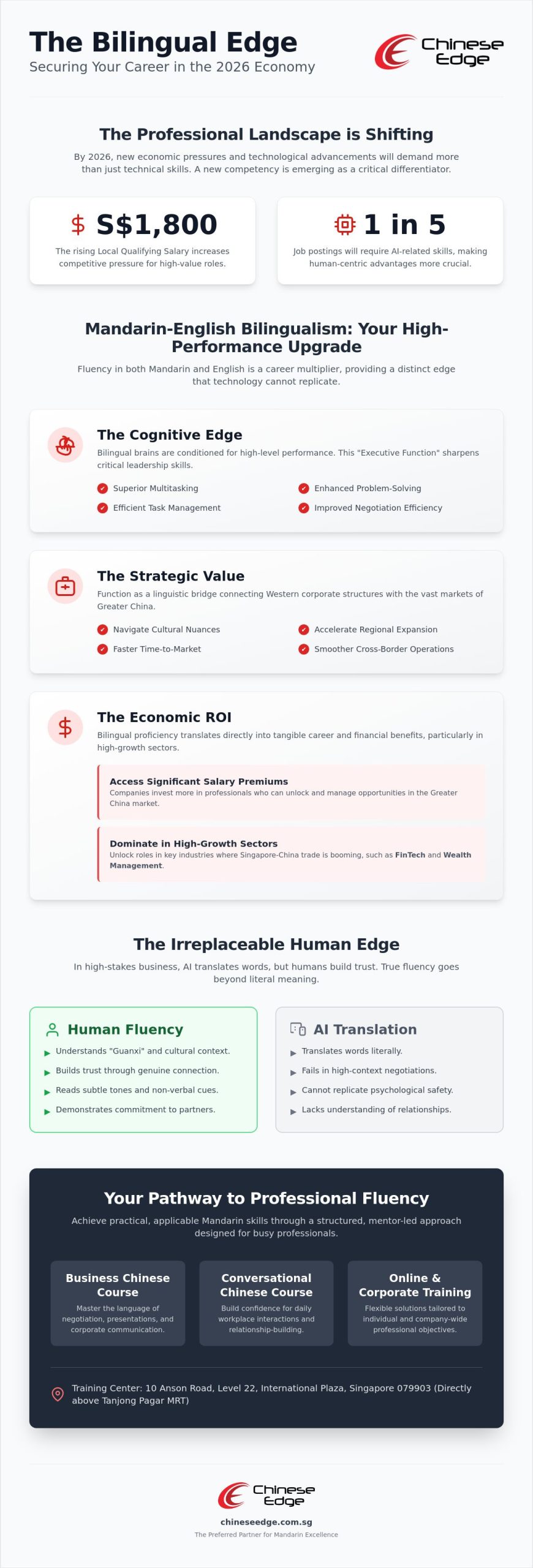
By 2026, with the Local Qualifying Salary rising to S$1,800 and one in five job postings requiring AI-related skills, the most valuable asset you can possess isn’t just technical; it’s linguistic. You might feel replaceable in a hyper-competitive market, but the strategic benefits of bilingual employees in Singapore go far beyond simple translation. Fluency in Mandarin and English acts as a high-performance operating system for your career, providing a cognitive edge and a significant salary premium that AI cannot replicate.
It’s frustrating to face stagnant career growth or struggle to connect with regional stakeholders because of a language gap. We believe that fluency is an attainable goal through a disciplined, results-oriented approach. This article explains how bilingualism drives leadership potential and global marketability for professionals. You’ll discover how a structured business chinese course or conversational chinese course can secure your professional future. We’ll also preview how our specialized training at 10 Anson Road, level 22, International Plaza, Singapore 079903, located right above Tanjong Pagar MRT, provides the workplace chinese communication skills you need to navigate the 2026 economy with confidence.
Key Takeaways
- Understand how bilingualism functions as a professional competency that bridges the gap between Western markets and Greater China in the 2026 economy.
- Discover how “Executive Function” and “Theory of Mind” enhance your leadership capabilities and negotiation efficiency during complex business interactions.
- Learn about the significant salary premiums and specific high-growth sectors, such as FinTech and Wealth Management, that highlight the benefits of bilingual employees in Singapore.
- Identify the most effective learning pathways, from online Mandarin classes to in-person business Mandarin courses, tailored to your specific professional objectives.
- See how a structured, mentor-led approach at a premium boutique school ensures your fluency is both practical and immediately applicable in a corporate setting.
The Strategic Value of Bilingualism in Singapore’s 2026 Economy
Bilingualism in Singapore has evolved. In 2026, it’s no longer just a cultural heritage marker but a rigorous professional competency. For professionals working in multinational corporations (MNCs), the ability to switch between English and Mandarin is a functional asset. This skill allows Singapore to serve as a unique linguistic bridge, connecting Western corporate structures with the vast markets of Greater China. Companies increasingly recognize that the benefits of bilingual employees in Singapore include a faster time-to-market for regional products and smoother internal operations across borders.
The foundation of this capability lies in Singapore’s bilingual language education policy, which has cultivated a workforce uniquely equipped for regional expansion. As regional trade agreements become more complex and integrated, the benefits of bilingual employees in Singapore become evident through their ability to navigate cultural nuances that data alone cannot capture. This shift from a “nice-to-have” skill to a “business-critical” requirement is particularly visible in regional roles where deep linguistic nuance is the difference between a signed contract and a missed opportunity.
To better understand how these linguistic skills translate to real-world success, watch this helpful video:
The Human Edge in the Post-AI Era
While AI translation tools have advanced significantly by 2026, they often fail in high-context Mandarin business negotiations. Professional communication requires an understanding of “Guanxi,” the intricate network of relationships and social influence. Machines can translate words, but they can’t replicate the subtle shifts in tone or the non-verbal cues essential for building trust. In high-stakes deals, human fluency is indispensable for trust-building because it demonstrates a personal commitment to the partner’s culture and values. This direct communication fosters a level of psychological safety that automated systems simply cannot provide.
Singapore as a Regional Language Hub
Singapore’s bilingual workforce is a primary reason why MNCs continue to choose the city-state as their regional headquarters. The Singapore-China trade corridor relies heavily on professionals who can manage workplace chinese communication without friction. By closing the linguistic gap, local talent ensures that projects move faster and with fewer misunderstandings. If you want to stay competitive, Mastering Mandarin is a necessity for anyone aiming for a regional role. Our center at 10 Anson Road, level 22, International Plaza, Singapore 079903, right above Tanjong Pagar MRT, provides the structured environment needed to achieve this professional edge.
Cognitive Edge: How Multilingualism Sharpens Leadership Skills
The boardroom is a high-pressure environment where information overload is a constant threat. Bilingual professionals possess a distinct advantage here known as “Executive Function.” This is the brain’s ability to manage complex tasks, switch focus rapidly, and prioritize information. Because bilingual individuals constantly navigate between two linguistic systems, their brains are conditioned for high-level multitasking. In a corporate setting, this translates to more efficient task management and a superior ability to filter out noise during a crisis. The benefits of bilingual employees in Singapore extend beyond simple communication; they include a cognitive resilience that is vital for modern leadership.
This mental agility is a product of the cornerstone of Singapore’s language policy, which has long recognized that linguistic diversity sharpens the intellect. When you choose to learn Chinese for professionals, you aren’t just memorizing characters. You’re training your brain to adopt different frameworks for problem-solving. This cognitive flexibility allows leaders to approach corporate strategy with more creativity, often finding solutions that mono-linguistic thinkers might overlook. It’s about seeing the world through multiple lenses.
Sharpening the Boardroom Multitasker
The “Bilingual Brain” is scientifically proven to be more adept at decision-making. Bilingual leaders are trained to inhibit irrelevant linguistic information, a skill that transfers perfectly to filtering out distractions in the workplace. During a corporate crisis, this ability to stay focused on the core objective while ignoring secondary pressures is invaluable. If you find your current cognitive tools aren’t enough for the 2026 economy, you might consider how a mandarin course can revitalize your mental processing speed and help you manage high-pressure environments with ease.
Empathy and Negotiation Nuance
Negotiation is as much about psychology as it is about numbers. Bilinguals often score higher in “Theory of Mind” tests, which measure the ability to understand that others have different beliefs, desires, and perspectives. In business, this means a bilingual negotiator can better anticipate a client’s needs and reactions. Understanding Mandarin idioms, for instance, provides a window into Chinese business philosophy, allowing you to align your pitch with their underlying values. Speaking a client’s native tongue creates an immediate psychological bond, reducing the typical resistance found in high-stakes deals. Linguistic empathy acts as a lubricant for international business, significantly reducing friction in cross-border transactions and ensuring that both parties feel understood from the very first meeting.
The Economic ROI: Salary Premiums and Marketability
Investing in a business chinese course offers a measurable financial return that few other professional skills can match. In the 2026 economy, bilingual professionals in Singapore often command a salary premium of up to 20% compared to their monolingual peers. This “Bilingual Bonus” isn’t just about the ability to translate words; it reflects the added value of a professional who can navigate high-stakes environments without a middleman. The benefits of bilingual employees in Singapore are most visible during annual salary reviews and when negotiating for senior leadership roles within regional headquarters.
Employability during economic downturns is another critical factor you should consider. When companies consolidate, they often retain “versatile” employees who can cover multiple territories. A professional who has mastered workplace chinese communication is twice as valuable to a firm looking to maintain its regional footprint with fewer staff. This versatility acts as a career insurance policy that protects your earning potential regardless of market volatility. It transforms you from a replaceable worker into a strategic asset that the company cannot afford to lose.
Industry-Specific Gains: Finance to Technology
Wealth Management and Family Offices in Singapore have seen a massive surge in demand for Mandarin-English bilingual staff. These institutions prioritize candidates who can communicate with high-net-worth individuals from Greater China with cultural precision and absolute discretion. Similarly, the tech sector relies on bilingual project managers to lead regional expansion into emerging markets. A bilingual career trajectory often leads to faster promotions and more frequent opportunities for international assignments. While a monolingual professional might be limited to local operations, a bilingual expert is seen as a “Global Citizen” capable of representing the firm on a world stage.
Maximizing Your Professional Value
To make the most of your skills, you must position your language proficiency strategically on your 2026 CV. Don’t just list “Mandarin” under a generic skills section. Instead, highlight specific instances of Business Chinese in Singapore where your linguistic skills directly influenced a project’s success or closed a deal. This specialized skill set provides long-term career stability and opens doors to niche sectors like FinTech and Logistics that require deep linguistic integration. If you’re looking for a mandarin class singapore that fits a busy professional schedule, our center at 10 Anson Road, level 22, International Plaza, Singapore 079903, located right above Tanjong Pagar MRT, offers the specialized training you need to secure these economic gains. We provide a structured environment where fluency isn’t just a goal, but a guaranteed outcome of our proven methodology.
Building a Bilingual Workforce: Practical Steps for Professionals
Transitioning from a monolingual professional to a bilingual leader requires more than just intent. It demands a structured plan that respects the constraints of a high-pressure career. You should begin by honestly assessing your current proficiency level. Are you starting with conversational basics, or do you already possess a foundation that needs refining into business-grade fluency? Setting realistic milestones is essential for adult learners. Instead of aiming for overnight mastery, focus on achieving specific workplace goals, such as leading a project update or participating in a regional stakeholder meeting. While the benefits of bilingual employees in Singapore are clear, achieving that status requires a methodical strategy tailored to a professional schedule.
Integrating language practice into your daily routine is the most effective way to see progress. This involves active workplace chinese communication, where you apply new vocabulary to real-world emails and meetings immediately after your lesson. Consistency is more valuable than intensity. Spending twenty minutes a day on targeted business mandarin is often more effective than a single four-hour block once a week. By treating language acquisition as a core professional development task rather than a hobby, you ensure that your progress remains steady and measurable.
Choosing a Vetted Mandarin Program
Not all language programs are created equal. For a professional, native speakers are essential because they provide the subtle nuances of tone and etiquette that automated apps often miss. Mastery of professional tones is what builds credibility in a boardroom. Many professionals find that structured group Chinese courses offer an additional advantage: networking. Learning alongside peers from different sectors allows you to practice your skills in a simulated corporate environment. When evaluating a program, look for criteria such as a focus on business context, flexible timing, and a central location that doesn’t add to your commute stress.
The Convenience of CBD Learning
Proximity is often the deciding factor in whether a professional sticks with their training. Our training center is strategically located at 10 Anson Road, level 22, International Plaza, Singapore 079903, which is situated right above Tanjong Pagar MRT. This location allows CBD professionals to easily attend classes during their lunch hour or immediately after work without navigating heavy traffic. Commuting to 10 Anson Road is seamless for anyone working in the heart of the commercial district, ensuring that your learning fits perfectly into your workday. If you’re ready to take the next step in your career, you can book a consultation for a mandarin course today to find the right level for your goals.
Why Chinese Edge is the Preferred Partner for Mandarin Excellence
Achieving the strategic benefits of bilingual employees in Singapore requires a learning partner that understands the specific demands of the corporate world. Chinese Edge is not a general language school; we specialize exclusively in adult conversational and business Mandarin. Our methodology is designed for professionals who need to see immediate, practical results in their workplace communication. We recognize that your time is a premium asset, so our lessons focus on high-impact linguistic skills that you can apply in meetings and negotiations the very next day.
Our Expert Mentor approach sets us apart from traditional learning centers. Every instructor at Chinese Edge is a native speaker with a deep corporate background, ensuring they understand the professional etiquette and industry-specific terminology you need. They don’t just teach grammar; they provide a sophisticated bridge between your current skills and the target linguistic world. This results-oriented focus ensures that you develop the confidence to lead cross-border projects and manage regional stakeholders with ease. Whether you prefer online Mandarin classes for maximum flexibility or in-person sessions at 10 Anson Road, level 22, International Plaza, Singapore 079903, we provide a structured environment that guarantees progress.
Tailored Corporate Training Solutions
For organizations looking to scale the benefits of bilingual employees in Singapore across their teams, we offer highly customized corporate training solutions. We design our programs to meet the unique needs of specific industries, including banking, real estate, and wealth management. On-site training is a particularly effective way to upskill entire departments, fostering a culture of linguistic excellence within your firm. You can learn more about our specialized approach in our guide to Corporate Mandarin Classes, which outlines how we help teams navigate the complexities of the 2026 economy.
Join the Community of Professional Learners
Our success is reflected in the achievements of our students. We take pride in the numerous testimonials from Singapore-based professionals who have moved from hesitant speakers to confident bilingual leaders. The Expert Mentor philosophy works because it treats language learning as a disciplined, professional pursuit rather than a casual hobby. By choosing a boutique school located right above Tanjong Pagar MRT, you’re joining a community of like-minded individuals dedicated to career excellence. It’s time to stop feeling replaceable in a competitive market and start building the cognitive and economic edge that only fluency can provide. Start your professional Mandarin journey at Chinese Edge today and secure your place in Singapore’s future economy.
Secure Your Professional Edge in the 2026 Economy
The landscape of Singapore’s workforce is shifting towards a future where linguistic dexterity is a non-negotiable asset. You’ve seen how mastering Mandarin provides a measurable cognitive edge through enhanced executive function and opens doors to significant salary premiums in high-growth sectors like FinTech and Wealth Management. By embracing these benefits of bilingual employees in Singapore, you position yourself as a global citizen capable of navigating complex regional negotiations with cultural precision.
Our Expert Mentors are ready to guide you through a specialized curriculum designed specifically for adult professional learners. With native-speaking instructors who possess deep corporate experience, we ensure your training is both rigorous and practical. Our center at 10 Anson Road, level 22, International Plaza, Singapore 079903, is located right above Tanjong Pagar MRT for your convenience. We invite you to Master Business Mandarin at our Tanjong Pagar Centre and unlock your full leadership potential. Fluency is an attainable goal, and we’re here to support your journey toward professional excellence.
Frequently Asked Questions
What are the main advantages of bilingualism for adults in Singapore?
The primary advantages include enhanced cognitive flexibility and the ability to navigate complex regional markets with cultural nuance. In a landscape where one in five job postings requires AI-related skills, bilingualism provides a human edge in building trust and “Guanxi” that machines cannot replicate. It transforms a professional into a versatile asset capable of managing high-stakes international projects with confidence.
How much can a second language increase my salary in 2026?
Professionals with Mandarin-English fluency can command a salary premium of up to 20% in the 2026 economy. This “Bilingual Bonus” is particularly prevalent in sectors like FinTech, Wealth Management, and Logistics. Employers value the direct communication and reduced operational friction that bilingual staff provide, which leads to higher compensation and faster promotion cycles compared to monolingual peers.
Is it too late to become a bilingual employee as an adult?
It’s never too late to achieve fluency through a structured and results-oriented approach. While children learn through immersion, adults benefit from methodical instruction that links linguistic rules directly to professional objectives. Our Expert Mentors specialize in helping busy professionals reach workplace proficiency by focusing on practical application rather than abstract theory, making fluency an attainable goal at any career stage.
Can online Mandarin classes be as effective as in-person training?
Online Mandarin classes are highly effective when they utilize live, interactive sessions with native-speaking mentors. These digital programs offer the same academic rigor as in-person training while providing the flexibility required by a corporate schedule. They’re an ideal solution for professionals who need to balance rigorous learning with frequent travel or remote work arrangements without sacrificing the quality of instruction.
How does bilingualism help with leadership and management skills?
Bilingualism sharpens “Executive Function,” allowing leaders to manage complex tasks and filter out irrelevant information more efficiently. It also develops “Theory of Mind,” which is the ability to understand diverse perspectives during negotiation. These cognitive tools are essential for modern leadership, enabling managers to reduce friction in cross-border deals and foster psychological safety within multicultural teams.
What is the best way to learn Business Mandarin while working full-time?
The most effective method is choosing a program that integrates seamlessly into your workday. Attending a mandarin course near your office, such as our center at 10 Anson Road, level 22, International Plaza, located right above Tanjong Pagar MRT, allows you to utilize lunch hours or post-work slots. Consistency is key; brief, daily practice of workplace chinese communication is more effective than infrequent, long sessions.
Why is Mandarin considered the best second language for Singaporean professionals?
Mandarin is the premier second language due to Singapore’s role as a strategic bridge to Greater China. Proficiency in this language is a prerequisite for high-growth regional roles and facilitates the critical Singapore-China trade corridor. The benefits of bilingual employees in Singapore are most pronounced when they can navigate the world’s second-largest economy without relying on third-party translators.
Does being bilingual help with networking in the CBD?
Being bilingual significantly enhances networking opportunities within the commercial district. Engaging in a mandarin class singapore allows you to connect with a community of professional learners from various sectors. Speaking the same language as regional stakeholders at networking events in the CBD builds immediate rapport and opens doors to exclusive professional circles that are often inaccessible to monolingual speakers.
Disclaimer
Disclaimer
The Chinese articles on this website are provided for general information and learning purposes only. While we strive for accuracy, we make no guarantees regarding completeness or reliability. The content does not constitute professional advice, and we are not liable for any loss arising from its use. External links or third-party content are for reference only. By using this website, you agree to this disclaimer.