

What if the secret to earning respect and “face” with your spouse’s family had less to do with perfect grammar and everything to do with showing genuine effort? Many adults feel like an outsider during festive gatherings, often paralyzed by the fear that a misplaced tone might cause unintended offense. You aren’t alone if you find yourself nodding along to fast-paced dinner conversations you don’t actually understand. However, learning mandarin to connect with in-laws doesn’t require you to become a linguistic scholar overnight. It’s about mastering the practical, conversational blocks that bridge the gap between awkward silence and genuine connection.
You likely agree that the ultimate goal is to feel like a respected member of the family rather than a guest. We promise to show you how a structured approach to language can replace your anxiety with the confidence to engage in small talk and earn cultural respect. This article previews the specific communication strategies and HSK 3.0 standards you need for 2026. Whether you choose online mandarin classes or visit our professional center at 10 Anson Road, level 22, International Plaza, Singapore 079903, right above Tanjong Pagar MRT, you’ll find that building these bonds is entirely within your reach.
Key Takeaways
- Understand why demonstrating effort through consistent speech is more impactful than perfect grammar when building “face” and respect within your spouse’s family.
- Master the nuances of family titles and honorifics to ensure you address every relative with the appropriate level of formality and cultural awareness.
- Discover why learning mandarin to connect with in-laws is most effective through a structured conversational chinese course that provides real-time feedback on your tones.
- Learn how to use strategic “buffer phrases” to handle common yet sensitive dinner table questions about your career or personal life with poise.
- Identify how a methodical learning plan at our International Plaza center can help you transition from a silent observer to an active participant in family traditions.
Why Learning Mandarin is the Ultimate Gesture of Respect (Mianzi)
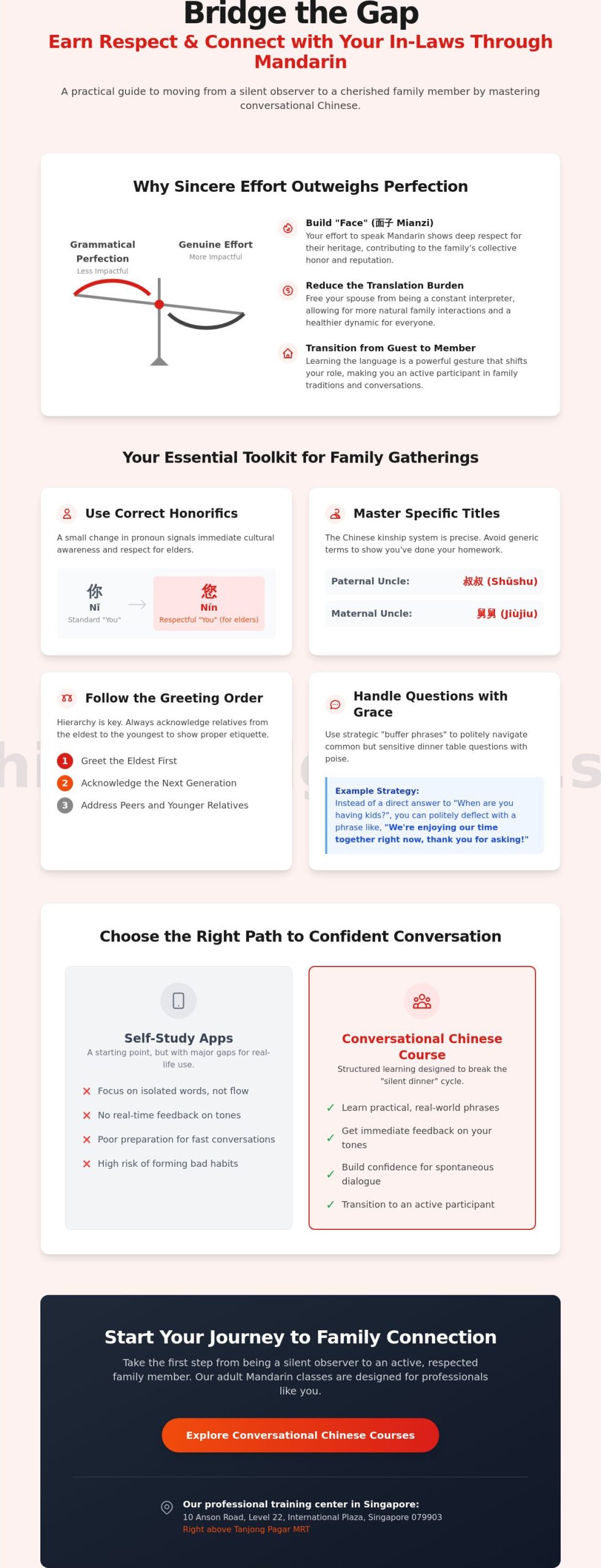
In Chinese social dynamics, the concept of Mianzi, or “face,” acts as a vital currency of respect and reputation. When you begin learning mandarin to connect with in-laws, you aren’t just memorizing vocabulary; you’re actively contributing to the family’s collective honor. This gesture signals that you value their heritage enough to invest your time and energy into their native tongue. It shifts the perception of you from a permanent guest to an integrated family member who respects the complexities of the Chinese kinship system.
Many learners stall because they fear their grammar isn’t perfect. However, in a family setting, your willingness to try is often more significant than your technical accuracy. Your in-laws don’t expect you to be a linguistic scholar. They want to see that you care enough to bridge the gap. By demonstrating this effort, you reduce the “translation burden” on your spouse, allowing them to enjoy family time rather than acting as a constant intermediary. This shift creates a healthier psychological environment for everyone involved.
To better understand how these cultural nuances play out in real life, watch this helpful video:
The Cultural Weight of Language in 2026
By 2026, the global emphasis on practical communication has made it clear that language is the primary bridge to ancestral values. While functional communication gets the point across, emotional connection requires a deeper level of engagement. Showing interest in your in-laws’ native language validates their life experiences. It creates a shared space for storytelling that English simply cannot replicate, moving the relationship beyond surface-level pleasantries into genuine bonding.
Breaking the “Silent Dinner” Cycle
Sitting in silence while the rest of the family laughs at a joke or discusses news is a common pain point. This “outsider” feeling is easily addressed through a structured conversational chinese course. Instead of relying on apps that focus on isolated words, a professional program teaches you to navigate real-time dinner conversations. Ultimately, learning mandarin to connect with in-laws is about reclaiming your voice during family visits. It allows you to participate in rituals and celebrations with confidence. If you are looking for a mandarin course singapore, our center at 10 Anson Road, level 22, International Plaza, is located right above Tanjong Pagar MRT to help you start this journey.
Essential Mandarin Phrases and Etiquette for Family Gatherings
Mastering a language involves more than just vocabulary; it requires an understanding of social hierarchy. When you focus on learning mandarin to connect with in-laws, your first priority should be the correct application of honorifics. Using the standard “Nǐ” (you) might be acceptable in a business meeting, but using the respectful “Nín” (您) when addressing elders signals immediate cultural awareness. This subtle shift in your speech patterns demonstrates that you recognize their status within the family unit.
Greetings and the Power of Proper Titles
The conversational chinese course curriculum highlights that the Chinese kinship system is far more granular than Western equivalents. Simply calling everyone “Uncle” or “Auntie” can lead to confusion in a traditional household. You must learn to distinguish between Shushu (paternal uncle) and Jiujiu (maternal uncle). Following the “Greeting Order” is equally vital. Always acknowledge the eldest person in the room first before moving to younger relatives. Using the wrong title can be a major faux pas, as it may inadvertently suggest a lack of respect for their specific position in the family hierarchy.
Dining Etiquette: More Than Just Chopsticks
In Singapore, family gatherings often revolve around the dining table. Whether it’s a casual dinner or a festive Chinese New Year celebration, knowing how to navigate the meal is essential. Praising the cook is the fastest way to bond with a mother-in-law. Instead of a simple “thank you,” use phrases like “Tai hao chi le!” (This is too delicious!) to show genuine appreciation. During tea service, always offer tea to your in-laws first using both hands to present the cup. This small gesture carries significant weight in traditional households.
When attending a local wedding or celebration, you’ll likely encounter the “Yum Seng” toast. While the chant is boisterous, your individual interactions should remain poised. If you are offered a third helping of food you cannot finish, the art of the “Polite Refusal” is key. Phrases like “Wo tai bao le, xiexie” (I am too full, thank you) allow you to decline graciously without offending the host’s hospitality. If you feel overwhelmed by these social nuances, joining a mandarin course singapore can provide the role-playing practice needed to handle these situations with grace. Our center at 10 Anson Road, level 22, International Plaza, right above Tanjong Pagar MRT, specializes in these practical communication scenarios.
Why a Conversational Chinese Course Beats Self-Study for Family Integration
Many learners fall into the “App Trap.” They believe that a daily streak on a gamified mobile platform provides sufficient preparation for a traditional family reunion. While these digital tools help build basic vocabulary, they often fail when a real-time response is required. A dinner table isn’t a flashcard session. It’s a dynamic, high-pressure environment where multiple speakers overlap and dialects may blend. Transitioning from a screen to a live conversation requires a level of auditory processing that self-study simply cannot replicate.
Professional instruction provides the critical feedback necessary to master Mandarin tones. In a tonal language, a slight mispronunciation can transform a respectful greeting into a confusing or even offensive remark. Correcting these errors early prevents the development of bad habits that are difficult to break later. For the busy professional in Singapore, structured lessons are the most efficient path forward. Aimless self-study often leads to plateaus, whereas a disciplined curriculum ensures that every hour invested translates directly to improved family integration.
Simulating Real-World Family Interactions
Our Adult Conversational Mandarin Course focuses on the realities of “Social Mandarin” rather than the rigid structures of “Textbook Mandarin.” We prioritize listening comprehension across multiple speakers, helping you follow the thread of a conversation even when it moves quickly. This approach builds the confidence to participate in family rituals without the paralyzing fear of making a grammatical mistake. The goal is to move beyond functional communication and toward a genuine emotional bond.
The Role of Native Instructors in Cultural Coaching
Native instructors serve as more than just language teachers; they are cultural mentors. They provide insights into the underlying subtexts and non-verbal cues that define Chinese social interactions. Understanding when to use a specific phrase or how to interpret a subtle nod is something an algorithm cannot teach. Successfully learning mandarin to connect with in-laws requires this nuanced coaching to avoid social awkwardness. For those seeking the best training options, we recommend reviewing Mandarin Classes in Singapore: The Definitive 2026 Guide for Professionals. Our center at 10 Anson Road, level 22, International Plaza, Singapore 079903, is conveniently located right above Tanjong Pagar MRT, making it easy for professionals to access premium training after work hours.
Strategic Communication: Answering “Difficult” Questions with Grace
A family dinner can often feel like a friendly interrogation. In many Chinese households, elders express care through direct questions that might seem intrusive in a Western context. When you are learning mandarin to connect with in-laws, you need more than a list of nouns. You need a defensive communication strategy. Mastering “buffer phrases” allows you to acknowledge a question while buying yourself the necessary seconds to formulate a respectful response. This prevents the awkward silence that often follows a complex inquiry you didn’t quite catch.
The “Big Three” topics typically include your career, plans for children, and your current salary. These aren’t meant to be rude; they’re markers of your stability and success in their eyes. Instead of giving long, complex explanations, use “safe” responses. Phrases like “Gongzuo hai mang” (Work is still busy) or “Hai keyi” (It’s going well) provide enough information to be polite without inviting further scrutiny. If you’re complimented on your progress, remember to practice humility. Phrases like “Nali, nali” (Not at all) or “Wo hai zai xuexi” (I’m still learning) are culturally superior to a simple “thank you.”
The “Interrogation” Survival Guide
Success starts with active listening. You don’t need to understand every word to respond effectively. Listen for keywords like gongzuo (work) or xinshui (salary). Once you identify the topic, acknowledge it with a smile and a brief, standard response. If you work in a technical field in Singapore, avoid jargon. Explain your role in the simplest terms possible. For example, stating you work in “diannao gongzuo” (computer work) is often sufficient for casual conversation.
Deflecting and Redirecting with Politeness
There’ll be moments when the conversation moves too fast. In these instances, knowing how to ask for help is a sign of strength. Instead of shutting down, ask your spouse, “Ni bang wo jieshi yixia?” (Can you help me explain?). This keeps you engaged in the interaction. While “Ting bu dong” (I don’t understand) is a valid response, using “Qing zai shuo yi bian” (Please say it again) is more effective; it signals that you’re making a genuine effort to follow the discussion. To master these high-pressure interactions, consider enrolling in professional mandarin training. Our center is located at 10 Anson Road, level 22, International Plaza, Singapore 079903, directly above Tanjong Pagar MRT.
Start Your Journey: Adult Mandarin Classes at International Plaza
Choosing the right environment is the final piece of the puzzle. If you’re serious about learning mandarin to connect with in-laws, you need a training center that understands the specific needs of adult learners. Our facility is located at 10 Anson Road, level 22, International Plaza, Singapore 079903. This central location ensures that you don’t have to travel far from the business district to attend high-quality lessons. Being positioned directly above Tanjong Pagar MRT means you can transition from your office to the classroom in minutes.
Class sizes are intentionally kept small. This structure ensures that every student receives personalized attention from our instructors. You won’t be just another face in a crowded lecture hall. Instead, you’ll engage in meaningful practice that targets your specific communication goals. We understand that busy professionals have demanding schedules. Our program offers several advantages designed for your success:
- Small group classes that maximize your individual speaking time.
- A curriculum focused on real-world adult social and professional scenarios.
- Flexible evening and weekend schedules to accommodate a full-time career.
- Native-speaking instructors with extensive experience in adult pedagogy.
Why Chinese Edge is the Right Choice for You
Our conversational chinese course is designed specifically for adults who need practical results. We move beyond rote memorization to focus on the Expert Mentor approach. This methodology prioritizes real-world application, ensuring you can use what you learn at the very next family gathering. For a deeper look at how to structure your studies, read our Learn Chinese in Singapore: The Professional’s Roadmap to Fluency in 2026. We provide the steady support you need to reach your linguistic goals with confidence.
Take the First Step Toward Family Connection
We invite you to visit our Tanjong Pagar center for a detailed consultation. During this session, we’ll help you identify the best conversational or business modules for your current proficiency level. The enrollment process is straightforward and transparent, designed to get you started without unnecessary delays. Don’t let another family event pass in silence. Successfully learning mandarin to connect with in-laws starts with a single step. Join our next Adult Mandarin intake and start connecting with your family today. By choosing a systematic and proven approach, you’ll find that fluency is an attainable goal. Our instructors are ready to partner with you on this rewarding personal journey.
Transform Your Family Dynamics Through Language
Building a genuine connection with your spouse’s family requires more than just attending holiday gatherings. It involves a dedicated commitment to cultural integration and the strategic use of conversational tools. Earning respect and “face” is achieved through the visible effort you invest into learning mandarin to connect with in-laws. By mastering proper titles and utilizing linguistic buffer phrases, you transition from a silent observer to a confident participant in family life. This shift doesn’t just improve communication; it strengthens the emotional foundation of your marriage.
If you’re ready to replace awkward silences with meaningful dialogue, a structured learning path is your most efficient option. Our center at 10 Anson Road, level 22, International Plaza, Singapore 079903, offers a specialized curriculum for conversational fluency. We feature native-speaking instructors with deep adult education expertise. Our location right above Tanjong Pagar MRT makes attendance seamless for busy professionals. You don’t have to navigate this cultural bridge alone. Our proven methodology ensures that every lesson brings you closer to your goal.
Master Conversational Mandarin at our Tanjong Pagar Center and start building the family bonds you deserve. With steady support and a disciplined approach, achieving fluency is a practical and rewarding goal. Take the first step today.
Frequently Asked Questions
How long does it take to learn enough Mandarin to talk to my in-laws?
It typically takes approximately 20 to 40 hours of structured instruction to master basic social greetings and dining etiquette. If you follow the HSK 3.0 proficiency standards fully implemented in July 2026, reaching the first level requires a vocabulary of 300 words. This foundation allows you to participate in simple family exchanges. Consistency is key; attending a weekly mandarin course singapore ensures steady progress toward meaningful inclusion in family conversations.
Should I learn Mandarin or the specific dialect my in-laws speak (like Hokkien or Cantonese)?
Mandarin is generally the more strategic choice for long-term family integration and professional growth. While your in-laws may speak dialects like Hokkien or Cantonese, the vast majority of dialect speakers in Singapore are also fluent in Mandarin. Learning Mandarin provides a broader communicative reach and more structured learning resources. It allows you to connect with the wider family network while simultaneously enhancing your workplace chinese communication skills.
What if my tones are bad and they can’t understand me?
Tonal errors are a common concern for adult learners, but context often clarifies your meaning during family interactions. Your in-laws will likely prioritize your effort to speak their language over perfect pronunciation. However, to minimize misunderstandings, a conversational chinese course provides the real-time feedback necessary to refine your tones. Professional instructors help you identify specific phonetic patterns, ensuring you gain the confidence to speak clearly during high-pressure holiday gatherings.
Is it better to learn in a group class or with a private tutor for family-specific goals?
Group classes are highly effective for family-specific goals because they simulate the multi-speaker environment of a family dinner. Hearing different voices helps train your ear for real-world social settings. If you have highly specific needs, such as learning unique family titles, a private course offers tailored curriculum focus. Many professionals find that starting with a group class provides the essential social foundation before moving to specialized private coaching at our center above Tanjong Pagar MRT.
How can I practice Mandarin if my spouse is too impatient to help me?
It’s common for native-speaking spouses to find it difficult to transition into a teaching role. Instead of relying on them, utilize our online mandarin classes or visit our center at International Plaza for dedicated practice. You can also supplement your lessons by watching Chinese media or using interactive platforms. This independence reduces household friction and ensures that your learning mandarin to connect with in-laws remains a positive, self-driven journey toward family bonding.
Will learning Mandarin really change how my in-laws perceive me?
Demonstrating a commitment to the language fundamentally shifts your status from a guest to a dedicated family member. In Chinese culture, the effort you invest in learning mandarin to connect with in-laws is viewed as a high form of respect, directly contributing to their “face” or Mianzi. This proactive approach signals that you value their heritage. Over time, these small linguistic efforts build a bridge of trust that transforms your relationship into one of genuine mutual respect.
Disclaimer
Disclaimer
The Chinese articles on this website are provided for general information and learning purposes only. While we strive for accuracy, we make no guarantees regarding completeness or reliability. The content does not constitute professional advice, and we are not liable for any loss arising from its use. External links or third-party content are for reference only. By using this website, you agree to this disclaimer.