

Professional Chinese emails are a performance of respect; mastering the hierarchy is often more important than the actual message you’re sending. You likely feel the tension of trying to balance Western business directness with the intricate layers of honorifics required in a corporate context. It’s natural to worry about using the wrong level of formality or struggling with specific punctuation that differs from English standards. These small details are precisely what define your professional reputation. Mastering how to write professional emails in chinese is a vital step for any leader aiming to build trust with partners in Singapore and across the global market.
This guide will show you how to communicate with senior managers and stakeholders with absolute confidence. We’ll provide a clear, reusable template and the essential phrases taught by our expert mentors in our business chinese course. You will learn to navigate opening and closing protocols that signal you’re a culturally competent and disciplined partner. Whether you join us at 10 Anson Road, level 22, International Plaza, located right above Tanjong Pagar MRT, or via our online platforms, we’ll help you bridge the gap between basic language skills and high-level corporate success through our proven, methodical approach.
Key Takeaways
- Understand how the concept of ‘Mianzi’ (Face) and organizational hierarchy dictate every word choice in your correspondence to ensure you maintain professional respect.
- Master the step-by-step structure of a formal message, including rank-appropriate salutations, to learn how to write professional emails in chinese effectively.
- Gain a repertoire of polite opening and closing phrases specifically designed for making business requests or following up on previous discussions.
- Learn how to deliver bad news or decline proposals without being “too direct,” preserving your professional relationships through nuanced workplace chinese communication.
- Discover how a structured business mandarin course can help you apply these writing techniques to real-world corporate scenarios in Singapore or online.
Understanding the Etiquette of Chinese Professional Correspondence
Professional communication in China isn’t just about exchanging data; it’s about managing social capital. At the heart of every interaction is the concept of ‘Mianzi’ or ‘Face’. In a written context, this means your email must uphold the recipient’s dignity and social standing. If you’re too blunt or fail to acknowledge their status, you risk causing a loss of face that can damage a partnership permanently. This cultural weight is why learning how to write professional emails in chinese requires more than just a large vocabulary. It requires a deep understanding of social dynamics.
While Western business culture often prizes brevity and “getting to the point,” Chinese professional norms lean toward a more elaborate politeness. This is an investment in the relationship. Even as the medium has shifted from traditional paper letters (写信) to modern digital emails (写电子邮件), the underlying expectations for respect remain firm. Digital speed hasn’t replaced the need for formal structure. Understanding these nuances is a key part of Avoiding Common Cultural Pitfalls in Workplace Communication and ensuring your message is received with the respect it deserves.
To better understand these nuances, watch this helpful video:
The Concept of Hierarchy in Business Writing
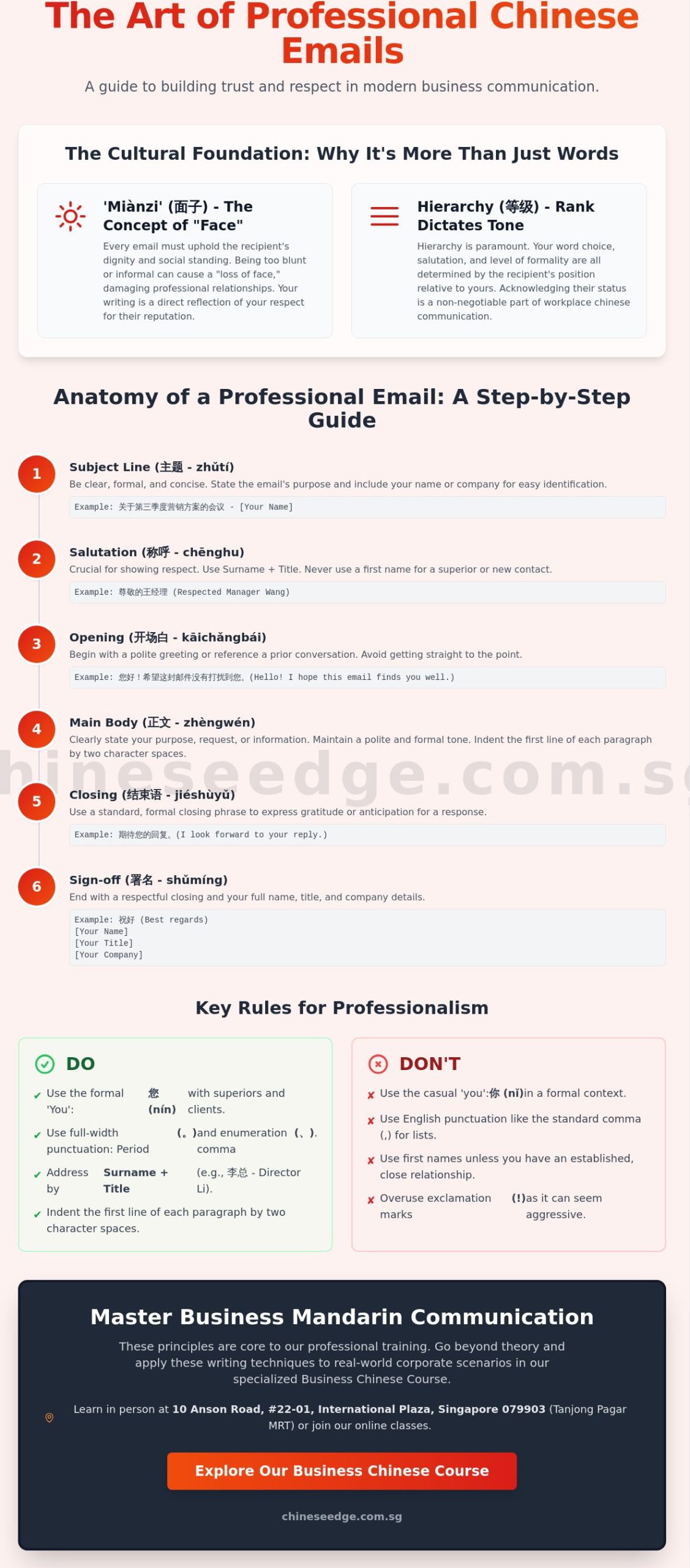
Hierarchy dictates every word choice in a Chinese email. You should never address a superior or a client by their first name. Instead, use their Surname followed by their official Title, such as Wang Jingli (Manager Wang) or Li Zong (Director Li). If you aren’t sure of their exact title, a safe and respectful option is Surname plus ‘Xiansheng’ (Mr.) or ‘Nüshi’ (Ms.). Always use the honorific ‘Nin’ (您) rather than the casual ‘Ni’ (你) when addressing anyone of higher rank or age. Our group chinese courses at International Plaza emphasize these distinctions to help you sound like a seasoned professional from day one.
Essential Punctuation for Professionalism
Your layout and punctuation are visual signals of your education and discipline. You must use the full-width period (。) and the enumeration comma (、) which is used specifically for listing items. Standard English commas are not used for lists in Chinese. Keep exclamation marks to an absolute minimum; they can appear overly emotional or even aggressive in a formal thread. Proper indentation is also vital. In a traditional professional layout, the first line of each paragraph should be indented by two character spaces. This creates a clean, organized appearance that reflects a methodical approach to your work. Mastering these small details is essential when learning how to write professional emails in chinese that command respect.
The Anatomy of a Professional Chinese Email: A Step-by-Step Format
Constructing a high-stakes message in a corporate setting requires a methodical approach that prioritizes clarity and respect. When you learn how to write professional emails in chinese, you’re not just translating words; you’re assembling a structured presentation of your professional identity. Following a standardized layout ensures that your recipient can navigate your request efficiently while feeling appropriately honored by your attention to detail. This systematic flow is a core component of The Anatomy of a Professional Chinese Email: A Step-by-Step Format, which serves as a blueprint for successful workplace communication.
The Art of the Subject Line
Your subject line (主题) is the first impression you make. In a busy corporate environment, it must be descriptive and functional. Avoid vague titles like “Hello” or “Question.” Instead, use specific brackets to categorize your message, such as [紧急] (Urgent) for time-sensitive matters or [会议确认] (Meeting Confirmation) for logistics. For example, a professional update should look like “关于[项目名称]的进展更新” (Update regarding the progress of [Project Name]). This level of precision shows that you value the recipient’s time and possess a disciplined work ethic.
Salutations and Formal Greetings
Choosing the right salutation (称呼) is critical for establishing the correct power dynamic. While ‘Qin’ai de’ (亲爱的) translates to “Dear,” it’s often too intimate for business and should be avoided in formal threads. Use ‘Zunjing de’ (尊敬的) when writing to a high-level executive or a new client to show deep respect. For general professional use, ‘Surname + Title + 您好’ is the gold standard. If you’re addressing a group, ‘大家好’ (Hello everyone) is a safe and inclusive choice. If you’re looking to refine these nuances in a supportive environment, consider joining a group chinese course where we practice these scenarios in real-time.
The main body (正文) of your email should state the purpose of your writing in the very first paragraph. Chinese business culture appreciates a polite opening greeting (问候语), such as ‘希望您一切顺利’ (I hope everything is going well for you), before diving into the details. Keep your sentences direct and functional. When you’re ready to conclude, use formal closing wishes (祝颂语) like ‘祝工作顺利’ (Wish you success in your work) or the highly formal ‘此致 敬礼’ (With best regards). Finally, ensure your signature (署名) includes your full name, title, and company name to maintain a polished, professional image. Our instructors at 10 Anson Road, level 22, International Plaza, located right above Tanjong Pagar MRT, can help you master these templates so you never have to second-guess your drafts again.
Essential Chinese Phrases for Business Requests and Follow-ups
Mastering the structural layout is only half the battle. To truly excel at how to write professional emails in chinese, you must deploy specific phrases that signal your intent while maintaining a respectful distance. Unlike the generic lists found in many academic textbooks, professional correspondence requires language categorized by specific business functions. Whether you’re acknowledging a previous thread or initiating a new project, your choice of words reflects your understanding of Understanding the Etiquette of Chinese Professional Correspondence and the underlying social capital involved.
When acknowledging previous correspondence, avoid starting too abruptly. Use phrases like ‘关于我们上次的会议’ (Regarding our last meeting) or ‘感谢您的回复’ (Thank you for your reply) to establish a polite context. If you’re providing an update, ‘向您汇报一下项目的进展’ (To report the project progress to you) is a disciplined way to show you’re on top of your responsibilities. For emails involving documentation, clearly state ‘请查收附件’ (Please find the attachment) so the recipient doesn’t overlook important files. These phrases act as the connective tissue of your message, ensuring a logical progression that feels natural to a native speaker.
Making Requests with ‘Qing’ (请)
In a corporate setting, a direct command can feel aggressive. Instead of saying “Please do this,” shift toward “I would appreciate it if you could…” by using ‘如果方便的话,请…’ (If it is convenient, please…). This softens the request and gives the recipient ‘face’. If you’re following up on an unanswered email, don’t be demanding. A phrase like ‘不知您是否查收到了我之前的邮件’ (I’m not sure if you received my previous email) is a polite nudge that doesn’t place blame. Our business chinese course students often find that these subtle shifts in workplace chinese communication are what lead to faster response times and better collaboration.
Closing with Professionalism
Your closing is your final opportunity to leave a positive impression. While ‘工作顺利’ (Success in your work) is a standard and safe closing wish, you can elevate your tone depending on the recipient’s rank. ‘此致’ (Sincerely) is versatile, while ‘敬上’ (Respectfully submitted) is best for very high-level managers or formal reports. Your signature block should be equally disciplined. Include your full name, your official title, and your company’s contact information. If you’re unsure about the hierarchy of these details, our mentors at 10 Anson Road, level 22, International Plaza, right above Tanjong Pagar MRT, can provide personalized feedback on your specific business drafts. Mastering how to write professional emails in chinese is a results-oriented skill that pays dividends in your career growth.
Avoiding Common Cultural Pitfalls in Workplace Communication
Professionalism in a Chinese corporate environment involves a delicate dance of indirectness. While you’ve mastered the structural layout and essential phrases, the psychological nuances of how to write professional emails in chinese can still prove challenging. If your communication is too direct, you risk appearing aggressive or unrefined, which can lead to a significant loss of ‘face’ for both parties. In high-stakes negotiations, maintaining harmony is often more valuable than immediate clarity. This requires a shift in mindset where you learn to prioritize the relationship as much as the result.
Understanding the ‘vague’ response is a critical skill for any leader. In many Western cultures, a delayed or non-committal email is seen as poor management. In a Chinese context, it’s frequently a signal that you need to read between the lines. If a partner provides a response that lacks a definitive “yes” or keeps shifting the timeline, they may be signaling a polite “no” without wanting to cause social friction. Recognizing these subtle cues allows you to pivot your strategy without forcing your counterpart into an uncomfortable position. Our corporate mandarin training programs focus heavily on these cultural interpretations to ensure your messages always land with the intended impact.
Softening Your Language
To avoid sounding blunt, you should incorporate hedging language that creates a sense of collaborative inquiry. Using words like ‘可能’ (maybe) or ‘我觉得’ (I think/feel) allows you to present ideas as suggestions rather than demands. Even the word ‘可以’ (can) plays a strategic role in negotiations; it suggests a possibility that remains open for discussion. In a formal context, the phrase ‘I’ll think about it’ often serves as a polite way to signal a rejection without causing immediate social friction. By adopting this softer tone, you demonstrate a high level of cultural intelligence that commands respect in the boardroom.
Modern Digital Etiquette in 2026
The landscape of workplace chinese communication has expanded beyond the inbox. While formal emails remain the standard for contracts and official documentation, much of the daily operational flow in Singapore now happens on mobile platforms. With WeChat and enterprise tools like Lark dominating professional interactions, you must know when to transition from a formal thread to a quick mobile update. In this mobile-first environment, response time is a primary trust signal. A quick acknowledgment on a messaging app often carries more weight than a perfectly drafted email sent three days later. It shows you’re disciplined and attentive to the partnership’s momentum.
If you’re ready to move beyond basic templates and master the art of nuanced negotiation, our business mandarin course offers the structured, results-oriented training you need. Visit us at 10 Anson Road, level 22, International Plaza, right above Tanjong Pagar MRT, to start your journey toward true professional fluency. We provide the steady support and expert mentorship required to bridge the gap between a learner and a sophisticated communicator in the global Chinese market.
Master Business Mandarin at Chinese Edge in Singapore
Mastering the nuances of corporate correspondence requires more than just memorizing a list of phrases. It demands a systematic understanding of the cultural logic that governs high-level interactions. For those looking to excel in business chinese singapore, structured learning provides the necessary framework to navigate complex social hierarchies with ease. At Chinese Edge, we bridge the gap between academic theory and practical application, ensuring you possess the tools to command respect in every digital interaction. Learning how to write professional emails in chinese is a core pillar of our curriculum, designed specifically for the results-oriented professional.
Our methodology focuses on the problem-solution framework often encountered in the corporate world. If you find yourself struggling to translate Western directness into polite Chinese, our instructors provide the steady support needed to refine your tone. We don’t just teach vocabulary; we teach the strategic application of language. This results-oriented approach ensures that your emails reflect a disciplined and sophisticated professional identity, which is essential for building long-term trust with Chinese partners and stakeholders.
Our Professional Training Center
Success in the global market begins with the right environment. Our training center is located at 10 Anson Road, level 22, International Plaza, Singapore 079903, positioned right above Tanjong Pagar MRT. This central location in the heart of the business district makes it easy for busy executives to attend lessons without disrupting their schedules. You will learn from native speakers who possess deep corporate experience, providing you with insights that go beyond what you’ll find in standard textbooks. For those who require even more flexibility, we offer comprehensive online mandarin classes singapore that maintain the same academic rigor as our in-person sessions.
Why Choose a Specialized Business Course?
Generic language apps often fail to address the specific etiquette required in a boardroom or a formal email thread. Choosing a specialized mandarin course allows you to move beyond basic conversation toward professional fluency. Our lessons are meticulously planned to cover workplace chinese communication, including negotiation tactics and formal writing protocols. You’ll join a community of adult learners who share your professional goals, creating a network of peers in a premium boutique school setting. By focusing on the methodical nature of the language, we ensure that your journey toward fluency is both predictable and successful. Mastering how to write professional emails in chinese is a vital investment in your career, and we are here to serve as your reliable partner in that growth.
Advance Your Career with Professional Mandarin Fluency
Mastering the balance of hierarchy, etiquette, and precise phrasing is the key to commanding respect in the Chinese corporate world. By applying the structured templates and cultural insights shared in this guide, you’ll transform your correspondence from basic exchanges into powerful trust-building tools. Understanding how to write professional emails in chinese allows you to navigate high-stakes negotiations with the poise of a seasoned leader. It’s about more than words; it’s about demonstrating cultural intelligence in every thread.
Our expert native-speaking instructors have helped corporate professionals achieve proven results since 2012. Whether you’re aiming to refine your workplace communication or lead international teams, we provide the steady support needed to reach your goals. Visit us at our prime CBD location at 10 Anson Road, level 22, International Plaza, right above Tanjong Pagar MRT. We take pride in individual student success and offer a methodical approach that makes fluency an attainable goal for any driven professional.
Enroll in our Business Mandarin Course at International Plaza today!
You have the potential to bridge cultural gaps and achieve lasting success in the global marketplace. We’re ready to help you take that next decisive step toward professional mastery with confidence.
Frequently Asked Questions
What is the most formal way to start a Chinese email?
The most formal greeting is ‘Zunjing de’ (尊敬的) paired with the recipient’s surname and job title. For example, addressing a CEO would be ‘Zunjing de [Surname] Zong’ (尊敬的[姓]总). This structure establishes immediate respect and demonstrates your understanding of corporate hierarchy. It’s the standard for first-time outreach or communicating with high-level stakeholders to ensure you don’t cause a loss of face.
Should I use Pinyin or Characters when writing a business email?
You must use Chinese characters for all business correspondence. Writing in Pinyin is considered unprofessional and suggests a lack of disciplined training. If you’re still mastering how to write professional emails in chinese, use input methods that convert Pinyin to characters. Our business mandarin course at International Plaza ensures you can recognize and use the correct characters in any corporate setting.
How do I address a Chinese client whose name I don’t know?
If the recipient’s name is unknown, use ‘Zunjing de xiansheng/nüshi’ (尊敬的先生/女士) which translates to ‘Respected Sir/Madam’. Alternatively, you can use ‘Zunjing de kehu’ (尊敬的客户) if you’re addressing a client base generally. This maintains a professional distance while ensuring you remain polite. It’s a safe way to initiate contact before you’ve established a formal relationship with a specific individual.
What is the Chinese equivalent of ‘Sincerely yours’?
The closest equivalent to ‘Sincerely yours’ in a formal business context is ‘Ci zhi jing li’ (此致敬礼). This is often split into two lines at the end of the message. It’s a results-oriented sign-off that signals you’ve completed your request with the appropriate level of deference. Use it for official reports, formal proposals, or high-stakes external partner communications where academic rigor is expected.
Is it okay to use English names in a Chinese business email?
Using English names is acceptable if the recipient has introduced themselves using one or includes it in their signature. Many professionals in Singapore and global hubs use English names for convenience. However, when you first learn how to write professional emails in chinese, it’s safer to use their Chinese surname and title until they signal a preference for a more casual English name.
How do I politely ask for a late payment in Chinese?
To ask for a late payment politely, use indirect language that assumes a technical error rather than negligence. You might say, ‘We haven’t yet received the payment for [Invoice Number]; perhaps there was a delay in the bank transfer?’ This approach allows the client to save face while still addressing the financial objective. It’s a key part of workplace chinese communication that preserves the long-term partnership.
Do I need to indent paragraphs in a Chinese email?
Traditional formal Chinese emails require an indentation of two character spaces at the start of every new paragraph. While some modern tech companies have moved toward left-aligned block formatting, the double-space indentation remains the gold standard for formal corporate communication. This disciplined layout shows attention to detail and a respect for established linguistic norms, reflecting the systematic nature of your professional training.
What are the common sign-offs for internal emails to colleagues?
For internal emails to colleagues or peers, you can use less formal but still professional sign-offs like ‘Zhu hao’ (祝好), which means ‘Best wishes’. Another common option is ‘Xiexie’ (谢谢) if the email involves a specific request. These options strike a balance between the accessibility of a modern office and the professional rigor expected in a high-performing corporate environment.
Disclaimer
Disclaimer
The Chinese articles on this website are provided for general information and learning purposes only. While we strive for accuracy, we make no guarantees regarding completeness or reliability. The content does not constitute professional advice, and we are not liable for any loss arising from its use. External links or third-party content are for reference only. By using this website, you agree to this disclaimer.